
Telescoping Series
A telescoping series is a series whose terms can be written as differences, a_n = b_n - b_{n+1}, so that most of each partial sum cancels. The nth partial sum collapses to S_n = b_1 - b_{n+1}, and the sum of the series is b_1 - \lim_{n \to \infty} b_{n+1}, if that limit exists.
Before this lesson: Infinite Series and Partial Sums, Divergence Test and Partial Fraction Decomposition
How a telescoping series collapses
An old spyglass telescope slides shut, leaving only its two ends. A telescoping series does the same thing to its partial sums: the middle pieces cancel, and only the first and last pieces are left.
Look at \tfrac{1}{1 \cdot 2} + \tfrac{1}{2 \cdot 3} + \tfrac{1}{3 \cdot 4} + \cdots. Each term splits into a difference, such as \tfrac{1}{2 \cdot 3} = \tfrac{1}{2} - \tfrac{1}{3}. Written that way, the first four terms are below.
S_4 = \left(1 - \tfrac{1}{2}\right) + \left(\tfrac{1}{2} - \tfrac{1}{3}\right) + \left(\tfrac{1}{3} - \tfrac{1}{4}\right) + \left(\tfrac{1}{4} - \tfrac{1}{5}\right) = 1 - \tfrac{1}{5}Every −½ cancels the next +½, every −⅓ cancels the next +⅓, and so on. Only 1 and −1/5 survive.
The telescoping series rule
If each term is a difference of consecutive values of some sequence b_n, the partial sums and the sum follow directly.
S_n = \sum_{k=1}^{n} \left(b_k - b_{k+1}\right) = b_1 - b_{n+1}\sum_{n=1}^{\infty} \left(b_n - b_{n+1}\right) = b_1 - \lim_{n \to \infty} b_n \quad \text{(when the limit is finite)}If b_n has no finite limit, the series diverges. When the terms are b_n - b_{n+2}, two values survive at the front instead of one: the sum is b_1 + b_2 - 2\lim b_n.
How to sum a telescoping series
- If the terms are a fraction, split them with partial fraction decomposition.
- Write out the first few terms and the last term or two of S_n.
- Cancel the matching pieces and write S_n with the few pieces that are left.
- Take the limit of S_n as n → ∞. If it is finite, that is the sum; otherwise the series diverges.
Telescoping series examples
Example 1: The classic telescoping series
Find the sum of \sum_{n=1}^{\infty} \dfrac{1}{n(n + 1)}.
\dfrac{1}{n(n + 1)} = \dfrac{A}{n} + \dfrac{B}{n + 1}Set up partial fractions.
1 = A(n + 1) + Bn
Multiply both sides by n(n + 1).
A = 1
Let n = 0: 1 = A(1).
B = -1
Let n = −1: 1 = B(−1).
\dfrac{1}{n(n + 1)} = \dfrac{1}{n} - \dfrac{1}{n + 1}Write the term as a difference.
S_n = \left(1 - \tfrac{1}{2}\right) + \left(\tfrac{1}{2} - \tfrac{1}{3}\right) + \cdots + \left(\tfrac{1}{n} - \tfrac{1}{n + 1}\right)Write out the partial sum.
S_n = 1 - \dfrac{1}{n + 1}Cancel the matching pieces.
\lim_{n \to \infty} \left(1 - \dfrac{1}{n + 1}\right) = 1 - 0 = 1Take the limit; 1/(n + 1) goes to 0.
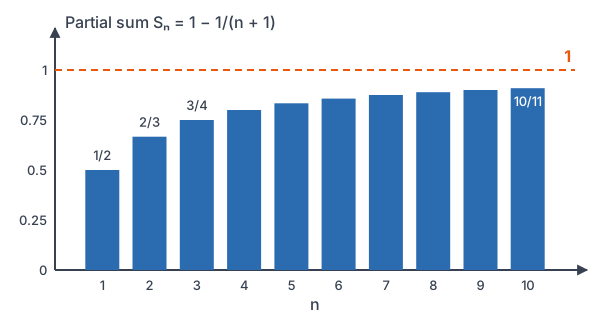
Answer: the series converges to 1. The partial sums are 1/2, 2/3, 3/4, 4/5, …, which climb toward 1.
Example 2: Partial fractions with 2n − 1 and 2n + 1
Find the sum of \sum_{n=1}^{\infty} \dfrac{6}{(2n - 1)(2n + 1)}.
\dfrac{6}{(2n - 1)(2n + 1)} = \dfrac{A}{2n - 1} + \dfrac{B}{2n + 1}Set up partial fractions.
6 = A(2n + 1) + B(2n - 1)
Multiply both sides by (2n − 1)(2n + 1).
6 = 2A \quad \Rightarrow \quad A = 3
Let n = 1/2, which makes 2n − 1 = 0.
6 = -2B \quad \Rightarrow \quad B = -3
Let n = −1/2, which makes 2n + 1 = 0.
\dfrac{6}{(2n - 1)(2n + 1)} = \dfrac{3}{2n - 1} - \dfrac{3}{2n + 1}Write the term as a difference.
S_n = \left(3 - 1\right) + \left(1 - \tfrac{3}{5}\right) + \left(\tfrac{3}{5} - \tfrac{3}{7}\right) + \cdots + \left(\tfrac{3}{2n - 1} - \tfrac{3}{2n + 1}\right)Write out the partial sum (n = 1 gives 3 − 1).
S_n = 3 - \dfrac{3}{2n + 1}Cancel the matching pieces.
\lim_{n \to \infty} \left(3 - \dfrac{3}{2n + 1}\right) = 33/(2n + 1) goes to 0.
Answer: the series converges to 3.
Example 3: Terms that cancel two places apart
Find the sum of \sum_{n=1}^{\infty} \dfrac{4}{n(n + 2)}.
\dfrac{4}{n(n + 2)} = \dfrac{A}{n} + \dfrac{B}{n + 2}Set up partial fractions.
4 = A(n + 2) + Bn
Multiply both sides by n(n + 2).
A = 2,\ B = -2
Let n = 0, then n = −2.
\dfrac{4}{n(n + 2)} = \dfrac{2}{n} - \dfrac{2}{n + 2}Write the term as a difference.
S_n = \left(2 - \tfrac{2}{3}\right) + \left(\tfrac{2}{2} - \tfrac{2}{4}\right) + \left(\tfrac{2}{3} - \tfrac{2}{5}\right) + \cdots + \left(\tfrac{2}{n} - \tfrac{2}{n + 2}\right)Write out the partial sum. Each negative piece cancels a positive piece two terms later.
S_n = 2 + 1 - \dfrac{2}{n + 1} - \dfrac{2}{n + 2}The first two positive pieces and the last two negative pieces survive.
\lim_{n \to \infty} S_n = 2 + 1 - 0 - 0 = 3Take the limit.
Answer: the series converges to 3. Check: S_1 = \tfrac{4}{3}, and the formula gives 3 - 1 - \tfrac{2}{3} = \tfrac{4}{3}.
Example 4: A telescoping series that diverges
Does \sum_{n=1}^{\infty} \ln\left(\dfrac{n}{n + 1}\right) converge?
\ln\left(\dfrac{n}{n + 1}\right) = \ln n - \ln(n + 1)Use the quotient property of logarithms (see properties of logarithms).
S_n = (\ln 1 - \ln 2) + (\ln 2 - \ln 3) + \cdots + (\ln n - \ln(n + 1))
Write out the partial sum.
S_n = \ln 1 - \ln(n + 1)
Cancel the matching pieces.
S_n = -\ln(n + 1)
ln 1 = 0.
\lim_{n \to \infty} \left(-\ln(n + 1)\right) = -\inftyln(n + 1) grows without bound.
Answer: the series diverges. Notice that its terms do go to 0, since ln(n/(n + 1)) → ln 1 = 0, so the divergence test could not decide this one.
Example 5: Water added to a tank (word problem)
During hour n, a pipe adds \dfrac{30}{(n + 1)(n + 2)} liters of water to a tank. How much water is added in the first 8 hours? How much would be added if the pipe ran forever?
\dfrac{30}{(n + 1)(n + 2)} = \dfrac{30}{n + 1} - \dfrac{30}{n + 2}Use partial fractions: 30(n + 2) − 30(n + 1) = 30.
S_n = \left(\tfrac{30}{2} - \tfrac{30}{3}\right) + \left(\tfrac{30}{3} - \tfrac{30}{4}\right) + \cdots + \left(\tfrac{30}{n + 1} - \tfrac{30}{n + 2}\right)Write out the partial sum.
S_n = 15 - \dfrac{30}{n + 2}Cancel; 30/2 = 15.
S_8 = 15 - \dfrac{30}{10} = 12Substitute n = 8.
\lim_{n \to \infty} \left(15 - \dfrac{30}{n + 2}\right) = 1530/(n + 2) goes to 0.
Answer: 12 liters are added in the first 8 hours, and the total would approach 15 liters if the pipe ran forever.
Common mistakes
| Mistake | Example of the error | Fix |
|---|---|---|
| Splitting into two divergent series | \sum \left(\frac{1}{n} - \frac{1}{n+1}\right) = \sum \frac{1}{n} - \sum \frac{1}{n+1} = \infty - \infty | Both series diverge, so you cannot split. Work with the partial sums instead. |
| Keeping only one survivor when terms cancel two apart | Writing S_n = 2 - \frac{2}{n+2} for \sum \left(\frac{2}{n} - \frac{2}{n+2}\right) | Write out enough terms to see that two pieces survive at each end. |
| Assuming every telescoping series converges | “The terms cancel, so \sum \ln\frac{n}{n+1} converges” | Find \lim S_n. Here S_n = -\ln(n + 1) \to -\infty. |
| Sign errors in partial fractions | \frac{6}{(2n-1)(2n+1)} = \frac{3}{2n+1} - \frac{3}{2n-1} | Check one value: at n = 1 the term is 2, and 3/1 − 3/3 = 2. |
| Ignoring the starting index | Using b_1 for a series that starts at n = 2 | The first surviving piece is the first term actually in the sum, here b_2. |
| Forgetting the limit of the leftover piece | Writing the sum as b_1 without checking b_n \to 0 | The sum is b_1 - \lim b_n, which equals b_1 only when b_n \to 0. |
Related methods
Spotting a telescoping series
Look for a fraction with a factored denominator whose factors differ by a constant, like n(n + 1) or (2n − 1)(2n + 1). Also look for differences of the same function at n and n + 1, like \sqrt{n + 1} - \sqrt{n}, \ln n - \ln(n + 1) or \arctan(n + 1) - \arctan n.
When a series does not telescope
Most series have no simple formula for S_n. For those, use a convergence test instead, starting with the integral test in the next lesson.
Practice problems
- Find the sum of \sum_{n=1}^{\infty} \left(\dfrac{1}{n + 2} - \dfrac{1}{n + 3}\right).
- Find the sum of \sum_{n=1}^{\infty} \dfrac{1}{(n + 1)(n + 2)}.
- Find the sum of \sum_{n=2}^{\infty} \dfrac{2}{n^2 - 1}.
- Find the sum of \sum_{n=1}^{\infty} \dfrac{5}{(5n - 3)(5n + 2)}.
- Does \sum_{n=1}^{\infty} \left(\sqrt{n + 1} - \sqrt{n}\right) converge?
- Find the sum of \sum_{n=1}^{\infty} \left(\cos\tfrac{1}{n} - \cos\tfrac{1}{n + 1}\right).
- Find the sum of \sum_{n=1}^{\infty} \left(e^{1/n} - e^{1/(n+1)}\right).
- Find the sum of \sum_{n=1}^{\infty} \dfrac{3}{n^2 + 3n}.
- Find the sum of \sum_{n=1}^{\infty} \left(\arctan(n + 1) - \arctan n\right).
- A charity receives \dfrac{600}{n(n + 1)} dollars in month n from a gift fund. How much does it receive in the first 11 months, and what total does the gift approach?
Show answers
1.
S_n = \left(\tfrac{1}{3} - \tfrac{1}{4}\right) + \left(\tfrac{1}{4} - \tfrac{1}{5}\right) + \cdots + \left(\tfrac{1}{n + 2} - \tfrac{1}{n + 3}\right)Write out the partial sum.
S_n = \dfrac{1}{3} - \dfrac{1}{n + 3}Cancel the matching pieces.
\lim_{n \to \infty} S_n = \dfrac{1}{3}1/(n + 3) goes to 0.
Answer: 1/3
2.
\dfrac{1}{(n + 1)(n + 2)} = \dfrac{1}{n + 1} - \dfrac{1}{n + 2}Partial fractions: (n + 2) − (n + 1) = 1.
S_n = \dfrac{1}{2} - \dfrac{1}{n + 2}Write out the partial sum and cancel.
\lim_{n \to \infty} S_n = \dfrac{1}{2}1/(n + 2) goes to 0.
Answer: 1/2
3.
\dfrac{2}{n^2 - 1} = \dfrac{2}{(n - 1)(n + 1)}Factor the difference of squares (see factoring the difference of squares).
\dfrac{2}{(n - 1)(n + 1)} = \dfrac{1}{n - 1} - \dfrac{1}{n + 1}Partial fractions: (n + 1) − (n − 1) = 2.
S_n = \left(1 - \tfrac{1}{3}\right) + \left(\tfrac{1}{2} - \tfrac{1}{4}\right) + \left(\tfrac{1}{3} - \tfrac{1}{5}\right) + \cdots + \left(\tfrac{1}{n - 1} - \tfrac{1}{n + 1}\right)Write out the partial sum, starting at n = 2.
S_n = 1 + \dfrac{1}{2} - \dfrac{1}{n} - \dfrac{1}{n + 1}Pieces cancel two apart, so two survive at each end.
\lim_{n \to \infty} S_n = \dfrac{3}{2}1/n and 1/(n + 1) go to 0.
Answer: 3/2
4.
\dfrac{5}{(5n - 3)(5n + 2)} = \dfrac{1}{5n - 3} - \dfrac{1}{5n + 2}Partial fractions: (5n + 2) − (5n − 3) = 5.
b_n = \dfrac{1}{5n - 3},\ b_{n+1} = \dfrac{1}{5n + 2}The second piece is the first piece with n + 1 in place of n.
\sum_{n=1}^{\infty} a_n = b_1 - \lim_{n \to \infty} b_n = \dfrac{1}{2} - 0Use the telescoping rule; b₁ = 1/(5 − 3).
Answer: 1/2
5.
S_n = \left(\sqrt{2} - \sqrt{1}\right) + \left(\sqrt{3} - \sqrt{2}\right) + \cdots + \left(\sqrt{n + 1} - \sqrt{n}\right)Write out the partial sum.
S_n = \sqrt{n + 1} - 1Cancel the matching pieces.
\lim_{n \to \infty} \left(\sqrt{n + 1} - 1\right) = \inftyThe square root grows without bound.
Answer: no, it diverges
6.
S_n = \cos 1 - \cos\dfrac{1}{n + 1}Here bₙ = cos(1/n), so the partial sum collapses to b₁ − bₙ₊₁.
\lim_{n \to \infty} \cos\dfrac{1}{n + 1} = \cos 0 = 1Cosine is continuous and 1/(n + 1) goes to 0.
\lim_{n \to \infty} S_n = \cos 1 - 1 \approx -0.460Subtract, using radians.
Answer: cos 1 − 1 ≈ −0.460
7.
S_n = e^{1} - e^{1/(n+1)}Here bₙ = e^(1/n), so the partial sum collapses to b₁ − bₙ₊₁.
\lim_{n \to \infty} e^{1/(n+1)} = e^0 = 1The exponent goes to 0.
\lim_{n \to \infty} S_n = e - 1 \approx 1.718Subtract.
Answer: e − 1 ≈ 1.718
8.
\dfrac{3}{n^2 + 3n} = \dfrac{3}{n(n + 3)}Factor out the GCF n (see factoring out the GCF).
\dfrac{3}{n(n + 3)} = \dfrac{1}{n} - \dfrac{1}{n + 3}Partial fractions: (n + 3) − n = 3.
S_n = 1 + \dfrac{1}{2} + \dfrac{1}{3} - \dfrac{1}{n + 1} - \dfrac{1}{n + 2} - \dfrac{1}{n + 3}Pieces cancel three apart, so three survive at each end.
\lim_{n \to \infty} S_n = 1 + \dfrac{1}{2} + \dfrac{1}{3}The last three pieces go to 0.
1 + \dfrac{1}{2} + \dfrac{1}{3} = \dfrac{6}{6} + \dfrac{3}{6} + \dfrac{2}{6} = \dfrac{11}{6}Add with a common denominator (see adding and subtracting fractions).
Answer: 11/6
9.
S_n = (\arctan 2 - \arctan 1) + (\arctan 3 - \arctan 2) + \cdots + (\arctan(n + 1) - \arctan n)
Write out the partial sum.
S_n = \arctan(n + 1) - \arctan 1
Cancel the matching pieces.
\lim_{n \to \infty} S_n = \dfrac{\pi}{2} - \dfrac{\pi}{4}arctan x levels off at π/2, and arctan 1 = π/4 (see inverse trig functions).
\dfrac{\pi}{2} - \dfrac{\pi}{4} = \dfrac{\pi}{4}Subtract.
Answer: π/4
10.
\dfrac{600}{n(n + 1)} = \dfrac{600}{n} - \dfrac{600}{n + 1}Partial fractions: 600(n + 1) − 600n = 600.
S_n = 600 - \dfrac{600}{n + 1}Write out the partial sum and cancel.
S_{11} = 600 - \dfrac{600}{12} = 600 - 50 = 550Substitute n = 11.
\lim_{n \to \infty} S_n = 600600/(n + 1) goes to 0.
Answer: $550 in the first 11 months; the total approaches $600
Telescoping series FAQ
What is a telescoping series?
It is a series whose terms are differences like b_n - b_{n+1}, so the partial sums cancel down to a few pieces. For example, \sum \frac{1}{n(n+1)} = \sum \left(\frac{1}{n} - \frac{1}{n+1}\right) = 1.
How do you know if a series is telescoping?
Try to write each term as a difference of the same expression at n and at a later index. Partial fractions often reveal this when the denominator factors into pieces like n and n + 1.
Does every telescoping series converge?
No. The partial sums collapse to b_1 - b_{n+1}, and the series converges only if b_n has a finite limit. For \sum (\sqrt{n+1} - \sqrt{n}), the partial sums grow without bound.
How do you find the sum of a telescoping series?
Write out S_n, cancel the matching pieces, and take the limit of what is left as n → ∞. If the limit is finite, that is the sum.
Summary
- A telescoping series has terms b_n - b_{n+1}, so S_n = b_1 - b_{n+1}.
- Its sum is b_1 - \lim b_n when that limit is finite; otherwise the series diverges.
- Partial fractions often turn a rational term into a telescoping difference.
- When pieces cancel k places apart, k pieces survive at each end.
- Never split a telescoping series into two divergent series.
Previous lesson: Divergence Test
Next lesson: Integral Test
Back to the Calculus 2 Index