
Infinite Series and Partial Sums
An infinite series adds the terms of a sequence forever: a_1 + a_2 + a_3 + \cdots. Its nth partial sum, S_n, adds just the first n terms. If the partial sums approach one finite number S, the series converges and S is its sum. If not, the series diverges.
Before this lesson: Convergence of Sequences, Sigma Notation, Geometric Series and Infinite Geometric Series
What an infinite series means
You cannot add infinitely many numbers one at a time. Instead, keep a running total. After one term you have S_1, after two terms S_2, and so on. These running totals form a new sequence, the sequence of partial sums.
Picture walking toward a wall 1 meter away. First you walk half the distance, then half of what is left, and so on. Your steps are 1/2, 1/4, 1/8, … meters, and your running totals are 0.5, 0.75, 0.875, …. They close in on 1, so \tfrac{1}{2} + \tfrac{1}{4} + \tfrac{1}{8} + \cdots = 1.
So the question “what is the sum of this infinite series?” really means “what number do the partial sums approach?” That turns a series question into a sequence question, which you already know how to answer.
Partial sums and the sum of a series
For a series \sum_{n=1}^{\infty} a_n, the nth partial sum and the sum are defined like this.
S_n = \sum_{k=1}^{n} a_k = a_1 + a_2 + \cdots + a_n\sum_{n=1}^{\infty} a_n = \lim_{n \to \infty} S_n \quad \text{(when this limit exists and is finite)}If the limit is a finite number, the series converges. If the limit is infinite or does not exist, the series diverges.
Geometric series. A series where each term is r times the one before has a partial sum formula, so its sum is easy to find. With first term a, the series converges only when |r| \lt 1.
S_n = \dfrac{a\left(1 - r^n\right)}{1 - r} \qquad \sum_{n=1}^{\infty} ar^{n-1} = \dfrac{a}{1 - r} \text{ when } |r| \lt 1Sum and constant multiple rules. If \sum a_n = A and \sum b_n = B both converge, then \sum (a_n + b_n) = A + B and \sum c\,a_n = cA. These are the limit laws applied to partial sums.
Terms from partial sums. Each term is the change in the running total: a_1 = S_1 and a_n = S_n - S_{n-1} for n ≥ 2.
How to decide if an infinite series converges from its partial sums
- Write the first few partial sums S_1, S_2, S_3 to see the pattern.
- Find a formula for S_n, if you can (for example, with the geometric series formula).
- Find \lim_{n \to \infty} S_n using the methods for convergence of sequences.
- If the limit is a finite number S, the series converges to S. Otherwise it diverges.
Infinite series examples
Example 1: Partial sums of 0.3 + 0.03 + 0.003 + ⋯
Find the first three partial sums and the sum of \sum_{n=1}^{\infty} \dfrac{3}{10^n}.
S_1 = 0.3
The first partial sum is the first term, 3/10.
S_2 = 0.3 + 0.03 = 0.33
Add the second term, 3/100.
S_3 = 0.33 + 0.003 = 0.333
Add the third term, 3/1000.
S_n = \dfrac{0.3\left(1 - 0.1^n\right)}{1 - 0.1}Each term is 0.1 times the one before, so use the geometric partial sum formula with a = 0.3 and r = 0.1.
S_n = \dfrac{0.3\left(1 - 0.1^n\right)}{0.9}Subtract in the denominator.
S_n = \dfrac{1}{3}\left(1 - 0.1^n\right)Simplify: 0.3/0.9 = 1/3.
\lim_{n \to \infty} 0.1^n = 0Powers of a number between −1 and 1 shrink to 0.
\lim_{n \to \infty} S_n = \dfrac{1}{3}(1 - 0) = \dfrac{1}{3}Take the limit of the partial sums.
Answer: S_1 = 0.3, S_2 = 0.33, S_3 = 0.333, and the series converges to 1/3. This is why the repeating decimal 0.333… equals 1/3.
Example 2: Finding the sum and the terms from S_n
The partial sums of a series are S_n = \dfrac{5n}{2n + 1}. Find the sum of the series and a formula for its terms a_n.
\sum_{n=1}^{\infty} a_n = \lim_{n \to \infty} \dfrac{5n}{2n + 1}The sum is the limit of the partial sums.
\lim_{n \to \infty} \dfrac{5n}{2n + 1} = \lim_{n \to \infty} \dfrac{5}{2 + \frac{1}{n}}Divide the top and bottom by n (see limits at infinity).
\lim_{n \to \infty} \dfrac{5}{2 + \frac{1}{n}} = \dfrac{5}{2}1/n goes to 0.
a_1 = S_1 = \dfrac{5(1)}{2(1) + 1} = \dfrac{5}{3}The first term equals the first partial sum.
a_n = S_n - S_{n-1}For n ≥ 2, each term is the change in the running total.
S_{n-1} = \dfrac{5(n - 1)}{2(n - 1) + 1} = \dfrac{5(n - 1)}{2n - 1}Replace n with n − 1 in the formula for S_n.
a_n = \dfrac{5n}{2n + 1} - \dfrac{5(n - 1)}{2n - 1}Substitute.
a_n = \dfrac{5n(2n - 1) - 5(n - 1)(2n + 1)}{(2n + 1)(2n - 1)}Write over a common denominator (see adding and subtracting rational expressions).
a_n = \dfrac{(10n^2 - 5n) - (10n^2 - 5n - 5)}{(2n + 1)(2n - 1)}Multiply out the top; (n − 1)(2n + 1) = 2n² − n − 1 (see multiplying binomials).
a_n = \dfrac{5}{(2n + 1)(2n - 1)}Combine like terms.
\dfrac{5}{(2(1) + 1)(2(1) - 1)} = \dfrac{5}{3}Check n = 1: the formula also gives a₁.
Answer: the series converges to 5/2, and a_n = \dfrac{5}{(2n + 1)(2n - 1)} for every n ≥ 1.
Example 3: A geometric series with alternating signs
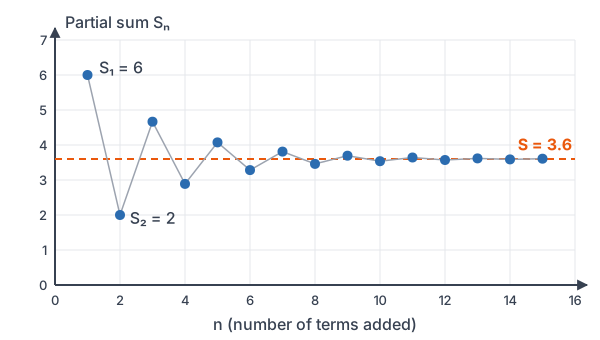
Find the sum of \sum_{n=1}^{\infty} 6\left(-\tfrac{2}{3}\right)^{n-1} = 6 - 4 + \tfrac{8}{3} - \tfrac{16}{9} + \cdots.
a = 6
The first term (n = 1).
r = -\tfrac{2}{3}Each term is −2/3 times the one before.
|r| = \tfrac{2}{3} \lt 1The size of r is less than 1, so the series converges.
S = \dfrac{6}{1 - \left(-\frac{2}{3}\right)}Use the geometric series sum a/(1 − r).
S = \dfrac{6}{\frac{5}{3}}Simplify the denominator: 1 + 2/3 = 5/3.
S = 6 \cdot \dfrac{3}{5}Divide by multiplying by the reciprocal (see multiplying and dividing fractions).
S = \dfrac{18}{5}Multiply.
Answer: the series converges to 18/5 = 3.6. The partial sums are 6, 2, 4.67, 2.89, 4.07, …, landing above and below 3.6 and closing in on it.
Example 4: Two series that diverge
Show that each series diverges: (a) \sum_{n=1}^{\infty} n = 1 + 2 + 3 + \cdots and (b) \sum_{n=1}^{\infty} (-1)^{n+1} = 1 - 1 + 1 - 1 + \cdots.
Part (a)
S_n = 1 + 2 + \cdots + n
Write the nth partial sum.
S_n = \dfrac{n(n + 1)}{2}Use the formula for an arithmetic series.
\lim_{n \to \infty} \dfrac{n(n + 1)}{2} = \inftyThe partial sums grow without bound.
Part (b)
S_1 = 1,\ S_2 = 0,\ S_3 = 1,\ S_4 = 0
Write the first few partial sums.
S_n = 1 \text{ for odd } n \text{ and } S_n = 0 \text{ for even } nThe running total keeps switching.
\lim_{n \to \infty} S_n \text{ does not exist}The partial sums never settle on one number.
Answer: both series diverge. In (a) the partial sums go to infinity. In (b) they jump between 1 and 0 forever.
Example 5: A bouncing ball (word problem)
A ball is dropped from a height of 12 meters. Each time it hits the floor, it bounces back up to 3/4 of the height it just fell. If it keeps bouncing forever, what total vertical distance does it travel?
12,\ 9,\ 6.75,\ 5.0625,\ \ldots
List the heights: each one is 3/4 of the one before.
D = 12 + 2(9 + 6.75 + 5.0625 + \cdots)
The ball falls 12 m once. After that, it goes up and back down each rebound height.
9 + 6.75 + 5.0625 + \cdots = \dfrac{9}{1 - \frac{3}{4}}The rebound heights form a geometric series with a = 9 and r = 3/4.
\dfrac{9}{1 - \frac{3}{4}} = \dfrac{9}{\frac{1}{4}}Subtract in the denominator.
\dfrac{9}{\frac{1}{4}} = 36Dividing by 1/4 is the same as multiplying by 4.
D = 12 + 2(36)
Substitute the sum.
D = 12 + 72
Multiply.
D = 84
Add.
Answer: the ball travels a total of 84 meters, even though it bounces infinitely many times.
Common mistakes
| Mistake | Example of the error | Fix |
|---|---|---|
| Confusing the terms with the partial sums | Saying \sum 1/n converges because 1/n \to 0 | The terms going to 0 is not enough. The series converges only if the partial sums S_n approach a number. |
| Using a/(1 − r) when |r| \ge 1 | “1 + 2 + 4 + \cdots = \frac{1}{1 - 2} = -1” | The formula works only when |r| \lt 1. Here r = 2, so the series diverges. |
| Using the wrong first term | For \sum_{n=1}^{\infty} (1/3)^n, writing a = 1 | The first term is the n = 1 term, 1/3. The sum is \frac{1/3}{1 - 1/3} = \frac{1}{2}. |
| Forgetting the starting index | Treating \sum_{n=0}^{\infty} and \sum_{n=1}^{\infty} of (1/2)^n as equal | Starting at n = 0 adds an extra term of 1, so the sums are 2 and 1. |
| Splitting a sum of divergent series | \sum (1 + (-1)) = \sum 1 + \sum (-1) | The sum rule needs both series to converge. Here neither does, even though \sum 0 = 0. |
| Finding a_n as S_n alone | For S_n = 5n/(2n + 1), writing a_n = 5n/(2n + 1) | Each term is a_n = S_n - S_{n-1}. |
Related methods
Repeating decimals as series
Any repeating decimal is a geometric series. For example, 0.\overline{27} = 0.27 + 0.0027 + \cdots, with a = 0.27 and r = 0.01, so its sum is \dfrac{0.27}{0.99} = \dfrac{3}{11}.
Tests for convergence
Most series do not have a neat formula for S_n. The rest of this unit gives tests that decide convergence without one. The first is the divergence test, which says that if the terms do not go to 0, the series diverges. Some series with nice partial sums, called telescoping series, are coming up too.
Practice problems
- Find S_1, S_2, S_3 and S_4 for \sum_{n=1}^{\infty} (2n - 1). Does the series converge?
- Find the sum of \sum_{n=1}^{\infty} 5\left(\tfrac{1}{4}\right)^{n-1}.
- Find the sum of \sum_{n=0}^{\infty} \left(-\tfrac{1}{2}\right)^n.
- Does \sum_{n=1}^{\infty} \left(\tfrac{5}{4}\right)^n converge?
- The partial sums of a series are S_n = 3 - \dfrac{2}{n}. Find the sum and a formula for a_n.
- Write the repeating decimal 0.\overline{45} as a fraction using a series.
- Find the sum of \sum_{n=1}^{\infty} \dfrac{2^n + 3^n}{6^n}.
- Find the sum of \sum_{n=1}^{\infty} \dfrac{3 \cdot 2^n}{5^{n+1}}.
- For which values of x does \sum_{n=0}^{\infty} \left(\dfrac{x}{3}\right)^n converge? What is its sum?
- A snail crawls 60 cm in the first hour. Each hour after that, it crawls 2/3 as far as the hour before. How far does it crawl in the first 4 hours, and what total distance does it approach?
Show answers
1.
S_1 = 1
The first term is 2(1) − 1 = 1.
S_2 = 1 + 3 = 4
Add the second term, 3.
S_3 = 4 + 5 = 9
Add the third term, 5.
S_4 = 9 + 7 = 16
Add the fourth term, 7.
S_n = n^2
The partial sums are the perfect squares.
\lim_{n \to \infty} n^2 = \inftyThey grow without bound.
Answer: 1, 4, 9, 16; the series diverges
2.
a = 5,\ r = \tfrac{1}{4}Read off the first term and the ratio.
|r| = \tfrac{1}{4} \lt 1The series converges.
S = \dfrac{5}{1 - \frac{1}{4}}Use a/(1 − r).
S = \dfrac{5}{\frac{3}{4}}Subtract in the denominator.
S = 5 \cdot \dfrac{4}{3} = \dfrac{20}{3}Multiply by the reciprocal.
Answer: 20/3
3.
a = \left(-\tfrac{1}{2}\right)^0 = 1The first term is the n = 0 term.
r = -\tfrac{1}{2}Each term is −1/2 times the one before.
S = \dfrac{1}{1 - \left(-\frac{1}{2}\right)}|r| is less than 1, so use a/(1 − r).
S = \dfrac{1}{\frac{3}{2}} = \dfrac{2}{3}Simplify.
Answer: 2/3
4.
r = \tfrac{5}{4}Each term is 5/4 times the one before.
|r| = \tfrac{5}{4} \ge 1The ratio is too big.
S_n = \dfrac{\frac{5}{4}\left(1 - \left(\frac{5}{4}\right)^n\right)}{1 - \frac{5}{4}} = 5\left(\left(\tfrac{5}{4}\right)^n - 1\right)Use the partial sum formula with a = 5/4 and simplify.
\lim_{n \to \infty} 5\left(\left(\tfrac{5}{4}\right)^n - 1\right) = \inftyPowers of 5/4 grow without bound.
Answer: no, it diverges
5.
\lim_{n \to \infty} \left(3 - \dfrac{2}{n}\right) = 3The sum is the limit of the partial sums; 2/n goes to 0.
a_1 = S_1 = 3 - 2 = 1
The first term equals the first partial sum.
a_n = \left(3 - \dfrac{2}{n}\right) - \left(3 - \dfrac{2}{n - 1}\right)For n ≥ 2, use a_n = S_n − S_{n−1}.
a_n = \dfrac{2}{n - 1} - \dfrac{2}{n}The 3s cancel.
a_n = \dfrac{2n - 2(n - 1)}{n(n - 1)}Write over a common denominator.
a_n = \dfrac{2}{n(n - 1)}Simplify the top.
Answer: the sum is 3; a₁ = 1 and aₙ = 2/(n(n − 1)) for n ≥ 2
6.
0.\overline{45} = 0.45 + 0.0045 + 0.000045 + \cdotsSplit the decimal into repeating blocks.
a = 0.45,\ r = 0.01
Each block is 1/100 of the one before.
S = \dfrac{0.45}{1 - 0.01} = \dfrac{0.45}{0.99}Use a/(1 − r).
S = \dfrac{45}{99}Multiply the top and bottom by 100.
S = \dfrac{5}{11}Divide the top and bottom by 9.
Answer: 5/11
7.
\dfrac{2^n + 3^n}{6^n} = \dfrac{2^n}{6^n} + \dfrac{3^n}{6^n}Split the fraction.
\dfrac{2^n}{6^n} + \dfrac{3^n}{6^n} = \left(\tfrac{1}{3}\right)^n + \left(\tfrac{1}{2}\right)^nSimplify each base (see exponent rules).
\sum_{n=1}^{\infty} \left(\tfrac{1}{3}\right)^n = \dfrac{\frac{1}{3}}{1 - \frac{1}{3}} = \dfrac{1}{2}Geometric series with a = 1/3 and r = 1/3.
\sum_{n=1}^{\infty} \left(\tfrac{1}{2}\right)^n = \dfrac{\frac{1}{2}}{1 - \frac{1}{2}} = 1Geometric series with a = 1/2 and r = 1/2.
\sum_{n=1}^{\infty} \dfrac{2^n + 3^n}{6^n} = \dfrac{1}{2} + 1 = \dfrac{3}{2}Both series converge, so add their sums.
Answer: 3/2
8.
a_1 = \dfrac{3 \cdot 2^1}{5^2} = \dfrac{6}{25}Find the first term.
\dfrac{a_{n+1}}{a_n} = \dfrac{3 \cdot 2^{n+1}/5^{n+2}}{3 \cdot 2^n/5^{n+1}} = \dfrac{2}{5}Find the ratio of consecutive terms.
S = \dfrac{\frac{6}{25}}{1 - \frac{2}{5}} = \dfrac{\frac{6}{25}}{\frac{3}{5}}|r| is less than 1, so use a/(1 − r).
S = \dfrac{6}{25} \cdot \dfrac{5}{3} = \dfrac{2}{5}Multiply by the reciprocal and simplify.
Answer: 2/5
9.
r = \dfrac{x}{3}This is geometric with first term 1 and ratio x/3.
\left|\dfrac{x}{3}\right| \lt 1It converges when the size of r is less than 1.
-3 \lt x \lt 3
Multiply by 3 (see absolute value inequalities).
S = \dfrac{1}{1 - \frac{x}{3}}Use a/(1 − r) with a = 1.
S = \dfrac{3}{3 - x}Multiply the top and bottom by 3.
Answer: it converges for −3 < x < 3, with sum 3/(3 − x)
10.
S_4 = \dfrac{60\left(1 - \left(\frac{2}{3}\right)^4\right)}{1 - \frac{2}{3}}Use the geometric partial sum formula with a = 60, r = 2/3 and n = 4.
S_4 = 180\left(1 - \tfrac{16}{81}\right)60 ÷ (1/3) = 180 and (2/3)⁴ = 16/81.
S_4 = 180 \cdot \tfrac{65}{81} = \tfrac{1300}{9} \approx 144.4Subtract, then multiply.
S = \dfrac{60}{1 - \frac{2}{3}} = 180Find the sum of the whole series.
Answer: about 144.4 cm in 4 hours; the total distance approaches 180 cm
Infinite series FAQ
What is a partial sum of a series?
The nth partial sum S_n is the total of the first n terms of the series. The partial sums form a sequence, and the series converges exactly when that sequence converges.
What is the difference between a sequence and a series?
A sequence is a list of numbers, like 1/2, 1/4, 1/8, …. A series is the sum of those numbers, like 1/2 + 1/4 + 1/8 + ⋯, which here equals 1.
Can a series converge if its terms do not go to 0?
No. If the terms do not approach 0, the partial sums keep changing by a noticeable amount, so the series diverges. This is the divergence test. The opposite is not true: terms going to 0 does not guarantee convergence.
How do you find the sum of an infinite series?
Find a formula for the partial sums and take its limit as n → ∞. For a geometric series with |r| \lt 1, the sum is a/(1 − r), where a is the first term.
Summary
- An infinite series adds the terms of a sequence forever; its nth partial sum S_n adds the first n terms.
- The series converges to S when S_n \to S, a finite number. Otherwise it diverges.
- A geometric series converges to a/(1 − r) when |r| \lt 1 and diverges when |r| \ge 1.
- Each term is the change in the running total: a_n = S_n - S_{n-1}.
- Convergent series can be added and multiplied by constants term by term.
Previous lesson: Convergence of Sequences
Next lesson: Divergence Test
Back to the Calculus 2 Index