
Convergence of Sequences
A sequence converges if its terms get closer and closer to one number L as n grows. Then we write \lim_{n \to \infty} a_n = L. If the terms grow without bound or never settle on one value, the sequence diverges. To find the limit, treat n like x and use limits at infinity, L’Hôpital’s rule or the squeeze theorem.
Before this lesson: Limits at Infinity, L’Hôpital’s Rule, Squeeze Theorem and Geometric Sequences
What it means for a sequence to converge
A sequence is an ordered list of numbers a_1, a_2, a_3, \ldots. It is usually given by a formula for the nth term, a_n. In calculus we care about what happens far down the list.
Take a_n = \dfrac{n + 1}{n}. Its terms are 2, 1.5, 1.333…, 1.25 and so on. They get as close to 1 as you like, so the sequence converges to 1.
Now take b_n = n^2, which gives 1, 4, 9, 16, …, and c_n = (-1)^n, which gives −1, 1, −1, 1, …. The first grows without bound. The second keeps jumping between two values. Both diverge.
Rules for the limit of a sequence
Definition. \lim_{n \to \infty} a_n = L means a_n can be made as close to L as we want by taking n large enough. In symbols: for every \varepsilon \gt 0 there is a number N with |a_n - L| \lt \varepsilon for all n \gt N. This is the sequence version of the epsilon-delta definition of a limit.
Function rule. If the terms come from a function, a_n = f(n), then the sequence has the same limit as the function. This lets you use every tool for limits of functions, including L’Hôpital’s rule.
\text{If } \lim_{x \to \infty} f(x) = L \text{ and } a_n = f(n), \text{ then } \lim_{n \to \infty} a_n = LGeometric sequences. Powers r^n follow a simple rule. They shrink to 0 when the size of r is less than 1.
\lim_{n \to \infty} r^n = \begin{cases} 0 & \text{if } |r| \lt 1 \\ 1 & \text{if } r = 1 \\ \text{diverges} & \text{if } r \le -1 \text{ or } r \gt 1 \end{cases}Squeeze theorem. If b_n \le a_n \le c_n for all n past some point, and b_n and c_n both converge to L, then a_n also converges to L.
Absolute value rule. If |a_n| \to 0, then a_n \to 0. This settles many sequences with alternating signs. It only works when the limit is 0.
The limit laws for sums, differences, products, quotients and constant multiples work for sequences the same way they work for functions.
How to decide if a sequence converges
- Write out the first few terms to get a feel for the pattern.
- If a_n = f(n) for a function you can work with, find the limit of f(x) as x → ∞ with algebra, limits at infinity or L’Hôpital’s rule.
- For pieces like (-1)^n, \sin n or n!, use the absolute value rule or the squeeze theorem instead. L’Hôpital’s rule does not apply to them.
- If the limit is one finite number, the sequence converges to it. If the terms grow without bound or keep returning to two or more different values, it diverges.
Convergence of sequences examples
Example 1: A rational sequence
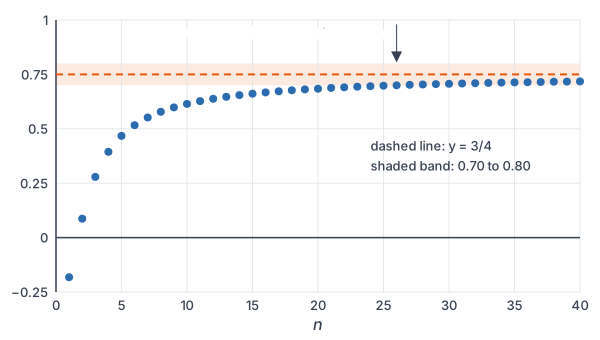
Does a_n = \dfrac{3n^2 - 5n}{4n^2 + 7} converge? If so, find its limit.
a_n = \dfrac{\frac{3n^2}{n^2} - \frac{5n}{n^2}}{\frac{4n^2}{n^2} + \frac{7}{n^2}}Divide every term by n², the highest power in the denominator.
a_n = \dfrac{3 - \frac{5}{n}}{4 + \frac{7}{n^2}}Simplify each fraction.
\lim_{n \to \infty} a_n = \dfrac{3 - 0}{4 + 0}5/n and 7/n² both go to 0 as n grows.
\lim_{n \to \infty} a_n = \dfrac{3}{4}Simplify.
Answer: the sequence converges to 3/4. The first terms are about −0.18, 0.09, 0.28 and 0.39, and the 100th term is about 0.737.
Example 2: Using L’Hôpital’s rule
Find the limit of the sequence a_n = \dfrac{\ln n}{n}.
f(x) = \dfrac{\ln x}{x}Use the function rule: replace n with x.
\lim_{x \to \infty} \dfrac{\ln x}{x} \text{ has the form } \dfrac{\infty}{\infty}Both ln x and x grow without bound (see indeterminate forms).
\lim_{x \to \infty} \dfrac{\ln x}{x} = \lim_{x \to \infty} \dfrac{1/x}{1}Apply L’Hôpital’s rule: the derivative of ln x is 1/x (see derivatives of logarithmic functions).
\lim_{x \to \infty} \dfrac{1/x}{1} = \lim_{x \to \infty} \dfrac{1}{x}Simplify.
\lim_{x \to \infty} \dfrac{1}{x} = 01/x shrinks toward 0.
\lim_{n \to \infty} \dfrac{\ln n}{n} = 0The sequence has the same limit as the function.
Answer: the sequence converges to 0. Even though ln n grows forever, n grows much faster.
Example 3: Alternating signs
Decide whether each sequence converges: (a) a_n = \dfrac{3(-1)^n}{n} and (b) b_n = \dfrac{(-1)^n n}{n + 1}.
Part (a)
|a_n| = \dfrac{3}{n}Take the absolute value; the size of (−1)ⁿ is 1.
\lim_{n \to \infty} \dfrac{3}{n} = 0The denominator grows without bound.
\lim_{n \to \infty} a_n = 0Use the absolute value rule.
Part (b)
\dfrac{n}{n + 1} = \dfrac{1}{1 + \frac{1}{n}}Find the size of each term: divide the top and bottom by n.
\lim_{n \to \infty} \dfrac{1}{1 + \frac{1}{n}} = 11/n goes to 0.
b_{2k} \to 1 \text{ and } b_{2k+1} \to -1Even-numbered terms are positive and odd-numbered terms are negative.
b_n \text{ diverges}The terms do not approach one number.
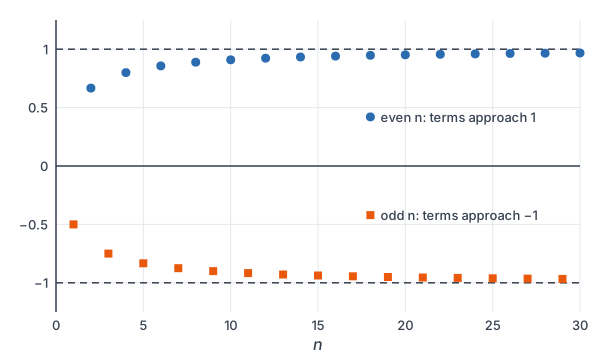
Answer: (a) converges to 0; (b) diverges. Alternating signs do not cause divergence by themselves. What matters is whether the size of the terms goes to 0.
Example 4: The squeeze theorem with factorials
Find the limit of a_n = \dfrac{n!}{n^n}, where n! = 1 \cdot 2 \cdot 3 \cdots n (see permutations and combinations for factorials). L’Hôpital’s rule cannot be used, because n! is only defined for whole numbers.
\dfrac{n!}{n^n} = \dfrac{1 \cdot 2 \cdot 3 \cdots n}{n \cdot n \cdot n \cdots n}Write out both products; each has n factors.
\dfrac{n!}{n^n} = \dfrac{1}{n} \cdot \dfrac{2}{n} \cdot \dfrac{3}{n} \cdots \dfrac{n}{n}Pair each factor on top with one n.
0 \lt \dfrac{2}{n} \cdot \dfrac{3}{n} \cdots \dfrac{n}{n} \le 1Every factor after the first is positive and at most 1.
0 \lt \dfrac{n!}{n^n} \le \dfrac{1}{n}So the whole product is positive and at most its first factor, 1/n.
\lim_{n \to \infty} 0 = 0 \text{ and } \lim_{n \to \infty} \dfrac{1}{n} = 0Both bounds go to 0.
\lim_{n \to \infty} \dfrac{n!}{n^n} = 0Apply the squeeze theorem.
Answer: the sequence converges to 0. For example, the 5th term is 120/3125 = 0.0384, which is below 1/5 = 0.2.
Example 5: Medicine in the body (word problem)
A patient takes a 50 mg dose of a medicine every day. By the next dose, 30% of the medicine in the body is still there. Let a_n be the amount in the body right after the nth dose. Does the amount level off?
a_1 = 50
The first dose.
a_2 = 0.3(50) + 50 = 65
30% of the first dose remains, plus a new dose.
a_3 = 0.3(65) + 50 = 69.5
Repeat the rule.
a_n = 50 + 50(0.3) + 50(0.3)^2 + \cdots + 50(0.3)^{n-1}Each older dose shrinks by a factor of 0.3 per day.
a_n = \dfrac{50\left(1 - 0.3^n\right)}{1 - 0.3}Use the sum of a finite geometric series (see geometric series).
a_n = \dfrac{500}{7}\left(1 - 0.3^n\right)Simplify: 50/0.7 = 500/7.
\lim_{n \to \infty} 0.3^n = 0Use the rule for rⁿ: the size of 0.3 is less than 1.
\lim_{n \to \infty} a_n = \dfrac{500}{7}(1 - 0)Use the limit laws.
\lim_{n \to \infty} a_n = \dfrac{500}{7} \approx 71.4Simplify.
Answer: yes. The amount right after each dose converges to 500/7 ≈ 71.4 mg, so it levels off just above 71 mg.
Common mistakes
| Mistake | Example of the error | Fix |
|---|---|---|
| Mixing up a sequence and a series | “1/n \to 0, so the series \sum 1/n converges” | A convergent sequence is about the terms. Whether their sum converges is a separate question, and the harmonic series \sum 1/n diverges. |
| Saying (-1)^n converges | “(-1)^n converges to 0 because it averages out to 0” | The terms jump between −1 and 1 forever, so the sequence diverges. |
| Using L’Hôpital’s rule on n! or (-1)^n | Trying to differentiate n! with respect to n | These have no derivative. Use the squeeze theorem or the absolute value rule. |
| Reading the function rule backward | “\sin(\pi x) has no limit, so \sin(\pi n) diverges” | \sin(\pi n) = 0 for every whole number n, so the sequence converges to 0. |
| Wrong rule for r^n | “(-1.5)^n \to 0 because the signs alternate” | r^n \to 0 only when |r| \lt 1. Here |r| = 1.5, so the sequence diverges. |
| Using the absolute value rule with a nonzero limit | “|b_n| \to 1, so b_n \to 1” for b_n = (-1)^n n/(n + 1) | The rule only works when the limit is 0. |
Related methods
Monotone sequences
A sequence is increasing if each term is at least as big as the one before it, and bounded above if no term is bigger than some fixed number. The Monotone Convergence Theorem says an increasing sequence that is bounded above must converge. The same holds for a decreasing sequence that is bounded below.
The medicine amounts in Example 5 increase (50, 65, 69.5, …) and never pass 500/7, so the theorem says they converge even before you find the limit.
Recursive sequences
When each term comes from the one before, a_{n+1} = g(a_n), and the sequence converges to L, the limit must satisfy L = g(L). In Example 5, a_{n+1} = 0.3a_n + 50. Solving L = 0.3L + 50 gives 0.7L = 50, so L = 500/7, which matches.
From sequences to series
An infinite series adds up the terms of a sequence. It converges when its sequence of partial sums converges, which is the subject of the next lesson, Infinite Series and Partial Sums. You have already seen one case in infinite geometric series.
Practice problems
- Does a_n = \dfrac{5n + 2}{2n - 1} converge? If so, find the limit.
- Does a_n = \dfrac{n^3 + 1}{4n^2} converge?
- Does a_n = 4\left(-\tfrac{2}{3}\right)^n converge?
- Does a_n = 1.05^n converge?
- Find the limit of a_n = ne^{-n}.
- Does a_n = \dfrac{(-1)^n \cdot 2n}{3n + 1} converge?
- Find the limit of a_n = \dfrac{\sin n}{n}.
- Find the limit of a_n = \left(1 + \dfrac{3}{n}\right)^n.
- Find the limit of a_n = \sqrt{n^2 + 4n} - n.
- A pond is stocked with fish, and after n months the model p_n = \dfrac{800n}{n + 4} gives the number of fish. Does the population level off? From which month on is it above 750?
Show answers
1.
\dfrac{5n + 2}{2n - 1} = \dfrac{5 + \frac{2}{n}}{2 - \frac{1}{n}}Divide the top and bottom by n.
\lim_{n \to \infty} a_n = \dfrac{5 + 0}{2 - 0}2/n and 1/n go to 0.
\lim_{n \to \infty} a_n = \dfrac{5}{2}Simplify.
Answer: converges to 5/2
2.
\dfrac{n^3 + 1}{4n^2} = \dfrac{n^3}{4n^2} + \dfrac{1}{4n^2}Split the fraction.
\dfrac{n^3 + 1}{4n^2} = \dfrac{n}{4} + \dfrac{1}{4n^2}Simplify the first fraction.
\dfrac{n}{4} \to \infty \text{ and } \dfrac{1}{4n^2} \to 0Find the limit of each part.
Answer: diverges; the terms grow without bound
3.
\left|-\tfrac{2}{3}\right| = \tfrac{2}{3} \lt 1Find the size of the ratio r.
\lim_{n \to \infty} \left(-\tfrac{2}{3}\right)^n = 0Use the rule for rⁿ with |r| less than 1.
\lim_{n \to \infty} 4\left(-\tfrac{2}{3}\right)^n = 4 \cdot 0 = 0Use the constant multiple law.
Answer: converges to 0
4.
1.05 \gt 1
Compare the ratio with 1.
1.05^n \to \infty
Use the rule for rⁿ: powers of a number above 1 grow without bound.
Answer: diverges. For example, the 100th term is about 131.5
5.
ne^{-n} = \dfrac{n}{e^n}Rewrite with a positive exponent (see zero and negative exponents).
\lim_{x \to \infty} \dfrac{x}{e^x} \text{ has the form } \dfrac{\infty}{\infty}Use the function rule.
\lim_{x \to \infty} \dfrac{x}{e^x} = \lim_{x \to \infty} \dfrac{1}{e^x}Apply L’Hôpital’s rule.
\lim_{x \to \infty} \dfrac{1}{e^x} = 0eˣ grows without bound.
Answer: converges to 0
6.
\dfrac{2n}{3n + 1} = \dfrac{2}{3 + \frac{1}{n}}Find the size of each term: divide the top and bottom by n.
\lim_{n \to \infty} \dfrac{2}{3 + \frac{1}{n}} = \dfrac{2}{3}1/n goes to 0.
a_{2k} \to \tfrac{2}{3} \text{ and } a_{2k+1} \to -\tfrac{2}{3}The sign alternates.
Answer: diverges; the terms keep returning near 2/3 and −2/3
7.
-1 \le \sin n \le 1
Sine is always between −1 and 1.
-\dfrac{1}{n} \le \dfrac{\sin n}{n} \le \dfrac{1}{n}Divide by n, which is positive.
\lim_{n \to \infty} \left(-\dfrac{1}{n}\right) = 0 \text{ and } \lim_{n \to \infty} \dfrac{1}{n} = 0Both bounds go to 0.
\lim_{n \to \infty} \dfrac{\sin n}{n} = 0Apply the squeeze theorem.
Answer: converges to 0
8.
\ln a_n = n\ln\left(1 + \dfrac{3}{n}\right)Take the natural log of both sides and use the power property (see properties of logarithms).
n\ln\left(1 + \dfrac{3}{n}\right) = \dfrac{\ln\left(1 + \frac{3}{n}\right)}{\frac{1}{n}}Rewrite as a quotient, which has the form 0/0.
\lim_{x \to \infty} \dfrac{\ln\left(1 + \frac{3}{x}\right)}{\frac{1}{x}} = \lim_{x \to \infty} \dfrac{\dfrac{-3/x^2}{1 + 3/x}}{-1/x^2}Apply L’Hôpital’s rule, using the chain rule on top.
\lim_{x \to \infty} \dfrac{\dfrac{-3/x^2}{1 + 3/x}}{-1/x^2} = \lim_{x \to \infty} \dfrac{3}{1 + \frac{3}{x}}Simplify: the −1/x² parts cancel.
\lim_{x \to \infty} \dfrac{3}{1 + \frac{3}{x}} = 33/x goes to 0.
\lim_{n \to \infty} a_n = e^3ln aₙ goes to 3, and aₙ = e raised to ln aₙ, where eˣ is continuous.
Answer: converges to e³ ≈ 20.09
9.
\sqrt{n^2 + 4n} - n = \dfrac{\left(\sqrt{n^2 + 4n} - n\right)\left(\sqrt{n^2 + 4n} + n\right)}{\sqrt{n^2 + 4n} + n}Multiply the top and bottom by the conjugate.
\sqrt{n^2 + 4n} - n = \dfrac{n^2 + 4n - n^2}{\sqrt{n^2 + 4n} + n}Multiply out the top as a difference of squares (see special products of binomials).
\sqrt{n^2 + 4n} - n = \dfrac{4n}{\sqrt{n^2 + 4n} + n}Combine like terms.
\sqrt{n^2 + 4n} - n = \dfrac{4}{\sqrt{1 + \frac{4}{n}} + 1}Divide the top and bottom by n; inside the root, divide by n².
\lim_{n \to \infty} a_n = \dfrac{4}{\sqrt{1 + 0} + 1}4/n goes to 0.
\lim_{n \to \infty} a_n = 2Simplify.
Answer: converges to 2
10.
\dfrac{800n}{n + 4} = \dfrac{800}{1 + \frac{4}{n}}Divide the top and bottom by n.
\lim_{n \to \infty} p_n = \dfrac{800}{1 + 0}4/n goes to 0.
\lim_{n \to \infty} p_n = 800Simplify.
\dfrac{800n}{n + 4} \gt 750Set up the inequality for “above 750.”
800n \gt 750n + 3000
Multiply both sides by n + 4, which is positive.
50n \gt 3000
Subtract 750n from both sides.
n \gt 60
Divide both sides by 50.
Answer: yes, the population levels off at 800 fish, staying just below it. It is above 750 from month 61 on
Convergence of sequences FAQ
What does it mean for a sequence to converge?
A sequence converges when its terms get as close as you like to one finite number L as n grows. That number is the limit of the sequence.
How do you tell if a sequence converges or diverges?
Find the limit of the nth term as n → ∞, using algebra, L’Hôpital’s rule on the matching function, or the squeeze theorem. If the limit is a finite number, the sequence converges; otherwise it diverges.
What is the difference between a convergent sequence and a convergent series?
A sequence converges when its terms approach a number. A series converges when the running totals of its terms approach a number. The terms 1/n go to 0, but the series of 1/n diverges.
Can a sequence with alternating signs converge?
Yes, if the size of the terms goes to 0, as with (−1)ⁿ/n. If the size approaches a nonzero number, the terms keep jumping between two values and the sequence diverges.
Summary
- A sequence converges to L if its terms get as close to L as you like as n → ∞.
- If a_n = f(n) and f(x) → L as x → ∞, then a_n \to L, so L’Hôpital’s rule can help.
- r^n \to 0 when |r| \lt 1, and it diverges when r \le -1 or r \gt 1.
- Use the squeeze theorem or the absolute value rule for factorials, sines and alternating signs.
- A sequence diverges if its terms grow without bound or keep returning to different values.
Previous lesson: Arc Length of Polar Curves
Next lesson: Infinite Series and Partial Sums
Back to the Calculus 2 Index