
Indeterminate Forms
Indeterminate forms are limit results like 0 \cdot \infty, \infty - \infty, 1^\infty, 0^0 and \infty^0 that don’t tell you the answer by themselves. To find these limits, rewrite the expression as a fraction of the form 0/0 or ∞/∞, then use L’Hôpital’s rule. For the three power forms, take the natural log first.
Before this lesson: L’Hôpital’s Rule, Properties of Logarithms and Adding and Subtracting Rational Expressions
Why these forms are indeterminate
In 0 \cdot \infty, one factor pulls toward 0 and the other toward ∞. Which one wins depends on how fast each one moves, so the limit could be 0, ∞ or any number in between. The same tug-of-war happens in the other forms: in 1^\infty, a base near 1 is raised to a huge power.
Some forms that look strange are not indeterminate. For example, 0^\infty = 0, \infty \cdot \infty = \infty and \frac{1}{\infty} = 0 always. Only the seven forms below need special work.
| Form | How to rewrite it | Then |
|---|---|---|
| \frac{0}{0}, \frac{\infty}{\infty} | Already a fraction | L’Hôpital’s rule |
| 0 \cdot \infty | Write fg as \frac{f}{1/g} or \frac{g}{1/f} | 0/0 or ∞/∞ |
| \infty - \infty | Combine into one fraction (common denominator) or factor | 0/0 or ∞/∞ |
| 1^\infty, 0^0, \infty^0 | Let y be the expression and take ln y = (exponent)(ln base) | Find lim ln y, then y = e to that power |
How to handle the power forms
- Let y equal the expression, such as y = \left(1 + \frac{3}{x}\right)^x.
- Take ln of both sides and bring the exponent down: \ln y = x\ln\left(1 + \frac{3}{x}\right).
- Find \lim \ln y. It is usually a 0 · ∞ form, so rewrite it as a fraction and use L’Hôpital’s rule.
- If \lim \ln y = L, then \lim y = e^L.
The last step works because e^x is continuous: y = e^{\ln y}, and the limit can move inside the exponent.
Indeterminate forms examples
Example 1: A 0 · ∞ form
Find \lim_{x \to 0^+} x\ln x.
0 \cdot (-\infty)
As x → 0⁺, x → 0 and ln x → −∞.
\lim_{x \to 0^+}\frac{\ln x}{\frac{1}{x}}Rewrite as a fraction: dividing by 1/x is multiplying by x. Now it is −∞/∞.
\lim_{x \to 0^+}\frac{\frac{1}{x}}{-\frac{1}{x^2}}L’Hôpital’s rule: differentiate the top and the bottom.
\lim_{x \to 0^+}(-x) = 0Simplify: (1/x)(−x²) = −x.
Answer: 0. Put ln x on top, not x. The other choice, \frac{x}{1/\ln x}, gets more complicated after differentiating.
Example 2: An ∞ − ∞ form
Find \lim_{x \to 1^+}\left(\frac{1}{\ln x} - \frac{1}{x - 1}\right).
\infty - \infty
As x → 1⁺, both fractions grow without bound.
\frac{(x - 1) - \ln x}{(x - 1)\ln x}Combine into one fraction with a common denominator. Now it is 0/0.
\lim_{x \to 1^+}\frac{1 - \frac{1}{x}}{\ln x + \frac{x - 1}{x}}L’Hôpital’s rule; product rule in the denominator. Still 0/0.
\lim_{x \to 1^+}\frac{x - 1}{x\ln x + x - 1}Multiply the top and the bottom by x to clear the small fractions.
\lim_{x \to 1^+}\frac{1}{\ln x + 1 + 1}L’Hôpital’s rule again: the derivative of x ln x is ln x + 1.
\frac{1}{0 + 2} = \frac{1}{2}Substitute x = 1.
Answer: \frac{1}{2}.
Example 3: A 1^∞ form
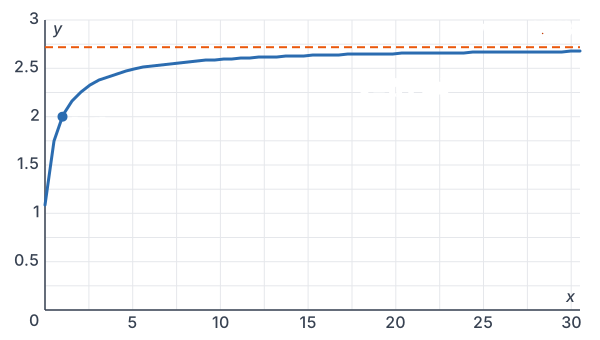
Find \lim_{x \to \infty}\left(1 + \frac{3}{x}\right)^x.
\ln y = x\ln\left(1 + \frac{3}{x}\right)Let y be the expression; take ln and bring the exponent down.
\lim_{x \to \infty}\frac{\ln\left(1 + \frac{3}{x}\right)}{\frac{1}{x}}This is ∞ · 0. Rewrite as 0/0.
\lim_{x \to \infty}\frac{\frac{-3/x^2}{1 + 3/x}}{-\frac{1}{x^2}}L’Hôpital’s rule, with the chain rule on top.
\lim_{x \to \infty}\frac{3}{1 + \frac{3}{x}} = 3The −1/x² factors cancel, and 3/x → 0.
\lim_{x \to \infty} y = e^3Since ln y → 3, y → e³.
Answer: e^3 \approx 20.09. In general, \lim_{x \to \infty}\left(1 + \frac{k}{x}\right)^x = e^k.
Example 4: A 0^0 form
Find \lim_{x \to 0^+} x^x.
\ln y = x\ln x
Let y = xˣ and take ln.
\lim_{x \to 0^+}x\ln x = 0This is Example 1.
\lim_{x \to 0^+} x^x = e^0 = 1Undo the log.
Answer: 1. (See the graph of xˣ in logarithmic differentiation.)
Example 5: Word problem with compound interest
You invest $1,000 at 5% interest per year, compounded n times a year. After 1 year the balance is 1000\left(1 + \frac{0.05}{n}\right)^n. What happens as interest is compounded more and more often?
\lim_{n \to \infty}\left(1 + \frac{0.05}{n}\right)^n = e^{0.05}This is a 1^∞ form with k = 0.05, just like Example 3.
1000e^{0.05} \approx 1000(1.051271)Multiply by the $1,000 deposit.
1000e^{0.05} \approx 1051.27Round to the nearest cent.
Answer: the balance approaches $1,051.27. This limit is continuous compounding, A = Pe^{rt} (see compound interest). Compounding more often helps, but only up to this cap.
Common mistakes
| Mistake | Example of the error | Fix |
|---|---|---|
| Treating 1^∞ as 1 | “(1 + \frac{3}{x})^x \to 1“ | The base is only near 1. Take ln: the limit is e³. |
| Treating 0 · ∞ as 0 | “x\ln x \to 0, because 0 times anything is 0″ | The answer happens to be 0 here, but x \cdot \frac{1}{x} \to 1. Always rewrite and check. |
| Using L’Hôpital’s rule on a product | Differentiating x and ln x separately in x ln x | The rule only works on a fraction. Rewrite first. |
| Forgetting to undo the log | Stopping at “the limit is 3” in Example 3 | That is the limit of ln y. The answer is e³. |
| Calling ∞ − ∞ equal to 0 | “\frac{1}{\ln x} - \frac{1}{x - 1} \to 0“ | Combine into one fraction. The limit in Example 2 is ½. |
Related methods
Algebra instead of L’Hôpital’s rule
Some ∞ − ∞ limits are easier with algebra. For \lim_{x \to \infty}\left(\sqrt{x^2 + x} - x\right), multiply by the conjugate to get \frac{x}{\sqrt{x^2 + x} + x} \to \frac{1}{2} (see evaluating limits algebraically).
The number e as a limit
Example 3 with k = 1 gives \lim_{x \to \infty}\left(1 + \frac{1}{x}\right)^x = e, one of the standard definitions of the number e.
Practice problems
- Find \lim_{x \to 0^+} x^2\ln x.
- Find \lim_{x \to \infty} xe^{-x}.
- Find \lim_{x \to \infty} x\sin\frac{1}{x}.
- Find \lim_{x \to 0^+}\left(\frac{1}{x} - \frac{1}{e^x - 1}\right).
- Find \lim_{x \to \infty}\left(1 + \frac{1}{x}\right)^{2x}.
- Find \lim_{x \to 0^+}(1 + x)^{1/x}.
- Find \lim_{x \to \infty} x^{1/x}.
- Find \lim_{x \to 0^+} x^{2x}.
- Find \lim_{x \to \infty}(x - \ln x).
- $500 is invested at 4% per year, compounded continuously. Find the balance after 10 years as a limit of 500\left(1 + \frac{0.04}{n}\right)^{10n}.
Show answers
1.
\lim_{x \to 0^+}\frac{\ln x}{\frac{1}{x^2}}0 · (−∞): rewrite as −∞/∞.
\lim_{x \to 0^+}\frac{\frac{1}{x}}{-\frac{2}{x^3}} = \lim_{x \to 0^+}\left(-\frac{x^2}{2}\right)L’Hôpital’s rule, then simplify.
-\frac{0}{2} = 0Substitute x = 0.
Answer: 0
2.
\lim_{x \to \infty}\frac{x}{e^x}∞ · 0: rewrite as ∞/∞.
\lim_{x \to \infty}\frac{1}{e^x} = 0L’Hôpital’s rule.
Answer: 0
3.
\lim_{x \to \infty}\frac{\sin\frac{1}{x}}{\frac{1}{x}}∞ · 0: rewrite as 0/0.
\lim_{x \to \infty}\frac{\cos\frac{1}{x} \cdot \left(-\frac{1}{x^2}\right)}{-\frac{1}{x^2}}L’Hôpital’s rule with the chain rule.
\lim_{x \to \infty}\cos\frac{1}{x} = \cos 0 = 1Cancel, then let 1/x → 0.
Answer: 1
4.
\frac{e^x - 1 - x}{x(e^x - 1)}∞ − ∞: combine into one fraction. Now 0/0.
\lim_{x \to 0^+}\frac{e^x - 1}{e^x - 1 + xe^x}L’Hôpital’s rule; product rule on the bottom. Still 0/0.
\lim_{x \to 0^+}\frac{e^x}{2e^x + xe^x} = \frac{1}{2}L’Hôpital’s rule again, then substitute x = 0.
Answer: \frac{1}{2}
5.
\ln y = 2x\ln\left(1 + \frac{1}{x}\right)1^∞: take ln.
\lim_{x \to \infty}\ln y = 2 \cdot 1 = 2x ln(1 + 1/x) → 1, as in Example 3 with k = 1.
Answer: e^2 \approx 7.389
6.
\ln y = \frac{\ln(1 + x)}{x}1^∞: take ln. This is 0/0.
\lim_{x \to 0^+}\frac{\frac{1}{1 + x}}{1} = 1L’Hôpital’s rule, then substitute x = 0.
Answer: e^1 = e
7.
\ln y = \frac{\ln x}{x}∞⁰: take ln. This is ∞/∞.
\lim_{x \to \infty}\frac{\frac{1}{x}}{1} = 0L’Hôpital’s rule.
Answer: e^0 = 1
8.
\ln y = 2x\ln x
0⁰: take ln.
\lim_{x \to 0^+} 2x\ln x = 2 \cdot 0 = 0Use Example 1.
Answer: e^0 = 1
9.
x - \ln x = x\left(1 - \frac{\ln x}{x}\right)∞ − ∞: factor out x.
\lim_{x \to \infty}\frac{\ln x}{x} = 0From L’Hôpital’s rule, so the parentheses → 1.
Answer: ∞. Here ∞ − ∞ turned out to be infinite.
10.
\lim_{n \to \infty}\left(1 + \frac{0.04}{n}\right)^{10n} = e^{0.04 \cdot 10} = e^{0.4}1^∞ form: ln y = 10n ln(1 + 0.04/n) → 10(0.04) = 0.4.
500e^{0.4} \approx 500(1.491825) \approx 745.91Multiply by 500.
Answer: about $745.91
Indeterminate forms FAQ
What are the seven indeterminate forms?
\frac{0}{0}, \frac{\infty}{\infty}, 0 \cdot \infty, \infty - \infty, 1^\infty, 0^0 and \infty^0. Each one can lead to different limits depending on the functions involved.
Why is 1 to the infinity indeterminate?
The base is only close to 1, not exactly 1. A base slightly above 1 raised to a huge power can grow to any size, so the result depends on how fast each part moves.
How do you solve a 0 times infinity limit?
Rewrite the product fg as a fraction, \frac{f}{1/g} or \frac{g}{1/f}, to get 0/0 or ∞/∞. Then use L’Hôpital’s rule.
Is 0 to the power infinity indeterminate?
No. A base near 0 raised to a huge power goes to 0, so 0^\infty = 0. Likewise, \infty^\infty = \infty.
Summary
- Seven indeterminate forms: 0/0, ∞/∞, 0 · ∞, ∞ − ∞, 1^∞, 0⁰ and ∞⁰.
- 0 · ∞: rewrite the product as a fraction.
- ∞ − ∞: combine into one fraction, or factor.
- Power forms: take ln, find the limit L of ln y, then the answer is e^L.
- \lim_{x \to \infty}\left(1 + \frac{k}{x}\right)^x = e^k.
Previous lesson: L’Hôpital’s Rule
Next lesson: Mean Value Theorem
Back to the Calculus 1 Index