
Mean Value Theorem
The mean value theorem says that if f is continuous on [a, b] and differentiable on (a, b), then at some point c between a and b, the instantaneous rate of change equals the average rate of change: f'(c) = \frac{f(b) - f(a)}{b - a}. Geometrically, some tangent line is parallel to the secant line through the endpoints.
Before this lesson: Continuity, Differentiability and Average Rate of Change
What the mean value theorem means
Draw the secant line that connects the two endpoints of a smooth curve. Now slide a line with the same slope across the graph. At some point it just touches the curve. There the tangent line is parallel to the secant line, so the two slopes are equal.
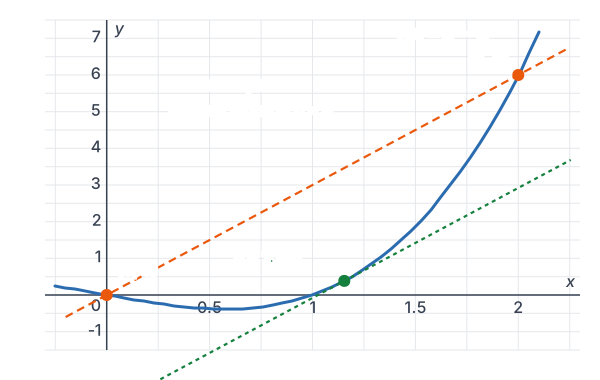
In terms of motion: if you drive 150 miles in 2 hours, your average speed is 75 mph. The theorem says that at some moment your speedometer read exactly 75 mph.
The mean value theorem and Rolle’s theorem
f'(c) = \frac{f(b) - f(a)}{b - a} \quad \text{for some } c \text{ in } (a, b)- Hypothesis 1: f is continuous on the closed interval [a, b].
- Hypothesis 2: f is differentiable on the open interval (a, b).
- Conclusion: at least one c strictly between a and b makes the equation true. There may be more than one.
Rolle’s theorem is the special case where f(a) = f(b). The average rate of change is then 0, so there is a c in (a, b) with f′(c) = 0: the graph has a horizontal tangent somewhere between the endpoints.
- Check both hypotheses.
- Find the average rate of change, \frac{f(b) - f(a)}{b - a}.
- Find f′(x) and set it equal to that number.
- Solve for c and keep only the solutions strictly between a and b.
Mean value theorem examples
Example 1: A quadratic
Find the value of c guaranteed by the mean value theorem for f(x) = x^2 + 2x on [0, 2].
f(2) = 4 + 4 = 8, \; f(0) = 0
Polynomials are continuous and differentiable everywhere, so the theorem applies. Find the endpoint values.
\frac{8 - 0}{2 - 0} = 4The average rate of change (slope of the secant line).
f'(x) = 2x + 2
Differentiate.
2c + 2 = 4
Set f′(c) equal to the average rate.
c = 1
Subtract 2, then divide by 2.
Answer: c = 1, which is in (0, 2).
Example 2: A cubic with an irrational c
Find c for f(x) = x^3 - x on [0, 2].
f(2) = 8 - 2 = 6, \; f(0) = 0
Find the endpoint values.
\frac{6 - 0}{2} = 3The average rate of change.
3c^2 - 1 = 3
Set f′(c) = 3c² − 1 equal to 3.
c^2 = \frac{4}{3}Add 1, then divide by 3.
c = \pm\frac{2}{\sqrt{3}}Take the square root of both sides (see solving quadratics with square roots).
c = \frac{2}{\sqrt{3}} \approx 1.155Reject the negative value; it is not in (0, 2).
Answer: c = \frac{2}{\sqrt{3}} = \frac{2\sqrt{3}}{3} \approx 1.155. The graph above shows this point.
Example 3: Rolle’s theorem
Show that Rolle’s theorem applies to f(x) = x^2 - 4x + 3 on [1, 3], and find c.
f(1) = 1 - 4 + 3 = 0
Evaluate at the left endpoint.
f(3) = 9 - 12 + 3 = 0
Evaluate at the right endpoint. f(1) = f(3), and f is a polynomial, so Rolle’s theorem applies.
f'(x) = 2x - 4
Differentiate.
2c - 4 = 0 \Rightarrow c = 2
Set f′(c) = 0: add 4, then divide by 2.
Answer: c = 2, the vertex of the parabola, where the tangent line is horizontal.
Example 4: When the hypotheses fail
Does the mean value theorem apply to f(x) = |x| on [−1, 1]? Is there a c with f′(c) equal to the average rate?
\frac{|1| - |-1|}{1 - (-1)} = \frac{0}{2} = 0The average rate of change is 0.
f'(x) = -1 \text{ or } 1The slope is −1 for x \lt 0 and 1 for x \gt 0 (see absolute value functions).
f'(0) \text{ does not exist}The graph has a corner at 0, so f is not differentiable on (−1, 1).
Answer: the theorem does not apply, and in fact no c works: f′(x) is never 0. This shows why the differentiability hypothesis matters.
Example 5: Word problem with a speeding ticket
Two toll booths on a highway are 30 miles apart. A driver passes the first at 2:00 pm and the second at 2:24 pm. The speed limit is 65 mph. Can the driver be ticketed for speeding?
24 \text{ min} = \frac{24}{60} = 0.4 \text{ h}Convert the time to hours.
\frac{30}{0.4} = 75Average speed in miles per hour.
s'(c) = 75
Position s(t) is continuous and differentiable, so by the mean value theorem the speed was exactly 75 mph at some moment c.
Answer: yes. At some instant between the booths, the driver was going 75 mph, which is over the 65 mph limit.
Common mistakes
| Mistake | Example of the error | Fix |
|---|---|---|
| Skipping the hypotheses | Using the theorem on \frac{1}{x} over [−1, 1] | Check continuity first: 1/x is undefined at 0, so the theorem doesn’t apply. |
| Keeping c values outside (a, b) | Keeping c = −2/√3 in Example 2 | c must be strictly between a and b. |
| Mixing up average and instantaneous rates | Setting f(c) equal to the average rate | Set the derivative f′(c) equal to the average rate. |
| Thinking the theorem finds c for you | Expecting a formula for c | The theorem only says c exists. You find it by solving f′(c) = average rate. |
| Assuming Rolle needs f(a) = f(b) = 0 | Rejecting Rolle when f(a) = f(b) = 5 | The endpoint values only need to be equal, not zero. |
Related methods
Why the theorem matters
The mean value theorem is the reason a function with f'(x) \gt 0 on an interval must be increasing there. That fact drives the connection between f and f′ and the first derivative test, coming up in this unit.
Functions with the same derivative
If f′(x) = 0 everywhere on an interval, the mean value theorem shows f is constant there. So two functions with the same derivative differ by a constant, which is why antiderivatives have a “+ C.”
Practice problems
- Find c for f(x) = x^2 on [1, 3].
- Find c for f(x) = \sqrt{x} on [0, 4].
- Find every c for f(x) = x^3 on [−1, 2].
- Find c for f(x) = \frac{1}{x} on [1, 3].
- Use Rolle’s theorem to find c for f(x) = x^3 - 9x on [0, 3].
- Use Rolle’s theorem to find c for f(x) = \sin x on [0, π].
- Does the mean value theorem apply to f(x) = x^{2/3} on [−1, 1]? Explain.
- Find c for f(x) = \ln x on [1, e].
- Find c for f(x) = e^x on [0, 1].
- The temperature rose from 50°F at 6 am to 74°F at noon. Explain why at some moment it was rising at exactly 4°F per hour.
Show answers
1.
\frac{9 - 1}{3 - 1} = 4Average rate of change.
2c = 4 \Rightarrow c = 2
Set f′(c) = 2c equal to 4 and divide by 2.
Answer: c = 2
2.
\frac{2 - 0}{4 - 0} = \frac{1}{2}Average rate: √4 = 2 and √0 = 0.
\frac{1}{2\sqrt{c}} = \frac{1}{2} \Rightarrow \sqrt{c} = 1Set f′(c) equal to ½ and cross-multiply.
c = 1
Square both sides.
Answer: c = 1
3.
\frac{8 - (-1)}{2 - (-1)} = \frac{9}{3} = 3Average rate.
3c^2 = 3 \Rightarrow c^2 = 1
Set f′(c) = 3c² equal to 3 and divide by 3.
c = 1
c = ±1, but −1 is an endpoint, not strictly inside (−1, 2).
Answer: c = 1
4.
\frac{\frac{1}{3} - 1}{3 - 1} = \frac{-\frac{2}{3}}{2} = -\frac{1}{3}Average rate.
-\frac{1}{c^2} = -\frac{1}{3} \Rightarrow c^2 = 3Set f′(c) = −1/c² equal to −1/3.
c = \sqrt{3} \approx 1.732Keep the positive root, which is in (1, 3).
Answer: c = \sqrt{3}
5.
f(0) = 0, \; f(3) = 27 - 27 = 0
The endpoint values are equal.
3c^2 - 9 = 0 \Rightarrow c^2 = 3
Set f′(c) = 0: add 9, divide by 3.
c = \sqrt{3}Keep the root in (0, 3).
Answer: c = \sqrt{3} \approx 1.732
6.
f(0) = 0, \; f(\pi) = 0
sin 0 = sin π = 0.
\cos c = 0 \Rightarrow c = \frac{\pi}{2}Set f′(c) = cos c equal to 0 and solve in (0, π).
Answer: c = \frac{\pi}{2}
7.
f'(x) = \frac{2}{3}x^{-1/3}Differentiate.
f'(0) \text{ does not exist}x^(−1/3) is undefined at 0: the graph has a cusp there.
Answer: no. f is not differentiable on (−1, 1). The average rate is 0, and f′ is never 0, so no c works.
8.
\frac{\ln e - \ln 1}{e - 1} = \frac{1}{e - 1}Average rate: ln e = 1 and ln 1 = 0.
\frac{1}{c} = \frac{1}{e - 1} \Rightarrow c = e - 1Set f′(c) = 1/c equal to it.
Answer: c = e − 1 ≈ 1.718
9.
\frac{e - 1}{1 - 0} = e - 1Average rate.
e^c = e - 1 \Rightarrow c = \ln(e - 1)
Set f′(c) = e^c equal to it; take ln.
Answer: c = ln(e − 1) ≈ 0.541
10.
\frac{74 - 50}{12 - 6} = \frac{24}{6} = 4Average rate in °F per hour.
Answer: temperature changes continuously and smoothly, so by the mean value theorem T′(c) = 4°F per hour at some moment c between 6 am and noon.
Mean value theorem FAQ
What does the mean value theorem say?
If f is continuous on [a, b] and differentiable on (a, b), then f′(c) equals the average rate of change for at least one c between a and b.
What is the difference between Rolle’s theorem and the mean value theorem?
Rolle’s theorem is the special case with f(a) = f(b). It guarantees a point where f′(c) = 0, a horizontal tangent.
Why does the mean value theorem need differentiability?
A corner or cusp lets the slope jump past the average rate without ever equaling it. The function |x| on [−1, 1] has average rate 0 but no point with slope 0.
Can there be more than one c?
Yes. The theorem guarantees at least one. For example, sin x on [0, 4π] has several points where f′(c) = 0.
Summary
- Hypotheses: continuous on [a, b], differentiable on (a, b).
- Conclusion: f'(c) = \frac{f(b) - f(a)}{b - a} for some c in (a, b).
- Rolle’s theorem: if f(a) = f(b), some c has f′(c) = 0.
- To find c, set f′(c) equal to the average rate and keep solutions inside (a, b).
- If a hypothesis fails, the conclusion may fail too.
Previous lesson: Indeterminate Forms
Next lesson: Critical Points
Back to the Calculus 1 Index