
Differentiability
A function is differentiable at x = a when its derivative f'(a) exists, which means the limit of the difference quotient is a finite number. Differentiability fails at corners, cusps, vertical tangents and discontinuities. Every differentiable function is continuous, but a continuous function can still fail to be differentiable, as |x| does at 0.
Before this lesson: Definition of the Derivative, Sketching the Graph of a Derivative, Continuity and One-Sided Limits
What differentiable means
Zoom in on a smooth curve and it starts to look like a straight line, its tangent line. A function is differentiable at a point when this happens: there is one tangent line with a finite slope.
Some graphs never straighten out, no matter how far you zoom. At a sharp corner, the left side and the right side keep their different slopes. At a cusp or a vertical tangent, the slope grows without bound. At a break, there is no single curve to zoom in on. In each case, f'(a) does not exist.
On a graph, differentiable means smooth and unbroken: no corners, no sharp points, no vertical tangent lines and no gaps.
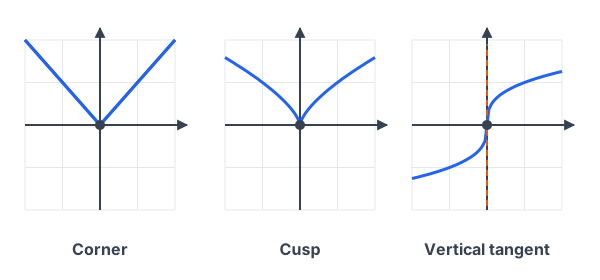
When a derivative does not exist
| Situation at x = a | Why f'(a) fails | Example |
|---|---|---|
| Corner | The left and right slopes are different numbers | |x| at 0 |
| Cusp | The slopes go to -\infty on one side and \infty on the other | x^{2/3} at 0 |
| Vertical tangent | The slope goes to \infty (or -\infty) on both sides | x^{1/3} at 0 |
| Discontinuity | A hole, jump or asymptote; f is not continuous | \frac{1}{x} at 0 |
Differentiability implies continuity: if f is differentiable at a, then f is continuous at a. The reverse is false; |x| is continuous at 0 but not differentiable.
Piecewise functions: f is differentiable at a boundary point a when (1) f is continuous at a, and (2) the slopes of the two pieces match at a.
Differentiability examples
Example 1: A corner
Show that f(x) = |x| is not differentiable at x = 0.
\frac{f(0 + h) - f(0)}{h} = \frac{|h|}{h}Write the difference quotient at 0.
\lim_{h \to 0^-} \frac{|h|}{h} = \lim_{h \to 0^-} \frac{-h}{h} = -1For h less than 0, |h| = −h. This is the slope from the left.
\lim_{h \to 0^+} \frac{|h|}{h} = \lim_{h \to 0^+} \frac{h}{h} = 1For h greater than 0, |h| = h. This is the slope from the right.
-1 \ne 1
The one-sided limits differ (see one-sided limits).
Answer: the limit does not exist, so f'(0) does not exist. The graph has a corner at the origin, even though |x| is continuous there.
Example 2: A vertical tangent
Is f(x) = x^{1/3} differentiable at x = 0?
\frac{f(h) - f(0)}{h} = \frac{h^{1/3}}{h}Write the difference quotient at 0.
\frac{h^{1/3}}{h} = \frac{1}{h^{2/3}}Subtract exponents: \frac{1}{3} - 1 = -\frac{2}{3} (see rational exponents).
h^{2/3} \gt 0h^{2/3} = (h^{1/3})^2 is a positive number near 0, on both sides.
\lim_{h \to 0} \frac{1}{h^{2/3}} = \inftyPositive over a tiny positive number.
Answer: no. The slope grows without bound, so the graph has a vertical tangent line at the origin and f'(0) does not exist.
Example 3: A cusp
Is f(x) = x^{2/3} differentiable at x = 0?
\frac{f(h) - f(0)}{h} = \frac{h^{2/3}}{h} = \frac{1}{h^{1/3}}Write the difference quotient and subtract exponents.
\lim_{h \to 0^-} \frac{1}{h^{1/3}} = -\inftyFor h less than 0, the cube root is negative.
\lim_{h \to 0^+} \frac{1}{h^{1/3}} = \inftyFor h greater than 0, it is positive.
Answer: no. The slopes blow up in opposite directions, which makes a sharp point called a cusp.
Example 4: A piecewise function that is smooth
Let f(x) = x^2 for x \le 1 and f(x) = 2x - 1 for x \gt 1. Is f differentiable at x = 1?
1^2 = 1
Continuity: the left piece gives f(1) = 1.
2(1) - 1 = 1
The right piece approaches 1, so f is continuous at 1.
2(1) = 2
Slope from the left: the derivative of x^2 is 2x (see definition of the derivative), which is 2 at x = 1.
2 = 2
Slope from the right: the line 2x − 1 has slope 2. The slopes match.
Answer: yes, f is differentiable at 1, with f'(1) = 2. The line is the tangent line to the parabola at (1, 1), so the pieces join smoothly.
Example 5: Word problem with a skateboard ramp
A skateboard ramp follows the curve y = 0.1x^2 for x from 0 to 5 meters, then continues as a straight line y = ax + b. Find a and b so the ramp has no bump or corner at x = 5.
0.1(5)^2 = 2.5
The curve’s height at x = 5.
0.2(5) = 1
The curve’s slope at x = 5: the derivative of 0.1x^2 is 0.2x.
a = 1
For no corner, the line’s slope must match.
5a + b = 2.5
For no gap, the line must have the same height at x = 5.
5 + b = 2.5
Substitute a = 1.
b = -2.5
Subtract 5 from both sides.
Answer: a = 1 and b = −2.5, so the straight part is y = x − 2.5. Matching height makes the ramp continuous, and matching slope makes it differentiable, so a skateboard rolls across the join smoothly.
Common mistakes
| Mistake | Example of the error | Fix |
|---|---|---|
| Thinking continuous means differentiable | “|x| is continuous at 0, so it has a derivative” | Continuity is needed but not enough. Check that the slopes agree. |
| Checking only the slopes of the pieces | Calling f differentiable because both pieces have slope 3 at the boundary, while there is a jump | Check continuity first. A jump means no derivative. |
| Calling a vertical tangent a zero slope | Saying x^{1/3} has f'(0) = 0 | The tangent is vertical, so the slope is undefined (infinite). |
| Using the wrong piece for a side | Using 2x − 1 for the left-hand slope in Example 4 | Left of 1 uses x^2; right of 1 uses 2x − 1. |
| Thinking a function can’t be differentiable at a piece boundary | Assuming every piecewise function has a corner | Pieces that match in height and slope join smoothly. |
| Mixing up cusp and corner | Calling |x| a cusp | Corner: finite slopes that differ. Cusp: slopes go to \pm\infty. |
Related methods
Why differentiable implies continuous
If f'(a) exists, then f(a + h) - f(a) = \frac{f(a + h) - f(a)}{h} \cdot h, which approaches f'(a) \cdot 0 = 0. So f(a + h) approaches f(a), which is continuity.
Derivatives on a graph
On the graph of f’, a corner of f becomes a jump, and a vertical tangent of f becomes a vertical asymptote. See sketching the graph of a derivative.
Practice problems
- Is f(x) = |x − 3| differentiable at x = 3? Explain.
- Is f(x) = x^2 + 1 differentiable everywhere? Explain.
- Is f(x) = (x - 2)^{1/3} differentiable at x = 2?
- Is f(x) = (x + 1)^{2/3} differentiable at x = −1?
- Is f(x) = \frac{1}{x} differentiable at x = 0?
- Let f(x) = 3x − 2 for x \lt 1 and f(x) = x^2 for x \ge 1. Is f differentiable at x = 1?
- Let f(x) = x^2 for x \lt 2 and f(x) = 4x − 4 for x \ge 2. Is f differentiable at x = 2?
- Find a and b so that f(x) = x^2 + 1 for x \le 2 and f(x) = ax + b for x \gt 2 is differentiable at x = 2.
- True or false: if f is continuous at a, then f is differentiable at a.
- Shipping costs C(w) = 5 + 2w dollars for w ≤ 10 pounds and C(w) = 25 + 1.5(w − 10) for w > 10. Is C differentiable at w = 10? What does that mean?
Show answers
1.
\lim_{h \to 0^-} \frac{|h|}{h} = -1The difference quotient at 3 is \frac{|h|}{h}; from the left it is −1.
\lim_{h \to 0^+} \frac{|h|}{h} = 1From the right it is 1.
Answer: no. The slopes −1 and 1 differ, so the graph has a corner at x = 3.
2.
f'(x) = 2x
The derivative exists for every x.
Answer: yes. Polynomials are smooth everywhere, with no corners, cusps, vertical tangents or breaks.
3.
\frac{h^{1/3}}{h} = \frac{1}{h^{2/3}} \to \inftyThe difference quotient at 2 grows without bound on both sides.
Answer: no; there is a vertical tangent at x = 2.
4.
\frac{h^{2/3}}{h} = \frac{1}{h^{1/3}}The difference quotient at −1.
Answer: no. It goes to -\infty from the left and \infty from the right: a cusp.
5.
f(0) \text{ is undefined}f is not continuous at 0.
Answer: no. A function must be continuous to be differentiable.
6.
3(1) - 2 = 1 = 1^2
Continuity: both pieces give 1 at x = 1.
3 \ne 2(1)
Slopes: the line has slope 3, and x^2 has slope 2x = 2 at x = 1.
Answer: no. f is continuous at 1, but the slopes differ, so there is a corner.
7.
2^2 = 4 = 4(2) - 4
Continuity: both pieces give 4.
2(2) = 4
Slopes: x^2 has slope 2x = 4 at x = 2, and the line has slope 4.
Answer: yes, and f'(2) = 4.
8.
a = 2(2) = 4
Match the slopes: x^2 + 1 has slope 2x, which is 4 at x = 2.
2a + b = 5
Match the heights: 2^2 + 1 = 5.
8 + b = 5
Substitute a = 4.
b = -3
Subtract 8 from both sides.
Answer: a = 4 and b = −3
9.
f(x) = |x|
A counterexample: |x| is continuous at 0 but not differentiable there.
Answer: false.
10.
5 + 2(10) = 25
Continuity: the first rule gives C(10) = 25, and the second rule also approaches 25.
2 \ne 1.5
Slopes: $2 per pound on the left, $1.50 per pound on the right.
Answer: no. C is continuous at 10 pounds but has a corner there: the cost per extra pound drops from $2 to $1.50.
Differentiability FAQ
What does it mean for a function to be differentiable?
It means the derivative exists: the limit of the difference quotient is a finite number. On a graph, the curve is smooth and has a single, non-vertical tangent line.
Where is a function not differentiable?
At corners, cusps, vertical tangent lines and discontinuities (holes, jumps and asymptotes).
Does differentiability imply continuity?
Yes. If f'(a) exists, f is continuous at a. The reverse is not true: |x| is continuous at 0 but not differentiable there.
How do you check if a piecewise function is differentiable?
At the boundary, check that the pieces meet (continuity) and that their slopes are equal. If both hold, the function is differentiable there.
Summary
- f is differentiable at a when f'(a) exists as a finite number.
- Derivatives fail at corners, cusps, vertical tangents and discontinuities.
- Differentiable implies continuous, but continuous does not imply differentiable.
- For piecewise functions, match both the heights and the slopes at the boundary.
- On a graph, differentiable means smooth: no sharp points, no vertical tangents and no breaks.
Previous lesson: Sketching the Graph of a Derivative
Next lesson: Power Rule
Back to the Calculus 1 Index