
Definition of the Derivative
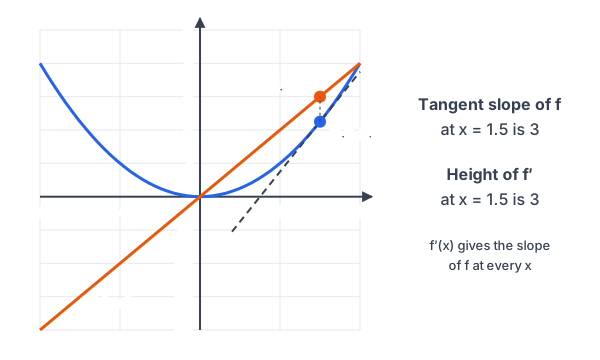
The definition of the derivative is f'(x) = \lim_{h \to 0} \frac{f(x + h) - f(x)}{h}, when this limit exists. The derivative f'(x) is a new function that gives the slope of the tangent line, or the instantaneous rate of change, of f at every x. Finding a derivative this way is called using the limit definition, or first principles.
Before this lesson: Instantaneous Rate of Change, Difference Quotient and Evaluating Limits Algebraically
What the derivative is
In the last lesson you found the instantaneous rate of change at one point, such as x = 1. Doing that over and over for every point is slow. Instead, keep x as a letter and do the algebra once. The result is a formula that works at every x.
That formula is the derivative. For f(x) = x^2, the derivative is f'(x) = 2x, so the slope at x = 3 is 6, at x = −1 it is −2, and so on. The process of finding a derivative is called differentiation.
The derivative has several common notations. They all mean the same thing:
| Notation | Read as |
|---|---|
| f'(x) | “f prime of x” |
| \frac{dy}{dx} | “dy dx,” the derivative of y with respect to x |
| \frac{d}{dx}[f(x)] | “the derivative of f(x)” |
| y' | “y prime” |
The limit definition of the derivative
f'(x) = \lim_{h \to 0} \frac{f(x + h) - f(x)}{h}- Write f(x + h) by replacing every x in the formula with (x + h).
- Subtract f(x). Every term without h should cancel.
- Factor h out of the numerator and cancel it with the denominator.
- Let h go to 0 by substituting h = 0. The result is f'(x).
To find the derivative at one number, such as f'(3), find f'(x) first and then substitute.
Definition of the derivative examples
Example 1: The derivative of x squared
Use the definition to find f'(x) for f(x) = x^2, then find f'(3).
f(x + h) = (x + h)^2 = x^2 + 2xh + h^2
Replace x with x + h and square the binomial (see special products of binomials).
f(x + h) - f(x) = x^2 + 2xh + h^2 - x^2 = 2xh + h^2
Subtract f(x). The x^2 terms cancel.
\frac{f(x + h) - f(x)}{h} = \frac{h(2x + h)}{h} = 2x + hFactor out h and cancel.
f'(x) = \lim_{h \to 0} (2x + h) = 2xSubstitute h = 0.
f'(3) = 2(3) = 6
Substitute x = 3.
Answer: f'(x) = 2x and f'(3) = 6.
Example 2: A quadratic with three terms
Find the derivative of f(x) = 4x^2 - 3x + 1.
f(x + h) = 4(x + h)^2 - 3(x + h) + 1
Replace each x with x + h.
f(x + h) = 4x^2 + 8xh + 4h^2 - 3x - 3h + 1
Expand and distribute.
f(x + h) - f(x) = 8xh + 4h^2 - 3h
Subtract 4x^2 - 3x + 1.
\frac{f(x + h) - f(x)}{h} = 8x + 4h - 3Divide each term by h.
f'(x) = \lim_{h \to 0} (8x + 4h - 3) = 8x - 3Substitute h = 0.
Answer: f'(x) = 8x − 3. Notice the constant 1 disappeared; constants do not change, so they add nothing to the slope.
Example 3: The derivative of x cubed
Find the derivative of f(x) = x^3.
(x + h)^3 = x^3 + 3x^2h + 3xh^2 + h^3
Expand the cube (see binomial theorem).
f(x + h) - f(x) = 3x^2h + 3xh^2 + h^3
Subtract x^3.
\frac{f(x + h) - f(x)}{h} = 3x^2 + 3xh + h^2Divide each term by h.
f'(x) = \lim_{h \to 0} (3x^2 + 3xh + h^2) = 3x^2Substitute h = 0.
Answer: f'(x) = 3x^2. Comparing with Example 1 hints at a pattern, the power rule, covered later in this unit.
Example 4: The derivative of a square root
Find the derivative of f(x) = \sqrt{x}.
\frac{f(x + h) - f(x)}{h} = \frac{\sqrt{x + h} - \sqrt{x}}{h}Write the difference quotient.
\frac{\sqrt{x + h} - \sqrt{x}}{h} = \frac{(x + h) - x}{h(\sqrt{x + h} + \sqrt{x})}Multiply the top and bottom by the conjugate \sqrt{x + h} + \sqrt{x}.
\frac{\sqrt{x + h} - \sqrt{x}}{h} = \frac{1}{\sqrt{x + h} + \sqrt{x}}Simplify the top to h and cancel.
f'(x) = \lim_{h \to 0} \frac{1}{\sqrt{x + h} + \sqrt{x}} = \frac{1}{2\sqrt{x}}Substitute h = 0.
Answer: f'(x) = \frac{1}{2\sqrt{x}}, for x > 0. At x = 0 the denominator is 0, so f has no derivative there; the graph of \sqrt{x} has a vertical tangent at the origin.
Example 5: Word problem with a growing circle
A stone dropped in a pond makes a circular ripple. Its area is A(r) = \pi r^2. Find A'(r) and evaluate it at r = 5 cm. What does it mean?
A(r + h) - A(r) = \pi(r^2 + 2rh + h^2) - \pi r^2 = \pi(2rh + h^2)
Expand and subtract.
\frac{A(r + h) - A(r)}{h} = \pi(2r + h)Divide by h.
A'(r) = \lim_{h \to 0} \pi(2r + h) = 2\pi rSubstitute h = 0.
A'(5) = 2\pi(5) = 10\pi \approx 31.4
Substitute r = 5.
Answer: A'(r) = 2\pi r, and A'(5) ≈ 31.4 cm² per cm. When the radius is 5 cm, the area grows by about 31.4 cm² for each extra centimeter of radius. The derivative of the area is the circumference.
Common mistakes
| Mistake | Example of the error | Fix |
|---|---|---|
| Replacing only some x’s with x + h | f(x + h) = 4(x + h)^2 - 3x + 1 | Every x becomes (x + h): -3(x + h). |
| Writing f(x) + h instead of f(x + h) | f(x + h) = x^2 + h for f(x) = x^2 | Substitute into the function: (x + h)^2. |
| Canceling before subtracting f(x) | Dividing x^2 + 2xh + h^2 by h | Subtract f(x) first so every term has a factor of h. |
| Substituting h = 0 before canceling | Getting \frac{0}{0} | Cancel the h first, then substitute. |
| Dropping the limit notation too early | Writing f'(x) = 2x + h | f'(x) is the limit: 2x. |
| Forgetting that some points have no derivative | Saying \sqrt{x} has derivative \frac{1}{0} at 0 | The limit does not exist there; the next lessons explain where derivatives fail. |
Related methods
The derivative at a point
The alternate form f'(a) = \lim_{x \to a} \frac{f(x) - f(a)}{x - a} finds the derivative at one number directly. AP Calculus problems often ask you to recognize a limit like \lim_{h \to 0} \frac{(3 + h)^2 - 9}{h} as f'(3) for f(x) = x^2, which is 6.
Shortcut rules
The limit definition always works, but it is slow. Starting with the power rule, the rest of this course builds rules that give derivatives in one step. Every one of those rules is proved from this definition.
Practice problems
- Use the definition to find f'(x) for f(x) = 7x + 2.
- Find f'(x) for f(x) = -3x^2.
- Find f'(x) for f(x) = x^2 + 5x.
- Find f'(x) for f(x) = 2x^2 - x + 4, then find f'(−1).
- Find f'(x) for f(x) = \frac{1}{x}.
- Find f'(x) for f(x) = \frac{1}{x - 2}.
- Find f'(x) for f(x) = \sqrt{x + 3}.
- Find f'(x) for f(x) = x^3 - 2x.
- Use your answer to problem 4 to find the slope of the tangent line to y = 2x^2 - x + 4 at x = 2.
- The volume of a cube with side s is V(s) = s^3. Find V'(s) and V'(4), and explain V'(4).
Show answers
1.
f(x + h) - f(x) = 7(x + h) + 2 - (7x + 2) = 7h
Expand and subtract.
f'(x) = \lim_{h \to 0} \frac{7h}{h} = 7Cancel h.
Answer: f'(x) = 7
2.
f(x + h) - f(x) = -3(x^2 + 2xh + h^2) + 3x^2 = -6xh - 3h^2
Expand and subtract.
f'(x) = \lim_{h \to 0} (-6x - 3h) = -6xDivide by h and substitute h = 0.
Answer: f'(x) = −6x
3.
f(x + h) - f(x) = 2xh + h^2 + 5h
Expand (x + h)^2 + 5(x + h) and subtract x^2 + 5x.
f'(x) = \lim_{h \to 0} (2x + h + 5) = 2x + 5Divide by h and substitute h = 0.
Answer: f'(x) = 2x + 5
4.
f(x + h) - f(x) = 4xh + 2h^2 - h
Expand 2(x + h)^2 - (x + h) + 4 and subtract.
f'(x) = \lim_{h \to 0} (4x + 2h - 1) = 4x - 1Divide by h and substitute h = 0.
f'(-1) = 4(-1) - 1 = -5
Substitute x = −1.
Answer: f'(x) = 4x − 1 and f'(−1) = −5
5.
\frac{1}{x + h} - \frac{1}{x} = \frac{x - (x + h)}{x(x + h)} = \frac{-h}{x(x + h)}Combine over a common denominator (see adding and subtracting rational expressions).
f'(x) = \lim_{h \to 0} \frac{-1}{x(x + h)} = -\frac{1}{x^2}Divide by h, cancel and substitute h = 0.
Answer: f'(x) = -\frac{1}{x^2}
6.
\frac{1}{x + h - 2} - \frac{1}{x - 2} = \frac{-h}{(x + h - 2)(x - 2)}Combine over a common denominator.
f'(x) = \lim_{h \to 0} \frac{-1}{(x + h - 2)(x - 2)} = -\frac{1}{(x - 2)^2}Divide by h, cancel and substitute h = 0.
Answer: f'(x) = -\frac{1}{(x - 2)^2}
7.
\frac{\sqrt{x + h + 3} - \sqrt{x + 3}}{h} = \frac{1}{\sqrt{x + h + 3} + \sqrt{x + 3}}Multiply by the conjugate, simplify the top to h and cancel.
f'(x) = \frac{1}{2\sqrt{x + 3}}Substitute h = 0.
Answer: f'(x) = \frac{1}{2\sqrt{x + 3}}
8.
f(x + h) - f(x) = 3x^2h + 3xh^2 + h^3 - 2h
Expand (x + h)^3 - 2(x + h) and subtract x^3 - 2x.
f'(x) = \lim_{h \to 0} (3x^2 + 3xh + h^2 - 2) = 3x^2 - 2Divide by h and substitute h = 0.
Answer: f'(x) = 3x^2 - 2
9.
f'(2) = 4(2) - 1 = 7
Substitute x = 2 into f'(x) = 4x − 1.
Answer: the slope is 7.
10.
V(s + h) - V(s) = 3s^2h + 3sh^2 + h^3
Expand (s + h)^3 and subtract s^3.
V'(s) = \lim_{h \to 0} (3s^2 + 3sh + h^2) = 3s^2Divide by h and substitute h = 0.
V'(4) = 3(16) = 48
Substitute s = 4.
Answer: V'(s) = 3s^2 and V'(4) = 48 cm³ per cm: when the side is 4 cm, the volume grows about 48 cm³ for each extra centimeter of side.
Definition of the derivative FAQ
What is the limit definition of the derivative?
f'(x) = \lim_{h \to 0} \frac{f(x + h) - f(x)}{h}. It is the limit of the difference quotient as h approaches 0.
What does the derivative tell you?
It gives the slope of the tangent line to the graph at each x, which is the instantaneous rate of change of the function there.
What is the difference between f'(x) and f'(a)?
f'(x) is a function that works for every x. f'(a) is one number: the slope at x = a.
Why do we need the limit definition if there are shortcut rules?
The shortcut rules are proved from the definition, and the definition is what you use for a new kind of function or to explain what a derivative means. Many tests also ask for it directly.
Summary
- f'(x) = \lim_{h \to 0} \frac{f(x + h) - f(x)}{h}, when the limit exists.
- f'(x) gives the tangent slope and the instantaneous rate of change at every x.
- Steps: find f(x + h), subtract f(x), cancel h, then let h → 0.
- Notations: f'(x), \frac{dy}{dx}, \frac{d}{dx}[f(x)] and y'.
- Results so far: (x^2)' = 2x, (x^3)' = 3x^2 and (\sqrt{x})' = \frac{1}{2\sqrt{x}}.
Previous lesson: Instantaneous Rate of Change
Next lesson: Sketching the Graph of a Derivative
Back to the Calculus 1 Index