
Instantaneous Rate of Change
The instantaneous rate of change of f at x = a is how fast f is changing at that exact moment. It is the limit of average rates of change over shorter and shorter intervals: \lim_{h \to 0} \frac{f(a + h) - f(a)}{h}. On a graph, secant line slopes approach the slope of the tangent line at (a, f(a)).
Before this lesson: Average Rate of Change, Difference Quotient and Evaluating Limits Algebraically
From average to instantaneous
A car’s speedometer shows how fast you are going right now, not your average for the whole trip. Average speed is easy: distance divided by time. Speed at one instant is harder, because over a single instant no distance and no time pass, which gives \frac{0}{0}.
Calculus solves this with a limit. Find the average rate of change over a short interval from a to a + h, then let h shrink to 0. If the averages settle on one number, that number is the instantaneous rate of change.
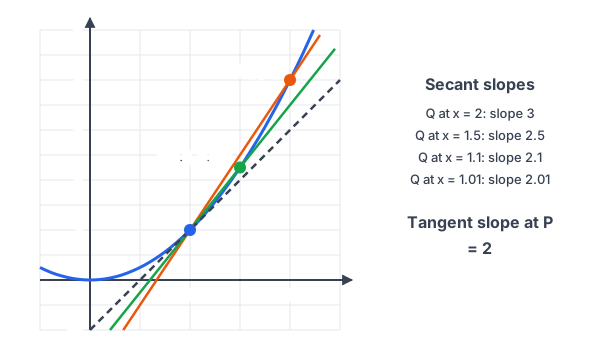
On a graph, an average rate of change is the slope of a secant line, a line through two points of the curve. As the second point slides toward the first, the secant lines turn into the tangent line, the line that just touches the curve at that point. Its slope is the instantaneous rate of change.
Instantaneous rate of change formula
The average rate of change of f from a to a + h is the slope of the secant line:
\frac{f(a + h) - f(a)}{h}The instantaneous rate of change at x = a is its limit as h approaches 0:
\lim_{h \to 0} \frac{f(a + h) - f(a)}{h}- Find f(a).
- Find and simplify f(a + h).
- Subtract f(a) and simplify the numerator. Every term should now have a factor of h.
- Divide by h (cancel the factor of h).
- Substitute h = 0.
This limit is so important that it gets its own name, the derivative, in the next lesson.
Instantaneous rate of change examples
Example 1: Estimate with secant slopes
Estimate the instantaneous rate of change of f(x) = x^2 at x = 1 using secant slopes.
| h | Second point | Secant slope \frac{f(1 + h) - f(1)}{h} |
|---|---|---|
| 1 | (2, 4) | 3 |
| 0.5 | (1.5, 2.25) | 2.5 |
| 0.1 | (1.1, 1.21) | 2.1 |
| 0.01 | (1.01, 1.0201) | 2.01 |
\frac{f(1.1) - f(1)}{0.1} = \frac{1.21 - 1}{0.1}Find one table value, with h = 0.1.
\frac{f(1.1) - f(1)}{0.1} = \frac{0.21}{0.1} = 2.1Subtract, then divide.
Answer: the secant slopes approach 2, so the instantaneous rate of change is about 2. The next example confirms it is exactly 2.
Example 2: Find it exactly
Find the instantaneous rate of change of f(x) = x^2 at x = 1.
f(1 + h) = (1 + h)^2 = 1 + 2h + h^2
Square the binomial (see special products of binomials).
f(1 + h) - f(1) = 1 + 2h + h^2 - 1 = 2h + h^2
Subtract f(1) = 1.
\frac{f(1 + h) - f(1)}{h} = \frac{h(2 + h)}{h} = 2 + hFactor out h and cancel.
\lim_{h \to 0} (2 + h) = 2Substitute h = 0.
Answer: exactly 2. The tangent line to y = x^2 at (1, 1) has slope 2.
Example 3: A quadratic with two terms
Find the instantaneous rate of change of f(x) = 3x^2 - 4x at x = 2.
f(2) = 3(4) - 8 = 4
Find f(2).
f(2 + h) = 3(2 + h)^2 - 4(2 + h)
Substitute 2 + h for x.
f(2 + h) = 12 + 12h + 3h^2 - 8 - 4h
Expand and distribute.
f(2 + h) - f(2) = 8h + 3h^2
Combine like terms and subtract f(2) = 4.
\frac{f(2 + h) - f(2)}{h} = 8 + 3hDivide each term by h.
\lim_{h \to 0} (8 + 3h) = 8Substitute h = 0.
Answer: 8. At x = 2, f is increasing 8 units for each unit of x.
Example 4: A rational function
Find the instantaneous rate of change of f(x) = \frac{1}{x} at x = 2.
f(2 + h) - f(2) = \frac{1}{2 + h} - \frac{1}{2}Write the numerator of the difference quotient.
\frac{1}{2 + h} - \frac{1}{2} = \frac{2 - (2 + h)}{2(2 + h)} = \frac{-h}{2(2 + h)}Use the common denominator 2(2 + h) and simplify.
\frac{f(2 + h) - f(2)}{h} = \frac{-1}{2(2 + h)}Divide by h: the h cancels.
\lim_{h \to 0} \frac{-1}{2(2 + h)} = -\frac{1}{4}Substitute h = 0.
Answer: -\frac{1}{4}. The negative sign means f is decreasing at x = 2.
Example 5: Word problem with a thrown ball
A ball is thrown upward, and its height after t seconds is s(t) = 80t - 16t^2 feet. Find its velocity at t = 2 seconds, and compare it with its average velocity from t = 2 to t = 3.
s(2) = 160 - 64 = 96
Height at t = 2.
s(2 + h) = 80(2 + h) - 16(2 + h)^2 = 96 + 16h - 16h^2
Expand: 160 + 80h − 64 − 64h − 16h².
\frac{s(2 + h) - s(2)}{h} = \frac{16h - 16h^2}{h} = 16 - 16hSubtract s(2) and divide by h.
\lim_{h \to 0} (16 - 16h) = 16Substitute h = 0. This is the velocity at t = 2.
\frac{s(3) - s(2)}{3 - 2} = \frac{96 - 96}{1} = 0For comparison: s(3) = 240 − 144 = 96, so the average velocity over [2, 3] is 0.
Answer: at t = 2 the ball is rising at 16 ft/s, even though its average velocity over the next second is 0 (it goes up and comes back to the same height). An average can hide what happens at an instant.
Common mistakes
| Mistake | Example of the error | Fix |
|---|---|---|
| Substituting h = 0 too early | \frac{f(1 + 0) - f(1)}{0} = \frac{0}{0} | Simplify and cancel h first, then substitute. |
| Forgetting to subtract f(a) | Using \frac{(1 + h)^2}{h} | The numerator is f(a + h) − f(a). |
| Expanding f(a + h) incorrectly | (2 + h)^2 = 4 + h^2 | (2 + h)^2 = 4 + 4h + h^2. |
| Distributing only part of a coefficient | 3(2 + h)^2 = 12 + 4h + h^2 | Multiply every term by 3: 12 + 12h + 3h^2. |
| Confusing average and instantaneous rates | Reporting the average velocity 0 as the velocity at t = 2 | The instantaneous rate needs the limit as h → 0. |
| Dropping the sign | Reporting \frac{1}{4} for \frac{1}{x} at 2 | Keep the negative: f is decreasing there. |
Related methods
Another form of the limit
Writing x for a + h gives an equivalent form: \lim_{x \to a} \frac{f(x) - f(a)}{x - a}. For x^2 at 1, it is \lim_{x \to 1} \frac{x^2 - 1}{x - 1} = \lim_{x \to 1} (x + 1) = 2.
Units
The units of an instantaneous rate are output units per input unit: feet per second for height and time, or dollars per item for cost and quantity. The rate tells you how much the output changes for a one-unit change in the input, near that point.
Practice problems
- Find the average rate of change of f(x) = x^3 on [1, 3].
- Estimate the instantaneous rate of change of g(x) = x^2 + 1 at x = 3 using h = 0.1 and h = 0.01.
- Find the instantaneous rate of change of f(x) = x^2 at x = −1.
- Find the instantaneous rate of change of f(x) = 5x − 2 at any x = a.
- Find the instantaneous rate of change of f(x) = 2x^2 + x at x = 1.
- Find the instantaneous rate of change of f(x) = \sqrt{x} at x = 4.
- Find the instantaneous rate of change of f(x) = \frac{1}{x + 1} at x = 1.
- Find the slope of the tangent line to y = x^2 - 4x at the point (3, −3).
- A town’s population, in hundreds, is P(t) = 200 + 30t + t^2 after t years. Find the rate of growth at t = 5.
- The cost to make x items is C(x) = 500 + 4x + 0.01x^2 dollars. Find the instantaneous rate of change of cost at x = 100.
Show answers
1.
\frac{f(3) - f(1)}{3 - 1} = \frac{27 - 1}{2}Use the average rate of change formula.
\frac{f(3) - f(1)}{3 - 1} = 13Simplify.
Answer: 13
2.
\frac{g(3.1) - g(3)}{0.1} = \frac{10.61 - 10}{0.1} = 6.1With h = 0.1: g(3.1) = 9.61 + 1 and g(3) = 10.
\frac{g(3.01) - g(3)}{0.01} = \frac{10.0601 - 10}{0.01} = 6.01With h = 0.01.
Answer: about 6
3.
f(-1 + h) - f(-1) = 1 - 2h + h^2 - 1 = -2h + h^2
Expand (-1 + h)^2 and subtract f(−1) = 1.
\lim_{h \to 0} \frac{-2h + h^2}{h} = \lim_{h \to 0} (-2 + h) = -2Cancel h and substitute.
Answer: −2
4.
f(a + h) - f(a) = 5(a + h) - 2 - (5a - 2) = 5h
Expand and subtract.
\lim_{h \to 0} \frac{5h}{h} = 5Cancel h.
Answer: 5 at every x, the slope of the line.
5.
f(1 + h) - f(1) = 2(1 + h)^2 + (1 + h) - 3 = 5h + 2h^2
f(1) = 3. Expand: 2 + 4h + 2h² + 1 + h − 3.
\lim_{h \to 0} \frac{5h + 2h^2}{h} = \lim_{h \to 0} (5 + 2h) = 5Cancel h and substitute.
Answer: 5
6.
\frac{\sqrt{4 + h} - 2}{h} = \frac{(4 + h) - 4}{h(\sqrt{4 + h} + 2)}Multiply the top and bottom by the conjugate \sqrt{4 + h} + 2.
\frac{\sqrt{4 + h} - 2}{h} = \frac{1}{\sqrt{4 + h} + 2}Simplify and cancel h.
\lim_{h \to 0} \frac{1}{\sqrt{4 + h} + 2} = \frac{1}{4}Substitute h = 0.
Answer: \frac{1}{4}
7.
\frac{1}{2 + h} - \frac{1}{2} = \frac{-h}{2(2 + h)}f(1 + h) = \frac{1}{2 + h} and f(1) = \frac{1}{2}. Combine.
\lim_{h \to 0} \frac{-1}{2(2 + h)} = -\frac{1}{4}Divide by h, cancel and substitute.
Answer: -\frac{1}{4}
8.
f(3 + h) = (3 + h)^2 - 4(3 + h) = -3 + 2h + h^2
Expand: 9 + 6h + h² − 12 − 4h.
\lim_{h \to 0} \frac{2h + h^2}{h} = \lim_{h \to 0} (2 + h) = 2Subtract f(3) = −3, cancel h and substitute.
Answer: 2
9.
P(5 + h) - P(5) = 30h + 10h + h^2 = 40h + h^2
P(5) = 375; expand 200 + 30(5 + h) + (5 + h)^2 and subtract.
\lim_{h \to 0} (40 + h) = 40Divide by h and substitute.
Answer: 40 hundred people per year, which is 4,000 people per year.
10.
C(100 + h) - C(100) = 4h + 2h + 0.01h^2 = 6h + 0.01h^2
C(100) = 1000. Expand: 4(100 + h) + 0.01(10000 + 200h + h^2) minus the matching terms.
\lim_{h \to 0} (6 + 0.01h) = 6Divide by h and substitute.
Answer: $6 per item. Economists call this the marginal cost: the 101st item costs about $6 to make.
Instantaneous rate of change FAQ
What is the instantaneous rate of change?
It is the rate at which a function is changing at one exact input value. It equals the slope of the tangent line there.
How is instantaneous rate of change different from average rate of change?
Average rate of change uses two points and is a secant slope. Instantaneous rate of change is the limit of those averages as the two points come together, which is a tangent slope.
How do you find the instantaneous rate of change?
Find \lim_{h \to 0} \frac{f(a + h) - f(a)}{h}: expand, subtract, cancel h, then substitute h = 0.
Is instantaneous rate of change the same as the derivative?
Yes. The derivative of f at a, written f'(a), is this limit. The next lesson defines it formally and finds it as a function.
Summary
- Average rate of change on [a, a + h]: \frac{f(a + h) - f(a)}{h}, the slope of a secant line.
- Instantaneous rate of change: the limit of that quotient as h → 0, the slope of the tangent line.
- Estimate it with shrinking h in a table, or find it exactly with algebra.
- Expand, subtract f(a), cancel h, and only then substitute h = 0.
- Its units are output units per input unit, such as feet per second.
Previous lesson: Epsilon-Delta Definition of a Limit
Next lesson: Definition of the Derivative
Back to the Calculus 1 Index