
Epsilon-Delta Definition of a Limit
The epsilon-delta definition of a limit makes “f(x) gets close to L” precise. \lim_{x \to a} f(x) = L means: for every \varepsilon \gt 0 there is a \delta \gt 0 such that if 0 \lt |x - a| \lt \delta, then |f(x) - L| \lt \varepsilon. In words, any tolerance on the output can be met by keeping x close enough to a.
Before this lesson: Introduction to Limits, Absolute Value Inequalities and Limit Laws
What epsilon and delta mean
Phrases like “gets close to” are fine for intuition, but they are too vague to prove anything. The epsilon-delta definition replaces them with a challenge and a response.
The challenger picks a tolerance \varepsilon (epsilon), a small positive number, and demands that f(x) be within \varepsilon of L. You must answer with a distance \delta (delta) so that every x within \delta of a (other than a itself) keeps f(x) inside that tolerance. If you can answer every possible \varepsilon, no matter how small, the limit is L.
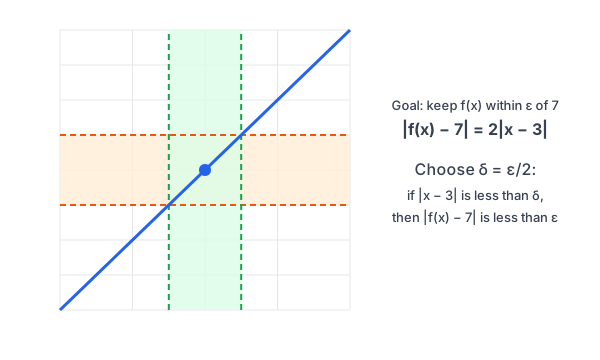
On a graph, \varepsilon sets a horizontal band around y = L, and \delta sets a vertical band around x = a. The limit is L when every horizontal band has a vertical band whose part of the graph stays inside it.
The epsilon-delta definition
\lim_{x \to a} f(x) = L \iff \text{for every } \varepsilon \gt 0 \text{ there is a } \delta \gt 0 \text{ with } 0 \lt |x - a| \lt \delta \Rightarrow |f(x) - L| \lt \varepsilonThe condition 0 \lt |x - a| means x ≠ a: the value f(a) never matters, just as in the informal idea of a limit.
| Step | What to do |
|---|---|
| 1. Scratch work | Simplify |f(x) - L| and write it in terms of |x - a|. |
| 2. Choose δ | Pick δ in terms of ε so that |x - a| \lt \delta forces |f(x) - L| \lt \varepsilon. |
| 3. Proof | Write it forward: let ε > 0, set δ, assume 0 \lt |x - a| \lt \delta, and show |f(x) - L| \lt \varepsilon. |
For a line f(x) = mx + b (m ≠ 0), the scratch work always gives |f(x) - L| = |m|\,|x - a|, so \delta = \frac{\varepsilon}{|m|} works.
Epsilon-delta examples
Example 1: Find delta for a given epsilon
For \lim_{x \to 3} (2x + 1) = 7, find a δ that works for ε = 0.1.
|(2x + 1) - 7| \lt 0.1
Write what we need: f(x) within 0.1 of 7.
|2x - 6| \lt 0.1
Simplify inside the absolute value.
2|x - 3| \lt 0.1
Factor out 2: |2x - 6| = 2|x - 3|.
|x - 3| \lt 0.05
Divide both sides by 2 (see absolute value inequalities).
\delta = 0.05
Any x within 0.05 of 3 works.
Answer: δ = 0.05 (any smaller positive δ also works). Check: x = 3.04 gives 2(3.04) + 1 = 7.08, which is within 0.1 of 7.
Example 2: Prove a linear limit
Prove that \lim_{x \to 3} (2x + 1) = 7.
|(2x + 1) - 7| = 2|x - 3|
Scratch work: simplify |f(x) - L| as in Example 1.
\delta = \frac{\varepsilon}{2}Choose δ. Let ε > 0 be given and set δ = ε/2.
0 \lt |x - 3| \lt \frac{\varepsilon}{2}Proof: assume x is within δ of 3.
|(2x + 1) - 7| = 2|x - 3|
Rewrite the distance from L.
2|x - 3| \lt 2 \cdot \frac{\varepsilon}{2} = \varepsilonUse the assumption on |x − 3|.
Conclusion: for every ε > 0, δ = ε/2 makes |f(x) - 7| \lt \varepsilon, so \lim_{x \to 3} (2x + 1) = 7.
Example 3: A line with a negative slope
Prove that \lim_{x \to -1} (5 - 4x) = 9.
|(5 - 4x) - 9| = |-4x - 4|
Scratch work: subtract L = 9.
|-4x - 4| = 4|x + 1|
Factor out −4; its absolute value is 4. Note |x + 1| = |x - (-1)|.
\delta = \frac{\varepsilon}{4}Choose δ = ε/4.
|(5 - 4x) - 9| = 4|x + 1| \lt 4 \cdot \frac{\varepsilon}{4} = \varepsilonProof: if 0 \lt |x + 1| \lt \frac{\varepsilon}{4}, the distance from 9 is less than ε.
Conclusion: δ = ε/4 works for every ε > 0, so the limit is 9.
Example 4: A quadratic limit
Prove that \lim_{x \to 2} x^2 = 4.
|x^2 - 4| = |x - 2|\,|x + 2|
Scratch work: factor the difference of squares.
|x - 2| \lt 1 \Rightarrow 1 \lt x \lt 3
Agree to take δ ≤ 1, so x stays between 1 and 3.
|x + 2| \lt 5
For x between 1 and 3, x + 2 is between 3 and 5.
|x^2 - 4| \lt 5|x - 2|
Combine the last two lines.
\delta = \min\left(1, \frac{\varepsilon}{5}\right)Choose δ as the smaller of 1 and ε/5, so both conditions hold.
|x^2 - 4| \lt 5 \cdot \frac{\varepsilon}{5} = \varepsilonProof: if 0 \lt |x - 2| \lt \delta, then |x + 2| \lt 5 and |x - 2| \lt \frac{\varepsilon}{5}.
Conclusion: \lim_{x \to 2} x^2 = 4. The trick of first limiting δ to 1 keeps the extra factor |x + 2| from growing.
Example 5: Word problem with a machined plate
A square metal plate must have an area within 0.5 cm² of 100 cm². How close to 10 cm must the side length x be?
|x^2 - 100| \lt 0.5
The area is x^2, and it must be within ε = 0.5 of 100.
|x^2 - 100| = |x - 10|\,|x + 10|
Factor the difference of squares.
|x + 10| \lt 21
If |x − 10| is less than 1, then x is between 9 and 11, so x + 10 is less than 21.
21|x - 10| \lt 0.5
It is enough to make this true.
|x - 10| \lt \frac{0.5}{21} \approx 0.0238Divide both sides by 21.
Answer: keeping the side within about 0.0238 cm of 10 cm guarantees an area within 0.5 cm² of 100 cm². This δ is safe, not the largest possible: the exact limits are \sqrt{99.5} \approx 9.97497 and \sqrt{100.5} \approx 10.02497.
Common mistakes
| Mistake | Example of the error | Fix |
|---|---|---|
| Making δ depend on x | “δ = ε/|x + 2|” | δ may depend on ε and a, but not on x. Bound |x + 2| first. |
| Writing the proof backward | Starting from |f(x) - L| \lt \varepsilon and ending with δ | That is scratch work. The proof starts with δ and ends with \lt \varepsilon. |
| Forgetting the absolute value of the slope | δ = ε/(−4) in Example 3 | δ must be positive: use ε/4. |
| Using δ = ε/5 alone for x² | Skipping the bound on |x + 2| | Use δ = min(1, ε/5) so that |x + 2| stays less than 5. |
| Checking only one ε | Showing δ = 0.05 works for ε = 0.1 and calling it a proof | A proof must work for every ε > 0. |
| Including x = a | Worrying about f(a) | The definition requires |x − a| to be greater than 0, so x = a is excluded. |
Related methods
Why this matters
Every limit law and theorem about limits, including the squeeze theorem, is proved from this definition. Later courses use the same pattern for continuity, sequences and series.
Limits at infinity
A similar definition handles x \to \infty: for every ε > 0 there is an M such that x > M implies |f(x) - L| \lt \varepsilon. For \frac{1}{x} \to 0, choose M = \frac{1}{\varepsilon}.
Practice problems
- For \lim_{x \to 4} (3x - 2) = 10, find δ for ε = 0.03.
- Prove that \lim_{x \to 1} (6x + 5) = 11.
- Prove that \lim_{x \to 2} (7 - 3x) = 1.
- Prove that \lim_{x \to 5} 8 = 8.
- Prove that \lim_{x \to a} x = a.
- Prove that \lim_{x \to -2} \left(\frac{x}{2} + 4\right) = 3.
- For \lim_{x \to 3} x^2 = 9, use \delta = \min\left(1, \frac{\varepsilon}{7}\right) to find δ when ε = 0.7.
- Prove that \lim_{x \to 1} x^2 = 1.
- For f(x) = 2x + 1 near x = 3, what is the largest δ that works for ε = 0.5?
- An oven reaches T = 5x + 150 degrees Fahrenheit at dial setting x. How close to x = 40 must the dial be to keep T within 2°F of 350°F?
Show answers
1.
|(3x - 2) - 10| = 3|x - 4|
Simplify: |3x - 12| = 3|x - 4|.
3|x - 4| \lt 0.03
Require this to be less than ε.
|x - 4| \lt 0.01
Divide by 3.
Answer: δ = 0.01
2.
|(6x + 5) - 11| = 6|x - 1|
Scratch work.
\delta = \frac{\varepsilon}{6}Choose δ.
6|x - 1| \lt 6 \cdot \frac{\varepsilon}{6} = \varepsilonIf 0 \lt |x - 1| \lt \delta.
Answer: δ = ε/6 works for every ε > 0, which proves the limit.
3.
|(7 - 3x) - 1| = |6 - 3x| = 3|x - 2|
Scratch work.
3|x - 2| \lt 3 \cdot \frac{\varepsilon}{3} = \varepsilonWith δ = ε/3 and 0 \lt |x - 2| \lt \delta.
Answer: δ = ε/3
4.
|8 - 8| = 0
The distance from L is always 0.
0 \lt \varepsilon
True for every ε > 0.
Answer: any δ > 0 works (for example, δ = 1).
5.
|x - a| \lt \delta = \varepsilon
Here f(x) = x and L = a, so |f(x) - L| = |x - a|. Choose δ = ε.
Answer: δ = ε
6.
\left|\frac{x}{2} + 4 - 3\right| = \left|\frac{x}{2} + 1\right| = \frac{1}{2}|x + 2|Scratch work.
\frac{1}{2}|x + 2| \lt \frac{1}{2}(2\varepsilon) = \varepsilonWith δ = 2ε.
Answer: δ = 2ε
7.
\frac{0.7}{7} = 0.1Find ε/7.
\min(1, 0.1) = 0.1
Take the smaller value.
Answer: δ = 0.1. (With |x − 3| less than 1, |x + 3| is less than 7, so |x^2 - 9| \lt 7(0.1) = 0.7.)
8.
|x^2 - 1| = |x - 1|\,|x + 1|
Factor.
|x + 1| \lt 3
If |x − 1| is less than 1, then x is between 0 and 2.
|x^2 - 1| \lt 3|x - 1| \lt 3 \cdot \frac{\varepsilon}{3} = \varepsilonWith \delta = \min\left(1, \frac{\varepsilon}{3}\right).
Answer: \delta = \min\left(1, \frac{\varepsilon}{3}\right)
9.
2|x - 3| \lt 0.5
Need |(2x + 1) - 7| \lt 0.5.
|x - 3| \lt 0.25
Divide by 2.
Answer: δ = 0.25 (any larger δ lets f(x) leave the band).
10.
|(5x + 150) - 350| = 5|x - 40|
Simplify.
5|x - 40| \lt 2
Require T within 2°F.
|x - 40| \lt 0.4
Divide by 5.
Answer: keep the dial within 0.4 of 40 (between 39.6 and 40.4).
Epsilon-delta FAQ
What is the epsilon-delta definition of a limit?
\lim_{x \to a} f(x) = L means that for every ε > 0 there is a δ > 0 such that 0 \lt |x - a| \lt \delta guarantees |f(x) - L| \lt \varepsilon.
What do epsilon and delta represent?
ε is how close the outputs must be to L. δ is how close the inputs must be to a to guarantee it.
How do you find delta from epsilon?
Simplify |f(x) - L| until it is a constant times |x - a|, then divide ε by that constant. For nonlinear functions, first restrict δ (often δ ≤ 1) to bound the extra factor.
Do you need epsilon-delta proofs for the AP Calculus exam?
No, the AP exams do not test them. They are part of many college Calculus I courses and are the foundation for later proof-based courses.
Summary
- \lim_{x \to a} f(x) = L means every output tolerance ε can be met by an input distance δ.
- ε sets a horizontal band around L; δ sets a vertical band around a.
- Scratch work: write |f(x) - L| in terms of |x - a|. Proof: start from δ and end with \lt \varepsilon.
- For lines, δ = ε/|m|.
- For nonlinear functions, bound the extra factor first, as in \delta = \min\left(1, \frac{\varepsilon}{5}\right).
Previous lesson: Intermediate Value Theorem
Next lesson: Instantaneous Rate of Change
Back to the Calculus 1 Index