
First Derivative Test
The first derivative test uses the sign of f′ to find where a function increases or decreases and to classify its critical points. If f′ changes from positive to negative at a critical number c, f has a local maximum at c. If f′ changes from negative to positive, f has a local minimum.
Before this lesson: Critical Points, Mean Value Theorem and Polynomial Inequalities
Increasing, decreasing and the sign of f′
Where f'(x) \gt 0, the tangent lines slope up, so f is increasing. Where f'(x) \lt 0, f is decreasing. (The mean value theorem is what makes this true.)
A local maximum is a point higher than every nearby point: the graph rises into it and falls after it. A local minimum is lower than every nearby point: the graph falls into it and rises after it. Together they are called local extrema.
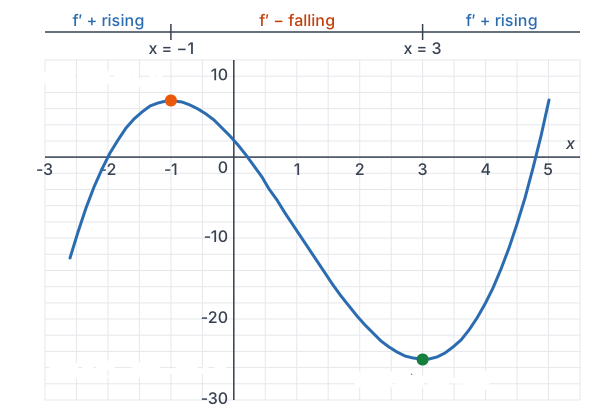
The first derivative test
| Sign of f′ around c | What happens at c |
|---|---|
| + then − | Local maximum |
| − then + | Local minimum |
| + then +, or − then − | No local extremum |
- Find the critical numbers of f.
- Mark them on a number line. They split it into intervals.
- Pick a test value in each interval and find the sign of f′ there. This is a sign chart.
- Read off where f is increasing (+) and decreasing (−).
- Classify each critical number with the table, and find f(c) for the extreme values.
Also mark x-values that are not in the domain (like an asymptote) on the sign chart. f′ can change sign there, but they are not extrema.
First derivative test examples
Example 1: A cubic
Find where f(x) = x^3 - 3x^2 - 9x + 2 is increasing and decreasing, and find its local extrema.
f'(x) = 3x^2 - 6x - 9
Differentiate.
f'(x) = 3(x - 3)(x + 1)
Factor out 3, then factor the trinomial (see factoring trinomials).
x = -1, \; x = 3
The critical numbers.
f'(-2) = 3(-5)(-1) = 15
Test x = −2 in (−∞, −1): positive.
f'(0) = 3(-3)(1) = -9
Test x = 0 in (−1, 3): negative.
f'(4) = 3(1)(5) = 15
Test x = 4 in (3, ∞): positive.
f(-1) = -1 - 3 + 9 + 2 = 7
+ to − at x = −1: local maximum value.
f(3) = 27 - 27 - 27 + 2 = -25
− to + at x = 3: local minimum value.
Answer: f is increasing on (−∞, −1) and (3, ∞), and decreasing on (−1, 3). It has a local maximum of 7 at x = −1 and a local minimum of −25 at x = 3.
Example 2: A critical point that is not an extremum
Classify the critical numbers of f(x) = x^4 - 4x^3.
f'(x) = 4x^3 - 12x^2 = 4x^2(x - 3)
Differentiate and factor out 4x².
x = 0, \; x = 3
The critical numbers.
f'(-1) = 4(1)(-4) = -16
Test x = −1: negative.
f'(1) = 4(1)(-2) = -8
Test x = 1: negative. No sign change at 0.
f'(4) = 4(16)(1) = 64
Test x = 4: positive.
f(3) = 81 - 108 = -27
− to + at x = 3: local minimum value.
Answer: x = 0 is not an extremum (f′ stays negative; the graph just flattens for a moment). There is a local minimum of −27 at x = 3. The factor x² never changes sign, which is why nothing happens at 0.
Example 3: A critical point where f′ is undefined
Find the local extrema of f(x) = x - 3x^{2/3}.
f'(x) = 1 - 2x^{-1/3}Power rule: (3)(2/3) = 2 and 2/3 − 1 = −1/3.
f'(x) = \frac{x^{1/3} - 2}{x^{1/3}}Write it as one fraction.
x = 8, \; x = 0
The numerator is 0 when x^(1/3) = 2, so x = 8. The denominator is 0 at x = 0.
f'(-1) = \frac{-1 - 2}{-1} = 3Test x = −1: positive.
f'(1) = \frac{1 - 2}{1} = -1Test x = 1: negative.
f'(27) = \frac{3 - 2}{3} = \frac{1}{3}Test x = 27: positive.
f(0) = 0, \; f(8) = 8 - 3(4) = -4
8^(2/3) = 4.
Answer: a local maximum of 0 at x = 0 (a sharp peak, or cusp) and a local minimum of −4 at x = 8.
Example 4: An exponential function
Find the local extrema of f(x) = xe^{-x}.
f'(x) = e^{-x} - xe^{-x} = e^{-x}(1 - x)Product rule, then factor out e^(−x).
x = 1
e^(−x) is always positive, so only 1 − x = 0.
f'(0) = 1 \cdot 1 = 1, \; f'(2) = e^{-2}(-1) \lt 0Test on each side: + then −.
f(1) = e^{-1} \approx 0.368Local maximum value.
Answer: f increases on (−∞, 1), decreases on (1, ∞), and has a local maximum of \frac{1}{e} \approx 0.368 at x = 1.
Example 5: Word problem with app users
An app’s daily users (in thousands) t days after an update are U(t) = t^3 - 15t^2 + 63t for 0 \le t \le 10. When were users rising and falling, and when were there local highs and lows?
U'(t) = 3t^2 - 30t + 63 = 3(t - 3)(t - 7)
Differentiate and factor.
t = 3, \; t = 7
Critical numbers.
U'(1) = 3(-2)(-6) = 36
Test t = 1: positive.
U'(5) = 3(2)(-2) = -12
Test t = 5: negative.
U'(8) = 3(5)(1) = 15
Test t = 8: positive.
U(3) = 27 - 135 + 189 = 81
Local maximum value.
U(7) = 343 - 735 + 441 = 49
Local minimum value.
Answer: users rose for the first 3 days to a local high of 81,000, fell until day 7 to a local low of 49,000, then rose again through day 10.
Common mistakes
| Mistake | Example of the error | Fix |
|---|---|---|
| Calling every critical point an extremum | Saying x = 0 is a min of x^4 - 4x^3 | Check the sign on both sides. No sign change means no extremum. |
| Testing the sign of f instead of f′ | Using f(−2) to decide if f is increasing | Increasing and decreasing come from the sign of f′. |
| Giving x when the value is asked | “The local max is −1” for Example 1 | The max occurs at x = −1; its value is f(−1) = 7. |
| Forgetting where f′ is undefined | Missing x = 0 for x - 3x^{2/3} | Include points where f′ does not exist, if f is defined there. |
| Including an asymptote as an extremum | Calling x = 0 an extremum of x + \frac{4}{x} | x = 0 is not in the domain. Mark it on the chart, but don’t classify it. |
Related methods
The second derivative test
Instead of a sign chart, you can sometimes check the sign of f″ at a critical point where f′ = 0. That is the second derivative test, later in this unit.
Absolute extrema
The first derivative test finds local extrema. To find the highest and lowest values on a closed interval, compare f at the critical numbers and at the endpoints. That is the next lesson, Absolute Extrema.
Practice problems
- Find the intervals of increase and decrease and the local extrema of f(x) = x^2 - 6x + 5.
- Find the local extrema of f(x) = x^3 - 12x.
- Find the local extrema of f(x) = 2x^3 + 3x^2 - 12x.
- Does f(x) = x^3 have a local extremum at x = 0?
- Find the local extrema of f(x) = x^4 - 2x^2.
- Find the local extrema of f(x) = \frac{x}{x^2 + 1}.
- Find the local extremum of f(x) = x\ln x.
- Find the local extremum of f(x) = |x + 2|.
- Find the local extrema of f(x) = x + \frac{4}{x}.
- Find the local extrema of f(x) = \sin x + \cos x on (0, 2π).
Show answers
1.
f'(x) = 2x - 6 = 0 \Rightarrow x = 3
Differentiate and solve.
f'(0) = -6, \; f'(4) = 2
Test each side: − then +.
f(3) = 9 - 18 + 5 = -4
Local minimum value.
Answer: decreasing on (−∞, 3), increasing on (3, ∞); local min −4 at x = 3
2.
f'(x) = 3x^2 - 12 = 3(x - 2)(x + 2)
Differentiate and factor.
f'(-3) = 15, \; f'(0) = -12, \; f'(3) = 15
Signs: +, −, +.
f(-2) = -8 + 24 = 16, \; f(2) = 8 - 24 = -16
Evaluate f.
Answer: local max 16 at x = −2; local min −16 at x = 2
3.
f'(x) = 6x^2 + 6x - 12 = 6(x + 2)(x - 1)
Differentiate and factor.
f'(-3) = 24, \; f'(0) = -12, \; f'(2) = 24
Signs: +, −, +.
f(-2) = -16 + 12 + 24 = 20, \; f(1) = 2 + 3 - 12 = -7
Evaluate f.
Answer: local max 20 at x = −2; local min −7 at x = 1
4.
f'(x) = 3x^2
Differentiate.
f'(-1) = 3, \; f'(1) = 3
Positive on both sides of 0.
Answer: no. f′ does not change sign, so x = 0 is not an extremum.
5.
f'(x) = 4x^3 - 4x = 4x(x - 1)(x + 1)
Differentiate and factor.
f'(-2) = -24, \; f'(-0.5) = 1.5, \; f'(0.5) = -1.5, \; f'(2) = 24
Signs: −, +, −, +.
f(-1) = -1, \; f(0) = 0, \; f(1) = -1
Evaluate f.
Answer: local min −1 at x = ±1; local max 0 at x = 0
6.
f'(x) = \frac{1 - x^2}{(x^2 + 1)^2}Quotient rule.
f'(-2) = -\frac{3}{25}, \; f'(0) = 1, \; f'(2) = -\frac{3}{25}Signs: −, +, − around x = −1 and x = 1.
f(-1) = -\frac{1}{2}, \; f(1) = \frac{1}{2}Evaluate f.
Answer: local min −½ at x = −1; local max ½ at x = 1
7.
f'(x) = \ln x + 1 = 0 \Rightarrow x = \frac{1}{e}Differentiate and solve.
f'(0.1) \approx -1.30, \; f'(1) = 1
Signs: − then +.
f\left(\frac{1}{e}\right) = \frac{1}{e}\ln\frac{1}{e} = -\frac{1}{e}ln(1/e) = −1.
Answer: local min -\frac{1}{e} \approx -0.368 at x = \frac{1}{e}
8.
f'(x) = -1 \text{ for } x \lt -2, \; f'(x) = 1 \text{ for } x \gt -2A V-shaped graph with its corner at x = −2.
Answer: local min 0 at x = −2 (f′ undefined there, − then +)
9.
f'(x) = 1 - \frac{4}{x^2} = \frac{x^2 - 4}{x^2}Differentiate and combine.
x = \pm 2
Critical numbers; x = 0 is not in the domain.
f'(-3) = \frac{5}{9}, \; f'(-1) = -3, \; f'(1) = -3, \; f'(3) = \frac{5}{9}Signs: +, −, −, + (the chart breaks at 0).
f(-2) = -4, \; f(2) = 4
Evaluate f.
Answer: local max −4 at x = −2; local min 4 at x = 2
10.
f'(x) = \cos x - \sin x = 0 \Rightarrow x = \frac{\pi}{4}, \frac{5\pi}{4}tan x = 1 in (0, 2π).
f'(0.1) \gt 0, \; f'(\pi) = -1, \; f'(6) \gt 0
Signs: +, −, +.
f\left(\frac{\pi}{4}\right) = \sqrt{2}, \; f\left(\frac{5\pi}{4}\right) = -\sqrt{2}Evaluate f.
Answer: local max √2 at π/4; local min −√2 at 5π/4
First derivative test FAQ
What is the first derivative test?
A way to classify a critical point by the sign of f′ on each side: + to − is a local max, − to + is a local min, and no change is neither.
How do you find where a function is increasing?
Find where f'(x) \gt 0. Make a sign chart for f′ using its critical numbers and test a value in each interval.
What is the difference between a local and an absolute maximum?
A local maximum is the highest point nearby. An absolute maximum is the highest point on the whole domain or interval. A function can have several local maximums but only one absolute maximum value.
Do you include endpoints in increasing intervals?
Many textbooks use open intervals, like (−1, 3). Including endpoints where f is continuous is also correct; follow your teacher’s convention.
Summary
- f′ positive: f increasing. f′ negative: f decreasing.
- Make a sign chart for f′ using the critical numbers (and any breaks in the domain).
- + to −: local max. − to +: local min. No change: no extremum.
- Report the extreme value f(c), not just the location c.
Previous lesson: Critical Points
Next lesson: Absolute Extrema
Back to the Calculus 1 Index