
Absolute Extrema
The absolute extrema of a function on an interval are its highest and lowest values there. By the extreme value theorem, a function that is continuous on a closed interval [a, b] always has both an absolute maximum and an absolute minimum. To find them, evaluate f at the critical numbers and at the endpoints, then compare.
Before this lesson: First Derivative Test, Critical Points and Continuity
Local versus absolute extrema
A local maximum is the highest point in its own neighborhood. The absolute maximum is the highest value on the whole interval. On a closed interval, the absolute maximum can happen at a peak inside the interval or at an endpoint, where the graph simply stops.
The extreme value theorem and the closed interval method
Extreme value theorem: if f is continuous on a closed interval [a, b], then f has an absolute maximum and an absolute minimum on [a, b].
Both conditions matter. On the open interval (0, 1), f(x) = x has no maximum: it gets close to 1 but never reaches it. And f(x) = 1/x on [−1, 1] has no maximum because it is not continuous at 0.
- Check that f is continuous on [a, b].
- Find the critical numbers of f inside (a, b).
- Evaluate f at each critical number and at both endpoints. This is the candidates test.
- The largest value is the absolute maximum; the smallest is the absolute minimum.
You don’t need a sign chart. Comparing the values is enough.
Absolute extrema examples
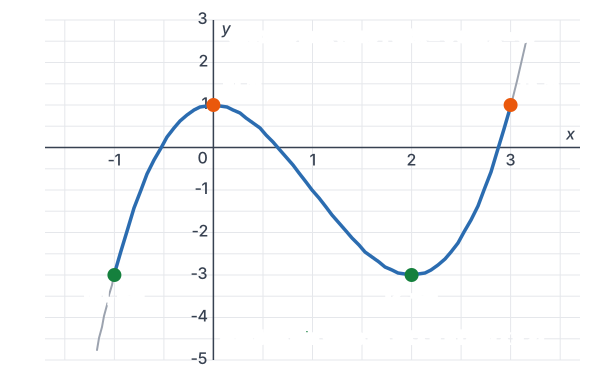
Example 1: A cubic with ties
Find the absolute extrema of f(x) = x^3 - 3x^2 + 1 on [−1, 3].
f'(x) = 3x^2 - 6x = 3x(x - 2)
Differentiate and factor out 3x.
x = 0, \; x = 2
Critical numbers; both are inside [−1, 3].
f(-1) = -1 - 3 + 1 = -3
Left endpoint.
f(0) = 1
Critical number.
f(2) = 8 - 12 + 1 = -3
Critical number.
f(3) = 27 - 27 + 1 = 1
Right endpoint.
Answer: the absolute maximum is 1, at x = 0 and x = 3. The absolute minimum is −3, at x = −1 and x = 2. A maximum value can occur at more than one x.
Example 2: A rational function
Find the absolute extrema of f(x) = x + \frac{4}{x} on [1, 4].
f'(x) = 1 - \frac{4}{x^2} = \frac{x^2 - 4}{x^2}Differentiate and combine into one fraction.
x = 2
x² − 4 = 0 gives ±2; only 2 is in [1, 4]. (x = 0 is outside the interval.)
f(1) = 1 + 4 = 5
Left endpoint.
f(2) = 2 + 2 = 4
Critical number.
f(4) = 4 + 1 = 5
Right endpoint.
Answer: absolute maximum 5 at x = 1 and x = 4; absolute minimum 4 at x = 2.
Example 3: A critical point where f′ is undefined
Find the absolute extrema of f(x) = x^{2/3} on [−1, 8].
f'(x) = \frac{2}{3x^{1/3}}Differentiate. f′ is never 0.
x = 0
f′ is undefined at 0, which is in the interval.
f(-1) = (-1)^{2/3} = 1Left endpoint: the cube root of −1 is −1, and (−1)² = 1.
f(0) = 0
Critical number.
f(8) = 8^{2/3} = 4Right endpoint: the cube root of 8 is 2, and 2² = 4.
Answer: absolute maximum 4 at x = 8; absolute minimum 0 at x = 0.
Example 4: A trig function
Find the absolute extrema of f(x) = \sin x + \cos x on [0, π].
f'(x) = \cos x - \sin x
Differentiate.
\tan x = 1 \Rightarrow x = \frac{\pi}{4}Set f′ = 0; only π/4 is in [0, π].
f(0) = 0 + 1 = 1
Left endpoint.
f\left(\frac{\pi}{4}\right) = \frac{\sqrt{2}}{2} + \frac{\sqrt{2}}{2} = \sqrt{2}Critical number (see trig values of special angles).
f(\pi) = 0 + (-1) = -1
Right endpoint.
Answer: absolute maximum \sqrt{2} \approx 1.414 at x = \frac{\pi}{4}; absolute minimum −1 at x = π.
Example 5: Word problem with temperature
The temperature t hours after 8 am is T(t) = -0.5t^2 + 4t + 60 degrees Fahrenheit, for 0 \le t \le 10. Find the warmest and coolest temperatures in that time.
T'(t) = -t + 4
Differentiate.
t = 4
Set T′ = 0. It is inside [0, 10].
T(0) = 60
At 8 am.
T(4) = -8 + 16 + 60 = 68
At noon: 0.5(16) = 8.
T(10) = -50 + 40 + 60 = 50
At 6 pm: 0.5(100) = 50.
Answer: the warmest is 68°F at noon (t = 4), and the coolest is 50°F at 6 pm (t = 10), an endpoint.
Common mistakes
| Mistake | Example of the error | Fix |
|---|---|---|
| Forgetting the endpoints | Saying the min of x³ − 3x² + 1 on [−1, 3] is only at x = 2 | Always evaluate f at a and b too. |
| Including critical numbers outside the interval | Testing x = −2 for x + 4/x on [1, 4] | Only use critical numbers inside [a, b]. |
| Reporting the x-value as the maximum | “The absolute max is x = 3” | The max is the value f(3) = 1; it occurs at x = 3. |
| Using the method on an open interval | Expecting a max of x on (0, 1) | Without endpoints, the extreme value theorem doesn’t apply. There may be no max or min. |
| Comparing f′ values instead of f values | Picking the largest f′(c) | Compare the function values f(c). |
Related methods
Optimization
Word problems that ask for the largest area, the least cost or the shortest time are absolute extrema problems in disguise. You write a function, find its domain, and use the closed interval method. That is optimization, later in this unit.
Open or infinite intervals
If the interval is open or infinite, the candidates test may not work. Use the first derivative test instead: if a function has only one critical point and it is a local max, it is also the absolute max.
Practice problems
- Find the absolute extrema of f(x) = x^2 - 4x + 1 on [0, 3].
- Find the absolute extrema of f(x) = x^3 - 12x on [−3, 3].
- Find the absolute extrema of f(x) = 2x^3 - 9x^2 + 12x on [0, 3].
- Find the absolute extrema of f(x) = \sqrt{x} - x on [0, 4].
- Find the absolute extrema of f(x) = xe^{-x} on [0, 3].
- Find the absolute extrema of f(x) = \frac{x}{x^2 + 1} on [0, 3].
- Find the absolute extrema of f(x) = \ln x - x on \left[\frac{1}{2}, 2\right].
- Find the absolute extrema of f(x) = |x - 1| on [−2, 3].
- Find the absolute extrema of f(x) = 2\cos x + x on [0, π].
- Find the absolute extrema of f(x) = \frac{1}{x} on [1, 5].
Show answers
1.
f'(x) = 2x - 4 = 0 \Rightarrow x = 2
Critical number.
f(0) = 1, \; f(2) = -3, \; f(3) = -2
Evaluate at the endpoints and x = 2.
Answer: max 1 at x = 0; min −3 at x = 2
2.
f'(x) = 3x^2 - 12 = 0 \Rightarrow x = \pm 2
Both are inside [−3, 3].
f(-3) = 9, \; f(-2) = 16, \; f(2) = -16, \; f(3) = -9
Evaluate the four candidates.
Answer: max 16 at x = −2; min −16 at x = 2
3.
f'(x) = 6x^2 - 18x + 12 = 6(x - 1)(x - 2)
Critical numbers 1 and 2.
f(0) = 0, \; f(1) = 5, \; f(2) = 4, \; f(3) = 9
Evaluate: f(3) = 54 − 81 + 36.
Answer: max 9 at x = 3; min 0 at x = 0
4.
f'(x) = \frac{1}{2\sqrt{x}} - 1 = 0 \Rightarrow \sqrt{x} = \frac{1}{2}Solve: 2√x = 1.
x = \frac{1}{4}Square both sides.
f(0) = 0, \; f\left(\frac{1}{4}\right) = \frac{1}{2} - \frac{1}{4} = \frac{1}{4}, \; f(4) = 2 - 4 = -2Evaluate the candidates.
Answer: max ¼ at x = ¼; min −2 at x = 4
5.
f'(x) = e^{-x}(1 - x) = 0 \Rightarrow x = 1Critical number.
f(0) = 0, \; f(1) = e^{-1} \approx 0.368, \; f(3) = 3e^{-3} \approx 0.149Evaluate.
Answer: max 1/e at x = 1; min 0 at x = 0
6.
f'(x) = \frac{1 - x^2}{(x^2 + 1)^2} = 0 \Rightarrow x = 1x = −1 is outside [0, 3].
f(0) = 0, \; f(1) = \frac{1}{2}, \; f(3) = \frac{3}{10}Evaluate.
Answer: max ½ at x = 1; min 0 at x = 0
7.
f'(x) = \frac{1}{x} - 1 = 0 \Rightarrow x = 1Critical number.
f\left(\frac{1}{2}\right) \approx -1.193, \; f(1) = -1, \; f(2) \approx -1.307ln ½ ≈ −0.693 and ln 2 ≈ 0.693.
Answer: max −1 at x = 1; min ln 2 − 2 ≈ −1.307 at x = 2
8.
f'(1) \text{ does not exist}The corner of the V at x = 1 is the critical number.
f(-2) = 3, \; f(1) = 0, \; f(3) = 2
Evaluate.
Answer: max 3 at x = −2; min 0 at x = 1
9.
f'(x) = -2\sin x + 1 = 0 \Rightarrow \sin x = \frac{1}{2}x = π/6 or 5π/6.
f(0) = 2, \; f\left(\frac{\pi}{6}\right) = \sqrt{3} + \frac{\pi}{6} \approx 2.256Evaluate the left endpoint and π/6.
f\left(\frac{5\pi}{6}\right) = -\sqrt{3} + \frac{5\pi}{6} \approx 0.886, \; f(\pi) = \pi - 2 \approx 1.142Evaluate 5π/6 and the right endpoint.
Answer: max ≈ 2.256 at x = π/6; min ≈ 0.886 at x = 5π/6
10.
f'(x) = -\frac{1}{x^2}Never 0, and defined on [1, 5]: no critical numbers.
f(1) = 1, \; f(5) = \frac{1}{5}Only the endpoints are candidates.
Answer: max 1 at x = 1; min 1/5 at x = 5
Absolute extrema FAQ
How do you find absolute extrema on a closed interval?
Find the critical numbers inside the interval, evaluate f at them and at both endpoints, and pick the largest and smallest values.
What does the extreme value theorem say?
A function that is continuous on a closed interval [a, b] has an absolute maximum and an absolute minimum on that interval.
Can an absolute maximum happen at an endpoint?
Yes. In Example 5, the coolest temperature happens at t = 10, the right endpoint. That is why endpoints are always candidates.
What is the difference between absolute and local extrema?
A local extremum is the highest or lowest point nearby. An absolute extremum is the highest or lowest value on the whole interval. An absolute extremum inside the interval is also a local one.
Summary
- Extreme value theorem: continuous on [a, b] guarantees an absolute max and min.
- Candidates: critical numbers inside [a, b] plus both endpoints.
- Evaluate f at every candidate; largest = absolute max, smallest = absolute min.
- Report the value f(c) and where it occurs.
- On open or infinite intervals, the method may fail.
Previous lesson: First Derivative Test
Next lesson: Concavity and Inflection Points
Back to the Calculus 1 Index