
Concavity and Inflection Points
Concavity describes which way a graph bends. Where f''(x) \gt 0, the graph is concave up, shaped like a cup. Where f''(x) \lt 0, it is concave down, shaped like a cap. An inflection point is a point on the graph where the concavity changes, which usually happens where f″ = 0 or f″ is undefined.
Before this lesson: Higher-Order Derivatives, First Derivative Test and Critical Points
What concavity means
Concave up means the slopes are increasing: the tangent lines get steeper from left to right, and the curve lies above them. Concave down means the slopes are decreasing, and the curve lies below its tangent lines.
Since f″ is the derivative of f′, the sign of f″ tells whether the slope is growing or shrinking. That is why the second derivative controls concavity.
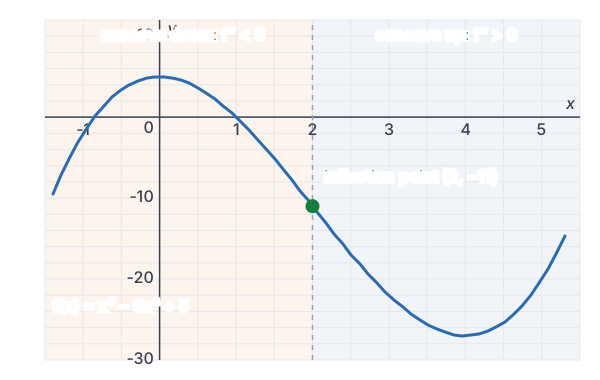
Concavity test and inflection points
| Sign of f″ on an interval | Shape of the graph | Slopes |
|---|---|---|
| f'' \gt 0 | Concave up (cup) | Increasing |
| f'' \lt 0 | Concave down (cap) | Decreasing |
- Find f″(x).
- Find where f″(x) = 0 or f″(x) is undefined. These are the candidates.
- Make a sign chart for f″ using the candidates, and test a value in each interval.
- Where the sign of f″ changes and f is defined, there is an inflection point. Give it as (c, f(c)).
f″(c) = 0 alone does not make an inflection point. The sign has to change, just as a critical point needs a sign change in f′ to be an extremum.
Concavity and inflection points examples
Example 1: A cubic
Find where f(x) = x^3 - 6x^2 + 5 is concave up and concave down, and find its inflection point.
f'(x) = 3x^2 - 12x
First derivative.
f''(x) = 6x - 12
Second derivative.
6x - 12 = 0 \Rightarrow x = 2
Candidate: add 12, then divide by 6.
f''(0) = -12, \; f''(3) = 6
Test each side: negative, then positive.
f(2) = 8 - 24 + 5 = -11
Find the y-coordinate.
Answer: concave down on (−∞, 2), concave up on (2, ∞), and the inflection point is (2, −11). Every cubic has exactly one inflection point.
Example 2: Two inflection points
Find the intervals of concavity and the inflection points of f(x) = x^4 - 6x^2.
f'(x) = 4x^3 - 12x
First derivative.
f''(x) = 12x^2 - 12 = 12(x - 1)(x + 1)
Second derivative, factored.
x = -1, \; x = 1
Candidates.
f''(-2) = 36, \; f''(0) = -12, \; f''(2) = 36
Signs: +, −, +.
f(-1) = 1 - 6 = -5, \; f(1) = -5
Find the y-coordinates.
Answer: concave up on (−∞, −1) and (1, ∞), concave down on (−1, 1). The inflection points are (−1, −5) and (1, −5).
Example 3: f″ = 0 but no inflection point
Does f(x) = x^4 have an inflection point at x = 0?
f''(x) = 12x^2
Differentiate twice.
f''(0) = 0
x = 0 is a candidate.
f''(-1) = 12, \; f''(1) = 12
Positive on both sides: no sign change.
Answer: no. x⁴ is concave up everywhere; it is just very flat at 0. A candidate is only an inflection point if f″ changes sign.
Example 4: f″ undefined
Find the inflection point of f(x) = x^{1/3}.
f'(x) = \frac{1}{3}x^{-2/3}Power rule.
f''(x) = -\frac{2}{9}x^{-5/3} = -\frac{2}{9x^{5/3}}Power rule again: −⅔ − 1 = −⁵⁄₃.
x = 0
f″ is never 0, but it is undefined at 0, where f(0) = 0 is defined.
f''(-1) = \frac{2}{9}, \; f''(1) = -\frac{2}{9}Positive, then negative: the sign changes.
Answer: the inflection point is (0, 0). The cube root graph is concave up for x below 0 and concave down for x above 0, with a vertical tangent at the inflection point.
Example 5: Word problem with diminishing returns
A new product’s total sales t months after launch are S(t) = -t^3 + 9t^2 + 20t thousand units, for 0 \le t \le 8. When are sales growing fastest?
S'(t) = -3t^2 + 18t + 20
Rate of sales (thousand units per month).
S''(t) = -6t + 18
Rate of change of the sales rate.
-6t + 18 = 0 \Rightarrow t = 3
Candidate: subtract 18, then divide by −6.
S''(1) = 12, \; S''(5) = -12
Concave up, then concave down.
S'(3) = -27 + 54 + 20 = 47
The sales rate at the inflection point.
Answer: sales grow fastest at t = 3 months, at about 47,000 units per month. After that, sales still rise, but more slowly. Business writers call this inflection point the point of diminishing returns.
Common mistakes
| Mistake | Example of the error | Fix |
|---|---|---|
| Calling every f″ = 0 an inflection point | x = 0 for x⁴ | Check that f″ changes sign. |
| Using f′ to decide concavity | “f' \gt 0, so it is concave up” | Concavity comes from f″. f′ tells increasing or decreasing. |
| Giving only the x-value | “The inflection point is 2” | Write the point: (2, −11). |
| Missing where f″ is undefined | Finding no inflection point for x^(1/3) | Include points where f″ does not exist but f does. |
| Counting points outside the domain | Calling x = 0 an inflection point of x + 1/x | f must be defined there. Concavity can change at an asymptote without an inflection point. |
Related methods
Concavity and the tangent line
Where f is concave up, tangent lines lie below the graph, so a linear approximation underestimates. Where it is concave down, the tangent line lies above, so the estimate is too high.
The second derivative test
At a critical point with f′(c) = 0, concave up means a valley (local minimum) and concave down means a hill (local maximum). That shortcut is the second derivative test, the next lesson.
Practice problems
- Find the intervals of concavity and the inflection point of f(x) = x^3 + 3x^2 - 2.
- Find the inflection point of f(x) = 2x^3 - 12x^2 + 7x.
- Find the intervals of concavity and the inflection points of f(x) = x^4 - 4x^3.
- Find the inflection points of f(x) = e^{-x^2}.
- Find the inflection point of f(x) = xe^x.
- Find the inflection points of f(x) = \ln(x^2 + 1).
- Find the intervals of concavity and the inflection point of f(x) = \sin x on (0, 2π).
- Does f(x) = x + \frac{1}{x} have an inflection point?
- If f''(x) = (x - 1)(x + 3)^2, where does f have inflection points?
- A company’s revenue is R(x) = -x^3 + 12x^2 + 60x thousand dollars when it spends x thousand dollars on ads, for 0 \le x \le 10. Find the point of diminishing returns.
Show answers
1.
f''(x) = 6x + 6
Differentiate twice: f′ = 3x² + 6x.
6x + 6 = 0 \Rightarrow x = -1
Candidate.
f''(-2) = -6, \; f''(0) = 6
Signs: −, +.
f(-1) = -1 + 3 - 2 = 0
y-coordinate.
Answer: concave down on (−∞, −1), up on (−1, ∞); inflection point (−1, 0)
2.
f''(x) = 12x - 24
Differentiate twice: f′ = 6x² − 24x + 7.
12x - 24 = 0 \Rightarrow x = 2
Candidate; f″ changes from − to + there.
f(2) = 16 - 48 + 14 = -18
y-coordinate.
Answer: (2, −18)
3.
f''(x) = 12x^2 - 24x = 12x(x - 2)
Differentiate twice: f′ = 4x³ − 12x².
f''(-1) = 36, \; f''(1) = -12, \; f''(3) = 36
Signs: +, −, +.
f(0) = 0, \; f(2) = 16 - 32 = -16
y-coordinates.
Answer: up on (−∞, 0) and (2, ∞), down on (0, 2); inflection points (0, 0) and (2, −16)
4.
f'(x) = -2xe^{-x^2}Chain rule.
f''(x) = -2e^{-x^2} + 4x^2e^{-x^2} = (4x^2 - 2)e^{-x^2}Product rule, then factor.
4x^2 - 2 = 0 \Rightarrow x = \pm\frac{1}{\sqrt{2}}e^(−x²) is never 0; f″ changes sign at both.
f\left(\pm\frac{1}{\sqrt{2}}\right) = e^{-1/2} \approx 0.607y-coordinate.
Answer: \left(\pm\frac{1}{\sqrt{2}}, e^{-1/2}\right) \approx (\pm 0.707, 0.607)
5.
f''(x) = (x + 2)e^x
f′ = (x + 1)eˣ, then the product rule again.
x = -2
f″ changes from − to + there.
f(-2) = -2e^{-2} \approx -0.271y-coordinate.
Answer: (−2, −2e⁻²) ≈ (−2, −0.271)
6.
f''(x) = \frac{2(x^2 + 1) - 2x(2x)}{(x^2 + 1)^2} = \frac{2 - 2x^2}{(x^2 + 1)^2}Quotient rule on f′ = 2x/(x² + 1).
x = \pm 1
f″ changes sign at both.
f(\pm 1) = \ln 2
y-coordinate.
Answer: (−1, ln 2) and (1, ln 2)
7.
f''(x) = -\sin x
Differentiate twice.
-\sin x = 0 \Rightarrow x = \pi
The only zero in (0, 2π).
Answer: concave down on (0, π), up on (π, 2π); inflection point (π, 0)
8.
f''(x) = \frac{2}{x^3}f′ = 1 − x⁻², so f″ = 2x⁻³.
Answer: no. f″ changes sign at x = 0, but 0 is not in the domain, so there is no inflection point.
9.
(x + 3)^2 \ge 0
This factor never changes sign.
f''(0) = -9, \; f''(2) = 25
Sign change at x = 1; at x = −3 the sign stays negative.
Answer: an inflection point at x = 1 only
10.
R''(x) = -6x + 24
R′ = −3x² + 24x + 60, then differentiate again.
-6x + 24 = 0 \Rightarrow x = 4
R″ changes from + to −.
R(4) = -64 + 192 + 240 = 368
Revenue at x = 4.
Answer: at $4,000 of ads (revenue $368,000); after that, extra ad dollars add revenue more slowly
Concavity and inflection points FAQ
How do you know if a graph is concave up or down?
Check the sign of the second derivative. If f'' \gt 0 on an interval, the graph is concave up there; if f'' \lt 0, it is concave down.
What is an inflection point?
A point on the graph where the concavity changes, from up to down or down to up. f must be defined there.
Is every point where f″ = 0 an inflection point?
No. For x⁴, f″(0) = 0 but the graph is concave up on both sides. The sign of f″ must change.
What does an inflection point mean in a word problem?
It is where the rate of change is largest or smallest, such as when sales grow fastest. It is often called the point of diminishing returns.
Summary
- f'' \gt 0: concave up (cup). f'' \lt 0: concave down (cap).
- Candidates: where f″ = 0 or f″ is undefined.
- An inflection point needs a sign change in f″ and f defined at that x.
- Give inflection points as (c, f(c)).
- At an inflection point, f′ has a local max or min.
Previous lesson: Absolute Extrema
Next lesson: Second Derivative Test
Back to the Calculus 1 Index