
Critical Points
A critical point of a function f is a point where x = c is in the domain of f and either f′(c) = 0 or f′(c) does not exist. The number c is called a critical number. Every local maximum or minimum inside an interval happens at a critical point.
Before this lesson: Mean Value Theorem, Differentiability and Solving Polynomial Equations
Why critical points matter
At the top of a smooth hill or the bottom of a smooth valley, the tangent line is flat, so f′ = 0. At a sharp peak or a cusp, there is no tangent slope at all, so f′ does not exist. Either way, the function can switch from rising to falling there.
That is why every local maximum or minimum inside an interval happens at a critical point. The reverse is not always true: a critical point can also be a flat spot where the graph keeps rising, like x = 0 on y = x^3.
How to find critical points
- Find the domain of f.
- Find f′(x) and simplify it into one fraction, fully factored.
- Solve f′(x) = 0: set the numerator equal to 0.
- Find where f′(x) is undefined: set the denominator equal to 0.
- Keep only the values that are in the domain of f. Those are the critical numbers.
To give a critical point as an ordered pair, substitute each critical number into f.
Critical points examples
Example 1: A cubic
Find the critical numbers of f(x) = x^3 - 12x + 1.
f'(x) = 3x^2 - 12
Differentiate with the power rule. The derivative exists everywhere.
3x^2 - 12 = 0
Set f′(x) = 0.
x^2 = 4
Add 12, then divide by 3.
x = \pm 2
Take the square root of both sides.
Answer: x = −2 and x = 2. The critical points are (−2, 17) and (2, −15).
Example 2: A derivative that doesn’t exist
Find the critical numbers of f(x) = x^{1/3}(x - 4).
f(x) = x^{4/3} - 4x^{1/3}Distribute; add the exponents 1/3 + 1 = 4/3 (see rational exponents).
f'(x) = \frac{4}{3}x^{1/3} - \frac{4}{3}x^{-2/3}Power rule on each term.
f'(x) = \frac{4}{3}x^{-2/3}(x - 1)Factor out the smaller power, (4/3)x^(−2/3) (see factoring out the GCF).
f'(x) = \frac{4(x - 1)}{3x^{2/3}}Write it as one fraction.
x - 1 = 0 \Rightarrow x = 1
The numerator is 0 at x = 1.
3x^{2/3} = 0 \Rightarrow x = 0The denominator is 0 at x = 0, and 0 is in the domain of f.
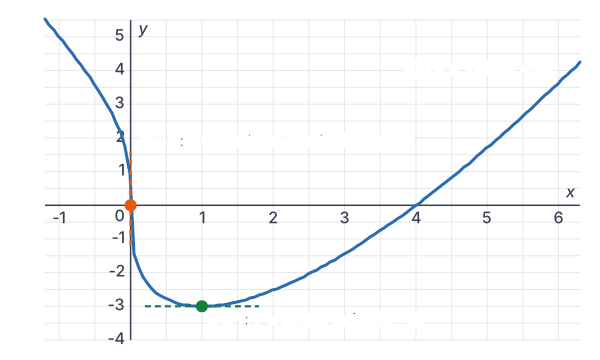
Answer: x = 0 and x = 1. The critical points are (0, 0) and (1, −3), as in the graph above.
Example 3: Points not in the domain
Find the critical numbers of f(x) = \frac{x^2 + 1}{x}.
f(x) = x + \frac{1}{x}Split the fraction. The domain is every x except 0.
f'(x) = 1 - \frac{1}{x^2}Differentiate.
f'(x) = \frac{x^2 - 1}{x^2}Combine into one fraction.
x^2 - 1 = 0 \Rightarrow x = \pm 1
The numerator is 0 at x = ±1.
x^2 = 0 \Rightarrow x = 0
f′ is undefined at 0, but 0 is not in the domain, so it is not a critical number.
Answer: x = −1 and x = 1. A vertical asymptote is not a critical point.
Example 4: A trig function on an interval
Find the critical numbers of f(x) = x + 2\cos x on [0, 2π].
f'(x) = 1 - 2\sin x
Differentiate (see derivatives of trig functions).
1 - 2\sin x = 0
Set f′(x) = 0.
\sin x = \frac{1}{2}Subtract 1, then divide by −2.
x = \frac{\pi}{6} \text{ or } x = \frac{5\pi}{6}Sine is ½ in Quadrants I and II (see unit circle).
Answer: x = \frac{\pi}{6} and x = \frac{5\pi}{6}.
Example 5: Word problem with profit
A company’s monthly profit from selling x items is P(x) = -0.02x^2 + 60x - 1000 dollars. Find the critical number and explain what happens there.
P'(x) = -0.04x + 60
Differentiate.
-0.04x + 60 = 0
Set P′(x) = 0.
x = \frac{60}{0.04} = 1500Subtract 60, then divide by −0.04.
P(1500) = -0.02(2{,}250{,}000) + 90{,}000 - 1000Substitute x = 1500; 1500² = 2,250,000.
P(1500) = -45{,}000 + 90{,}000 - 1000 = 44{,}000Multiply, then add.
Answer: the critical number is x = 1500 items. Profit rises before it and falls after it, so the maximum monthly profit is $44,000.
Common mistakes
| Mistake | Example of the error | Fix |
|---|---|---|
| Only solving f′ = 0 | Missing x = 0 for x^{1/3}(x - 4) | Also find where f′ is undefined. |
| Including points outside the domain | Listing x = 0 for x + \frac{1}{x} | c must be in the domain of f. |
| Assuming every critical point is a max or min | Calling x = 0 a minimum of x^3 | Test it: x³ keeps rising through 0. The first derivative test decides. |
| Dividing out a variable factor | Dividing 4x^3 - 16x = 0 by x and losing x = 0 | Factor instead: 4x(x^2 - 4) = 0. |
| Giving only x-values when points are asked for | Answering “−2 and 2” for the critical points | Include y: (−2, 17) and (2, −15). |
Related methods
What comes next
Critical points split the number line into intervals where f′ keeps one sign. Testing those signs is the first derivative test, the next lesson. On a closed interval, comparing f at the critical points and the endpoints gives the absolute extrema.
Critical points from a graph of f′
On a graph of f′, critical numbers are where the graph touches or crosses the x-axis, plus any x where f′ has a hole or a vertical asymptote while f is defined.
Practice problems
- Find the critical numbers of f(x) = 2x^3 - 3x^2 - 12x.
- Find the critical numbers of f(x) = x^4 - 8x^2.
- Find the critical numbers of f(x) = \frac{x}{x^2 + 4}.
- Find the critical numbers of f(x) = x^{2/3}.
- Find the critical numbers of f(x) = |x - 3|.
- Find the critical numbers of f(x) = xe^{-x}.
- Find the critical numbers of f(x) = x\ln x.
- Find the critical numbers of f(x) = \sin x + \cos x on [0, 2π].
- Find the critical numbers of f(x) = \frac{1}{x - 2}.
- A ball’s height is h(t) = -16t^2 + 64t + 5 feet. Find the critical number and the height there.
Show answers
1.
f'(x) = 6x^2 - 6x - 12
Differentiate.
6(x^2 - x - 2) = 0
Set f′ = 0 and factor out 6.
6(x - 2)(x + 1) = 0
Factor the trinomial (see factoring trinomials).
Answer: x = −1 and x = 2
2.
f'(x) = 4x^3 - 16x
Differentiate.
4x(x^2 - 4) = 0
Set f′ = 0 and factor out 4x.
4x(x - 2)(x + 2) = 0
Factor the difference of squares.
Answer: x = −2, 0 and 2
3.
f'(x) = \frac{(x^2 + 4) - x(2x)}{(x^2 + 4)^2} = \frac{4 - x^2}{(x^2 + 4)^2}Quotient rule, then simplify.
4 - x^2 = 0 \Rightarrow x = \pm 2
The denominator is never 0.
Answer: x = −2 and x = 2
4.
f'(x) = \frac{2}{3}x^{-1/3} = \frac{2}{3x^{1/3}}Differentiate and write as a fraction.
3x^{1/3} = 0 \Rightarrow x = 0f′ is never 0, but it is undefined at 0, which is in the domain.
Answer: x = 0
5.
f'(x) = -1 \text{ for } x \lt 3, \; f'(x) = 1 \text{ for } x \gt 3The graph is a V with its corner at x = 3.
f'(3) \text{ does not exist}The slopes don’t match at the corner.
Answer: x = 3
6.
f'(x) = e^{-x} - xe^{-x} = e^{-x}(1 - x)Product rule, then factor out e^(−x).
1 - x = 0 \Rightarrow x = 1
e^(−x) is never 0.
Answer: x = 1
7.
f'(x) = \ln x + 1
Product rule; the domain is x \gt 0.
\ln x = -1 \Rightarrow x = e^{-1}Subtract 1, then rewrite in exponential form.
Answer: x = \frac{1}{e} \approx 0.368
8.
f'(x) = \cos x - \sin x
Differentiate.
\cos x = \sin x \Rightarrow \tan x = 1
Set f′ = 0 and divide by cos x.
x = \frac{\pi}{4} \text{ or } x = \frac{5\pi}{4}Tangent is 1 in Quadrants I and III.
Answer: x = \frac{\pi}{4} and x = \frac{5\pi}{4}
9.
f'(x) = -\frac{1}{(x - 2)^2}Differentiate (x − 2)^(−1).
f'(x) \ne 0
The numerator is −1, never 0. f′ is undefined only at x = 2, which is not in the domain.
Answer: no critical numbers
10.
h'(t) = -32t + 64
Differentiate.
-32t + 64 = 0 \Rightarrow t = 2
Subtract 64, then divide by −32.
h(2) = -64 + 128 + 5 = 69
Substitute t = 2.
Answer: t = 2 s, where the ball reaches its highest point, 69 ft
Critical points FAQ
What is a critical point in calculus?
A point in the domain of f where the derivative is 0 or does not exist. These are the candidates for local maximums and minimums.
Is every critical point a maximum or minimum?
No. For f(x) = x^3, f′(0) = 0, but the graph keeps rising through x = 0. Use the first or second derivative test to classify a critical point.
Can a critical point be where the derivative is undefined?
Yes, if the function itself is defined there. Corners, cusps and vertical tangents give critical points, but vertical asymptotes and holes do not.
What is the difference between a critical number and a critical point?
The critical number is the x-value c. The critical point is the ordered pair (c, f(c)) on the graph.
Summary
- A critical number c is in the domain of f with f′(c) = 0 or f′(c) undefined.
- Write f′ as one factored fraction: numerator = 0 and denominator = 0 give the candidates.
- Throw out values not in the domain of f.
- Every local max or min inside an interval is at a critical point, but not every critical point is one.
- Give critical points as (c, f(c)).
Previous lesson: Mean Value Theorem
Next lesson: First Derivative Test
Back to the Calculus 1 Index