
Economic Order Quantity
The economic order quantity (EOQ) is the order size that makes a store’s yearly inventory cost as small as possible. If D items are needed per year, each order costs S dollars and holding one item for a year costs H dollars, the best order size is x = \sqrt{\frac{2DS}{H}}.
Before this lesson: Minimizing Average Cost, Maximizing Profit and Zero and Negative Exponents
The idea
A store that sells 1,500 phone cases a year has a choice. It can order all 1,500 at once, or order a few at a time, many times a year. Both choices cost money, in different ways.
Every order has a fixed ordering cost: shipping, paperwork and handling. Ordering often makes this cost large. Every item on the shelf has a holding cost: storage space, insurance and money tied up in stock. Ordering a lot at once makes this cost large.
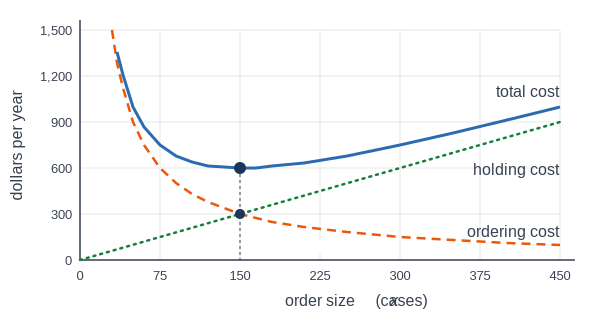
The EOQ balances the two. Calculus finds the order size where the total is smallest, and at that size the two costs turn out to be equal.
Economic order quantity formula
Let x be the number of items in each order. Then the store places \frac{D}{x} orders a year. Stock drops steadily from x to 0 before each new order arrives, so the average number on the shelf is \frac{x}{2}.
| Symbol | Meaning | Example |
|---|---|---|
| D | Items needed per year (annual demand) | 1,500 phone cases |
| S | Cost to place one order | $30 per order |
| H | Cost to hold one item for one year | $4 per item per year |
| x | Items in each order (order size) | what we want to find |
T(x) = S \cdot \frac{D}{x} + H \cdot \frac{x}{2} \qquad \text{(ordering cost + holding cost)}x = \sqrt{\frac{2DS}{H}}- Write the total yearly inventory cost T(x) = \frac{SD}{x} + \frac{Hx}{2}.
- Set T'(x) = -\frac{SD}{x^2} + \frac{H}{2} equal to 0 and solve for x > 0. This gives the EOQ formula.
- Find the number of orders per year, \frac{D}{x}, and the total cost T(x).
- If x must be a whole number and the answer is not one, compare the two nearest whole numbers.
Economic order quantity examples
Example 1: Finding the EOQ with calculus
A store sells 1,500 phone cases a year. Each order costs $30 to place, and holding one case for a year costs $4. Find the order size that minimizes the yearly inventory cost.
T(x) = 30 \cdot \dfrac{1500}{x} + 4 \cdot \dfrac{x}{2}Write the total cost with D = 1500, S = 30 and H = 4.
T(x) = 45{,}000x^{-1} + 2xMultiply, and rewrite with a negative exponent (see zero and negative exponents).
T'(x) = -45{,}000x^{-2} + 2Differentiate each term (see power rule).
-\dfrac{45{,}000}{x^2} + 2 = 0Set the derivative equal to 0.
2 = \dfrac{45{,}000}{x^2}Add 45,000/x² to both sides.
2x^2 = 45{,}000Multiply both sides by x².
x^2 = 22{,}500Divide both sides by 2.
x = 150
Take the positive square root (see solving quadratics with square roots).
T''(x) = 90{,}000x^{-3}Differentiate again.
T''(150) \gt 0
Positive for every x > 0, so x = 150 is a minimum (see second derivative test).
T(150) = 300 + 300 = 600
Find the total: 45,000 ÷ 150 = 300 and 2(150) = 300.
Answer: order 150 cases at a time. The store places 1500 ÷ 150 = 10 orders a year, and its inventory cost is $600 a year.
Example 2: Using the EOQ formula
Use the EOQ formula to check Example 1.
x = \sqrt{\dfrac{2(1500)(30)}{4}}Substitute D = 1500, S = 30 and H = 4.
x = \sqrt{\dfrac{90{,}000}{4}}Multiply in the numerator.
x = \sqrt{22{,}500}Divide.
x = 150
Take the square root (see square root).
Answer: x = 150, the same as Example 1. The formula is the shortcut for the calculus steps.
Example 3: How often to order
A hardware store uses 5,000 boxes of screws a year. Each order costs $20, and holding a box for a year costs $5. Find the EOQ, the number of orders a year, the time between orders and the total yearly cost.
x = \sqrt{\dfrac{2(5000)(20)}{5}}Substitute into the EOQ formula.
x = \sqrt{\dfrac{200{,}000}{5}} = \sqrt{40{,}000}Multiply in the numerator, then divide.
x = 200
Take the square root.
\dfrac{5000}{200} = 25Orders per year: D ÷ x.
\dfrac{365}{25} = 14.6Days between orders: 365 ÷ 25.
T(200) = 20(25) + 5(100)
Ordering cost: $20 per order. Holding cost: $5 times an average of 100 boxes.
T(200) = 500 + 500 = 1000
Multiply, then add.
Answer: order 200 boxes at a time, 25 times a year, or about every 15 days. The yearly inventory cost is $1,000.
Example 4: When the EOQ is not a whole number
A shop needs 2,000 filters a year. Each order costs $25, and holding one filter for a year costs $3. Find the best whole-number order size.
x = \sqrt{\dfrac{2(2000)(25)}{3}}Substitute into the EOQ formula.
x = \sqrt{\dfrac{100{,}000}{3}} \approx \sqrt{33{,}333.3}Multiply in the numerator, then divide.
x \approx 182.57
Take the square root with a calculator.
T(182) = \dfrac{50{,}000}{182} + 1.5(182) \approx 547.725Check 182 in T(x) = 50,000/x + 1.5x.
T(183) = \dfrac{50{,}000}{183} + 1.5(183) \approx 547.724Check 183.
547.724 \lt 547.725
Compare.
Answer: order 183 filters at a time, for a yearly cost of about $547.72. The two choices differ by less than a cent, so either is fine in practice.
Example 5: Ordering textbooks (word problem)
A campus bookstore sells 4,500 copies of a textbook a year. Each order costs $40 in shipping and processing, and holding one book for a year costs $4. The manager now orders 900 books at a time. How much would the store save by switching to the EOQ?
x = \sqrt{\dfrac{2(4500)(40)}{4}} = \sqrt{90{,}000}Substitute into the EOQ formula and simplify.
x = 300
Take the square root.
T(300) = 40(15) + 4(150)
At x = 300: 4500 ÷ 300 = 15 orders, and the average stock is 150.
T(300) = 600 + 600 = 1200
Multiply, then add.
T(900) = 40(5) + 4(450)
At x = 900: 4500 ÷ 900 = 5 orders, and the average stock is 450.
T(900) = 200 + 1800 = 2000
Multiply, then add.
2000 - 1200 = 800
Subtract to find the savings.
Answer: ordering 300 books at a time, 15 times a year, costs $1,200 a year instead of $2,000. The store saves $800 a year.
Common mistakes
| Mistake | Example of the error | Fix |
|---|---|---|
| Using x instead of x/2 for the holding cost | T(x) = \frac{45{,}000}{x} + 4x in Example 1 | Stock falls from x to 0, so the average on the shelf is x/2: use \frac{Hx}{2}. |
| Leaving out the 2 in the formula | \sqrt{\frac{DS}{H}} \approx 106 in Example 1 | The formula is \sqrt{\frac{2DS}{H}} = 150. |
| Mixing time units | Using monthly demand with a yearly holding cost | Write D and H for the same time period, usually one year. |
| Answering only x | Stopping at x = 200 when Example 3 asks how often to order | Also find D/x orders a year and the time between them. |
| Rounding without checking | Rounding 182.57 to 182 | Compare T at the two nearest whole numbers. |
| Thinking fewer orders always saves money | Ordering 900 books in Example 5 | Big orders cut ordering cost but raise holding cost. The EOQ balances them. |
Related ideas
Ordering cost equals holding cost at the EOQ
Setting T'(x) = 0 gives \frac{SD}{x^2} = \frac{H}{2}. Multiply both sides by x to get \frac{SD}{x} = \frac{Hx}{2}: the ordering cost equals the holding cost. In every example above, the two costs come out equal at the EOQ.
The same shape as average cost
T(x) = \frac{SD}{x} + \frac{Hx}{2} has the same form as the average cost \frac{F}{x} + b + ax from minimizing average cost. In both, a cost that shrinks as x grows is balanced against one that grows, and the best x is a square root.
How the EOQ changes
Because of the square root, doubling the demand does not double the order size: it multiplies it by \sqrt{2} \approx 1.41. A higher holding cost makes the EOQ smaller, and a higher ordering cost makes it larger.
Practice problems
- A store needs 800 items a year. Each order costs $25, and holding one item for a year costs $4. Find the EOQ and the yearly inventory cost.
- In Problem 1, how many orders does the store place each year, and about how many days apart are they?
- A warehouse needs 10,000 units a year, with S = $20 and H = $4. Find the best whole-number order size.
- For D = 2000, S = $50 and H = $5, write T(x) and use calculus to find the EOQ.
- In Problem 4, show that the ordering cost and the holding cost are equal at the EOQ.
- In Problem 4, the holding cost rises to $10. Find the new EOQ.
- In Problem 4, how much more does it cost per year to order 400 at a time instead of the EOQ?
- Use the second derivative to show that the EOQ in Problem 4 is a minimum.
- A coffee shop uses 5,200 pounds of beans a year. Each order costs $13, and storing one pound for a year costs $2. Find the EOQ, the number of orders a year and the yearly cost.
- The store in Example 1 has room for only 100 cases. What order size should it use now, and what is the yearly cost?
Show answers
1.
x = \sqrt{\dfrac{2(800)(25)}{4}} = \sqrt{10{,}000}Substitute into the EOQ formula and simplify.
x = 100
Take the square root.
T(100) = 25(8) + 4(50) = 400
800 ÷ 100 = 8 orders; the average stock is 50.
Answer: order 100 at a time; the yearly cost is $400
2.
\dfrac{800}{100} = 8Orders per year.
\dfrac{365}{8} \approx 45.6Days between orders.
Answer: 8 orders a year, about every 46 days
3.
x = \sqrt{\dfrac{2(10{,}000)(20)}{4}} = \sqrt{100{,}000} \approx 316.23Substitute into the EOQ formula.
T(316) = \dfrac{200{,}000}{316} + 2(316) \approx 1264.911Check 316 in T(x) = 200,000/x + 2x.
T(317) = \dfrac{200{,}000}{317} + 2(317) \approx 1264.915Check 317.
Answer: 316 units (yearly cost about $1,264.91)
4.
T(x) = \dfrac{100{,}000}{x} + 2.5xSD = 50(2000) = 100,000 and H/2 = 2.5.
T'(x) = -100{,}000x^{-2} + 2.5Differentiate each term.
2.5x^2 = 100{,}000Set T′(x) = 0 and multiply both sides by x².
x^2 = 40{,}000Divide both sides by 2.5.
x = 200
Take the positive square root.
Answer: the EOQ is 200
5.
\dfrac{100{,}000}{200} = 500Ordering cost at x = 200.
2.5(200) = 500
Holding cost at x = 200.
Answer: both are $500, so they are equal
6.
x = \sqrt{\dfrac{2(2000)(50)}{10}} = \sqrt{20{,}000}Substitute H = 10.
x \approx 141.4
Take the square root with a calculator.
Answer: about 141 (the EOQ shrinks by a factor of √2)
7.
T(400) = 250 + 1000 = 1250
100,000 ÷ 400 = 250 and 2.5(400) = 1000.
T(200) = 500 + 500 = 1000
Cost at the EOQ.
1250 - 1000 = 250
Subtract.
Answer: $250 more per year
8.
T''(x) = 200{,}000x^{-3}Differentiate T′(x) = −100,000x⁻² + 2.5.
T''(200) = \dfrac{200{,}000}{8{,}000{,}000} = 0.025 \gt 0Substitute x = 200.
Answer: T″(200) is positive, so x = 200 is a minimum
9.
x = \sqrt{\dfrac{2(5200)(13)}{2}} = \sqrt{67{,}600}Substitute into the EOQ formula and simplify.
x = 260
Take the square root.
\dfrac{5200}{260} = 20Orders per year.
T(260) = 13(20) + 2(130) = 520
Ordering cost plus holding cost.
Answer: order 260 pounds at a time, 20 times a year, for $520 a year
10.
T'(x) = -45{,}000x^{-2} + 2 \lt 0For x below 150, the derivative is negative, so T is still falling at 100.
T(100) = 450 + 200 = 650
45,000 ÷ 100 = 450 and 2(100) = 200.
Answer: order the full 100 cases each time; the yearly cost is $650 (see absolute extrema: the best point is at the endpoint)
Economic order quantity FAQ
What is the EOQ formula?
The economic order quantity is x = \sqrt{\frac{2DS}{H}}, where D is the yearly demand, S is the cost per order and H is the yearly holding cost per item.
How is the EOQ formula derived?
Write the yearly cost T(x) = \frac{SD}{x} + \frac{Hx}{2}, take the derivative and set it equal to 0. Solving -\frac{SD}{x^2} + \frac{H}{2} = 0 for x gives the formula.
Why is the average inventory x/2?
Each order arrives with x items, and the stock falls steadily to 0 before the next order arrives. The average of x and 0 is x/2.
What happens at the economic order quantity?
The yearly ordering cost and the yearly holding cost are equal, and their total is as small as possible.
Summary
- The EOQ balances ordering cost, \frac{SD}{x}, and holding cost, \frac{Hx}{2}.
- Total yearly cost: T(x) = \frac{SD}{x} + \frac{Hx}{2}.
- Setting T'(x) = 0 gives the EOQ, x = \sqrt{\frac{2DS}{H}}.
- At the EOQ, ordering cost equals holding cost; there are D/x orders a year.
- Keep D and H in the same time units, and compare nearby whole numbers when needed.
Previous lesson: Minimizing Average Cost
Next lesson: Consumer and Producer Surplus
Back to the Finite Math Index