
Maximizing Profit
Maximizing profit means finding the production level where profit P(x) = R(x) - C(x) is largest. Set the marginal profit equal to zero, P'(x) = 0, which is the same as marginal revenue equal to marginal cost (MR = MC). Then check that P''(x) \lt 0 to confirm the point is a maximum.
Before this lesson: Marginal Analysis, Price Elasticity of Demand and Second Derivative Test
The idea
Making more items brings in more money, but it also costs more. At first, each extra item adds profit. Later, prices must drop to sell more, or costs per item rise, and each extra item adds less. Profit is largest at the point where one more item would add nothing.
That point is where the marginal profit is zero. On the graph of P(x), it is the top of the hill, where the tangent line is flat. Since P'(x) = R'(x) - C'(x), marginal profit is zero exactly when marginal revenue equals marginal cost.
How to maximize profit
- Write the profit function P(x) = R(x) - C(x). If you are given a demand equation for the price p, first write R(x) = x \cdot p.
- Find P'(x) and solve P'(x) = 0. These are the critical points.
- Check that the point is a maximum: P''(x) \lt 0 there.
- Answer the question: the number of units, the price (from the demand equation) and the maximum profit P(x).
P'(x) = 0 \quad \Longleftrightarrow \quad R'(x) = C'(x) \qquad \text{(MR = MC)}If production is limited, such as “at most 300 units,” also compare the profit at the limit, since the best point might be at the edge (see Practice 7).
Maximizing profit examples
Example 1: Profit from a profit function
A bakery’s weekly profit from x cakes is P(x) = -0.02x^2 + 16x - 300 dollars. How many cakes maximize profit, and what is the maximum profit?
P'(x) = -0.04x + 16
Differentiate each term (see power rule).
-0.04x + 16 = 0
Set the marginal profit equal to 0.
-0.04x = -16
Subtract 16 from both sides.
x = 400
Divide both sides by −0.04.
P''(x) = -0.04
Differentiate again.
-0.04 \lt 0
The second derivative is negative, so x = 400 is a maximum (see second derivative test).
P(400) = -0.02(160{,}000) + 16(400) - 300Substitute x = 400 into P; 400² = 160,000.
P(400) = -3200 + 6400 - 300
Multiply.
P(400) = 2900
Add and subtract from left to right.
Answer: 400 cakes a week give the largest profit, $2,900. This is the point where marginal profit changed from positive to negative in the marginal analysis lesson.
Example 2: Setting marginal revenue equal to marginal cost
A company has revenue R(x) = 80x - 0.2x^2 and cost C(x) = 1000 + 20x + 0.1x^2 for x units. Find the output that maximizes profit and the maximum profit.
R'(x) = 80 - 0.4x
Find the marginal revenue.
C'(x) = 20 + 0.2x
Find the marginal cost.
80 - 0.4x = 20 + 0.2x
Set MR = MC.
80 - 0.6x = 20
Subtract 0.2x from both sides (see variables on both sides).
-0.6x = -60
Subtract 80 from both sides.
x = 100
Divide both sides by −0.6.
P''(x) = -0.4 - 0.2 = -0.6
Check: P″ = R″ − C″ is negative, so this is a maximum.
R(100) = 8000 - 2000 = 6000
Revenue at 100: evaluate each term, then subtract.
C(100) = 1000 + 2000 + 1000 = 4000
Cost at 100: evaluate each term, then add.
P(100) = 6000 - 4000 = 2000
Profit is revenue minus cost.
Answer: 100 units, with a maximum profit of $2,000.
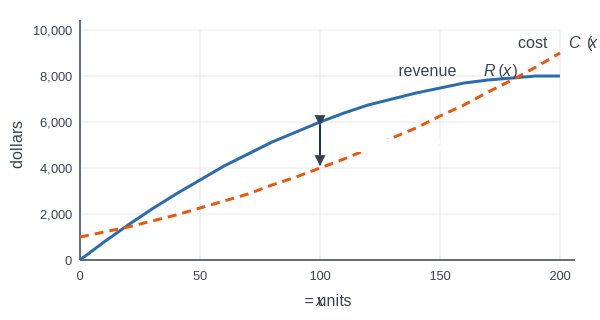
Example 3: Finding the best price from a demand equation
A company can sell x headphones a month at a price of p = 50 - 0.01x dollars. Its cost is C(x) = 2000 + 10x. What price maximizes profit?
R(x) = x(50 - 0.01x)
Revenue is quantity times price.
R(x) = 50x - 0.01x^2
Distribute x.
P(x) = 50x - 0.01x^2 - 2000 - 10x
Subtract the cost, distributing the minus sign.
P(x) = -0.01x^2 + 40x - 2000
Combine like terms.
P'(x) = -0.02x + 40
Differentiate each term.
-0.02x + 40 = 0
Set the marginal profit equal to 0.
-0.02x = -40
Subtract 40 from both sides.
x = 2000
Divide both sides by −0.02.
P''(x) = -0.02 \lt 0
Negative, so this is a maximum.
p = 50 - 0.01(2000)
Substitute x = 2000 into the demand equation.
p = 50 - 20 = 30
Multiply, then subtract.
P(2000) = -40{,}000 + 80{,}000 - 2000Substitute x = 2000 into P and multiply.
P(2000) = 38{,}000Add and subtract.
Answer: charge $30. The company sells 2,000 headphones a month and makes $38,000 in profit.
Example 4: A cubic cost function
A furniture maker sells chairs for $120 each. Its cost for x chairs a month is C(x) = 0.001x^3 - 0.3x^2 + 30x + 5000. How many chairs maximize profit?
P(x) = 120x - (0.001x^3 - 0.3x^2 + 30x + 5000)
Profit is revenue minus cost, with R(x) = 120x.
P(x) = 120x - 0.001x^3 + 0.3x^2 - 30x - 5000
Distribute the minus sign.
P(x) = -0.001x^3 + 0.3x^2 + 90x - 5000
Combine like terms.
P'(x) = -0.003x^2 + 0.6x + 90
Differentiate each term.
-0.003x^2 + 0.6x + 90 = 0
Set the marginal profit equal to 0.
x^2 - 200x - 30{,}000 = 0Divide both sides by −0.003.
(x - 300)(x + 100) = 0
Factor the trinomial (see factoring trinomials).
x = 300
Set each factor to 0; x = −100 makes no sense for chairs.
P''(x) = -0.006x + 0.6
Differentiate P′.
P''(300) = -1.8 + 0.6 = -1.2
Substitute x = 300: multiply, then add.
-1.2 \lt 0
Negative, so x = 300 is a maximum.
P(300) = -27{,}000 + 27{,}000 + 27{,}000 - 5000Substitute x = 300 and evaluate each term.
P(300) = 22{,}000Add and subtract.
Answer: 300 chairs a month, for a maximum profit of $22,000.
Example 5: Raising the ticket price (word problem)
A concert promoter sells 2,000 tickets at $40. For each $1 increase in price, 40 fewer people buy tickets. Each person who attends costs $8 (staff and cleanup), and the hall costs $10,000. What ticket price maximizes profit?
\text{price} = 40 + n,\ \text{tickets} = 2000 - 40nLet n be the number of $1 increases.
P(n) = (40 + n)(2000 - 40n) - 8(2000 - 40n) - 10{,}000Profit = revenue − cost per person − hall cost.
P(n) = (32 + n)(2000 - 40n) - 10{,}000Combine the first two terms: (40 + n) − 8 = 32 + n.
P(n) = 64{,}000 + 720n - 40n^2 - 10{,}000Multiply the binomials (see multiplying binomials): −1280n + 2000n = 720n.
P(n) = -40n^2 + 720n + 54{,}000Combine the constants.
P'(n) = -80n + 720
Differentiate each term.
-80n + 720 = 0
Set the marginal profit equal to 0.
-80n = -720
Subtract 720 from both sides.
n = 9
Divide both sides by −80.
P''(n) = -80 \lt 0
Negative, so n = 9 is a maximum.
40 + 9 = 49,\ 2000 - 40(9) = 1640
Find the price and the number of tickets.
P(9) = (32 + 9)(1640) - 10{,}000Substitute n = 9.
P(9) = 67{,}240 - 10{,}000 = 57{,}240Multiply, then subtract.
Answer: charge $49. The promoter sells 1,640 tickets and makes $57,240, compared with $54,000 at $40.
Common mistakes
| Mistake | Example of the error | Fix |
|---|---|---|
| Maximizing revenue instead of profit | Solving R'(x) = 0 in Example 2 and getting x = 200 | Profit includes cost. Solve P'(x) = 0, or MR = MC. |
| Stopping at x and not answering the question | Giving x = 2000 when Example 3 asks for a price | Put x back into the demand equation to get the price p = $30. |
| Skipping the maximum check | Assuming every critical point is a maximum | Check P''(x) \lt 0, or compare profit values on both sides. |
| Not distributing the minus sign in R − C | 120x - 0.001x^3 - 0.3x^2 + 30x + 5000 | Put C(x) in parentheses: every term of C changes sign. |
| Keeping a negative or impossible answer | Using x = −100 chairs in Example 4 | Production must be 0 or more and within any limit. |
| Ignoring a production limit | Making 400 cakes when the oven allows only 300 | If the critical point is outside the allowed range, check the endpoints. |
Related ideas
The same steps minimize costs, as in the economic order quantity, the order size with the lowest total inventory cost.
Why MR = MC
If MR > MC, one more unit brings in more than it costs, so make more. If MR < MC, the last unit cost more than it brought in, so make fewer. The best output is where they are equal.
Maximum revenue is not maximum profit
Revenue is largest where R'(x) = 0, which is where demand is unit elastic (see price elasticity of demand). Profit peaks at a smaller output, because each unit also costs money. In Example 2, revenue peaks at 200 units but profit peaks at 100.
The general method
Maximizing profit is one case of optimization. The same steps find the largest area, the smallest cost or the shortest time: write a function, find its critical points and test them.
Practice problems
- A company’s profit is P(x) = -0.5x^2 + 300x - 20{,}000. Find the output that maximizes profit and the maximum profit.
- For R(x) = 120x - 0.5x^2 and C(x) = 2000 + 20x, use MR = MC to find the best output and the maximum profit.
- The demand equation is p = 90 - 0.03x and the cost is C(x) = 1500 + 30x. Find the price that maximizes profit and the maximum profit.
- Use the second derivative test to confirm your answer to Problem 3.
- For R(x) = 50x - 0.05x^2 and C(x) = 0.05x^2 + 10x + 400, find the best output and the maximum profit.
- A company’s profit is P(x) = -x^3 + 6x^2 + 15x - 20 thousand dollars, where x is hundreds of units. Find the best output.
- The bakery in Example 1 can bake at most 300 cakes a week. How many should it bake, and what is its profit?
- An apartment complex has 100 units, all rented at $1,200 a month. For each $50 increase in rent, 2 units become empty. Each rented unit costs $200 a month to maintain. What rent maximizes profit?
- At the current output, marginal revenue is $25 and marginal cost is $18. Should the company make more or fewer units? About how much profit does one more unit add?
- The number sold at price p is x = 1000 - 20p, and the cost is C = 5x + 2000. Write profit as a function of p and find the best price.
Show answers
1.
P'(x) = -x + 300
Differentiate each term.
-x + 300 = 0
Set the marginal profit equal to 0.
x = 300
Add x to both sides.
P(300) = -45{,}000 + 90{,}000 - 20{,}000Substitute x = 300 and evaluate each term.
P(300) = 25{,}000Add and subtract.
Answer: 300 units, for a maximum profit of $25,000 (P″ = −1 < 0)
2.
120 - x = 20
Set MR = MC: R′(x) = 120 − x and C′(x) = 20.
x = 100
Add x to both sides, then subtract 20.
P(100) = 12{,}000 - 5000 - 2000 - 2000P = R − C at 100: evaluate each term.
P(100) = 3000
Subtract from left to right.
Answer: 100 units, for a maximum profit of $3,000
3.
P(x) = 90x - 0.03x^2 - 1500 - 30x
R(x) = x(90 − 0.03x); subtract C(x).
P(x) = -0.03x^2 + 60x - 1500
Combine like terms.
P'(x) = -0.06x + 60
Differentiate each term.
x = 1000
Solve −0.06x + 60 = 0: subtract 60, then divide by −0.06.
p = 90 - 0.03(1000) = 60
Substitute into the demand equation.
P(1000) = -30{,}000 + 60{,}000 - 1500 = 28{,}500Substitute x = 1000 into P.
Answer: charge $60; 1,000 units sell, for a profit of $28,500
4.
P''(x) = -0.06
Differentiate P′(x) = −0.06x + 60.
-0.06 \lt 0
The second derivative is negative.
Answer: P″ is negative, so x = 1000 (price $60) is a maximum
5.
50 - 0.1x = 0.1x + 10
Set MR = MC.
50 = 0.2x + 10
Add 0.1x to both sides.
40 = 0.2x
Subtract 10 from both sides.
x = 200
Divide both sides by 0.2.
P(200) = 8000 - 4400 = 3600
R(200) = 10,000 − 2000 = 8000 and C(200) = 2000 + 2000 + 400 = 4400.
Answer: 200 units, for a maximum profit of $3,600
6.
P'(x) = -3x^2 + 12x + 15
Differentiate each term.
x^2 - 4x - 5 = 0
Set P′(x) = 0 and divide both sides by −3.
(x - 5)(x + 1) = 0
Factor the trinomial.
x = 5
Keep the positive solution.
P''(5) = -6(5) + 12 = -18
P″(x) = −6x + 12; substitute x = 5.
P(5) = -125 + 150 + 75 - 20 = 80
Find the maximum profit.
Answer: 500 units (x = 5), for a profit of $80,000
7.
P'(x) = -0.04x + 16 \gt 0
For x below 400, marginal profit is positive, so profit is still rising at 300.
P(300) = -1800 + 4800 - 300 = 2700
Profit at the limit.
Answer: bake all 300 cakes, for a profit of $2,700 (see absolute extrema: the best point is at the endpoint)
8.
P(n) = (1200 + 50n - 200)(100 - 2n)
Let n be the number of $50 increases; each rented unit earns its rent minus $200.
P(n) = (1000 + 50n)(100 - 2n)
Combine like terms.
P(n) = -100n^2 + 3000n + 100{,}000Multiply the binomials.
P'(n) = -200n + 3000
Differentiate each term.
n = 15
Solve −200n + 3000 = 0.
1200 + 50(15) = 1950
Find the rent.
P(15) = (1750)(70) = 122{,}500Rent minus upkeep times the 70 rented units.
Answer: rent of $1,950 a month, with 70 units rented and a profit of $122,500 a month
9.
25 - 18 = 7
Marginal profit is MR − MC.
7 \gt 0
Positive, so profit is still rising.
Answer: make more units; one more unit adds about $7 of profit
10.
P(p) = p(1000 - 20p) - 5(1000 - 20p) - 2000
Revenue is p times x; cost is 5x + 2000.
P(p) = (p - 5)(1000 - 20p) - 2000
Factor out (1000 − 20p) from the first two terms.
P(p) = -20p^2 + 1100p - 7000
Multiply the binomials and combine like terms.
P'(p) = -40p + 1100
Differentiate with respect to p.
p = 27.5
Solve −40p + 1100 = 0.
P(27.5) = (22.5)(450) - 2000 = 8125
At p = 27.5, x = 1000 − 550 = 450.
Answer: charge $27.50; 450 units sell, for a profit of $8,125
Maximizing profit FAQ
How do you find maximum profit in calculus?
Write P(x) = R(x) - C(x), set P'(x) = 0 and solve for x. Check that P''(x) \lt 0, then substitute x into P(x) to find the maximum profit.
Why is profit maximized when marginal revenue equals marginal cost?
Marginal profit is MR − MC. While MR is bigger, each extra unit adds profit; once MC is bigger, each extra unit loses money. The switch happens where they are equal.
Is maximum revenue the same as maximum profit?
No. Revenue ignores costs, so it usually peaks at a larger output. Profit peaks earlier, where the extra revenue from one more unit just covers its extra cost.
How do you find the price that maximizes profit?
Find the best quantity x first, then put it into the demand equation to get the price. Or write profit as a function of price, as in Practice 10, and set its derivative to 0.
Summary
- Profit is P(x) = R(x) - C(x); it is largest where P'(x) = 0.
- P'(x) = 0 is the same as MR = MC.
- Confirm a maximum with P''(x) \lt 0.
- Use the demand equation to turn the best quantity into the best price.
- Throw out negative answers, and check the endpoints when production is limited.
Previous lesson: Price Elasticity of Demand
Next lesson: Minimizing Average Cost
Back to the Finite Math Index