
Marginal Analysis
Marginal analysis uses derivatives to measure how cost, revenue and profit change when a business makes one more item. Marginal cost is C'(x), marginal revenue is R'(x) and marginal profit is P'(x). Each one estimates the change from the next unit, so C'(100) \approx C(101) - C(100).
Before this lesson: Cost, Revenue and Profit Functions, Power Rule and Instantaneous Rate of Change
The idea
In business, “marginal” means “for one more unit.” A factory owner wants to know: if we make one more chair, how much will our cost go up? How much more money will we take in? Will profit rise or fall?
The derivative answers these questions. A derivative is a rate of change. C'(x) tells how fast total cost is rising when x items are made, in dollars per item. So C'(x) is close to the cost of making item number x + 1.
For a linear cost function such as C(x) = 500 + 20x, every item adds the same $20, so the marginal cost is the slope. When the cost function curves, the marginal cost changes with x, and calculus is the tool to find it.
Marginal analysis formulas
Let x be the number of units made and sold. Then:
| Function | Marginal function | What it estimates |
|---|---|---|
| Cost C(x) | Marginal cost C'(x) | The extra cost of one more unit |
| Revenue R(x) = x \cdot p | Marginal revenue R'(x) | The extra revenue from one more unit |
| Profit P(x) = R(x) - C(x) | Marginal profit P'(x) = R'(x) - C'(x) | The extra profit from one more unit |
C'(x) \approx C(x + 1) - C(x)
Here p is the price per unit. When price depends on how many units are sold, the price is given by a demand equation, so you first write R(x) = x \cdot p as a function of x. The same estimate works for R and P.
- Write the cost, revenue or profit function in terms of x.
- Take its derivative, term by term.
- Substitute the production level.
- State the meaning in words, with units: dollars per unit.
Marginal analysis examples
Example 1: Marginal cost
A company’s cost to make x desk lamps is C(x) = 500 + 20x + 0.01x^2 dollars. Find the marginal cost at x = 100, and compare it with the exact cost of the 101st lamp.
C'(x) = 0 + 20 + 0.01(2x)
Differentiate each term (see power rule). The constant 500 has derivative 0.
C'(x) = 20 + 0.02x
Simplify.
C'(100) = 20 + 0.02(100)
Substitute x = 100.
C'(100) = 20 + 2
Multiply.
C'(100) = 22
Add.
C(100) = 500 + 2000 + 100
For the exact cost, first evaluate each term of C(100).
C(100) = 2600
Add.
C(101) = 500 + 2020 + 102.01
Evaluate each term of C(101).
C(101) = 2622.01
Add.
C(101) - C(100) = 2622.01 - 2600
The exact cost of lamp 101 is the change in total cost.
C(101) - C(100) = 22.01
Subtract.
Answer: the marginal cost is $22 per lamp at x = 100. The 101st lamp really costs $22.01, so the estimate is off by only 1 cent.
Example 2: Marginal revenue from a demand equation
A store can sell x speakers per month at a price of p = 60 - 0.1x dollars each. Find the marginal revenue at x = 200 and at x = 400.
R(x) = x(60 - 0.1x)
Revenue is quantity times price.
R(x) = 60x - 0.1x^2
Distribute x (see distributive property).
R'(x) = 60 - 0.2x
Differentiate each term.
R'(200) = 60 - 0.2(200)
Substitute x = 200.
R'(200) = 60 - 40
Multiply.
R'(200) = 20
Subtract.
R'(400) = 60 - 0.2(400)
Substitute x = 400.
R'(400) = 60 - 80
Multiply.
R'(400) = -20
Subtract.
Answer: at 200 speakers, one more sale adds about $20 of revenue. At 400 speakers, one more sale lowers revenue by about $20. To sell more, the store must cut the price on every speaker, and at 400 that loss is bigger than the extra sale.
Example 3: Marginal profit
Use the lamp cost from Example 1 and the revenue from Example 2: C(x) = 500 + 20x + 0.01x^2 and R(x) = 60x - 0.1x^2. Find the marginal profit at x = 100 and x = 200.
P(x) = (60x - 0.1x^2) - (500 + 20x + 0.01x^2)
Profit is revenue minus cost.
P(x) = 60x - 0.1x^2 - 500 - 20x - 0.01x^2
Distribute the minus sign to every term of C.
P(x) = -0.11x^2 + 40x - 500
Combine like terms.
P'(x) = -0.22x + 40
Differentiate each term.
P'(100) = -0.22(100) + 40
Substitute x = 100.
P'(100) = -22 + 40
Multiply.
P'(100) = 18
Add.
R'(100) - C'(100) = 40 - 22 = 18
Check: R'(100) = 60 − 20 = 40 and C'(100) = 22 from Example 1, and marginal profit is their difference.
P'(200) = -0.22(200) + 40
Substitute x = 200.
P'(200) = -44 + 40
Multiply.
P'(200) = -4
Add.
Answer: at 100 units, one more unit adds about $18 of profit. At 200 units, one more unit lowers profit by about $4, so making more past that point hurts.
Example 4: Marginal average cost
The average cost is the cost per unit, \bar{C}(x) = \frac{C(x)}{x}. For the lamps in Example 1, find the average cost and the marginal average cost at x = 100.
\bar{C}(x) = \dfrac{500 + 20x + 0.01x^2}{x}Divide total cost by the number of lamps.
\bar{C}(x) = \dfrac{500}{x} + 20 + 0.01xDivide each term by x.
\bar{C}(x) = 500x^{-1} + 20 + 0.01xRewrite with a negative exponent (see zero and negative exponents).
\bar{C}'(x) = -500x^{-2} + 0.01Differentiate each term with the power rule.
\bar{C}(100) = 5 + 20 + 1 = 26Average cost at 100: evaluate each term, then add.
\bar{C}'(100) = -\dfrac{500}{100^2} + 0.01Substitute x = 100 into the derivative.
\bar{C}'(100) = -0.05 + 0.01Divide: 500 ÷ 10,000 = 0.05.
\bar{C}'(100) = -0.04Add.
Answer: at 100 lamps, the average cost is $26 per lamp. It is falling by about 4 cents per lamp for each extra lamp, because the $500 fixed cost is spread over more lamps.
Example 5: Should the bakery bake more? (word problem)
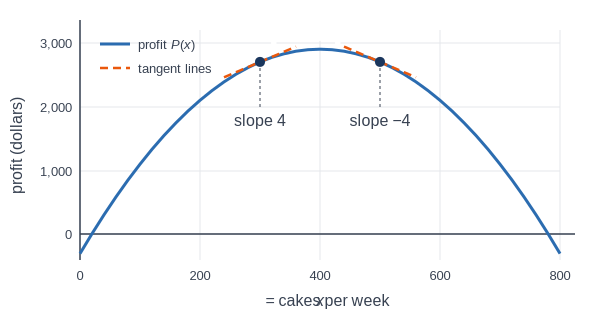
A bakery’s weekly cost to make x cakes is C(x) = 300 + 4x dollars. It can sell x cakes a week at a price of p = 20 - 0.02x dollars. It now sells 300 cakes a week. Use marginal profit to decide whether it should make more. Then check the marginal profit at 500 cakes.
R(x) = x(20 - 0.02x)
Revenue is quantity times price.
R(x) = 20x - 0.02x^2
Distribute x.
P(x) = 20x - 0.02x^2 - (300 + 4x)
Profit is revenue minus cost.
P(x) = 20x - 0.02x^2 - 300 - 4x
Distribute the minus sign.
P(x) = -0.02x^2 + 16x - 300
Combine like terms.
P'(x) = -0.04x + 16
Differentiate each term.
P'(300) = -0.04(300) + 16
Substitute x = 300.
P'(300) = -12 + 16
Multiply.
P'(300) = 4
Add.
P(301) - P(300) = 2703.98 - 2700
Check: evaluate P(301) and P(300) with a calculator.
P(301) - P(300) = 3.98
Subtract. The estimate of $4 is close.
P'(500) = -0.04(500) + 16
Substitute x = 500.
P'(500) = -20 + 16
Multiply.
P'(500) = -4
Add.
Answer: at 300 cakes, the next cake adds about $4 of profit, so the bakery should make more. At 500 cakes, the next cake loses about $4, so that is too many. Marginal profit is 0 between them, at x = 400, which is where profit is largest. The lesson on optimization shows how to find that point.
Common mistakes
| Mistake | Example of the error | Fix |
|---|---|---|
| Using the total instead of the derivative | “The marginal cost at 100 is C(100) = $2,600.” | Marginal cost is the derivative: C'(100) = 22 dollars per unit. |
| Calling the marginal cost the exact cost of the next unit | “Lamp 101 costs exactly $22.” | C'(100) is an estimate. The exact cost is C(101) - C(100) = 22.01. |
| Differentiating the price instead of revenue | Using p' = -0.1 as the marginal revenue in Example 2 | Write R(x) = x \cdot p first, then differentiate. |
| Not subtracting every term of the cost | P(x) = 60x - 0.1x^2 - 500 + 20x + 0.01x^2 | Put the cost in parentheses and distribute the minus sign to every term. |
| Keeping the fixed cost in the derivative | C'(x) = 500 + 20 + 0.02x | The derivative of a constant is 0. Fixed costs do not change the marginal cost. |
| Reading a negative marginal value as a negative total | “R'(400) = −20, so revenue is negative.” | It means revenue is falling: one more unit lowers revenue by about $20. |
Related ideas
Marginal cost is also the key to minimizing average cost, because average cost is smallest where it equals marginal cost. With two inputs, marginal analysis uses partial derivatives, as in the Cobb-Douglas production function.
Marginal analysis is linear approximation
The estimate C(a + 1) \approx C(a) + C'(a) is the tangent line rule from linear approximation with a step of 1. For a step of h units, C(a + h) \approx C(a) + h \cdot C'(a).
Linear cost and revenue
When C(x) = mx + b, as in cost, revenue and profit functions, the marginal cost is the constant m. When price is fixed, the marginal revenue is the price. Marginal analysis matters most when these rates change with x.
Where marginal profit is zero
Profit stops rising and starts falling where P'(x) = 0. That is the idea behind finding the most profitable production level, and it uses the same steps as break-even analysis in reverse: instead of P = 0, solve P′ = 0.
Practice problems
- A company’s cost is C(x) = 1200 + 35x dollars. Find the marginal cost and explain it.
- For C(x) = 900 + 8x + 0.004x^2, find the marginal cost at x = 250.
- In Problem 2, find the exact cost of unit 251, C(251) - C(250).
- For R(x) = 90x - 0.03x^2, find the marginal revenue at x = 1000 and explain it.
- The demand equation is p = 150 - 0.5x. Find R(x), R′(x) and the marginal revenue at x = 100.
- In Problem 5, at what sales level is the marginal revenue 0?
- For R(x) = 50x - 0.02x^2 and C(x) = 2000 + 10x, find the marginal profit at x = 500.
- A firm knows C(400) = 18{,}000 dollars and C'(400) = 25 dollars per unit. Estimate the cost of making 403 units.
- For C(x) = 2000 + 5x + 0.002x^2, find the marginal average cost at x = 500.
- A phone-case maker has C(x) = 4000 + 3x + 0.0005x^2 and R(x) = 15x - 0.001x^2. Find the marginal profit at 2,000 and at 5,000 cases. Should it raise production from 5,000?
Show answers
1.
C'(x) = 0 + 35
Differentiate each term. The constant 1200 has derivative 0.
C'(x) = 35
Simplify.
Answer: the marginal cost is $35 per unit at every level; each extra unit adds $35 to the total cost
2.
C'(x) = 8 + 0.008x
Differentiate each term: 0.004(2x) = 0.008x.
C'(250) = 8 + 0.008(250)
Substitute x = 250.
C'(250) = 8 + 2
Multiply.
C'(250) = 10
Add.
Answer: $10 per unit
3.
C(250) = 900 + 2000 + 250 = 3150
Evaluate each term, then add.
C(251) = 900 + 2008 + 252.004 = 3160.004
Evaluate each term, then add.
C(251) - C(250) = 3160.004 - 3150
Subtract the totals.
C(251) - C(250) = 10.004
Subtract.
Answer: about $10.00, very close to the marginal cost of $10
4.
R'(x) = 90 - 0.06x
Differentiate each term.
R'(1000) = 90 - 0.06(1000)
Substitute x = 1000.
R'(1000) = 90 - 60
Multiply.
R'(1000) = 30
Subtract.
Answer: $30 per unit; selling unit 1,001 adds about $30 of revenue
5.
R(x) = x(150 - 0.5x)
Revenue is quantity times price.
R(x) = 150x - 0.5x^2
Distribute x.
R'(x) = 150 - x
Differentiate each term: 0.5(2x) = x.
R'(100) = 150 - 100 = 50
Substitute x = 100, then subtract.
Answer: R(x) = 150x - 0.5x^2, R'(x) = 150 - x, and R'(100) = 50 dollars per unit
6.
150 - x = 0
Set the marginal revenue equal to 0.
x = 150
Add x to both sides.
Answer: at 150 units
7.
P(x) = 50x - 0.02x^2 - 2000 - 10x
Profit is revenue minus cost; distribute the minus sign.
P(x) = -0.02x^2 + 40x - 2000
Combine like terms.
P'(x) = -0.04x + 40
Differentiate each term.
P'(500) = -0.04(500) + 40
Substitute x = 500.
P'(500) = -20 + 40 = 20
Multiply, then add.
Answer: $20 per unit
8.
C(403) \approx C(400) + 3 \cdot C'(400)
Each of the 3 extra units adds about C′(400).
C(403) \approx 18{,}000 + 3(25)Substitute the known values.
C(403) \approx 18{,}000 + 75Multiply.
C(403) \approx 18{,}075Add.
Answer: about $18,075
9.
\bar{C}(x) = \dfrac{2000}{x} + 5 + 0.002xDivide each term of C(x) by x.
\bar{C}(x) = 2000x^{-1} + 5 + 0.002xRewrite with a negative exponent.
\bar{C}'(x) = -2000x^{-2} + 0.002Differentiate each term.
\bar{C}'(500) = -\dfrac{2000}{500^2} + 0.002Substitute x = 500.
\bar{C}'(500) = -0.008 + 0.002Divide: 2000 ÷ 250,000 = 0.008.
\bar{C}'(500) = -0.006Add.
Answer: −0.006 dollars per unit; the average cost falls by about 0.6 cents for each extra unit
10.
P(x) = 15x - 0.001x^2 - 4000 - 3x - 0.0005x^2
Profit is revenue minus cost; distribute the minus sign.
P(x) = -0.0015x^2 + 12x - 4000
Combine like terms.
P'(x) = -0.003x + 12
Differentiate each term.
P'(2000) = -0.003(2000) + 12 = -6 + 12
Substitute x = 2000, then multiply.
P'(2000) = 6
Add.
P'(5000) = -0.003(5000) + 12 = -15 + 12
Substitute x = 5000, then multiply.
P'(5000) = -3
Add.
Answer: about $6 per case at 2,000 and −$3 per case at 5,000; no, past 5,000 each extra case lowers profit
Marginal analysis FAQ
What is marginal cost in calculus?
Marginal cost is the derivative of the cost function, C'(x). It is the rate at which total cost rises per extra unit, and it estimates the cost of making one more unit.
Is marginal cost the same as the cost of the next item?
Not exactly. C'(x) is an estimate of C(x + 1) - C(x). For smooth cost functions the two are usually very close, as in Example 1 ($22 vs. $22.01).
How do you find marginal revenue from a demand equation?
Multiply the quantity by the price to get R(x) = x \cdot p, written in terms of x. Then take the derivative R'(x).
What does a negative marginal profit mean?
It means profit is falling at that production level. Making one more unit would lower total profit, so the business is producing too much.
Summary
- “Marginal” means “for one more unit”; marginal values are derivatives.
- Marginal cost C'(x), marginal revenue R'(x) and marginal profit P'(x) = R'(x) - C'(x).
- Each estimates the change from one more unit: C'(x) \approx C(x + 1) - C(x).
- Write revenue as R(x) = x \cdot p before differentiating, and subtract all of C(x) to get profit.
- A negative marginal value means the total is falling; marginal profit is 0 where profit peaks.
Previous lesson: Mixed Strategy Games
Next lesson: Price Elasticity of Demand
Back to the Finite Math Index