
Mixed Strategy Games
A mixed strategy game is a zero-sum game with no saddle point, so each player does best by choosing at random. A mixed strategy lists the probability of playing each row or column. The optimal mixed strategies give an expected payoff, called the value of the game, that the other player cannot change by switching.
Before this lesson: Strictly Determined Games, Matrix Multiplication and Expected Value
The idea
We use the same setup as the last lesson. Player R picks a row and player C picks a column of the payoff matrix M. Each entry is what C pays R, so R wants big numbers and C wants small ones.
Some games have no saddle point. Then any fixed choice can be beaten. If R always plays row 1, C will learn it and pick the column that hurts row 1 most. The way out is to be unpredictable.
A mixed strategy is a list of probabilities, one for each choice. R uses the row vector p = \begin{bmatrix} p_1 & p_2 \end{bmatrix}, and C uses the column vector q = \begin{bmatrix} q_1 \\ q_2 \end{bmatrix}. Each list adds to 1. A pure strategy is the special case where one probability is 1.
Mixed strategy games: the formulas
If R plays p and C plays q, the expected payoff to R is the long-run average payoff per round:
E = pMq
For a 2 × 2 game with no saddle point, write the payoff matrix as below. The optimal mixed strategies and the value v of the game are:
M = \begin{bmatrix} a & b \\ c & d \end{bmatrix}, \qquad D = a + d - b - cp_1 = \frac{d - c}{D}, \quad p_2 = 1 - p_1, \qquad q_1 = \frac{d - b}{D}, \quad q_2 = 1 - q_1v = \frac{ad - bc}{D}- Check for a saddle point first. If there is one, the game is strictly determined and pure strategies are best.
- Remove any dominated rows or columns until the matrix is 2 × 2.
- Use the formulas for p, q and v.
- Check: each entry of pM should equal v.
A game is fair when its value is 0. If v is positive, the game favors R; if v is negative, it favors C.
Mixed strategy games examples
Example 1: Expected payoff of two mixed strategies
The payoff matrix is M = \begin{bmatrix} 3 & -1 \\ -2 & 4 \end{bmatrix}. R plays each row half the time, so p = \begin{bmatrix} \tfrac{1}{2} & \tfrac{1}{2} \end{bmatrix}. C plays column 1 one-fourth of the time, so q_1 = \tfrac{1}{4} and q_2 = \tfrac{3}{4}. Find the expected payoff to R.
E = pMq
Use the expected payoff formula (see expected value). First find pM.
\tfrac{1}{2}(3) + \tfrac{1}{2}(-2) = \tfrac{3}{2} + (-1)Entry 1 of pM: multiply p by column 1 of M (see matrix multiplication).
\tfrac{3}{2} + (-1) = \tfrac{1}{2}Add.
\tfrac{1}{2}(-1) + \tfrac{1}{2}(4) = -\tfrac{1}{2} + 2Entry 2 of pM: multiply p by column 2.
-\tfrac{1}{2} + 2 = \tfrac{3}{2}Add.
pM = \begin{bmatrix} \tfrac{1}{2} & \tfrac{3}{2} \end{bmatrix}Write the row vector.
\tfrac{1}{2} \cdot \tfrac{1}{4} + \tfrac{3}{2} \cdot \tfrac{3}{4} = \tfrac{1}{8} + \tfrac{9}{8}Multiply pM by q.
\tfrac{1}{8} + \tfrac{9}{8} = \tfrac{10}{8}Add.
\tfrac{10}{8} = \tfrac{5}{4}Simplify.
Answer: E = \tfrac{5}{4} = 1.25. With these strategies, R wins 1.25 per round on average.
Example 2: Optimal strategies and the value of a game
Find the optimal mixed strategies and the value of the game in Example 1, M = \begin{bmatrix} 3 & -1 \\ -2 & 4 \end{bmatrix}.
\max(-1, -2) = -1
The row minimums are −1 and −2. R’s maximin is the larger one (see strictly determined games).
\min(3, 4) = 3
The column maximums are 3 and 4. C’s minimax is the smaller one.
-1 \ne 3
They differ, so there is no saddle point. Use mixed strategies.
a = 3,\ b = -1,\ c = -2,\ d = 4
Name the entries of M.
D = 3 + 4 - (-1) - (-2)
Substitute into D = a + d − b − c.
D = 3 + 4 + 1 + 2 = 10
Subtracting a negative number adds it.
p_1 = \dfrac{4 - (-2)}{10}Substitute into the formula for p_1.
p_1 = \dfrac{6}{10}Subtract.
p_1 = \dfrac{3}{5}Simplify.
p_2 = 1 - \dfrac{3}{5} = \dfrac{2}{5}The two probabilities add to 1.
q_1 = \dfrac{4 - (-1)}{10}Substitute into the formula for q_1.
q_1 = \dfrac{5}{10} = \dfrac{1}{2}Subtract, then simplify.
q_2 = 1 - \dfrac{1}{2} = \dfrac{1}{2}The two probabilities add to 1.
v = \dfrac{3(4) - (-1)(-2)}{10}Substitute into the formula for v.
v = \dfrac{12 - 2}{10}Multiply.
v = \dfrac{10}{10} = 1Subtract, then divide.
\tfrac{3}{5}(3) + \tfrac{2}{5}(-2) = \tfrac{9}{5} - \tfrac{4}{5}Check entry 1 of pM: R’s payoff if C plays column 1.
\tfrac{9}{5} - \tfrac{4}{5} = 1Subtract. It equals v.
\tfrac{3}{5}(-1) + \tfrac{2}{5}(4) = -\tfrac{3}{5} + \tfrac{8}{5}Check entry 2 of pM: R’s payoff if C plays column 2.
-\tfrac{3}{5} + \tfrac{8}{5} = 1Add. It also equals v.
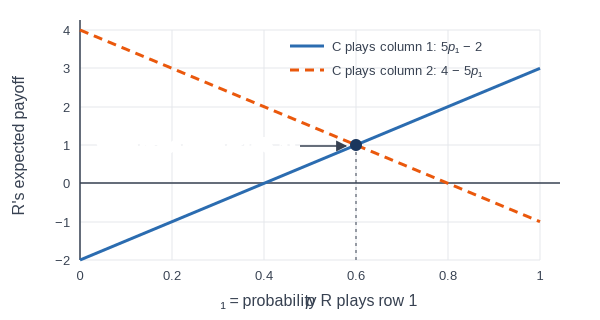
Answer: R plays row 1 with probability \tfrac{3}{5} and row 2 with probability \tfrac{2}{5}. C plays each column half the time. The value is v = 1, so the game favors R by 1 per round. In Example 1, C’s strategy was not optimal, which is why R did better than 1.
Example 3: A game that looks fair (word problem)
R and C each show one or two fingers at the same time. If both show one, C pays R $2. If both show two, C pays R $4. If they differ, R pays C $3. Each player can win $6 in total across the outcomes, so the game looks fair. Is it?
M = \begin{bmatrix} 2 & -3 \\ -3 & 4 \end{bmatrix}Rows and columns are “one finger” and “two fingers”; entries are R’s winnings.
\max(-3, -3) = -3
The row minimums are both −3.
\min(2, 4) = 2
The column maximums are 2 and 4. Since −3 ≠ 2, there is no saddle point.
D = 2 + 4 - (-3) - (-3)
Substitute into D = a + d − b − c.
D = 2 + 4 + 3 + 3 = 12
Subtracting a negative number adds it.
p_1 = \dfrac{4 - (-3)}{12} = \dfrac{7}{12}Substitute into the formula for p_1, then subtract.
p_2 = 1 - \dfrac{7}{12} = \dfrac{5}{12}The two probabilities add to 1.
q_1 = \dfrac{4 - (-3)}{12} = \dfrac{7}{12}Substitute into the formula for q_1, then subtract.
q_2 = 1 - \dfrac{7}{12} = \dfrac{5}{12}The two probabilities add to 1.
v = \dfrac{2(4) - (-3)(-3)}{12}Substitute into the formula for v.
v = \dfrac{8 - 9}{12}Multiply.
v = -\dfrac{1}{12}Subtract.
-\dfrac{1}{12} \approx -0.083Divide to get dollars per round.
Answer: the game is not fair. Both players should show one finger \tfrac{7}{12} of the time. Then C wins about 8 cents per round on average, since v = -\tfrac{1}{12} is negative.
Example 4: Removing a dominated column first
Solve the game M = \begin{bmatrix} 1 & 4 & 3 \\ 5 & 2 & 6 \end{bmatrix}.
1 \le 3,\ 5 \le 6
Compare column 1 with column 3. Column 1 is never larger, and C wants small payoffs.
M' = \begin{bmatrix} 1 & 4 \\ 5 & 2 \end{bmatrix}Column 3 is dominated, so C never plays it. Delete it.
\max(1, 2) = 2
The row minimums are 1 and 2.
\min(5, 4) = 4
The column maximums are 5 and 4. Since 2 ≠ 4, there is no saddle point.
D = 1 + 2 - 4 - 5 = -6
Substitute into D = a + d − b − c.
p_1 = \dfrac{2 - 5}{-6} = \dfrac{-3}{-6}Substitute into the formula for p_1, then subtract.
p_1 = \dfrac{1}{2},\ p_2 = \dfrac{1}{2}Simplify; the probabilities add to 1.
q_1 = \dfrac{2 - 4}{-6} = \dfrac{-2}{-6}Substitute into the formula for q_1, then subtract.
q_1 = \dfrac{1}{3},\ q_2 = \dfrac{2}{3}Simplify; the probabilities add to 1.
v = \dfrac{1(2) - 4(5)}{-6}Substitute into the formula for v.
v = \dfrac{2 - 20}{-6} = \dfrac{-18}{-6}Multiply, then subtract.
v = 3
Divide.
\tfrac{1}{2}(3) + \tfrac{1}{2}(6) = \tfrac{9}{2}Check the deleted column: R would get 4.5 against it.
\tfrac{9}{2} \gt 3That is more than v, so C is right to skip column 3.
Answer: R plays each row half the time. C plays column 1 with probability \tfrac{1}{3}, column 2 with probability \tfrac{2}{3} and never column 3. The value is 3.
Example 5: Penalty kicks (word problem)
In soccer, a kicker aims left or right, and the goalie dives left or right. From past games, the kicker scores 55% of the time when both pick left, 95% when the kicker aims left and the goalie dives right, 90% when the kicker aims right and the goalie dives left, and 60% when both pick right. The kicker wants a high scoring rate and the goalie wants a low one. How should each one mix?
M = \begin{bmatrix} 55 & 95 \\ 90 & 60 \end{bmatrix}Rows: kicker aims left, right. Columns: goalie dives left, right. Entries are scoring percents.
\max(55, 60) = 60
The row minimums are 55 and 60.
\min(90, 95) = 90
The column maximums are 90 and 95. Since 60 ≠ 90, there is no saddle point.
D = 55 + 60 - 95 - 90 = -70
Substitute into D = a + d − b − c.
p_1 = \dfrac{60 - 90}{-70} = \dfrac{-30}{-70}Substitute into the formula for p_1, then subtract.
p_1 = \dfrac{3}{7} \approx 0.43Simplify, then divide.
p_2 = 1 - \dfrac{3}{7} = \dfrac{4}{7}The two probabilities add to 1.
q_1 = \dfrac{60 - 95}{-70} = \dfrac{-35}{-70}Substitute into the formula for q_1, then subtract.
q_1 = \dfrac{1}{2},\ q_2 = \dfrac{1}{2}Simplify; the probabilities add to 1.
v = \dfrac{55(60) - 95(90)}{-70}Substitute into the formula for v.
v = \dfrac{3300 - 8550}{-70}Multiply.
v = \dfrac{-5250}{-70} = 75Subtract, then divide.
Answer: the kicker should aim left \tfrac{3}{7} of the time (about 43%) and right \tfrac{4}{7} of the time. The goalie should dive each way half the time. Then the kicker scores 75% of the time, and neither player can do better by switching alone.
Common mistakes
| Mistake | Example of the error | Fix |
|---|---|---|
| Using the mixed strategy formulas when there is a saddle point | Solving \begin{bmatrix} 3 & 1 \\ 2 & 0 \end{bmatrix} with the formulas | Check for a saddle point first. Here 1 is a saddle point, so both players use pure strategies and v = 1. |
| Mixing up the p and q formulas | Writing q_1 = \frac{d - c}{D} | p_1 uses d − c and q_1 uses d − b. Check that each entry of pM equals v. |
| Sign errors in D | In Example 2, D = 3 + 4 - 1 - 2 = 4 | Subtracting a negative adds: D = 3 + 4 + 1 + 2 = 10. |
| Getting a probability below 0 or above 1 | p_1 = \tfrac{6}{5} | A probability must be between 0 and 1. Recheck D and look for a saddle point or a dominated row. |
| Deleting the wrong row or column | Deleting column 1 in Example 4 because its first entry is smallest | R deletes rows with smaller entries; C deletes columns with larger entries, compared entry by entry. |
| Thinking the value is won every round | “v = 1, so R wins 1 each round” | v is the long-run average. Single rounds still vary. |
Related ideas
The graphing method
The graph after Example 2 shows R’s payoff against each column as a line in p_1. R gets the lower of the two lines, because C can switch to the worse column. The highest point on that lower edge is where the lines cross, so the crossing gives p_1 and v.
Why the check works
At the optimal p, R gets the same payoff v against every column C uses. So C cannot gain by switching. The same is true for q against R’s rows. This balance is called an equilibrium.
Larger games
Games bigger than 2 × 2 that do not reduce by dominance can be solved with linear programming. Each game becomes a pair of linear programs, and the simplex method finds p, q and v.
Practice problems
- For M = \begin{bmatrix} 2 & -1 \\ 0 & 3 \end{bmatrix}, p = \begin{bmatrix} \tfrac{1}{3} & \tfrac{2}{3} \end{bmatrix} and q_1 = q_2 = \tfrac{1}{2}, find the expected payoff E.
- Show that M = \begin{bmatrix} 4 & -2 \\ -1 & 3 \end{bmatrix} has no saddle point.
- Find the optimal strategies and the value of the game in Problem 2.
- Check your answer to Problem 3: find pM.
- In matching pennies, M = \begin{bmatrix} 1 & -1 \\ -1 & 1 \end{bmatrix}. Find the optimal strategies and the value. Is the game fair?
- Solve the game M = \begin{bmatrix} 0 & 5 \\ 3 & 1 \end{bmatrix}.
- Solve the game M = \begin{bmatrix} -2 & 3 \\ 1 & -1 \end{bmatrix}. Which player does it favor?
- Solve the game M = \begin{bmatrix} 2 & 0 \\ 1 & -1 \\ -1 & 3 \end{bmatrix} by first removing a dominated row.
- In Example 2, suppose R plays each row half the time. What is C’s best reply, and what does R expect then?
- A tennis server aims at the receiver’s forehand or backhand. The receiver leans forehand or backhand. The server wins 40% of points if both pick forehand, 80% if the server aims forehand and the receiver leans backhand, 70% if the server aims backhand and the receiver leans forehand, and 50% if both pick backhand. Find the server’s best mix and winning rate.
Show answers
1.
\tfrac{1}{3}(2) + \tfrac{2}{3}(0) = \tfrac{2}{3}Entry 1 of pM.
\tfrac{1}{3}(-1) + \tfrac{2}{3}(3) = -\tfrac{1}{3} + 2Entry 2 of pM: multiply.
-\tfrac{1}{3} + 2 = \tfrac{5}{3}Add.
\tfrac{2}{3} \cdot \tfrac{1}{2} + \tfrac{5}{3} \cdot \tfrac{1}{2} = \tfrac{1}{3} + \tfrac{5}{6}Multiply pM by q.
\tfrac{1}{3} + \tfrac{5}{6} = \tfrac{7}{6}Add.
Answer: E = \tfrac{7}{6} \approx 1.17
2.
\max(-2, -1) = -1
The row minimums are −2 and −1.
\min(4, 3) = 3
The column maximums are 4 and 3.
-1 \ne 3
Maximin and minimax differ.
Answer: no saddle point, because the maximin −1 is not equal to the minimax 3
3.
D = 4 + 3 - (-2) - (-1)
Substitute into D = a + d − b − c.
D = 4 + 3 + 2 + 1 = 10
Subtracting a negative adds it.
p_1 = \dfrac{3 - (-1)}{10} = \dfrac{4}{10}Substitute into the formula for p_1, then subtract.
p_1 = \dfrac{2}{5},\ p_2 = \dfrac{3}{5}Simplify; the probabilities add to 1.
q_1 = \dfrac{3 - (-2)}{10} = \dfrac{5}{10}Substitute into the formula for q_1, then subtract.
q_1 = \dfrac{1}{2},\ q_2 = \dfrac{1}{2}Simplify; the probabilities add to 1.
v = \dfrac{4(3) - (-2)(-1)}{10} = \dfrac{12 - 2}{10}Substitute into the formula for v, then multiply.
v = \dfrac{10}{10} = 1Subtract, then divide.
Answer: p = \begin{bmatrix} \tfrac{2}{5} & \tfrac{3}{5} \end{bmatrix}, q_1 = q_2 = \tfrac{1}{2}, v = 1
4.
\tfrac{2}{5}(4) + \tfrac{3}{5}(-1) = \tfrac{8}{5} - \tfrac{3}{5}Entry 1 of pM: multiply.
\tfrac{8}{5} - \tfrac{3}{5} = 1Subtract.
\tfrac{2}{5}(-2) + \tfrac{3}{5}(3) = -\tfrac{4}{5} + \tfrac{9}{5}Entry 2 of pM: multiply.
-\tfrac{4}{5} + \tfrac{9}{5} = 1Add.
Answer: pM = \begin{bmatrix} 1 & 1 \end{bmatrix}; both entries equal v, so the answer checks
5.
\max(-1, -1) = -1,\ \min(1, 1) = 1
Maximin −1 and minimax 1 differ, so there is no saddle point.
D = 1 + 1 - (-1) - (-1) = 4
Substitute into D = a + d − b − c.
p_1 = \dfrac{1 - (-1)}{4} = \dfrac{2}{4} = \dfrac{1}{2}Substitute, subtract, then simplify.
q_1 = \dfrac{1 - (-1)}{4} = \dfrac{1}{2}Substitute, subtract, then simplify.
v = \dfrac{1(1) - (-1)(-1)}{4} = \dfrac{1 - 1}{4}Substitute into the formula for v, then multiply.
v = \dfrac{0}{4} = 0Subtract, then divide.
Answer: each player picks each side half the time; v = 0, so the game is fair
6.
\max(0, 1) = 1,\ \min(3, 5) = 3
Maximin 1 and minimax 3 differ, so there is no saddle point.
D = 0 + 1 - 5 - 3 = -7
Substitute into D = a + d − b − c.
p_1 = \dfrac{1 - 3}{-7} = \dfrac{-2}{-7} = \dfrac{2}{7}Substitute, subtract, then simplify.
q_1 = \dfrac{1 - 5}{-7} = \dfrac{-4}{-7} = \dfrac{4}{7}Substitute, subtract, then simplify.
v = \dfrac{0(1) - 5(3)}{-7} = \dfrac{-15}{-7}Substitute into the formula for v, then multiply and subtract.
v = \dfrac{15}{7} \approx 2.14Simplify, then divide.
Answer: p = \begin{bmatrix} \tfrac{2}{7} & \tfrac{5}{7} \end{bmatrix}, q_1 = \tfrac{4}{7}, q_2 = \tfrac{3}{7}, v = \tfrac{15}{7}
7.
\max(-2, -1) = -1,\ \min(1, 3) = 1
Maximin −1 and minimax 1 differ, so there is no saddle point.
D = -2 + (-1) - 3 - 1 = -7
Substitute into D = a + d − b − c.
p_1 = \dfrac{-1 - 1}{-7} = \dfrac{-2}{-7} = \dfrac{2}{7}Substitute, subtract, then simplify.
q_1 = \dfrac{-1 - 3}{-7} = \dfrac{-4}{-7} = \dfrac{4}{7}Substitute, subtract, then simplify.
v = \dfrac{(-2)(-1) - 3(1)}{-7} = \dfrac{2 - 3}{-7}Substitute into the formula for v, then multiply.
v = \dfrac{-1}{-7} = \dfrac{1}{7}Subtract, then divide.
Answer: p = \begin{bmatrix} \tfrac{2}{7} & \tfrac{5}{7} \end{bmatrix}, q_1 = \tfrac{4}{7}, q_2 = \tfrac{3}{7}, v = \tfrac{1}{7}; the value is positive, so the game favors R
8.
2 \ge 1,\ 0 \ge -1
Row 1 is at least as large as row 2 in every column, and R wants large payoffs.
M' = \begin{bmatrix} 2 & 0 \\ -1 & 3 \end{bmatrix}Delete the dominated row 2.
\max(0, -1) = 0,\ \min(2, 3) = 2
Maximin 0 and minimax 2 differ, so there is no saddle point.
D = 2 + 3 - 0 - (-1) = 6
Substitute into D = a + d − b − c.
p_1 = \dfrac{3 - (-1)}{6} = \dfrac{4}{6} = \dfrac{2}{3}Substitute, subtract, then simplify.
q_1 = \dfrac{3 - 0}{6} = \dfrac{3}{6} = \dfrac{1}{2}Substitute, subtract, then simplify.
v = \dfrac{2(3) - 0(-1)}{6} = \dfrac{6}{6} = 1Substitute, multiply, then divide.
Answer: R plays row 1 with probability \tfrac{2}{3}, row 2 never and row 3 with probability \tfrac{1}{3}; C plays each column half the time; v = 1
9.
\tfrac{1}{2}(3) + \tfrac{1}{2}(-2) = \tfrac{1}{2}R’s payoff if C plays column 1 (from Example 1).
\tfrac{1}{2}(-1) + \tfrac{1}{2}(4) = \tfrac{3}{2}R’s payoff if C plays column 2.
\tfrac{1}{2} \lt \tfrac{3}{2}C wants the smaller payoff.
Answer: C should always play column 1; R then expects only \tfrac{1}{2} per round, less than the value 1
10.
M = \begin{bmatrix} 40 & 80 \\ 70 & 50 \end{bmatrix}Rows: server aims forehand, backhand. Columns: receiver leans forehand, backhand.
\max(40, 50) = 50,\ \min(70, 80) = 70
Maximin 50 and minimax 70 differ, so there is no saddle point.
D = 40 + 50 - 80 - 70 = -60
Substitute into D = a + d − b − c.
p_1 = \dfrac{50 - 70}{-60} = \dfrac{-20}{-60} = \dfrac{1}{3}Substitute, subtract, then simplify.
v = \dfrac{40(50) - 80(70)}{-60} = \dfrac{2000 - 5600}{-60}Substitute into the formula for v, then multiply.
v = \dfrac{-3600}{-60} = 60Subtract, then divide.
Answer: aim at the forehand \tfrac{1}{3} of the time and the backhand \tfrac{2}{3} of the time; the server then wins 60% of points
Mixed strategy games FAQ
What is a mixed strategy in game theory?
A mixed strategy is a plan to choose each option with a set probability, such as row 1 with probability 3/5 and row 2 with probability 2/5. It keeps the other player from predicting your move.
How do you find the optimal mixed strategy for a 2 × 2 game?
First check that there is no saddle point. Then use p_1 = \frac{d - c}{D} and q_1 = \frac{d - b}{D} with D = a + d - b - c, and subtract each from 1 to get the other probability.
What is the value of a game?
The value is the expected payoff to R when both players use their optimal strategies. For a 2 × 2 game without a saddle point, v = \frac{ad - bc}{D}.
When is a game fair?
A game is fair when its value is 0, so neither player wins on average with best play. A game can look fair, as in Example 3, and still favor one player.
Summary
- A mixed strategy gives a probability for each row (p) or column (q); each list adds to 1.
- The expected payoff to R is E = pMq.
- Check for a saddle point and remove dominated rows or columns first.
- For a 2 × 2 game with no saddle point, D = a + d - b - c, p_1 = \frac{d - c}{D}, q_1 = \frac{d - b}{D} and v = \frac{ad - bc}{D}.
- Check that every entry of pM equals v. The game is fair when v = 0.
Previous lesson: Strictly Determined Games
Next lesson: Marginal Analysis
Back to the Finite Math Index