
Strictly Determined Games
A strictly determined game is a two-player game whose payoff matrix has a saddle point: an entry that is the smallest in its row and the largest in its column. Each player’s best plan is then to play that entry’s row or column every time, and the entry is the value of the game.
Before this lesson: Matrix Operations and Absorbing Markov Chains
The idea
Two players, called R (rows) and C (columns), each choose a strategy at the same time. In a zero-sum game, whatever one player wins, the other loses. A payoff matrix lists what R wins for each pair of choices. A negative entry means R pays C.
R wants big entries, and C wants small ones. A careful R asks, “What is the worst that can happen in each row?” and picks the row with the best worst case. A careful C asks the same about each column. When both answers land on the same entry, neither player can do better by switching alone. That entry is a saddle point.
How to find a saddle point
- Write the smallest entry of each row (the row minimums). The largest of these is the maximin, R’s guaranteed result.
- Write the largest entry of each column (the column maximums). The smallest of these is the minimax, the most C can be forced to pay.
- If the maximin equals the minimax, the game is strictly determined. The entry where they meet is a saddle point, and its value is the value of the game.
- The optimal pure strategies are R’s row and C’s column through the saddle point. If the value is 0, the game is fair.
\max(\text{row minimums}) = \min(\text{column maximums}) = v \quad \Rightarrow \quad \text{strictly determined with value } vThe maximin is never larger than the minimax. When the maximin is smaller, there is no saddle point, and players should mix their strategies (the next lesson).
Strictly determined game examples
Example 1: Finding a saddle point
Find the saddle point, the optimal strategies and the value of the game.
M = \begin{bmatrix} 3 & -1 & 2 \\ 4 & 1 & 5 \\ -2 & 0 & 6 \end{bmatrix}\min(3, -1, 2) = -1
Row 1 minimum.
\min(4, 1, 5) = 1
Row 2 minimum.
\min(-2, 0, 6) = -2
Row 3 minimum.
\max(-1, 1, -2) = 1
The maximin is 1, in row 2.
\max(3, 4, -2) = 4
Column 1 maximum.
\max(-1, 1, 0) = 1
Column 2 maximum.
\max(2, 5, 6) = 6
Column 3 maximum.
\min(4, 1, 6) = 1
The minimax is 1, in column 2.
1 = 1
Maximin equals minimax, so the game is strictly determined.
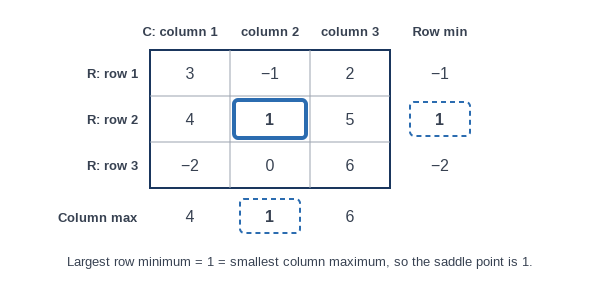
Answer: the saddle point is the 1 in row 2, column 2. R should always play row 2, C should always play column 2, and the value of the game is 1, so R wins 1 per play on average.
Example 2: A game that is not strictly determined
Decide whether M = \begin{bmatrix} 2 & -3 \\ -1 & 4 \end{bmatrix} is strictly determined.
\min(2, -3) = -3,\ \min(-1, 4) = -1
Row minimums.
\max(-3, -1) = -1
The maximin is −1.
\max(2, -1) = 2,\ \max(-3, 4) = 4
Column maximums.
\min(2, 4) = 2
The minimax is 2.
-1 \ne 2
Maximin and minimax differ.
Answer: not strictly determined, because there is no saddle point. If R always played one row, C could exploit it, so both players should mix their choices. That is the topic of the next lesson, Mixed Strategy Games.
Example 3: Is the game fair?
Decide whether the game is strictly determined and fair.
M = \begin{bmatrix} 0 & 2 & -1 \\ 1 & 3 & 0 \\ -2 & 4 & -3 \end{bmatrix}\min(0, 2, -1) = -1,\ \min(1, 3, 0) = 0,\ \min(-2, 4, -3) = -3
Row minimums.
\max(-1, 0, -3) = 0
The maximin is 0, in row 2.
\max(0, 1, -2) = 1,\ \max(2, 3, 4) = 4,\ \max(-1, 0, -3) = 0
Column maximums.
\min(1, 4, 0) = 0
The minimax is 0, in column 3.
0 = 0
They are equal, so the saddle point is the 0 in row 2, column 3.
Answer: the game is strictly determined with value 0, so it is fair. With best play, neither player wins in the long run.
Example 4: Removing dominated strategies first
Simplify the game with dominance, then find its value.
M = \begin{bmatrix} 1 & 4 & 3 \\ 2 & 5 & 6 \\ 0 & 3 & 2 \end{bmatrix}A row dominates another row if each of its entries is at least as large, because R never does worse with it. A column dominates another column if each of its entries is at most as large, because C wants small payoffs.
(2, 5, 6) \text{ vs. } (1, 4, 3):\ 2 \ge 1,\ 5 \ge 4,\ 6 \ge 3Row 2 dominates row 1, so delete row 1.
(2, 5, 6) \text{ vs. } (0, 3, 2):\ 2 \ge 0,\ 5 \ge 3,\ 6 \ge 2Row 2 dominates row 3, so delete row 3.
\begin{bmatrix} 2 & 5 & 6 \end{bmatrix}Only row 2 is left.
\min(2, 5, 6) = 2
C chooses the smallest entry, in column 1.
\max(1, 2, 0) = 2
Check in the full matrix: 2 is the largest entry of column 1.
Answer: the saddle point is the 2 in row 2, column 1, and the value of the game is 2. Dominance does not change the value; it only makes the matrix smaller.
Example 5: Competing ad campaigns (word problem)
Store R can advertise on TV, radio or online. Store C can advertise on TV or online. The matrix gives the percentage points of market share R gains from C. Which choice should each store make, and what happens?
M = \begin{bmatrix} 2 & -1 \\ 3 & 1 \\ -1 & 0 \end{bmatrix} \quad \text{(rows: TV, radio, online; columns: TV, online)}\min(2, -1) = -1,\ \min(3, 1) = 1,\ \min(-1, 0) = -1
Row minimums for TV, radio and online.
\max(-1, 1, -1) = 1
The maximin is 1, for radio.
\max(2, 3, -1) = 3,\ \max(-1, 1, 0) = 1
Column maximums for TV and online.
\min(3, 1) = 1
The minimax is 1, for online.
1 = 1
The saddle point is radio (R) against online (C).
Answer: Store R should advertise on radio and Store C online. R gains 1 percentage point of market share. Neither store can do better by changing only its own choice.
Common mistakes
| Mistake | Example of the error | Fix |
|---|---|---|
| Using row maximums instead of row minimums | Taking the largest entry of each row in Example 1 | R plans for the worst case: use the minimum of each row, then the largest of those. |
| Using column minimums for C | Taking the smallest entry of each column | Payoffs go to R, so C fears the largest entry in each column. Use column maximums, then the smallest. |
| Calling the largest entry a saddle point | Choosing 6 in Example 1 | A saddle point is the smallest in its row and the largest in its column. |
| Reading the payoff from C’s point of view | Treating −1 as a gain for R | Entries are R’s winnings; a negative entry means R pays C. |
| Deleting the wrong column with dominance | Deleting a column with smaller entries | C prefers small payoffs, so a column with larger entries is the dominated one. |
| Thinking “fair” means equal payoffs | Calling a game fair because it has as many positive as negative entries | A game is fair when its value is 0. |
Related ideas
More than one saddle point
A game can have several saddle points, but they all have the same value. Any row and column through a saddle point is an optimal pair of strategies (see Practice Problem 8).
Saddle points in calculus
The name comes from the shape of a saddle, which is lowest along one direction and highest along another. A payoff saddle point is a minimum across its row and a maximum down its column, just like a saddle point of a surface in extrema of functions of two variables.
Value, expected value and linear programming
The value is R’s average winnings per play with best play, the same idea as an expected value. Games without a saddle point can be solved with linear programming or the simplex method.
Practice problems
- Find the saddle point and value of \begin{bmatrix} 5 & 1 \\ 3 & 2 \end{bmatrix}.
- Is \begin{bmatrix} 4 & -2 \\ -3 & 1 \end{bmatrix} strictly determined?
- Find the saddle point and value of \begin{bmatrix} -1 & 2 & 0 \\ 3 & 4 & 1 \\ 2 & -5 & -2 \end{bmatrix}.
- Is \begin{bmatrix} 0 & -1 \\ 1 & 0 \end{bmatrix} strictly determined? Is it fair?
- Find the optimal strategies and value of \begin{bmatrix} 6 & 2 & 4 \\ 1 & -3 & 0 \end{bmatrix}.
- Use dominance to simplify \begin{bmatrix} 3 & 1 & 4 \\ 2 & 0 & 3 \\ 5 & 2 & 6 \end{bmatrix}, then find the value.
- In \begin{bmatrix} 1 & 4 \\ 2 & 3 \end{bmatrix}, explain why 4 is not a saddle point, and find the saddle point.
- Find every saddle point of \begin{bmatrix} 2 & 3 & 2 \\ 1 & 4 & 0 \\ 2 & 5 & 2 \end{bmatrix}.
- Candidate R campaigns in the city or the suburbs; candidate C campaigns in the city, the suburbs or rural areas. The matrix \begin{bmatrix} -2 & 3 & 1 \\ 0 & 2 & 4 \end{bmatrix} gives the votes, in thousands, that R gains. Find each candidate’s best choice and the value.
- In a matching game, R and C each show heads or tails. If they match, C pays R $1; if not, R pays C $1. Write the payoff matrix and decide whether the game is strictly determined.
Show answers
1.
\min(5, 1) = 1,\ \min(3, 2) = 2
Row minimums.
\max(1, 2) = 2
Maximin, in row 2.
\max(5, 3) = 5,\ \max(1, 2) = 2
Column maximums.
\min(5, 2) = 2
Minimax, in column 2.
Answer: saddle point 2 in row 2, column 2; value 2.
2.
\min(4, -2) = -2,\ \min(-3, 1) = -3
Row minimums.
\max(-2, -3) = -2
Maximin.
\max(4, -3) = 4,\ \max(-2, 1) = 1
Column maximums.
\min(4, 1) = 1
Minimax.
Answer: No, because −2 ≠ 1.
3.
\min(-1, 2, 0) = -1,\ \min(3, 4, 1) = 1,\ \min(2, -5, -2) = -5
Row minimums.
\max(-1, 1, -5) = 1
Maximin, in row 2.
\max(-1, 3, 2) = 3,\ \max(2, 4, -5) = 4,\ \max(0, 1, -2) = 1
Column maximums.
\min(3, 4, 1) = 1
Minimax, in column 3.
Answer: saddle point 1 in row 2, column 3; value 1.
4.
\min(0, -1) = -1,\ \min(1, 0) = 0
Row minimums; the maximin is 0.
\max(0, 1) = 1,\ \max(-1, 0) = 0
Column maximums; the minimax is 0.
Answer: Yes. The saddle point is the 0 in row 2, column 2, and the game is fair (value 0).
5.
\min(6, 2, 4) = 2,\ \min(1, -3, 0) = -3
Row minimums; the maximin is 2, in row 1.
\max(6, 1) = 6,\ \max(2, -3) = 2,\ \max(4, 0) = 4
Column maximums; the minimax is 2, in column 2.
Answer: R plays row 1, C plays column 2, and the value is 2.
6.
5 \ge 3,\ 2 \ge 1,\ 6 \ge 4
Row 3 dominates row 1.
5 \ge 2,\ 2 \ge 0,\ 6 \ge 3
Row 3 dominates row 2.
\min(5, 2, 6) = 2
With only row 3 left, C picks column 2.
\max(1, 0, 2) = 2
Check: 2 is the largest entry of column 2.
Answer: value 2, at row 3, column 2.
7.
\min(1, 4) = 1 \ne 4
4 is not the smallest entry in row 1.
\min(1, 4) = 1,\ \min(2, 3) = 2
Row minimums; the maximin is 2, in row 2.
\max(1, 2) = 2,\ \max(4, 3) = 4
Column maximums; the minimax is 2, in column 1.
Answer: 4 is largest in its column but not smallest in its row. The saddle point is the 2 in row 2, column 1.
8.
\min(2, 3, 2) = 2,\ \min(1, 4, 0) = 0,\ \min(2, 5, 2) = 2
Row minimums; the maximin 2 occurs in rows 1 and 3.
\max(2, 1, 2) = 2,\ \max(3, 4, 5) = 5,\ \max(2, 0, 2) = 2
Column maximums; the minimax 2 occurs in columns 1 and 3.
Answer: four saddle points, at (row 1, column 1), (1, 3), (3, 1) and (3, 3), each with value 2.
9.
\min(-2, 3, 1) = -2,\ \min(0, 2, 4) = 0
Row minimums; the maximin is 0, for the suburbs.
\max(-2, 0) = 0,\ \max(3, 2) = 3,\ \max(1, 4) = 4
Column maximums; the minimax is 0, for the city.
Answer: R campaigns in the suburbs and C in the city. The value is 0, so neither gains votes: the game is fair.
10.
M = \begin{bmatrix} 1 & -1 \\ -1 & 1 \end{bmatrix}Rows and columns in the order heads, tails.
\max(-1, -1) = -1
Both row minimums are −1, so the maximin is −1.
\min(1, 1) = 1
Both column maximums are 1, so the minimax is 1.
Answer: not strictly determined, because −1 ≠ 1.
Strictly determined games FAQ
What is a saddle point in game theory?
It is an entry of the payoff matrix that is the smallest in its row and the largest in its column. Neither player can gain by switching away from it alone.
How do you know if a game is strictly determined?
Find the largest row minimum and the smallest column maximum. The game is strictly determined exactly when these two numbers are equal.
What is the value of a game?
It is the amount R wins per play, on average, when both players play their best strategies. In a strictly determined game, it is the saddle point entry.
What is a fair game?
A game is fair when its value is 0, so neither player has an advantage with best play.
Summary
- In a payoff matrix, entries are R’s winnings; R wants large entries and C wants small ones.
- Maximin: the largest row minimum. Minimax: the smallest column maximum.
- If they are equal, the game is strictly determined, and the meeting entry is a saddle point.
- The optimal pure strategies are the saddle point’s row and column, and its entry is the value.
- Dominance removes rows and columns that a player would never use, without changing the value.
Previous lesson: Absorbing Markov Chains
Next lesson: Mixed Strategy Games
Back to the Finite Math and Business Calculus Index