
Cobb-Douglas Production Function
The Cobb-Douglas production function Q = AL^aK^b gives the output a business makes from L units of labor and K units of capital. Its partial derivatives \frac{\partial Q}{\partial L} and \frac{\partial Q}{\partial K} are the marginal productivity of labor and of capital: the extra output from one more unit of each input.
Before this lesson: Partial Derivatives, Rational Exponents and Marginal Analysis
What a production function measures
A factory turns inputs into output. Two key inputs are labor L, such as worker-hours, and capital K, such as machine-hours or money spent on equipment. A production function Q(L, K) tells you how many units come out.
Economists Charles Cobb and Paul Douglas fit the formula Q = AL^aK^b to U.S. factory data in 1928. It is still the most common production model in business and economics classes.
To see what one input adds, hold the other one fixed. That is exactly what a partial derivative does. The marginal product of labor \frac{\partial Q}{\partial L} is about how much more output one more unit of labor brings when capital stays the same.
The Cobb-Douglas formula
Q(L, K) = AL^{a}K^{b}- A is a positive constant that measures overall productivity, such as technology.
- a and b are numbers between 0 and 1. They are called the output elasticities of labor and capital. A 1% increase in labor raises output by about a%.
- Many textbooks use b = 1 - a, so the formula becomes Q = AL^aK^{1-a}.
Use the power rule on one variable at a time, treating the other as a constant:
\frac{\partial Q}{\partial L} = aAL^{a-1}K^{b} \qquad \frac{\partial Q}{\partial K} = bAL^{a}K^{b-1}Shortcut. Since aAL^{a-1}K^b = a \cdot \frac{AL^aK^b}{L}, the marginal products are also \frac{\partial Q}{\partial L} = \frac{aQ}{L} and \frac{\partial Q}{\partial K} = \frac{bQ}{K}. This is a quick way to check your answers.
Returns to scale
What happens if you multiply both inputs by the same number t? The exponents add:
Q(tL, tK) = A(tL)^{a}(tK)^{b} = t^{a+b} \cdot AL^{a}K^{b} = t^{a+b}Q- If a + b = 1, output grows by the same factor t. This is constant returns to scale.
- If a + b \gt 1, output grows by more than t: increasing returns to scale.
- If a + b \lt 1, output grows by less than t: decreasing returns to scale.
How to find marginal productivity
- Write the function with decimal or fraction exponents.
- Take the partial derivative with respect to L, treating K as a constant.
- Take the partial derivative with respect to K, treating L as a constant.
- Substitute the given values of L and K. Rewrite negative exponents as fractions.
- Interpret each answer as extra units of output per extra unit of input.
Cobb-Douglas production function examples
Example 1: Output and marginal products
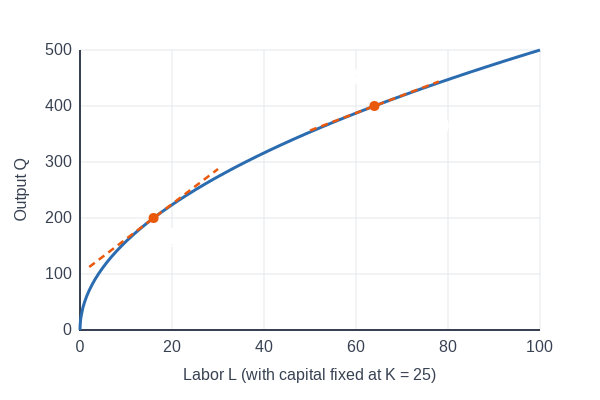
A company’s output is Q = 10L^{0.5}K^{0.5} units. Find the output and both marginal products when L = 16 and K = 25.
Q = 10(16)^{0.5}(25)^{0.5}Substitute L = 16 and K = 25.
= 10(4)(5)
A power of 0.5 is a square root (see rational exponents).
= 200
Multiply.
\frac{\partial Q}{\partial L} = 10(0.5)L^{-0.5}K^{0.5}Use the power rule on L and treat K as a constant (see partial derivatives).
= 5L^{-0.5}K^{0.5}Multiply the constants.
= 5 \cdot \frac{1}{4} \cdot 5Substitute: 16^{-0.5} = \frac{1}{\sqrt{16}} = \frac{1}{4} and 25^{0.5} = 5.
= 6.25
Multiply.
\frac{\partial Q}{\partial K} = 5L^{0.5}K^{-0.5}Use the power rule on K and treat L as a constant.
= 5 \cdot 4 \cdot \frac{1}{5}Substitute: 16^{0.5} = 4 and 25^{-0.5} = \frac{1}{5}.
= 4
Multiply.
Answer: Output is 200 units. One more unit of labor adds about 6.25 units, and one more unit of capital adds about 4 units. Check with the shortcut: \frac{0.5(200)}{16} = 6.25 and \frac{0.5(200)}{25} = 4.
Example 2: Unequal exponents
Find the output and both marginal products for Q = 100L^{0.75}K^{0.25} when L = 81 and K = 16.
81^{0.25} = 3,\quad 16^{0.25} = 2Take fourth roots, since 0.25 = \frac{1}{4}.
81^{0.75} = 3^3 = 27Cube the fourth root, since 0.75 = \frac{3}{4}.
Q = 100(27)(2)
Substitute into the formula.
= 5400
Multiply.
\frac{\partial Q}{\partial L} = 75L^{-0.25}K^{0.25}Power rule on L: 100(0.75) = 75.
= 75 \cdot \frac{1}{3} \cdot 2Substitute: 81^{-0.25} = \frac{1}{3}.
= 50
Multiply.
\frac{\partial Q}{\partial K} = 25L^{0.75}K^{-0.75}Power rule on K: 100(0.25) = 25.
= 25 \cdot 27 \cdot \frac{1}{8}Substitute: 16^{-0.75} = \frac{1}{2^3} = \frac{1}{8}.
= 84.375
Multiply.
\frac{0.75(5400)}{81} = 50,\quad \frac{0.25(5400)}{16} = 84.375Check with the shortcut \frac{aQ}{L} and \frac{bQ}{K}.
Answer: Q = 5400, the marginal product of labor is 50 and the marginal product of capital is 84.375 units.
Example 3: Returns to scale
Decide the returns to scale for Q_1 = 20L^{0.6}K^{0.4} and Q_2 = 5L^{0.5}K^{0.3}. What happens to each output when both inputs double?
Q_1(2L, 2K) = 20(2L)^{0.6}(2K)^{0.4}Replace L with 2L and K with 2K.
= 20 \cdot 2^{0.6}L^{0.6} \cdot 2^{0.4}K^{0.4}Use (2L)^{0.6} = 2^{0.6}L^{0.6} (see exponent rules).
= 2^{0.6 + 0.4} \cdot 20L^{0.6}K^{0.4}Multiply powers of 2 by adding exponents.
= 2Q_1
Add: 0.6 + 0.4 = 1.
0.5 + 0.3 = 0.8
Add the exponents of Q_2.
Q_2(2L, 2K) = 2^{0.8}Q_2Use Q(tL, tK) = t^{a+b}Q.
\approx 1.741Q_2
Evaluate 2^{0.8} with a calculator.
Answer: Q_1 has constant returns to scale: doubling both inputs doubles output. Q_2 has decreasing returns to scale: doubling both inputs multiplies output by only about 1.74.
Example 4: Which input to add (word problem)
A factory makes Q = 50L^{2/3}K^{1/3} parts per day with L = 125 worker-hours and K = 64 machine-hours. A worker-hour costs $20 and a machine-hour costs $30. Which input gives more output per dollar?
125^{1/3} = 5,\quad 64^{1/3} = 4Take cube roots.
125^{2/3} = 5^2 = 25Square the cube root.
Q = 50(25)(4)
Substitute into the formula.
= 5000
Multiply.
\frac{\partial Q}{\partial L} = \frac{2Q}{3L}Use the shortcut with a = \frac{2}{3}.
= \frac{2(5000)}{3(125)}Substitute Q = 5000 and L = 125.
= \frac{10000}{375}Multiply.
\approx 26.67
Divide.
\frac{\partial Q}{\partial K} = \frac{Q}{3K}Use the shortcut with b = \frac{1}{3}.
= \frac{5000}{3(64)}Substitute K = 64.
= \frac{5000}{192}Multiply.
\approx 26.04
Divide.
\frac{26.67}{20} \approx 1.33Divide by the cost of a worker-hour.
\frac{26.04}{30} \approx 0.87Divide by the cost of a machine-hour.
Answer: One more worker-hour adds about 1.33 parts per dollar, and one more machine-hour adds about 0.87 parts per dollar. The factory gets more output per dollar by adding labor.
Example 5: Estimating a change in output
The company in Example 1 is at L = 16 and K = 25. It plans to add 2 units of labor and cut 1 unit of capital. Estimate the change in output with the marginal products, then compare with the exact change.
\Delta Q \approx \frac{\partial Q}{\partial L}\Delta L + \frac{\partial Q}{\partial K}\Delta KEach marginal product times the change in its input (see linear approximation).
= 6.25(2) + 4(-1)
Substitute the marginal products from Example 1.
= 12.5 - 4
Multiply.
= 8.5
Subtract.
Q(18, 24) = 10\sqrt{18 \cdot 24}Find the exact new output. A power of 0.5 is a square root.
= 10\sqrt{432}Multiply under the root.
\approx 207.85
Evaluate with a calculator.
207.85 - 200 = 7.85
Subtract the old output.
Answer: The estimate is an increase of about 8.5 units, and the exact increase is about 7.85 units. The estimate is close because the changes in L and K are small.
Common mistakes
| Mistake | Example of the error | Fix |
|---|---|---|
| Taking the derivative of both variables at once | Writing \frac{\partial}{\partial L}(L^{0.5}K^{0.5}) = 0.5L^{-0.5} \cdot 0.5K^{-0.5} | K is a constant here. The answer is 0.5L^{-0.5}K^{0.5}. |
| Forgetting to subtract 1 from the exponent | Writing \frac{\partial Q}{\partial L} = 5L^{0.5}K^{0.5} for Q = 10L^{0.5}K^{0.5} | The new exponent is 0.5 - 1 = -0.5. |
| Making a negative exponent negative | Writing 16^{-0.5} = -4 | A negative exponent means a reciprocal: 16^{-0.5} = \frac{1}{4}. |
| Using A to judge returns to scale | Saying Q = 20L^{0.3}K^{0.3} has increasing returns because 20 is large | Only a + b matters. Here 0.6 \lt 1, so returns are decreasing. |
| Comparing marginal products without costs | Adding capital because 84.4 is more than 50, even when capital costs much more | Compare marginal product per dollar of each input. |
| Treating a marginal product as total output | Saying one more worker makes 6.25 units in all | It is the extra output from one more unit of that input, about 6.25 units. |
Related ideas
Diminishing returns. Since a - 1 is negative, the marginal product of labor aAL^{a-1}K^b gets smaller as L grows. The graph above shows this: each extra worker adds less than the one before when capital is fixed.
Marginal rate of technical substitution. The ratio \frac{\partial Q/\partial L}{\partial Q/\partial K} = \frac{aK}{bL} tells how many units of capital one unit of labor can replace while output stays the same.
Best mix of inputs. Spending is most efficient when each input gives the same output per dollar. Finding that mix under a budget is a Lagrange multipliers problem in Calculus 3.
Practice problems
- Find the output of Q = 4L^{0.5}K^{0.5} when L = 9 and K = 4.
- For the function in Problem 1, find both marginal products at L = 9 and K = 4.
- Find \frac{\partial Q}{\partial L} and \frac{\partial Q}{\partial K} for Q = 60L^{2/3}K^{1/3}.
- Evaluate the marginal products from Problem 3 at L = 27 and K = 8.
- Decide the returns to scale for Q = 3L^{0.7}K^{0.5}. By what factor does output grow if both inputs double?
- For Q = 80L^{0.25}K^{0.75}, find the output and both marginal products at L = 16 and K = 81.
- Show that \frac{\partial Q}{\partial L} = \frac{aQ}{L} for Q = AL^aK^b.
- For Q = 10L^{0.5}K^{0.5}, show that the marginal product of labor decreases as L increases.
- A bakery makes Q = 12L^{0.5}K^{0.5} loaves per hour with L = 4 workers and K = 9 ovens. A worker costs $18 per hour and an oven costs $10 per hour. Which input gives more loaves per dollar?
- For Q = 100L^{0.75}K^{0.25} at L = 81 and K = 16 (Example 2), estimate the change in output if L and K each increase by 1.
Show answers
1.
Q = 4(9)^{0.5}(4)^{0.5}Substitute L = 9 and K = 4.
= 4(3)(2)
Take square roots.
= 24
Multiply.
Answer: 24 units
2.
\frac{\partial Q}{\partial L} = 2L^{-0.5}K^{0.5}Power rule on L: 4(0.5) = 2.
= 2 \cdot \frac{1}{3} \cdot 2Substitute: 9^{-0.5} = \frac{1}{3}, 4^{0.5} = 2.
= \frac{4}{3} \approx 1.33Multiply.
\frac{\partial Q}{\partial K} = 2L^{0.5}K^{-0.5}Power rule on K.
= 2 \cdot 3 \cdot \frac{1}{2}Substitute: 9^{0.5} = 3, 4^{-0.5} = \frac{1}{2}.
= 3
Multiply.
Answer: about 1.33 units per unit of labor and 3 units per unit of capital
3.
\frac{\partial Q}{\partial L} = 60 \cdot \frac{2}{3}L^{-1/3}K^{1/3}Power rule on L: \frac{2}{3} - 1 = -\frac{1}{3}.
= 40L^{-1/3}K^{1/3}Multiply the constants.
\frac{\partial Q}{\partial K} = 60 \cdot \frac{1}{3}L^{2/3}K^{-2/3}Power rule on K: \frac{1}{3} - 1 = -\frac{2}{3}.
= 20L^{2/3}K^{-2/3}Multiply the constants.
4.
\frac{\partial Q}{\partial L} = 40 \cdot \frac{1}{3} \cdot 2Substitute: 27^{-1/3} = \frac{1}{3}, 8^{1/3} = 2.
= \frac{80}{3} \approx 26.67Multiply.
\frac{\partial Q}{\partial K} = 20 \cdot 9 \cdot \frac{1}{4}Substitute: 27^{2/3} = 3^2 = 9, 8^{-2/3} = \frac{1}{2^2} = \frac{1}{4}.
= 45
Multiply.
Answer: about 26.67 and 45
5.
0.7 + 0.5 = 1.2
Add the exponents.
1.2 \gt 1
Compare with 1: increasing returns to scale.
2^{1.2} \approx 2.297Evaluate t^{a+b} with t = 2.
Answer: increasing returns; output grows by a factor of about 2.30.
6.
16^{0.25} = 2,\quad 81^{0.25} = 3Take fourth roots.
81^{0.75} = 3^3 = 27Cube the fourth root of 81.
Q = 80(2)(27)
Substitute.
= 4320
Multiply.
\frac{\partial Q}{\partial L} = \frac{0.25(4320)}{16}Use the shortcut \frac{aQ}{L}.
= \frac{1080}{16}Multiply.
= 67.5
Divide.
\frac{\partial Q}{\partial K} = \frac{0.75(4320)}{81}Use the shortcut \frac{bQ}{K}.
= \frac{3240}{81}Multiply.
= 40
Divide.
Answer: Q = 4320, marginal products 67.5 and 40
7.
\frac{\partial Q}{\partial L} = aAL^{a-1}K^{b}Power rule on L.
= aAL^{a}L^{-1}K^{b}Split L^{a-1} = L^a \cdot L^{-1}.
= a \cdot \frac{AL^{a}K^{b}}{L}Write L^{-1} as division by L.
= \frac{aQ}{L}Replace AL^aK^b with Q.
8.
\frac{\partial Q}{\partial L} = 5L^{-0.5}K^{0.5}This is Example 1.
\frac{\partial^2 Q}{\partial L^2} = -2.5L^{-1.5}K^{0.5}Take the partial derivative with respect to L again.
-2.5L^{-1.5}K^{0.5} \lt 0L^{-1.5} and K^{0.5} are positive, so the result is negative.
Answer: the rate of change of the marginal product is negative, so the marginal product of labor decreases as L grows.
9.
\frac{\partial Q}{\partial L} = 6L^{-0.5}K^{0.5}Power rule on L.
= 6 \cdot \frac{1}{2} \cdot 3Substitute L = 4 and K = 9.
= 9
Multiply.
\frac{\partial Q}{\partial K} = 6L^{0.5}K^{-0.5}Power rule on K.
= 6 \cdot 2 \cdot \frac{1}{3}Substitute L = 4 and K = 9.
= 4
Multiply.
\frac{9}{18} = 0.5,\quad \frac{4}{10} = 0.4Divide each marginal product by its cost.
Answer: workers give 0.5 loaf per dollar and ovens give 0.4, so adding a worker is the better buy.
10.
\Delta Q \approx 50(1) + 84.375(1)
Use the marginal products from Example 2.
= 134.375
Add.
Answer: output rises by about 134 units. (The exact change is about 133.15.)
FAQ
What is the Cobb-Douglas production function?
It is the model Q = AL^aK^b for the output made from labor L and capital K. The constant A measures productivity, and the exponents a and b measure how strongly output responds to each input.
What is the marginal product of labor in a Cobb-Douglas function?
It is \frac{\partial Q}{\partial L} = aAL^{a-1}K^b, which also equals \frac{aQ}{L}. It is the extra output from one more unit of labor with capital held fixed.
What does a + b = 1 mean in a Cobb-Douglas function?
It means constant returns to scale: multiplying both inputs by any number t multiplies output by the same t. If a + b is more than 1 returns are increasing, and if it is less than 1 they are decreasing.
Why do the exponents have to be less than 1?
With 0 \lt a \lt 1, the marginal product of labor falls as more labor is added. That matches diminishing returns: the tenth worker at one machine adds less than the first.
Summary
- The Cobb-Douglas production function is Q = AL^aK^b, with labor L and capital K.
- The marginal products are \frac{\partial Q}{\partial L} = aAL^{a-1}K^b = \frac{aQ}{L} and \frac{\partial Q}{\partial K} = bAL^aK^{b-1} = \frac{bQ}{K}.
- Each marginal product is the extra output from one more unit of that input.
- a + b = 1 gives constant returns to scale, more than 1 increasing and less than 1 decreasing.
- To choose an input to add, compare marginal product per dollar.
Previous lesson: Lorenz Curve and Gini Index
Next lesson: Absolute and Relative Error, the first lesson of Numerical Methods. See the full Numerical Methods Index.
Back to the Finite Math Index