
Break-Even Analysis
Break-even analysis finds the number of items a business must sell so that revenue equals cost and profit is 0. This is the break-even point. Set R(x) = C(x) and solve for x. With fixed cost b, cost per item m and price p, the break-even quantity is x = \frac{b}{p - m}.
Before this lesson: Cost, Revenue and Profit Functions, Multi-Step Equations and Systems of Equations
What is the break-even point?
A new business usually starts with a loss. It has to pay fixed costs, like rent, before it sells anything. Each sale brings in a little more money than the item costs to make, and that extra money slowly pays off the fixed cost.
The break-even point is the sales level where the business has paid off all its costs but has not made any profit yet. Sell fewer items and the business loses money. Sell more and it makes a profit.
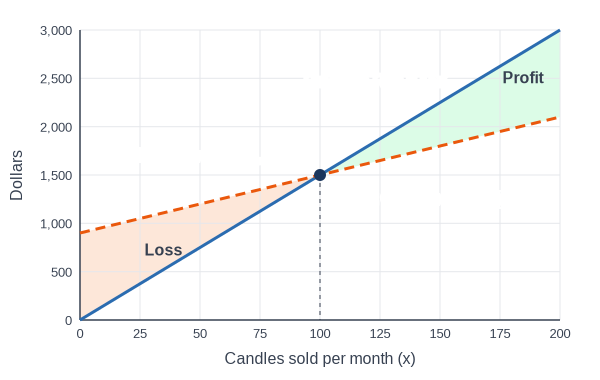
On a graph, the break-even point is where the revenue line crosses the cost line. It is the solution of a system of two linear equations, so you can find it by graphing or by algebra.
Break-even formula
Use the linear cost and revenue models from the last lesson: cost C(x) = mx + b and revenue R(x) = px. Here x is the number of items, b is the fixed cost, m is the variable cost per item, and p is the price.
| Idea | Formula | What it means |
|---|---|---|
| Break-even condition | R(x) = C(x), or P(x) = 0 | revenue covers every cost; profit is 0 |
| Break-even quantity | x = \frac{b}{p - m} | items needed to cover the fixed cost |
| Break-even revenue | R = p \cdot x | sales in dollars at the break-even point |
| Profit per item | p - m | money each sale puts toward the fixed cost |
The formula comes from solving px = mx + b. Subtract mx from both sides to get (p - m)x = b, then divide by p - m. Each item adds p - m dollars of profit, so you need enough items to add up to the fixed cost b.
The break-even quantity is often not a whole number. A business can’t sell part of an item, so round up to the next whole number. Rounding down leaves a small loss.
Break-even analysis examples
Example 1: Find the break-even point
A candle maker has fixed costs of $900 per month. Each candle costs $6 to make and sells for $15. Find the break-even quantity and the break-even revenue.
R(x) = C(x)
Set revenue equal to cost.
15x = 6x + 900
Write in the revenue and cost functions.
9x = 900
Subtract 6x from both sides (see variables on both sides).
x = 100
Divide both sides by 9.
R(100) = 15(100)
Put 100 into the revenue function.
R(100) = 1500
Multiply.
C(100) = 6(100) + 900
Check: put 100 into the cost function.
C(100) = 600 + 900
Multiply.
C(100) = 1500
Add. Cost equals revenue, so the answer checks.
Answer: the candle maker breaks even at 100 candles per month, which is $1,500 in sales. The graph shows why: the revenue line starts lower but climbs faster.
Example 2: Round up to a whole number
An online shop has fixed costs of $2,500 per month. Each phone case costs $4.25 to make and sells for $11. How many cases must the shop sell to break even?
x = \frac{b}{p - m}Use the break-even formula.
x = \frac{2500}{11 - 4.25}Put in b = 2,500, p = 11 and m = 4.25.
x = \frac{2500}{6.75}Subtract (see operations with decimals).
x \approx 370.37
Divide.
x = 371
Round up to the next whole case.
Check both whole numbers next to 370.37 with the profit function P(x) = 6.75x - 2500.
P(370) = 6.75(370) - 2500
Try 370 cases.
P(370) = 2497.50 - 2500
Multiply.
P(370) = -2.50
Subtract. This is a loss of $2.50.
P(371) = 6.75(371) - 2500
Try 371 cases.
P(371) = 2504.25 - 2500
Multiply.
P(371) = 4.25
Subtract. This is a profit of $4.25.
Answer: the shop needs to sell 371 cases. At 370 cases it still loses $2.50.
Example 3: Find where a business makes a profit
A company’s cost and revenue functions are C(x) = 12x + 4800 and R(x) = 20x. For which values of x does the company make a profit?
P(x) = 20x - (12x + 4800)
Profit is revenue minus cost.
P(x) = 20x - 12x - 4800
Distribute the minus sign (see distributive property).
P(x) = 8x - 4800
Combine like terms (see combining like terms).
8x - 4800 \gt 0
A profit means P(x) is greater than 0.
8x \gt 4800
Add 4,800 to both sides (see multi-step inequalities).
x \gt 600
Divide both sides by 8.
Answer: the break-even point is 600 items. The company makes a profit when it sells more than 600 items and has a loss when it sells fewer than 600.
Example 4: Find the price needed to break even
A small brand pays $6,000 to make a batch of hoodies, plus $18 for each hoodie. It expects to sell 400 hoodies. What price per hoodie lets it break even at 400?
400p = 18(400) + 6000
At the break-even point, revenue px equals cost mx + b, with x = 400.
400p = 7200 + 6000
Multiply.
400p = 13200
Add.
p = 33
Divide both sides by 400.
Check: revenue is 33 × 400 = $13,200, and cost is $7,200 + $6,000 = $13,200. Answer: a price of $33 lets the brand break even at 400 hoodies. Any higher price gives a profit at that sales level.
Example 5: A coffee cart (word problem)
A coffee cart pays $1,500 per month in rent. Each drink costs $1.20 to make and sells for $4.20. (a) Find the break-even point. (b) The rent goes up to $1,800. How many more drinks must the cart sell each month to break even? (c) With the new rent, the owner raises the price to $4.70. Find the new break-even point.
(a) Each drink adds 4.20 - 1.20 = 3 dollars toward the rent.
x = \frac{1500}{4.20 - 1.20}Use the break-even formula with b = 1,500.
x = \frac{1500}{3}Subtract.
x = 500
Divide.
(b) Use the new rent, b = 1,800.
x = \frac{1800}{3}Use the break-even formula with b = 1,800.
x = 600
Divide.
600 - 500 = 100
Subtract to compare with part (a).
(c) Use b = 1,800 and the new price, p = 4.70.
x = \frac{1800}{4.70 - 1.20}Use the break-even formula.
x = \frac{1800}{3.50}Subtract.
x \approx 514.29
Divide.
x = 515
Round up to a whole drink.
Answer: (a) 500 drinks per month. (b) 600 drinks, which is 100 more. (c) 515 drinks. Check (c): at 514 drinks the profit is 3.50(514) − 1,800 = −$1, a $1 loss, and at 515 drinks it is $2.50.
Common mistakes
| Mistake | Example of the error | Fix |
|---|---|---|
| Rounding the break-even quantity down | 370.37 cases rounded to 370 | Round up to 371. At 370 the shop still loses $2.50. |
| Dividing the fixed cost by the price | \frac{2500}{11} \approx 227 | Divide by the profit per item: \frac{2500}{11 - 4.25} \approx 370.37. |
| Leaving out the fixed cost | 15x = 6x, so x = 0 | Cost is C(x) = mx + b. Include b on the cost side. |
| Mixing up quantity and revenue | “Break even at 1,500 candles” | 100 is the number of candles; $1,500 is the revenue at that point. |
| Not distributing the minus sign in profit | 20x - 12x + 4800 | Write 20x - (12x + 4800) = 8x - 4800. |
Related ideas
Break-even by graphing
Graph y = R(x) and y = C(x) and find where they cross. The x-coordinate is the break-even quantity and the y-coordinate is the break-even revenue. This is the graphing method for systems of equations. Algebra gives the exact value, and the graph shows the loss and profit regions.
Break-even with the substitution method
Writing y = 15x and y = 6x + 900 and solving with the substitution method gives the same answer as Example 1. Setting R(x) = C(x) is substitution in a short form.
When revenue is not linear
If the price drops as more items are sold, revenue can be a quadratic, such as R(x) = 40x - 0.1x^2. Then R(x) = C(x) is a quadratic equation, so you solve it with the quadratic formula, and there can be two break-even points. Profit happens between them.
Supply and demand
The next lesson, Supply and Demand, also finds where two lines meet. There, the crossing point is the market price and quantity.
Practice problems
1. Fixed costs are $450, each item costs $5 to make, and it sells for $14. Find the break-even quantity.
2. Find the break-even point for C(x) = 7x + 2100 and R(x) = 13x.
3. Fixed costs are $1,000, the cost per item is $2.40, and the price is $6.40. Find the break-even quantity and the break-even revenue.
4. Fixed costs are $3,200, the cost per item is $9, and the price is $16. How many items must be sold to break even?
5. A profit function is P(x) = 11x - 2640. Find the break-even point. For which x is there a profit?
6. Fixed costs are $1,800 and the cost per item is $12. What price lets the business break even at 300 items?
7. An item sells for $25 and costs $10 to make. The business breaks even at 80 items. What are its fixed costs?
8. Fixed costs are $4,000, the price is $30, and the business breaks even at 250 items. What is the cost per item?
9. A school club pays a $360 design fee for T-shirts. Each shirt costs $7.50 to print and sells for $12. Find the break-even point. What is the profit if the club sells 95 shirts?
10. A copy shop buys a machine for $5,000. Each copy costs $0.04 to make and sells for $0.10. How many copies pay for the machine?
Show answers
1.
x = \frac{450}{14 - 5}Use the break-even formula.
x = \frac{450}{9}Subtract.
x = 50
Divide.
Answer: 50 items.
2.
13x = 7x + 2100
Set revenue equal to cost.
6x = 2100
Subtract 7x from both sides.
x = 350
Divide both sides by 6.
Answer: 350 items.
3.
x = \frac{1000}{6.40 - 2.40}Use the break-even formula.
x = \frac{1000}{4}Subtract.
x = 250
Divide.
R = 6.40(250)
Break-even revenue is price times quantity.
R = 1600
Multiply.
Answer: 250 items, which is $1,600 in sales.
4.
x = \frac{3200}{16 - 9}Use the break-even formula.
x = \frac{3200}{7}Subtract.
x \approx 457.14
Divide.
x = 458
Round up to a whole item.
Answer: 458 items. (At 457 items the profit is 7(457) − 3,200 = −$1, a loss.)
5.
11x - 2640 = 0
Break even where profit is 0.
11x = 2640
Add 2,640 to both sides.
x = 240
Divide both sides by 11.
11x - 2640 \gt 0
A profit means P(x) is greater than 0.
11x \gt 2640
Add 2,640 to both sides.
x \gt 240
Divide both sides by 11.
Answer: break even at 240 items; there is a profit when more than 240 items are sold.
6.
300p = 12(300) + 1800
Revenue equals cost at x = 300.
300p = 3600 + 1800
Multiply.
300p = 5400
Add.
p = 18
Divide both sides by 300.
Answer: a price of $18.
7.
25(80) = 10(80) + b
Revenue equals cost at x = 80.
2000 = 800 + b
Multiply.
1200 = b
Subtract 800 from both sides.
Answer: fixed costs of $1,200. Check: \frac{1200}{25 - 10} = \frac{1200}{15} = 80.
8.
30(250) = 250m + 4000
Revenue equals cost at x = 250.
7500 = 250m + 4000
Multiply.
3500 = 250m
Subtract 4,000 from both sides.
14 = m
Divide both sides by 250.
Answer: $14 per item.
9.
x = \frac{360}{12 - 7.50}Use the break-even formula.
x = \frac{360}{4.50}Subtract.
x = 80
Divide.
P(95) = 4.50(95) - 360
Profit is 4.50 per shirt minus the fee.
P(95) = 427.50 - 360
Multiply.
P(95) = 67.50
Subtract.
Answer: break even at 80 shirts; selling 95 shirts gives a profit of $67.50.
10.
x = \frac{5000}{0.10 - 0.04}Use the break-even formula.
x = \frac{5000}{0.06}Subtract.
x \approx 83333.33
Divide.
x = 83334
Round up to a whole copy.
Answer: 83,334 copies. (At 83,333 copies the profit is 0.06(83,333) − 5,000 = −$0.02.)
Break-even analysis FAQ
What is the break-even point?
The break-even point is the number of items where revenue equals cost, so profit is exactly 0. Below it the business has a loss, and above it the business makes a profit.
How do you calculate the break-even point?
Divide the fixed cost by the profit per item: x = \frac{b}{p - m}, where p is the price and m is the cost per item. You can also set R(x) = C(x) and solve for x.
Why do you round the break-even point up?
You can’t sell part of an item, and rounding down leaves the business just short of covering its costs. The next whole number up is the first sales level with no loss.
What is the difference between break-even quantity and break-even revenue?
The break-even quantity is how many items must be sold. The break-even revenue is the money those sales bring in, found by multiplying the quantity by the price.
Summary
- The break-even point is where R(x) = C(x), so profit is 0.
- Break-even quantity: x = \frac{b}{p - m}, the fixed cost divided by the profit per item.
- Break-even revenue is price times the break-even quantity.
- Round a decimal break-even quantity up to the next whole item.
- Fewer sales than the break-even point give a loss; more sales give a profit.
Previous lesson: Cost, Revenue and Profit Functions
Next lesson: Supply and Demand
Back to the Finite Math and Business Calculus Index