
Supply and Demand
Supply and demand equations show how price affects the amount buyers want and the amount sellers offer. The demand line falls as price rises, and the supply line rises. The market equilibrium is where they meet: set the supply price equal to the demand price, solve for the quantity q, then find the price p.
Before this lesson: Break-Even Analysis, Slope-Intercept Form and Systems of Equations
What are supply and demand?
Demand is how much of a product buyers will purchase at each price. When the price goes up, people buy less, so the demand line slopes down.
Supply is how much of a product sellers will offer at each price. A higher price makes selling more worth it, so the supply line slopes up.
The market equilibrium is the price where the amount buyers want equals the amount sellers offer. On a graph, it is the point where the two lines cross, just like the break-even point in the last lesson.
Supply and demand equations
In business math, both equations usually give the price p in terms of the quantity q. Linear equations are written in slope-intercept form.
| Equation | Form | Slope |
|---|---|---|
| Demand | p = -aq + b | negative: higher price, fewer items bought |
| Supply | p = cq + d | positive: higher price, more items offered |
| Equilibrium | demand price = supply price | the lines cross at (q, p) |
To find the equilibrium, set the two expressions for p equal, solve for q, and then put q back into either equation to get p. The equilibrium quantity is q, and the equilibrium price is p.
If the price is above the equilibrium price, sellers offer more than buyers want. The extra amount is a surplus. If the price is below it, buyers want more than sellers offer. The missing amount is a shortage.
Supply and demand examples
Example 1: Find the market equilibrium
For a phone charger, q is the number of chargers in thousands and p is the price in dollars. Demand is p = 60 - 0.4q and supply is p = 0.2q + 18. Find the equilibrium quantity and price.
60 - 0.4q = 0.2q + 18
Set the demand price equal to the supply price.
60 = 0.6q + 18
Add 0.4q to both sides (see variables on both sides).
42 = 0.6q
Subtract 18 from both sides.
70 = q
Divide both sides by 0.6 (see operations with decimals).
p = 60 - 0.4(70)
Put q = 70 into the demand equation.
p = 60 - 28
Multiply.
p = 32
Subtract.
p = 0.2(70) + 18
Check: put q = 70 into the supply equation.
p = 14 + 18
Multiply.
p = 32
Add. Both equations give 32, so the answer checks.
Answer: the equilibrium is (70, 32). The market settles at 70,000 chargers at $32 each.
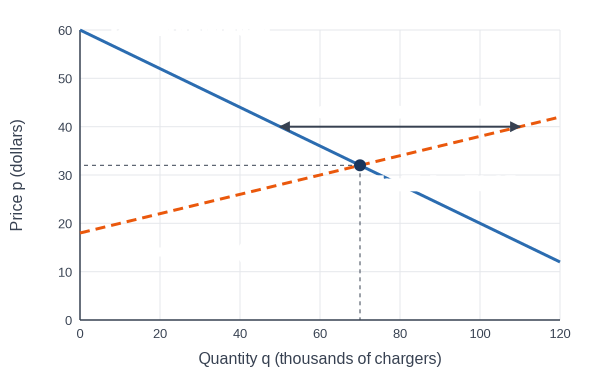
Example 2: Find a surplus or a shortage
Use the charger equations from Example 1. (a) What happens if the price is $40? (b) What happens if the price is $26?
(a) Find the quantity on each line when p = 40.
40 = 60 - 0.4q
Put p = 40 into the demand equation.
-20 = -0.4q
Subtract 60 from both sides.
50 = q
Divide both sides by −0.4.
40 = 0.2q + 18
Put p = 40 into the supply equation.
22 = 0.2q
Subtract 18 from both sides.
110 = q
Divide both sides by 0.2.
110 - 50 = 60
Subtract the amount demanded from the amount supplied.
(b) Find the quantity on each line when p = 26.
26 = 60 - 0.4q
Put p = 26 into the demand equation.
-34 = -0.4q
Subtract 60 from both sides.
85 = q
Divide both sides by −0.4.
26 = 0.2q + 18
Put p = 26 into the supply equation.
8 = 0.2q
Subtract 18 from both sides.
40 = q
Divide both sides by 0.2.
85 - 40 = 45
Subtract the amount supplied from the amount demanded.
Answer: (a) at $40, which is above the $32 equilibrium price, there is a surplus of 60 thousand chargers. (b) At $26, which is below it, there is a shortage of 45 thousand chargers.
Example 3: Write a demand equation from two points
A bakery sells 400 muffins a week at $12 a dozen and 520 muffins a week at $9 a dozen. Assume demand is linear. Write the demand equation with p in terms of q.
m = \frac{9 - 12}{520 - 400}Find the slope from the points (400, 12) and (520, 9) (see slope formula).
m = \frac{-3}{120}Subtract.
m = -0.025
Divide.
p - 12 = -0.025(q - 400)
Use point-slope form with (400, 12) (see point-slope form).
p - 12 = -0.025q + 10
Distribute −0.025 (see distributive property).
p = -0.025q + 22
Add 12 to both sides.
Check with the other point: -0.025(520) + 22 = -13 + 22 = 9. Answer: the demand equation is p = -0.025q + 22. The slope is negative, as a demand line should be.
Example 4: Equations written with q in terms of p
Economics books often solve for the quantity instead. Demand for a game is q = 500 - 20p and supply is q = 30p - 100, where p is the price in dollars. Find the equilibrium.
500 - 20p = 30p - 100
Set the quantity demanded equal to the quantity supplied.
500 = 50p - 100
Add 20p to both sides.
600 = 50p
Add 100 to both sides.
12 = p
Divide both sides by 50.
q = 500 - 20(12)
Put p = 12 into the demand equation.
q = 500 - 240
Multiply.
q = 260
Subtract.
q = 30(12) - 100
Check: put p = 12 into the supply equation.
q = 360 - 100
Multiply.
q = 260
Subtract. Both give 260.
Answer: the equilibrium price is $12, and 260 games are bought and sold. Here you solve for p first because the equations are written in terms of p.
Example 5: How a tax changes the equilibrium (word problem)
A coffee shop area has demand p = 8 - 0.002q and supply p = 0.003q + 2, where q is cups per day and p is the price in dollars. (a) Find the equilibrium. (b) The city adds a $1 tax on each cup, so the supply line moves up by 1 to p = 0.003q + 3. Find the new equilibrium. How much did the price change?
(a) Set the original lines equal.
8 - 0.002q = 0.003q + 2
Set demand equal to supply.
8 = 0.005q + 2
Add 0.002q to both sides.
6 = 0.005q
Subtract 2 from both sides.
1200 = q
Divide both sides by 0.005.
p = 8 - 0.002(1200)
Put q = 1,200 into the demand equation.
p = 8 - 2.4
Multiply.
p = 5.6
Subtract.
(b) Use the new supply line.
8 - 0.002q = 0.003q + 3
Set demand equal to the new supply.
8 = 0.005q + 3
Add 0.002q to both sides.
5 = 0.005q
Subtract 3 from both sides.
1000 = q
Divide both sides by 0.005.
p = 8 - 0.002(1000)
Put q = 1,000 into the demand equation.
p = 8 - 2
Multiply.
p = 6
Subtract.
6 - 5.6 = 0.4
Subtract the old price from the new price.
Answer: (a) 1,200 cups a day at $5.60. (b) 1,000 cups a day at $6.00. The price buyers pay rises by only $0.40, even though the tax is $1, and sales fall by 200 cups a day.
Common mistakes
| Mistake | Example of the error | Fix |
|---|---|---|
| Stopping after finding q | “The equilibrium is 70.” | Put q back into an equation to get the price. The equilibrium is a point, (70, 32). |
| Mixing up surplus and shortage | Calling the gap at $40 a shortage | Above the equilibrium price, supply is bigger: a surplus. Below it, demand is bigger: a shortage. |
| A demand line with a positive slope | p = 0.025q + 22 from Example 3 | Price falls as quantity rises, so the demand slope must be negative. |
| Setting each equation equal to 0 | Solving 60 - 0.4q = 0 for the equilibrium | Set the two prices equal to each other, not to 0. |
| Putting q into the wrong place in a q-form equation | Treating 12 in q = 500 - 20p as a quantity | Check which letter each equation solves for before you substitute. |
Related ideas
Break-even point
Equilibrium works like the break-even point: both are where two lines cross. Break-even sets revenue equal to cost; equilibrium sets the demand price equal to the supply price.
Solving with elimination
You can also write the two equations as a system and use the elimination method. Setting the two prices equal is the same as substituting one equation into the other.
Consumer and producer surplus
Buyers who would have paid more than the equilibrium price save money, and sellers who would have sold for less earn extra. Those amounts are areas between the lines, found later in Consumer and Producer Surplus.
Elasticity
How strongly demand reacts to a price change is measured by Price Elasticity of Demand, which uses derivatives.
Practice problems
1. Demand is p = 50 - 0.5q and supply is p = 0.5q + 10. Find the equilibrium.
2. Demand is p = 90 - 2q and supply is p = 3q + 15. Find the equilibrium.
3. Demand is p = 24 - 0.04q and supply is p = 0.02q + 6. Find the equilibrium.
4. Use the equations in Problem 1. Is there a surplus or a shortage at a price of $40? How large is it?
5. Use the equations in Problem 3. Is there a surplus or a shortage at a price of $9? How large is it?
6. Buyers purchase 300 units at $20 and 400 units at $15. Write the linear demand equation with p in terms of q.
7. Sellers offer 200 units at $10 and 400 units at $15. Write the linear supply equation with p in terms of q.
8. Find the equilibrium for the demand equation in Problem 6 and the supply equation in Problem 7.
9. Demand is q = 800 - 40p and supply is q = 60p - 200. Find the equilibrium price and quantity.
10. Demand is p = 30 - 0.1q and supply is p = 0.05q + 6. Find the equilibrium. Then a $3 tax per item moves supply to p = 0.05q + 9. Find the new equilibrium and the change in price.
Show answers
1.
50 - 0.5q = 0.5q + 10
Set demand equal to supply.
50 = q + 10
Add 0.5q to both sides.
40 = q
Subtract 10 from both sides.
p = 50 - 0.5(40)
Put q = 40 into the demand equation.
p = 50 - 20
Multiply.
p = 30
Subtract.
Answer: (40, 30). Check: 0.5(40) + 10 = 30.
2.
90 - 2q = 3q + 15
Set demand equal to supply.
90 = 5q + 15
Add 2q to both sides.
75 = 5q
Subtract 15 from both sides.
15 = q
Divide both sides by 5.
p = 90 - 2(15)
Put q = 15 into the demand equation.
p = 90 - 30
Multiply.
p = 60
Subtract.
Answer: (15, 60). Check: 3(15) + 15 = 60.
3.
24 - 0.04q = 0.02q + 6
Set demand equal to supply.
24 = 0.06q + 6
Add 0.04q to both sides.
18 = 0.06q
Subtract 6 from both sides.
300 = q
Divide both sides by 0.06.
p = 24 - 0.04(300)
Put q = 300 into the demand equation.
p = 24 - 12
Multiply.
p = 12
Subtract.
Answer: (300, 12). Check: 0.02(300) + 6 = 12.
4.
40 = 50 - 0.5q
Put p = 40 into the demand equation.
-10 = -0.5q
Subtract 50 from both sides.
20 = q
Divide both sides by −0.5.
40 = 0.5q + 10
Put p = 40 into the supply equation.
30 = 0.5q
Subtract 10 from both sides.
60 = q
Divide both sides by 0.5.
60 - 20 = 40
Subtract demand from supply.
Answer: $40 is above the equilibrium price of $30, so there is a surplus of 40 units.
5.
9 = 24 - 0.04q
Put p = 9 into the demand equation.
-15 = -0.04q
Subtract 24 from both sides.
375 = q
Divide both sides by −0.04.
9 = 0.02q + 6
Put p = 9 into the supply equation.
3 = 0.02q
Subtract 6 from both sides.
150 = q
Divide both sides by 0.02.
375 - 150 = 225
Subtract supply from demand.
Answer: $9 is below the equilibrium price of $12, so there is a shortage of 225 units.
6.
m = \frac{15 - 20}{400 - 300}Find the slope from (300, 20) and (400, 15).
m = \frac{-5}{100}Subtract.
m = -0.05
Divide.
p - 20 = -0.05(q - 300)
Use point-slope form with (300, 20).
p - 20 = -0.05q + 15
Distribute −0.05.
p = -0.05q + 35
Add 20 to both sides.
Answer: p = -0.05q + 35. Check: -0.05(400) + 35 = 15.
7.
m = \frac{15 - 10}{400 - 200}Find the slope from (200, 10) and (400, 15).
m = \frac{5}{200}Subtract.
m = 0.025
Divide.
p - 10 = 0.025(q - 200)
Use point-slope form with (200, 10).
p - 10 = 0.025q - 5
Distribute 0.025.
p = 0.025q + 5
Add 10 to both sides.
Answer: p = 0.025q + 5. Check: 0.025(400) + 5 = 15.
8.
-0.05q + 35 = 0.025q + 5
Set demand equal to supply.
35 = 0.075q + 5
Add 0.05q to both sides.
30 = 0.075q
Subtract 5 from both sides.
400 = q
Divide both sides by 0.075.
p = -0.05(400) + 35
Put q = 400 into the demand equation.
p = -20 + 35
Multiply.
p = 15
Add.
Answer: (400, 15). Both data sets include 400 units at $15, which is why the lines meet there.
9.
800 - 40p = 60p - 200
Set the quantity demanded equal to the quantity supplied.
800 = 100p - 200
Add 40p to both sides.
1000 = 100p
Add 200 to both sides.
10 = p
Divide both sides by 100.
q = 800 - 40(10)
Put p = 10 into the demand equation.
q = 800 - 400
Multiply.
q = 400
Subtract.
Answer: the equilibrium price is $10 and the quantity is 400. Check: 60(10) - 200 = 400.
10.
30 - 0.1q = 0.05q + 6
Set demand equal to supply.
30 = 0.15q + 6
Add 0.1q to both sides.
24 = 0.15q
Subtract 6 from both sides.
160 = q
Divide both sides by 0.15.
p = 30 - 0.1(160)
Put q = 160 into the demand equation.
p = 30 - 16
Multiply.
p = 14
Subtract.
30 - 0.1q = 0.05q + 9
Set demand equal to the taxed supply.
30 = 0.15q + 9
Add 0.1q to both sides.
21 = 0.15q
Subtract 9 from both sides.
140 = q
Divide both sides by 0.15.
p = 30 - 0.1(140)
Put q = 140 into the demand equation.
p = 30 - 14
Multiply.
p = 16
Subtract.
16 - 14 = 2
Subtract the old price from the new price.
Answer: before the tax, (160, 14); after it, (140, 16). The price rises by $2 and sales fall by 20 items.
Supply and demand FAQ
What is market equilibrium?
Market equilibrium is the price and quantity where the amount buyers want equals the amount sellers offer. On a graph, it is the point where the supply and demand lines cross.
How do you find the equilibrium price and quantity?
Set the demand equation equal to the supply equation and solve for q. Then put that q into either equation to find the equilibrium price p.
Why does the demand curve slope down?
At a higher price, fewer people are willing or able to buy, so the quantity demanded drops. That makes the slope of a demand line negative.
What happens when the price is above equilibrium?
Sellers offer more than buyers want, so there is a surplus. Unsold items usually push the price down toward the equilibrium.
Summary
- Demand lines slope down and supply lines slope up.
- The market equilibrium is where they cross: set the demand price equal to the supply price.
- Solve for q, then put it into either equation to get p, and check with the other.
- Above the equilibrium price there is a surplus; below it there is a shortage.
- Two data points give a linear supply or demand equation through the slope and point-slope form.
Previous lesson: Break-Even Analysis
Next lesson: Leontief Input-Output Model
Back to the Finite Math and Business Calculus Index