
Leontief Input-Output Model
The Leontief input-output model finds how much each industry must produce to meet outside demand when industries also use each other’s products. With technology matrix A, demand matrix D and production matrix X, the model is X = AX + D, so the total production is X = (I - A)^{-1}D.
Before this lesson: Supply and Demand, Matrix Multiplication and Inverse Matrices
What is the Leontief input-output model?
Industries depend on each other. A power plant needs steel for its equipment, and a steel mill needs electricity. So part of what each industry makes is used up inside the economy. Only the rest is left for consumers.
The economist Wassily Leontief used matrices to answer one question: how much must each industry make so that, after the industries supply each other, exactly the right amount is left for outside demand?
The outside demand is called final demand, or external demand. It comes from consumers, the government and exports. The amount the industries use from each other is called internal demand.
Leontief model formula
| Matrix | Name | What it holds |
|---|---|---|
| A | technology (input-output) matrix | entry a_{ij} = dollars of industry i’s product used to make $1 of industry j’s product |
| X | production matrix | the total output of each industry |
| D | final demand matrix | the output wanted outside the industries |
| AX | internal demand | the output the industries use up themselves |
Read A by columns. Column j lists what industry j needs from each industry to make $1 of its own product. If every column adds to less than 1, each industry uses less than $1 of inputs per $1 of output, and the model has a solution.
Total production must cover internal demand plus final demand.
X = AX + D
X - AX = D
Subtract AX from both sides.
(I - A)X = D
Factor out X, using the identity matrix I, since IX = X.
X = (I - A)^{-1}DMultiply both sides on the left by the inverse of I − A.
For a 2 × 2 matrix, use the inverse formula from inverse matrices: swap the diagonal entries, change the signs of the other two, and divide by the determinant.
\begin{bmatrix} a & b \\ c & d \end{bmatrix}^{-1} = \frac{1}{ad - bc}\begin{bmatrix} d & -b \\ -c & a \end{bmatrix}Leontief input-output model examples
Example 1: Read the technology matrix
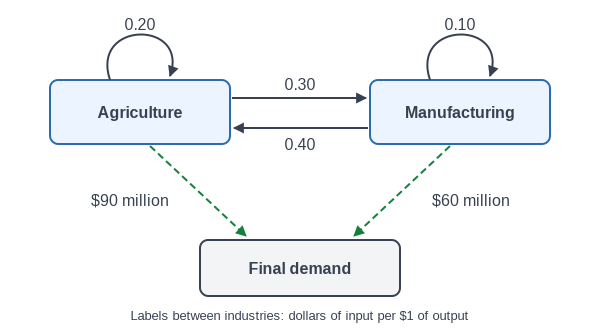
An economy has two industries, agriculture and manufacturing, with amounts in millions of dollars. Its technology matrix is below, with agriculture first. (a) What do 0.3 and 0.4 mean? (b) If agriculture makes $100 million and manufacturing makes $80 million, how much of each is left for final demand?
A = \begin{bmatrix} 0.2 & 0.3 \\ 0.4 & 0.1 \end{bmatrix}(a) The 0.3 is in row 1, column 2. To make $1 of manufacturing, the economy uses $0.30 of agriculture. The 0.4 is in row 2, column 1. To make $1 of agriculture, it uses $0.40 of manufacturing.
(b) Find the internal demand AX, then subtract it from X.
AX = \begin{bmatrix} 0.2 & 0.3 \\ 0.4 & 0.1 \end{bmatrix}\begin{bmatrix} 100 \\ 80 \end{bmatrix}Internal demand is A times the production matrix.
AX = \begin{bmatrix} 0.2(100) + 0.3(80) \\ 0.4(100) + 0.1(80) \end{bmatrix}Multiply each row by the column (see matrix multiplication).
AX = \begin{bmatrix} 20 + 24 \\ 40 + 8 \end{bmatrix}Multiply.
AX = \begin{bmatrix} 44 \\ 48 \end{bmatrix}Add.
D = \begin{bmatrix} 100 \\ 80 \end{bmatrix} - \begin{bmatrix} 44 \\ 48 \end{bmatrix}Final demand is production minus internal demand.
D = \begin{bmatrix} 56 \\ 32 \end{bmatrix}Subtract (see matrix operations).
Answer: the industries use $44 million of agriculture and $48 million of manufacturing themselves. That leaves $56 million of agriculture and $32 million of manufacturing for final demand.
Example 2: Find the production needed for a demand
Use the matrix A from Example 1. Final demand is $90 million of agriculture and $60 million of manufacturing. How much must each industry produce?
I - A = \begin{bmatrix} 0.8 & -0.3 \\ -0.4 & 0.9 \end{bmatrix}Subtract A from the 2 × 2 identity matrix.
\det(I - A) = 0.8(0.9) - (-0.3)(-0.4)
Find the determinant (see determinant of a matrix).
\det(I - A) = 0.72 - 0.12
Multiply.
\det(I - A) = 0.6
Subtract.
(I - A)^{-1} = \frac{1}{0.6}\begin{bmatrix} 0.9 & 0.3 \\ 0.4 & 0.8 \end{bmatrix}Swap the diagonal entries, change the signs of the others, and divide by the determinant.
X = \frac{1}{0.6}\begin{bmatrix} 0.9 & 0.3 \\ 0.4 & 0.8 \end{bmatrix}\begin{bmatrix} 90 \\ 60 \end{bmatrix}Use X = (I - A)^{-1}D.
X = \frac{1}{0.6}\begin{bmatrix} 0.9(90) + 0.3(60) \\ 0.4(90) + 0.8(60) \end{bmatrix}Multiply the matrix by the column.
X = \frac{1}{0.6}\begin{bmatrix} 81 + 18 \\ 36 + 48 \end{bmatrix}Multiply.
X = \frac{1}{0.6}\begin{bmatrix} 99 \\ 84 \end{bmatrix}Add.
X = \begin{bmatrix} 165 \\ 140 \end{bmatrix}Divide each entry by 0.6.
Check: AX has entries 0.2(165) + 0.3(140) = 33 + 42 = 75 and 0.4(165) + 0.1(140) = 66 + 14 = 80. Then 165 - 75 = 90 and 140 - 80 = 60, which matches D. Answer: agriculture must produce $165 million and manufacturing $140 million.
Example 3: Solve the model as a system of equations
An economy has technology matrix A = \begin{bmatrix} 0.5 & 0.2 \\ 0.25 & 0.4 \end{bmatrix} and final demand D = \begin{bmatrix} 10 \\ 20 \end{bmatrix}, in millions of dollars. Solve (I - A)X = D with elimination instead of an inverse.
Let x and y be the outputs of industries 1 and 2. Since I - A = \begin{bmatrix} 0.5 & -0.2 \\ -0.25 & 0.6 \end{bmatrix}, the system is 0.5x - 0.2y = 10 and -0.25x + 0.6y = 20.
-0.5x + 1.2y = 40
Multiply the second equation by 2 (see elimination method).
y = 50
Add it to the first equation: 0.5x − 0.5x = 0 and −0.2y + 1.2y = y.
0.5x - 0.2(50) = 10
Put y = 50 into the first equation.
0.5x - 10 = 10
Multiply.
0.5x = 20
Add 10 to both sides.
x = 40
Divide both sides by 0.5.
Answer: industry 1 must produce $40 million and industry 2 must produce $50 million. Check the second equation: -0.25(40) + 0.6(50) = -10 + 30 = 20.
Example 4: Build the matrix from a description
In a region, making $1 of coal uses $0.10 of coal and $0.30 of steel. Making $1 of steel uses $0.40 of coal and $0.20 of steel. Final demand is $60 million of coal and $90 million of steel. Find the technology matrix and the production needed.
Each industry’s needs go down its own column, so coal’s needs form column 1 and steel’s needs form column 2.
A = \begin{bmatrix} 0.1 & 0.4 \\ 0.3 & 0.2 \end{bmatrix}Column 1 is coal’s inputs (coal, steel); column 2 is steel’s inputs.
I - A = \begin{bmatrix} 0.9 & -0.4 \\ -0.3 & 0.8 \end{bmatrix}Subtract A from the identity matrix.
\det(I - A) = 0.9(0.8) - (-0.4)(-0.3)
Find the determinant.
\det(I - A) = 0.72 - 0.12
Multiply.
\det(I - A) = 0.6
Subtract.
X = \frac{1}{0.6}\begin{bmatrix} 0.8 & 0.4 \\ 0.3 & 0.9 \end{bmatrix}\begin{bmatrix} 60 \\ 90 \end{bmatrix}Write the inverse and multiply it by D.
X = \frac{1}{0.6}\begin{bmatrix} 0.8(60) + 0.4(90) \\ 0.3(60) + 0.9(90) \end{bmatrix}Multiply the matrix by the column.
X = \frac{1}{0.6}\begin{bmatrix} 48 + 36 \\ 18 + 81 \end{bmatrix}Multiply.
X = \frac{1}{0.6}\begin{bmatrix} 84 \\ 99 \end{bmatrix}Add.
X = \begin{bmatrix} 140 \\ 165 \end{bmatrix}Divide each entry by 0.6.
Answer: the region must mine $140 million of coal and make $165 million of steel. Check: internal demand is 0.1(140) + 0.4(165) = 80 for coal and 0.3(140) + 0.2(165) = 75 for steel, and 140 - 80 = 60, 165 - 75 = 90.
Example 5: A rise in demand (word problem)
In the region from Example 4, a new bridge project raises the final demand for steel by $12 million, while the demand for coal stays the same. How much more must each industry produce?
Because the model is linear, the change in production is (I - A)^{-1} times the change in demand.
\Delta X = \frac{1}{0.6}\begin{bmatrix} 0.8 & 0.4 \\ 0.3 & 0.9 \end{bmatrix}\begin{bmatrix} 0 \\ 12 \end{bmatrix}Multiply the inverse by the change in demand.
\Delta X = \frac{1}{0.6}\begin{bmatrix} 0.8(0) + 0.4(12) \\ 0.3(0) + 0.9(12) \end{bmatrix}Multiply the matrix by the column.
\Delta X = \frac{1}{0.6}\begin{bmatrix} 0 + 4.8 \\ 0 + 10.8 \end{bmatrix}Multiply.
\Delta X = \frac{1}{0.6}\begin{bmatrix} 4.8 \\ 10.8 \end{bmatrix}Add.
\Delta X = \begin{bmatrix} 8 \\ 18 \end{bmatrix}Divide each entry by 0.6.
Answer: coal output must rise by $8 million and steel output by $18 million, to $148 million and $183 million. Steel must rise by more than $12 million, because making the extra steel uses some steel too.
Common mistakes
| Mistake | Example of the error | Fix |
|---|---|---|
| Putting an industry’s inputs in a row | Writing coal’s needs 0.1 and 0.3 as row 1 | Each industry’s inputs go down its own column. |
| Using A^{-1}D or (A - I)^{-1}D | Inverting A instead of I − A | The formula is X = (I - A)^{-1}D. |
| Answering with final demand | Reporting D = (90, 60) as the production | X is total production; it is never smaller than D. |
| Multiplying in the wrong order | D(I - A)^{-1} | Matrix products don’t commute. Put the inverse on the left of D. |
| Sign errors in I − A | I - A = \begin{bmatrix} 0.8 & 0.3 \\ 0.4 & 0.9 \end{bmatrix} | Off-diagonal entries of I − A are the negatives of A’s entries. |
Related ideas
Larger economies
Real models have dozens of industries. The steps are the same, but finding (I - A)^{-1} by hand is slow, so use a calculator or spreadsheet for 3 × 3 and larger matrices. On a graphing calculator, enter A and D, then compute (I - A)^{-1}D with the identity matrix and the inverse key.
What the inverse tells you
Entry (i, j) of (I - A)^{-1} is the total output of industry i needed for each extra $1 of final demand for industry j. In Example 4, the entry 0.9/0.6 = 1.5 means each extra $1 of steel demand needs $1.50 of total steel output.
Linear programming
The next lesson, Simplex Method, also uses matrices, this time to find the best plan under limits, like the graphing method in linear programming.
Practice problems
Problems 1–4 use the technology matrix A = \begin{bmatrix} 0.3 & 0.1 \\ 0.2 & 0.4 \end{bmatrix} for farming (industry 1) and manufacturing (industry 2), in millions of dollars.
1. What does the entry 0.1 mean?
2. Farming makes $50 million and manufacturing makes $40 million. How much of each is left for final demand?
3. Find I - A and its determinant.
4. Find the production needed for a final demand of $26 million of farming and $28 million of manufacturing.
5. Solve (I - A)X = D by elimination for A = \begin{bmatrix} 0.4 & 0.2 \\ 0.3 & 0.5 \end{bmatrix} and D = \begin{bmatrix} 12 \\ 18 \end{bmatrix}.
6. Making $1 of electricity uses $0.05 of electricity and $0.10 of water. Making $1 of water uses $0.20 of electricity and $0.15 of water. Write the technology matrix with electricity first, and check that each column adds to less than 1.
7. In Problem 6, what does the entry in row 1, column 2 mean?
8. For some economy, (I - A)^{-1} = \begin{bmatrix} 1.5 & 0.5 \\ 1 & 2 \end{bmatrix}. Find the production for a final demand of 20 and 30.
9. In Problem 8, final demand for industry 2 rises by 6, and demand for industry 1 stays the same. How much more must each industry produce?
10. A town’s energy and transport sectors have technology matrix A = \begin{bmatrix} 0.2 & 0.4 \\ 0.1 & 0.2 \end{bmatrix}, with energy first. Final demand is $35 million of energy and $50 million of transport. Find the production needed.
Show answers
1.
The 0.1 is in row 1, column 2. Making $1 of manufacturing uses $0.10 of farming.
2.
AX = \begin{bmatrix} 0.3(50) + 0.1(40) \\ 0.2(50) + 0.4(40) \end{bmatrix}Multiply A by X.
AX = \begin{bmatrix} 15 + 4 \\ 10 + 16 \end{bmatrix}Multiply.
AX = \begin{bmatrix} 19 \\ 26 \end{bmatrix}Add.
D = \begin{bmatrix} 50 - 19 \\ 40 - 26 \end{bmatrix}Subtract internal demand from production.
D = \begin{bmatrix} 31 \\ 14 \end{bmatrix}Subtract.
Answer: $31 million of farming and $14 million of manufacturing are left for final demand.
3.
I - A = \begin{bmatrix} 0.7 & -0.1 \\ -0.2 & 0.6 \end{bmatrix}Subtract A from the identity matrix.
\det(I - A) = 0.7(0.6) - (-0.1)(-0.2)
Find the determinant.
\det(I - A) = 0.42 - 0.02
Multiply.
\det(I - A) = 0.4
Subtract.
Answer: I - A = \begin{bmatrix} 0.7 & -0.1 \\ -0.2 & 0.6 \end{bmatrix}, with determinant 0.4.
4.
X = \frac{1}{0.4}\begin{bmatrix} 0.6 & 0.1 \\ 0.2 & 0.7 \end{bmatrix}\begin{bmatrix} 26 \\ 28 \end{bmatrix}Write the inverse from Problem 3 and multiply by D.
X = \frac{1}{0.4}\begin{bmatrix} 0.6(26) + 0.1(28) \\ 0.2(26) + 0.7(28) \end{bmatrix}Multiply the matrix by the column.
X = \frac{1}{0.4}\begin{bmatrix} 15.6 + 2.8 \\ 5.2 + 19.6 \end{bmatrix}Multiply.
X = \frac{1}{0.4}\begin{bmatrix} 18.4 \\ 24.8 \end{bmatrix}Add.
X = \begin{bmatrix} 46 \\ 62 \end{bmatrix}Divide each entry by 0.4.
Answer: $46 million of farming and $62 million of manufacturing.
5.
0.6x - 0.2y = 12
Row 1 of I − A gives the first equation.
-0.3x + 0.5y = 18
Row 2 gives the second equation.
-0.6x + y = 36
Multiply the second equation by 2.
0.8y = 48
Add it to the first equation.
y = 60
Divide both sides by 0.8.
0.6x - 0.2(60) = 12
Put y = 60 into the first equation.
0.6x - 12 = 12
Multiply.
0.6x = 24
Add 12 to both sides.
x = 40
Divide both sides by 0.6.
Answer: X = \begin{bmatrix} 40 \\ 60 \end{bmatrix}.
6.
A = \begin{bmatrix} 0.05 & 0.20 \\ 0.10 & 0.15 \end{bmatrix}Column 1 is electricity’s inputs; column 2 is water’s inputs.
0.05 + 0.10 = 0.15
Add column 1.
0.20 + 0.15 = 0.35
Add column 2.
Answer: both column sums are less than 1, so each industry uses less than $1 of inputs per $1 of output.
7.
Row 1, column 2 is 0.20. Making $1 of water uses $0.20 of electricity.
8.
X = \begin{bmatrix} 1.5(20) + 0.5(30) \\ 1(20) + 2(30) \end{bmatrix}Multiply the inverse by D.
X = \begin{bmatrix} 30 + 15 \\ 20 + 60 \end{bmatrix}Multiply.
X = \begin{bmatrix} 45 \\ 80 \end{bmatrix}Add.
Answer: 45 for industry 1 and 80 for industry 2.
9.
\Delta X = \begin{bmatrix} 1.5(0) + 0.5(6) \\ 1(0) + 2(6) \end{bmatrix}Multiply the inverse by the change in demand.
\Delta X = \begin{bmatrix} 0 + 3 \\ 0 + 12 \end{bmatrix}Multiply.
\Delta X = \begin{bmatrix} 3 \\ 12 \end{bmatrix}Add.
Answer: industry 1 must produce 3 more and industry 2 must produce 12 more.
10.
I - A = \begin{bmatrix} 0.8 & -0.4 \\ -0.1 & 0.8 \end{bmatrix}Subtract A from the identity matrix.
\det(I - A) = 0.8(0.8) - (-0.4)(-0.1)
Find the determinant.
\det(I - A) = 0.64 - 0.04
Multiply.
\det(I - A) = 0.6
Subtract.
X = \frac{1}{0.6}\begin{bmatrix} 0.8 & 0.4 \\ 0.1 & 0.8 \end{bmatrix}\begin{bmatrix} 35 \\ 50 \end{bmatrix}Write the inverse and multiply it by D.
X = \frac{1}{0.6}\begin{bmatrix} 0.8(35) + 0.4(50) \\ 0.1(35) + 0.8(50) \end{bmatrix}Multiply the matrix by the column.
X = \frac{1}{0.6}\begin{bmatrix} 28 + 20 \\ 3.5 + 40 \end{bmatrix}Multiply.
X = \frac{1}{0.6}\begin{bmatrix} 48 \\ 43.5 \end{bmatrix}Add.
X = \begin{bmatrix} 80 \\ 72.5 \end{bmatrix}Divide each entry by 0.6.
Answer: $80 million of energy and $72.5 million of transport. Check: internal demand is 0.2(80) + 0.4(72.5) = 45 and 0.1(80) + 0.2(72.5) = 22.5, and 80 - 45 = 35, 72.5 - 22.5 = 50.
Leontief model FAQ
What is a technology matrix?
A technology matrix, or input-output matrix, lists how much of each industry’s product is needed to make $1 of every other industry’s product. Column j holds the inputs for industry j.
What is the formula for the Leontief model?
Production X must cover internal demand AX and final demand D, so X = AX + D. Solving gives X = (I - A)^{-1}D.
What is the difference between internal demand and final demand?
Internal demand, AX, is what the industries use up while making their products. Final demand, D, is what is left for consumers, the government and exports.
Does the Leontief model always have a solution?
It does when every column of A adds to less than 1, which means each industry uses less than $1 of inputs per $1 of output. Then I - A has an inverse with no negative entries, so the production levels are never negative.
Summary
- The technology matrix A holds the dollars of input from each industry (row) per $1 of output from each industry (column).
- Production covers internal and final demand: X = AX + D.
- Solve with X = (I - A)^{-1}D, or solve (I - A)X = D as a system.
- A change in final demand changes production by (I - A)^{-1} times the change.
- Production is never less than final demand, because industries also use some of each other’s output.
Previous lesson: Supply and Demand
Next lesson: Simplex Method
Back to the Finite Math and Business Calculus Index