
Price Elasticity of Demand
Price elasticity of demand measures how strongly the number of items people buy reacts to a change in price. For a demand function q = f(p), it is E(p) = -\frac{p \cdot f'(p)}{f(p)}. Demand is elastic when E > 1, inelastic when E < 1 and unit elastic when E = 1, where revenue is largest.
Before this lesson: Supply and Demand, Marginal Analysis and Percent Change
The idea
When a store raises its price, people buy less. The question is how much less. If a 1% price rise costs only a few sales, the store takes in more money. If it drives many buyers away, the store takes in less.
Elasticity compares the two changes in percent. It is the percent drop in quantity for each 1% rise in price. Using percents means the answer does not depend on units, so dollars or cents, single items or thousands give the same result.
A drug that people need has inelastic demand: they keep buying even if the price goes up. A brand of soda with many substitutes has elastic demand: a small price rise sends buyers to other brands.
Price elasticity of demand formula
Let q = f(p) be the quantity demanded at price p. Since demand falls as price rises, f'(p) is negative, and the minus sign makes E positive:
E(p) = -\frac{p \cdot f'(p)}{f(p)}| Value of E | Demand is | Effect of a small price increase on revenue |
|---|---|---|
| E \gt 1 | Elastic | Revenue goes down |
| E \lt 1 | Inelastic | Revenue goes up |
| E = 1 | Unit elastic | Revenue is at its largest |
Reading E as percents: if E = 2 at the current price, a 1% price rise lowers the quantity by about 2%, and a 3% price cut raises the quantity by about 6%.
- Write the demand function q = f(p) and find f'(p).
- Substitute into E(p) = -\frac{p \cdot f'(p)}{f(p)} and simplify.
- Evaluate at the given price and compare with 1.
- To find where revenue is largest, solve E(p) = 1.
Price elasticity of demand examples
Example 1: An inelastic price
The demand for a phone charger is q = 600 - 20p, where p is the price in dollars and q is the number sold per week. Find the elasticity at p = 10 and describe the demand.
f'(p) = -20
Differentiate the demand function (see power rule).
E(p) = -\dfrac{p(-20)}{600 - 20p}Substitute f and f′ into the formula.
E(p) = \dfrac{20p}{600 - 20p}Simplify: the two minus signs make a plus.
E(10) = \dfrac{20(10)}{600 - 20(10)}Substitute p = 10.
E(10) = \dfrac{200}{400}Multiply, then subtract in the denominator.
E(10) = 0.5
Divide.
0.5 \lt 1
Compare with 1.
Answer: E(10) = 0.5, so demand is inelastic at $10. A 1% price rise lowers sales by only about 0.5%, so raising the price a little would increase revenue.
Example 2: An elastic price
Use the same demand, q = 600 - 20p. Find the elasticity at p = 20.
E(20) = \dfrac{20(20)}{600 - 20(20)}Substitute p = 20 into E(p) = \frac{20p}{600 - 20p} from Example 1.
E(20) = \dfrac{400}{200}Multiply, then subtract in the denominator.
E(20) = 2
Divide.
2 \gt 1
Compare with 1.
Answer: E(20) = 2, so demand is elastic at $20. A 1% price rise lowers sales by about 2%, so raising the price would lower revenue. Lowering it a little would raise revenue.
Example 3: The price that maximizes revenue
For q = 600 - 20p, find the price where demand is unit elastic, and check that revenue is largest there.
\dfrac{20p}{600 - 20p} = 1Set the elasticity equal to 1.
20p = 600 - 20p
Multiply both sides by 600 − 20p.
40p = 600
Add 20p to both sides (see variables on both sides).
p = 15
Divide both sides by 40.
R(p) = p(600 - 20p)
Check with revenue: price times quantity.
R(p) = 600p - 20p^2
Distribute p.
R'(p) = 600 - 40p
Differentiate.
R'(15) = 600 - 40(15)
Substitute p = 15.
R'(15) = 600 - 600 = 0
Multiply, then subtract.
R(15) = 15(600 - 300) = 4500
Find the largest revenue: subtract inside the parentheses, then multiply.
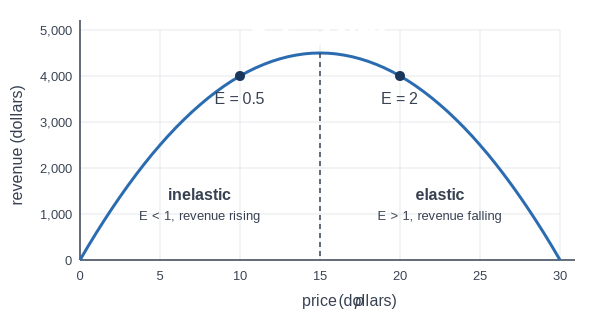
Answer: demand is unit elastic at p = $15, where revenue peaks at $4,500 per week. Below $15 demand is inelastic, and above $15 it is elastic.
Example 4: A curved demand function
The demand for a concert poster is q = 1200 - 4p^2. Find E(p), describe the demand at p = 5, and find the unit elastic price.
f'(p) = -8p
Differentiate with the power rule: 4(2p) = 8p.
E(p) = -\dfrac{p(-8p)}{1200 - 4p^2}Substitute f and f′ into the formula.
E(p) = \dfrac{8p^2}{1200 - 4p^2}Simplify: p times 8p is 8p², and the minus signs cancel.
E(5) = \dfrac{8(25)}{1200 - 4(25)}Substitute p = 5, so p² = 25.
E(5) = \dfrac{200}{1100}Multiply, then subtract in the denominator.
E(5) = \dfrac{2}{11} \approx 0.18Simplify, then divide.
8p^2 = 1200 - 4p^2
For unit elasticity, set E(p) = 1 and multiply both sides by the denominator.
12p^2 = 1200
Add 4p² to both sides.
p^2 = 100
Divide both sides by 12.
p = 10
Take the positive square root; a price cannot be negative.
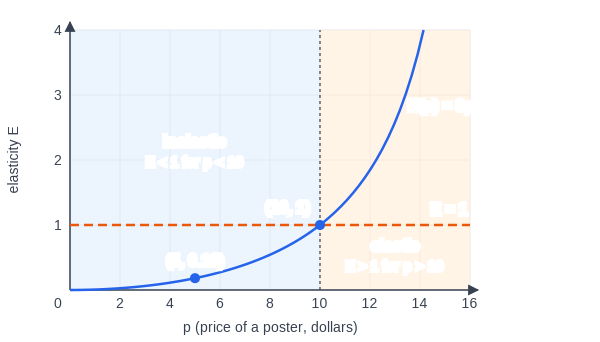
Answer: E(p) = \frac{8p^2}{1200 - 4p^2}. At $5, E \approx 0.18, so demand is very inelastic. Demand is unit elastic at $10, where the poster revenue is largest.
Example 5: Should the theater cut its ticket price? (word problem)
A small movie theater sells q = 2000 - 100p tickets per week at a price of p dollars. Tickets now cost $12. Use elasticity to decide whether the theater should raise or lower its price to take in more money. Then find the best price.
f'(p) = -100
Differentiate the demand function.
E(p) = \dfrac{100p}{2000 - 100p}Substitute into the formula; the minus signs cancel.
E(12) = \dfrac{100(12)}{2000 - 100(12)}Substitute p = 12.
E(12) = \dfrac{1200}{800}Multiply, then subtract in the denominator.
E(12) = 1.5
Divide. Since 1.5 > 1, demand is elastic.
100p = 2000 - 100p
For the best price, set E(p) = 1 and multiply both sides by the denominator.
200p = 2000
Add 100p to both sides.
p = 10
Divide both sides by 200.
R(12) = 12(800) = 9600
Check: revenue at $12 is price times the 800 tickets sold.
R(10) = 10(1000) = 10000
Revenue at $10: 2000 − 1000 = 1000 tickets are sold.
Answer: at $12, E = 1.5, so demand is elastic and the theater should lower its price. At $10 it sells 1,000 tickets and takes in $10,000 a week, $400 more than at $12.
Common mistakes
| Mistake | Example of the error | Fix |
|---|---|---|
| Leaving out the minus sign | Getting E(10) = -0.5 in Example 1 | The formula has a minus sign in front, so E comes out positive for normal demand. |
| Flipping the fraction | Using -\frac{f(p)}{p \cdot f'(p)} | Price goes on top: E = -\frac{p \cdot f'(p)}{f(p)}. |
| Using the slope as the elasticity | “The slope is −20, so E = 20.” | Elasticity also depends on p and q. For a straight demand line it changes along the line. |
| Mixing up elastic and inelastic | “E = 2, so demand is inelastic.” | E > 1 is elastic (buyers react strongly); E < 1 is inelastic. |
| Raising the price when demand is elastic | Raising the ticket price above $12 in Example 5 | When E > 1, a price rise lowers revenue. Lower the price instead. |
| Writing demand with q and p swapped | Using p = 30 − 0.05q directly in the formula | Solve for q first: q = 600 − 20p, then use f'(p). |
Related ideas
Why revenue peaks at E = 1
Revenue is R(p) = p \cdot f(p). By the product rule, R'(p) = f(p) + p \cdot f'(p) = f(p)\,(1 - E(p)). So R rises when E < 1, falls when E > 1 and has a flat top when E = 1.
Elasticity and marginal revenue
In terms of quantity, marginal revenue is positive where demand is elastic and negative where it is inelastic. That matches marginal analysis: in Example 2 of that lesson, marginal revenue turned negative once the store sold too many speakers at too low a price.
Constant elasticity
For the demand function q = \frac{k}{p}, the elasticity is 1 at every price, so revenue p \cdot q = k never changes. Economists also use demand functions like q = kp^{-a}, which have the same elasticity a at every price.
Practice problems
- The demand for a board game is q = 500 - 10p. Find E(p).
- In Problem 1, find E(20) and describe the demand.
- In Problem 1, find E(30) and describe the demand.
- In Problem 1, find the price that makes demand unit elastic.
- At the current price, the elasticity is 0.4. If the price rises 5%, about how much does the quantity fall? Does revenue go up or down?
- The demand for a bus pass is q = 90 - 3p. Find the elasticity at p = 10. Should the city raise the price to increase revenue?
- For q = 2400 - 8p^2, find E(p) and E(10).
- For q = \frac{300}{p}, show that E(p) = 1 at every price.
- A gym sells q = 4000 - 50p monthly passes at a price of p dollars. The price is $50 now. Find the elasticity, decide whether to raise or lower the price, and find the price that maximizes revenue.
- For q = 600 - 20p, show that the revenue function has its peak at the same price as in Example 3.
Show answers
1.
f'(p) = -10
Differentiate the demand function.
E(p) = -\dfrac{p(-10)}{500 - 10p}Substitute into the formula.
E(p) = \dfrac{10p}{500 - 10p}Simplify: the minus signs cancel.
Answer: E(p) = \frac{10p}{500 - 10p}
2.
E(20) = \dfrac{10(20)}{500 - 10(20)}Substitute p = 20.
E(20) = \dfrac{200}{300}Multiply, then subtract.
E(20) = \dfrac{2}{3} \approx 0.67Simplify, then divide. It is less than 1.
Answer: about 0.67, inelastic
3.
E(30) = \dfrac{10(30)}{500 - 10(30)}Substitute p = 30.
E(30) = \dfrac{300}{200}Multiply, then subtract.
E(30) = 1.5
Divide. It is greater than 1.
Answer: 1.5, elastic
4.
10p = 500 - 10p
Set E(p) = 1 and multiply both sides by 500 − 10p.
20p = 500
Add 10p to both sides.
p = 25
Divide both sides by 20.
Answer: $25
5.
0.4 \times 5 = 2
Each 1% price rise lowers quantity by about 0.4%.
0.4 \lt 1
Demand is inelastic.
Answer: the quantity falls by about 2%; revenue goes up, because demand is inelastic
6.
E(p) = \dfrac{3p}{90 - 3p}f′(p) = −3; substitute into the formula and cancel the minus signs.
E(10) = \dfrac{30}{90 - 30}Substitute p = 10 and multiply.
E(10) = \dfrac{30}{60} = 0.5Subtract, then divide.
Answer: 0.5; demand is inelastic, so yes, a higher price would bring in more revenue
7.
f'(p) = -16p
Differentiate: 8(2p) = 16p.
E(p) = \dfrac{16p^2}{2400 - 8p^2}Substitute into the formula and simplify.
E(10) = \dfrac{16(100)}{2400 - 8(100)}Substitute p = 10, so p² = 100.
E(10) = \dfrac{1600}{1600} = 1Multiply, subtract, then divide.
Answer: E(p) = \frac{16p^2}{2400 - 8p^2} and E(10) = 1, so revenue is largest at $10
8.
f(p) = 300p^{-1}Rewrite with a negative exponent (see zero and negative exponents).
f'(p) = -300p^{-2}Differentiate with the power rule.
E(p) = -\dfrac{p(-300p^{-2})}{300p^{-1}}Substitute into the formula.
E(p) = \dfrac{300p^{-1}}{300p^{-1}} = 1Multiply p by p⁻² to get p⁻¹, then divide.
Answer: E(p) = 1 for every price p > 0
9.
E(p) = \dfrac{50p}{4000 - 50p}f′(p) = −50; substitute into the formula and cancel the minus signs.
E(50) = \dfrac{2500}{4000 - 2500}Substitute p = 50 and multiply.
E(50) = \dfrac{2500}{1500} \approx 1.67Subtract, then divide. Demand is elastic.
50p = 4000 - 50p
Set E(p) = 1 and multiply both sides by the denominator.
100p = 4000
Add 50p to both sides.
p = 40
Divide both sides by 100.
Answer: E ≈ 1.67, so lower the price; revenue is largest at $40 (2,000 passes, $80,000 a month, compared with $75,000 at $50)
10.
R(p) = 600p - 20p^2
Revenue is p(600 − 20p); distribute p.
R'(p) = 600 - 40p
Differentiate.
600 - 40p = 0
The peak is where R′(p) = 0.
p = 15
Add 40p to both sides, then divide by 40.
Answer: p = 15, the same unit elastic price as in Example 3
Price elasticity of demand FAQ
What is the formula for price elasticity of demand in calculus?
For a demand function q = f(p), the elasticity is E(p) = -\frac{p \cdot f'(p)}{f(p)}. It gives the approximate percent drop in quantity for a 1% rise in price.
What is the difference between elastic and inelastic demand?
Demand is elastic when E > 1: buyers react strongly, and a price rise lowers revenue. It is inelastic when E < 1: buyers react weakly, and a price rise raises revenue.
What does unit elastic mean?
Unit elastic means E = 1: a 1% price change causes about a 1% change in quantity. Revenue is at its largest at a unit elastic price.
Why is there a negative sign in the elasticity formula?
Demand usually falls as price rises, so f'(p) is negative. The minus sign makes the elasticity a positive number that is easy to compare with 1.
Summary
- Price elasticity of demand: E(p) = -\frac{p \cdot f'(p)}{f(p)} for demand q = f(p).
- E is the approximate percent drop in quantity for each 1% rise in price.
- Elastic (E > 1): raising the price lowers revenue. Inelastic (E < 1): raising the price raises revenue.
- Revenue is largest at the unit elastic price, where E = 1.
- Along a straight demand line, elasticity changes from price to price.
Previous lesson: Marginal Analysis
Next lesson: Maximizing Profit
Back to the Finite Math Index