
Consumer and Producer Surplus
Consumer surplus is the money buyers save because they pay the market price instead of the most they were willing to pay. Producer surplus is the extra money sellers get above the lowest price they would accept. Each is an area between a curve and the price line, found with a definite integral.
Before this lesson: Supply and Demand, Definite Integrals and Area Between Curves
The idea
Picture a line of people who want concert tickets. The first fan would pay $90, the next $85, and so on down. This is the demand curve: it shows what each extra buyer is willing to pay. If tickets sell for $40, the $90 fan saves $50, the $85 fan saves $45, and so on.
Add up all those savings and you get the consumer surplus. On a graph, it is the area below the demand curve and above the price line.
Sellers work the same way. The supply curve shows the lowest price each extra unit could be sold for. A seller who would accept $25 but gets $40 earns $15 extra. The total of these extras is the producer surplus: the area above the supply curve and below the price line.
Consumer and producer surplus formulas
Let p = D(x) be the demand curve and p = S(x) the supply curve, where x is the quantity. At the market (equilibrium) point, D(x_e) = S(x_e) = p_e. Then:
CS = \int_0^{x_e} \left[D(x) - p_e\right] dxPS = \int_0^{x_e} \left[p_e - S(x)\right] dx- Find the market quantity x_e and price p_e. At equilibrium, set D(x) = S(x); if a price is given, solve D(x) = p or S(x) = p.
- For consumer surplus, integrate demand minus price from 0 to x_e.
- For producer surplus, integrate price minus supply from 0 to x_e.
- Check with geometry when the curves are lines: each surplus is a triangle with area \frac{1}{2} \cdot \text{base} \cdot \text{height}.
The total surplus, CS + PS, measures the total benefit of the market to buyers and sellers together.
Consumer and producer surplus examples
Example 1: Equilibrium and consumer surplus
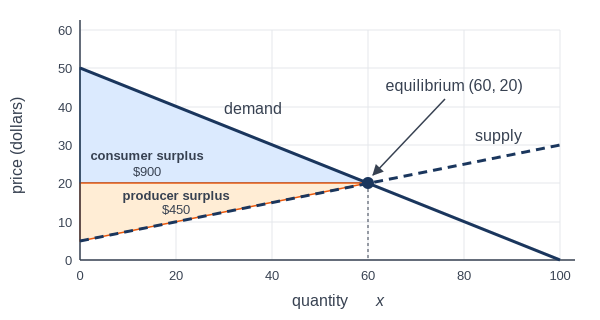
The demand for a phone stand is p = 50 - 0.5x and the supply is p = 5 + 0.25x, where x is the number sold per week and p is the price in dollars. Find the equilibrium and the consumer surplus.
50 - 0.5x = 5 + 0.25x
At equilibrium, demand price equals supply price.
45 - 0.5x = 0.25x
Subtract 5 from both sides.
45 = 0.75x
Add 0.5x to both sides.
x_e = 60
Divide both sides by 0.75.
p_e = 50 - 0.5(60) = 20
Substitute into the demand equation.
CS = \int_0^{60} \left[(50 - 0.5x) - 20\right] dxSet up the integral: demand minus the market price.
CS = \int_0^{60} (30 - 0.5x)\,dxSimplify the integrand.
CS = \left[30x - 0.25x^2\right]_0^{60}Find an antiderivative (see antiderivatives).
CS = 30(60) - 0.25(3600) - 0
Evaluate at 60 and subtract the value at 0 (see definite integrals).
CS = 1800 - 900
Multiply.
CS = 900
Subtract.
\tfrac{1}{2}(60)(30) = 900Check: the region is a triangle with base 60 and height 50 − 20 = 30.
Answer: the market settles at 60 stands a week for $20 each. Buyers save a total of $900 a week compared with the most they would have paid.
Example 2: Producer surplus
Use the market in Example 1. Find the producer surplus.
PS = \int_0^{60} \left[20 - (5 + 0.25x)\right] dxSet up the integral: market price minus supply.
PS = \int_0^{60} (15 - 0.25x)\,dxSimplify the integrand.
PS = \left[15x - 0.125x^2\right]_0^{60}Find an antiderivative.
PS = 15(60) - 0.125(3600) - 0
Evaluate at 60 and subtract the value at 0.
PS = 900 - 450
Multiply.
PS = 450
Subtract.
\tfrac{1}{2}(60)(15) = 450Check: a triangle with base 60 and height 20 − 5 = 15.
Answer: sellers earn $450 a week above their lowest acceptable prices. The total surplus is 900 + 450 = $1,350 a week.
Example 3: A curved demand function
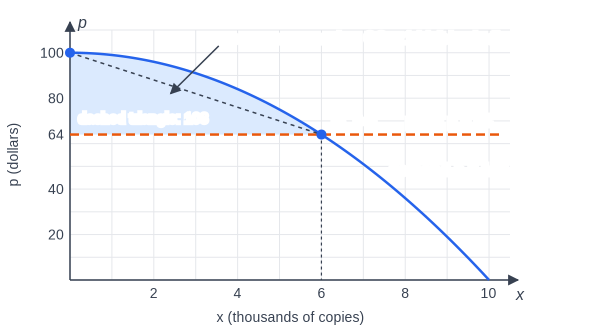
The demand for a video game is p = 100 - x^2, where x is in thousands of copies and p is in dollars. The market price is $64. Find the consumer surplus.
100 - x^2 = 64
Find the quantity sold at $64.
x^2 = 36
Subtract 64 from both sides and add x² to both sides.
x = 6
Take the positive square root.
CS = \int_0^{6} \left[(100 - x^2) - 64\right] dxSet up: demand minus price.
CS = \int_0^{6} (36 - x^2)\,dxSimplify the integrand.
CS = \left[36x - \tfrac{1}{3}x^3\right]_0^{6}Find an antiderivative.
CS = 216 - \tfrac{1}{3}(216) - 0Evaluate at 6 and 0; 6³ = 216.
CS = 216 - 72 = 144
Multiply, then subtract.
Answer: the consumer surplus is 144 thousand dollars, or $144,000. Since the demand is a curve, the region is not a triangle, so the integral is needed.
Example 4: Curved demand and supply
The demand for a bike part is p = 80 - 0.02x^2 and the supply is p = 5 + 0.01x^2. Find the equilibrium, the consumer surplus and the producer surplus.
80 - 0.02x^2 = 5 + 0.01x^2
Set demand equal to supply.
75 = 0.03x^2
Subtract 5 and add 0.02x² on both sides.
x^2 = 2500
Divide both sides by 0.03.
x_e = 50
Take the positive square root.
p_e = 80 - 0.02(2500) = 30
Substitute into the demand equation.
CS = \int_0^{50} (50 - 0.02x^2)\,dxDemand minus price: (80 − 0.02x²) − 30.
CS = \left[50x - \tfrac{0.02}{3}x^3\right]_0^{50}Find an antiderivative.
CS = 2500 - \tfrac{0.02}{3}(125{,}000)Evaluate at 50 (and 0); 50³ = 125,000.
CS \approx 2500 - 833.33 = 1666.67
Multiply and divide, then subtract.
PS = \int_0^{50} (25 - 0.01x^2)\,dxPrice minus supply: 30 − (5 + 0.01x²).
PS = \left[25x - \tfrac{0.01}{3}x^3\right]_0^{50}Find an antiderivative.
PS = 1250 - \tfrac{0.01}{3}(125{,}000)Evaluate at 50 (and 0).
PS \approx 1250 - 416.67 = 833.33
Multiply and divide, then subtract.
Answer: the market settles at 50 units for $30 each. Consumer surplus is about $1,666.67 and producer surplus is about $833.33.
Example 5: Concert tickets (word problem)
For a summer concert series, the demand for tickets is p = 120 - 0.04x and the supply is p = 20 + 0.01x, where x is the number of tickets. Find the equilibrium price and the total surplus, and say who benefits more.
120 - 0.04x = 20 + 0.01x
Set demand equal to supply.
100 = 0.05x
Subtract 20 and add 0.04x on both sides.
x_e = 2000
Divide both sides by 0.05.
p_e = 20 + 0.01(2000) = 40
Substitute into the supply equation.
CS = \int_0^{2000} (80 - 0.04x)\,dxDemand minus price: (120 − 0.04x) − 40.
CS = 80(2000) - 0.02(2000)^2 = 80{,}000The antiderivative is 80x − 0.02x²; evaluate at 2000 and 0.
PS = \int_0^{2000} (20 - 0.01x)\,dxPrice minus supply: 40 − (20 + 0.01x).
PS = 20(2000) - 0.005(2000)^2 = 20{,}000The antiderivative is 20x − 0.005x²; evaluate at 2000 and 0.
CS + PS = 80{,}000 + 20{,}000 = 100{,}000Add to find the total surplus.
Answer: 2,000 tickets sell at $40. Fans gain $80,000 and the organizers gain $20,000, for a total surplus of $100,000. Fans benefit four times as much.
Common mistakes
| Mistake | Example of the error | Fix |
|---|---|---|
| Integrating the demand curve alone | \int_0^{60} (50 - 0.5x)\,dx = 2100 in Example 1 | That is total willingness to pay. Subtract the price: integrate D(x) - p_e. |
| Swapping the order in producer surplus | \int_0^{60} \left[S(x) - 20\right] dx = -450 | Producer surplus is price minus supply, which is positive. |
| Using the wrong upper limit | Integrating to 100, where demand reaches 0 | Integrate from 0 to the quantity actually sold, x_e. |
| Using the price as the upper limit | \int_0^{20} in Example 1 | The limits are quantities, not prices. |
| Plugging x into the wrong curve for the price | Getting p_e from a curve that is not part of the problem | At equilibrium both curves give the same price; use either one to check. |
| Forgetting units | “CS = 144” in Example 3 | x was in thousands, so the surplus is $144,000. |
Related ideas
Another area-based measure in economics is the Gini index of income inequality; see Lorenz curve and Gini index.
Surplus as area between curves
Consumer surplus is the area between the curves p = D(x) and p = p_e. When the price line is the lower curve, the integrand is “top minus bottom,” exactly as in calculus.
Linear markets and triangles
When demand and supply are straight lines, as in supply and demand, both regions are triangles. Then CS = \frac{1}{2} x_e (D(0) - p_e) and PS = \frac{1}{2} x_e (p_e - S(0)), and no integral is needed. Integrals are needed for curved demand or supply.
Why total surplus matters
Economists use total surplus to compare policies. A price set above or below equilibrium sells fewer units, and the lost surplus, called deadweight loss, is another area between the curves.
Practice problems
- The demand curve is p = 40 - 0.2x and the market price is $20. Find the consumer surplus.
- The supply curve is p = 4 + 0.1x and the market price is $10. Find the producer surplus.
- Demand is p = 60 - 2x and supply is p = 12 + x. Find the equilibrium quantity and price.
- In Problem 3, find the consumer surplus and the producer surplus with integrals.
- The demand curve is p = 50 - x^2 and the market price is $25. Find the consumer surplus.
- The supply curve is p = x^2 + 4 and the market price is $13. Find the producer surplus.
- Demand is p = 90 - 0.01x^2 and supply is p = 15 + 0.02x^2. Find the equilibrium, the consumer surplus and the producer surplus.
- At a market price of $20, a buyer was willing to pay $35. How much consumer surplus does this one buyer get, and where does it appear on the graph?
- For a coffee blend, demand is p = 6 - 0.002x and supply is p = 1 + 0.003x, where x is pounds per week. Find the equilibrium and the total surplus.
- In Problem 1, the market price falls to $16. Find the new consumer surplus and how much it grew.
Show answers
1.
40 - 0.2x = 20
Find the quantity sold at $20.
x = 100
Subtract 40 from both sides, then divide by −0.2.
CS = \int_0^{100} (20 - 0.2x)\,dxDemand minus price.
CS = \left[20x - 0.1x^2\right]_0^{100} = 2000 - 1000Find an antiderivative and evaluate at 100 and 0.
CS = 1000
Subtract.
Answer: $1,000
2.
4 + 0.1x = 10
Find the quantity sold at $10.
x = 60
Subtract 4 from both sides, then divide by 0.1.
PS = \int_0^{60} (6 - 0.1x)\,dxPrice minus supply.
PS = \left[6x - 0.05x^2\right]_0^{60} = 360 - 180Find an antiderivative and evaluate.
PS = 180
Subtract.
Answer: $180
3.
60 - 2x = 12 + x
Set demand equal to supply.
48 = 3x
Subtract 12 and add 2x on both sides.
x_e = 16
Divide both sides by 3.
p_e = 12 + 16 = 28
Substitute into the supply equation.
Answer: 16 units at $28
4.
CS = \int_0^{16} (32 - 2x)\,dx = \left[32x - x^2\right]_0^{16}Demand minus price: (60 − 2x) − 28.
CS = 512 - 256 = 256
Evaluate at 16 and 0, then subtract.
PS = \int_0^{16} (16 - x)\,dx = \left[16x - 0.5x^2\right]_0^{16}Price minus supply: 28 − (12 + x).
PS = 256 - 128 = 128
Evaluate at 16 and 0, then subtract.
Answer: CS = $256 and PS = $128
5.
50 - x^2 = 25
Find the quantity sold at $25.
x = 5
x² = 25, so take the positive square root.
CS = \int_0^{5} (25 - x^2)\,dx = \left[25x - \tfrac{1}{3}x^3\right]_0^{5}Demand minus price; find an antiderivative.
CS = 125 - \tfrac{125}{3} = \tfrac{250}{3} \approx 83.33Evaluate at 5 and 0, then subtract.
Answer: about $83.33
6.
x^2 + 4 = 13
Find the quantity sold at $13.
x = 3
x² = 9, so take the positive square root.
PS = \int_0^{3} (9 - x^2)\,dx = \left[9x - \tfrac{1}{3}x^3\right]_0^{3}Price minus supply: 13 − (x² + 4).
PS = 27 - 9 = 18
Evaluate at 3 and 0, then subtract.
Answer: $18
7.
75 = 0.03x^2
Set 90 − 0.01x² = 15 + 0.02x²; subtract 15 and add 0.01x².
x_e = 50
x² = 2500, so take the positive square root.
p_e = 90 - 0.01(2500) = 65
Substitute into the demand equation.
CS = \int_0^{50} (25 - 0.01x^2)\,dx \approx 1250 - 416.67Demand minus price; antiderivative 25x − 0.01x³/3 at 50.
CS \approx 833.33
Subtract.
PS = \int_0^{50} (50 - 0.02x^2)\,dx \approx 2500 - 833.33Price minus supply; antiderivative 50x − 0.02x³/3 at 50.
PS \approx 1666.67
Subtract.
Answer: 50 units at $65; CS ≈ $833.33 and PS ≈ $1,666.67
8.
35 - 20 = 15
Willingness to pay minus the price paid.
Answer: $15; it is a thin strip of the region between the demand curve and the price line
9.
6 - 0.002x = 1 + 0.003x
Set demand equal to supply.
5 = 0.005x
Subtract 1 and add 0.002x on both sides.
x_e = 1000
Divide both sides by 0.005.
p_e = 6 - 0.002(1000) = 4
Substitute into the demand equation.
CS = \int_0^{1000} (2 - 0.002x)\,dx = 2000 - 1000 = 1000Antiderivative 2x − 0.001x², evaluated at 1000 and 0.
PS = \int_0^{1000} (3 - 0.003x)\,dx = 3000 - 1500 = 1500Antiderivative 3x − 0.0015x², evaluated at 1000 and 0.
Answer: 1,000 pounds a week at $4; total surplus = 1000 + 1500 = $2,500 a week
10.
40 - 0.2x = 16
Find the new quantity.
x = 120
Subtract 40 from both sides, then divide by −0.2.
CS = \int_0^{120} (24 - 0.2x)\,dx = 2880 - 1440Antiderivative 24x − 0.1x², evaluated at 120 and 0.
CS = 1440
Subtract.
1440 - 1000 = 440
Compare with Problem 1.
Answer: $1,440, an increase of $440
Consumer and producer surplus FAQ
How do you calculate consumer surplus with an integral?
Find the market quantity x_e and price p_e, then compute \int_0^{x_e} \left[D(x) - p_e\right] dx, where D(x) is the demand curve.
How do you calculate producer surplus?
Compute \int_0^{x_e} \left[p_e - S(x)\right] dx, where S(x) is the supply curve. It is the area between the price line and the supply curve.
What is the difference between consumer surplus and producer surplus?
Consumer surplus is the savings buyers get by paying less than they were willing to pay. Producer surplus is the extra money sellers get above the lowest price they would accept.
Can I use triangles instead of integrals?
Yes, when demand and supply are straight lines, since each region is then a triangle. For curved demand or supply, you need the integral.
Summary
- Consumer surplus: CS = \int_0^{x_e} \left[D(x) - p_e\right] dx, the area between demand and the price line.
- Producer surplus: PS = \int_0^{x_e} \left[p_e - S(x)\right] dx, the area between the price line and supply.
- Find x_e and p_e first by setting demand equal to supply (or using the given price).
- The limits are quantities from 0 to x_e; linear markets give triangles.
- Total surplus is CS + PS.
Previous lesson: Economic Order Quantity
Next lesson: Continuous Income Streams
Back to the Finite Math Index