
Definite Integrals
A definite integral, written \int_a^b f(x)\,dx, is the signed area between the graph of f and the x-axis from x = a to x = b. It is defined as the limit of Riemann sums as the number of rectangles goes to infinity. Area above the x-axis counts as positive, and area below it counts as negative.
Before this lesson: Riemann Sums, Trapezoidal Rule and Circumference and Area of Circles
From Riemann sums to the definite integral
Riemann sums get closer to the true area as the rectangles get thinner. The definite integral is the exact value they approach. In the notation \int_a^b f(x)\,dx, the stretched S stands for “sum,” a and b are the limits of integration, f(x) is the integrand, and dx stands for the tiny width Δx.
\int_a^b f(x)\,dx = \lim_{n \to \infty} \sum_{i=1}^{n} f(x_i)\,\Delta x, \qquad \Delta x = \frac{b - a}{n}, \; x_i = a + i\,\Delta xThis limit exists for every continuous function on [a, b]. Any sample points (left, right or midpoints) give the same limit.
Signed area
When f(x) is negative, each rectangle’s “height” f(xᵢ) is negative, so its contribution is negative. That is why the definite integral is a net or signed area: the area above the axis minus the area below it.
Until you learn the Fundamental Theorem of Calculus, you can find many definite integrals exactly with geometry: rectangles, triangles, trapezoids and circles.
Definite integral examples
Example 1: Area of a trapezoid
Evaluate \int_0^4 (2x + 1)\,dx using geometry.
f(0) = 1, \; f(4) = 9
The region under the line from 0 to 4 is a trapezoid with parallel sides 1 and 9.
\frac{1 + 9}{2} \cdot 4 = 5 \cdot 4Trapezoid area: average of the parallel sides times the width (see area of trapezoids).
\int_0^4 (2x + 1)\,dx = 20
Multiply.
Answer: 20.
Example 2: Area below the axis
Evaluate \int_{-2}^{3} x\,dx.
\frac{1}{2}(2)(2) = 2From −2 to 0, the region is a triangle below the axis with base 2 and height 2.
\frac{1}{2}(3)(3) = 4.5From 0 to 3, it is a triangle above the axis with base 3 and height 3.
\int_{-2}^{3} x\,dx = 4.5 - 2 = 2.5Signed area: above minus below.
Answer: 2.5. The total shaded area is 6.5, but the integral is 2.5 because the part below the axis counts as negative.
Example 3: A semicircle
Evaluate \int_{-3}^{3} \sqrt{9 - x^2}\,dx.
y = \sqrt{9 - x^2} \Rightarrow x^2 + y^2 = 9, \; y \ge 0Square both sides: the graph is the top half of a circle with radius 3 (see equation of a circle).
\frac{1}{2}\pi(3)^2 = \frac{9\pi}{2}Area of a half circle.
\frac{9\pi}{2} \approx 14.14Multiply.
Answer: \frac{9\pi}{2} \approx 14.14.
Example 4: The limit of Riemann sums
Evaluate \int_0^2 x^2\,dx as a limit of right Riemann sums.
\Delta x = \frac{2}{n}, \; x_i = \frac{2i}{n}Width and right endpoints.
R_n = \sum_{i=1}^{n}\left(\frac{2i}{n}\right)^2 \cdot \frac{2}{n} = \frac{8}{n^3}\sum_{i=1}^{n} i^2Square the endpoint and pull out the constants.
R_n = \frac{8}{n^3} \cdot \frac{n(n + 1)(2n + 1)}{6}Use the sum of squares formula (see sigma notation).
R_n = \frac{4(n + 1)(2n + 1)}{3n^2}Simplify: 8/6 = 4/3 and one n cancels.
\lim_{n \to \infty}\frac{4(2n^2 + 3n + 1)}{3n^2} = \frac{8}{3}Expand and take the limit: the leading terms give 4 · 2/3.
Answer: \int_0^2 x^2\,dx = \frac{8}{3}, the value the Riemann sums 1.75, 2.75 and 3.75 were approaching.
Example 5: Word problem with displacement
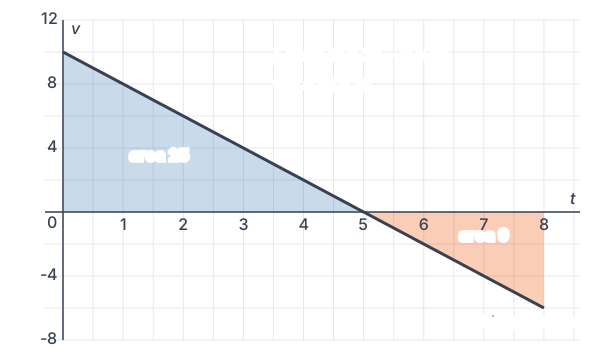
A cart’s velocity is v(t) = 10 - 2t m/s for 0 \le t \le 8. Find its displacement and the total distance it travels.
v(t) = 0 \Rightarrow t = 5
The cart stops and turns around at t = 5.
\frac{1}{2}(5)(10) = 25From 0 to 5: a triangle above the axis, height v(0) = 10.
\frac{1}{2}(3)(6) = 9From 5 to 8: a triangle below the axis, height |v(8)| = 6.
\int_0^8 v(t)\,dt = 25 - 9 = 16
Displacement: signed area.
25 + 9 = 34
Total distance: add the areas.
Answer: the displacement is 16 m (the cart ends 16 m forward), and the total distance traveled is 34 m. The graph above shows both regions.
Common mistakes
| Mistake | Example of the error | Fix |
|---|---|---|
| Adding areas below the axis as positive | \int_{-2}^{3} x\,dx = 6.5 | Below-axis area counts as negative: 4.5 − 2 = 2.5. |
| Confusing displacement and distance | Saying the cart traveled 16 m | Distance adds all areas: 34 m. |
| Forgetting the definite integral is a number | Adding + C to \int_0^4 (2x + 1)\,dx | A definite integral has no + C; its value is 20. |
| Using the wrong radius | Using r = 9 for \sqrt{9 - x^2} | x² + y² = 9 means r = 3. |
| Swapping the limits without changing the sign | \int_3^0 x\,dx = 4.5 | Reversing the limits flips the sign: −4.5. |
Related methods
Properties of definite integrals
Integrals over adjacent intervals add, constants factor out, and reversing the limits changes the sign. These rules come in the next lesson, Properties of Definite Integrals.
The fast way
Limits of sums are slow. The Fundamental Theorem of Calculus, later in this unit, evaluates definite integrals with antiderivatives: \int_0^2 x^2\,dx = \frac{2^3}{3} - 0 = \frac{8}{3} in one line.
Practice problems
- Evaluate \int_0^3 4\,dx.
- Evaluate \int_1^5 x\,dx.
- Evaluate \int_0^6 (6 - x)\,dx.
- Evaluate \int_{-4}^{0} x\,dx.
- Evaluate \int_{-1}^{1} |x|\,dx.
- Evaluate \int_0^2 \sqrt{4 - x^2}\,dx.
- Evaluate \int_0^{2\pi} \sin x\,dx using symmetry.
- Evaluate \int_0^3 (x - 1)\,dx.
- Evaluate \int_0^1 x^3\,dx as a limit of right Riemann sums. Use \sum_{i=1}^{n} i^3 = \left(\frac{n(n + 1)}{2}\right)^2.
- Water flows into a tank at r(t) = 2t liters per minute. Use a definite integral to find how much water flows in from t = 0 to t = 6.
Show answers
1.
\int_0^3 4\,dx = 3 \cdot 4 = 12
A rectangle with width 3 and height 4.
Answer: 12
2.
\frac{1 + 5}{2} \cdot 4 = 12A trapezoid with parallel sides 1 and 5 and width 4.
Answer: 12
3.
\frac{1}{2}(6)(6) = 18A triangle with base 6 and height 6.
Answer: 18
4.
-\frac{1}{2}(4)(4) = -8A triangle below the axis.
Answer: −8
5.
\frac{1}{2}(1)(1) + \frac{1}{2}(1)(1) = 1Two triangles above the axis.
Answer: 1
6.
\frac{1}{4}\pi(2)^2 = \piA quarter circle with radius 2.
Answer: π ≈ 3.142
7.
\int_0^{\pi}\sin x\,dx = -\int_{\pi}^{2\pi}\sin x\,dxThe hump below the axis matches the hump above it.
Answer: 0
8.
-\frac{1}{2}(1)(1) + \frac{1}{2}(2)(2) = -0.5 + 2Below the axis on [0, 1], above on [1, 3].
Answer: 1.5
9.
R_n = \sum_{i=1}^{n}\left(\frac{i}{n}\right)^3\frac{1}{n} = \frac{1}{n^4}\left(\frac{n(n + 1)}{2}\right)^2Δx = 1/n and xᵢ = i/n.
R_n = \frac{(n + 1)^2}{4n^2} \to \frac{1}{4}Simplify, then let n → ∞.
Answer: 1/4
10.
\int_0^6 2t\,dt = \frac{1}{2}(6)(12) = 36A triangle with base 6 and height r(6) = 12.
Answer: 36 liters
Definite integrals FAQ
What does a definite integral represent?
The signed area between the graph and the x-axis from a to b: area above the axis minus area below it. In context it is a total amount, such as distance from velocity.
What is the difference between a definite and an indefinite integral?
A definite integral has limits a and b and is a number. An indefinite integral has no limits and is a family of functions, F(x) + C.
Can a definite integral be negative?
Yes. If more of the area is below the x-axis than above it, the definite integral is negative.
How do you evaluate a definite integral without antiderivatives?
Use geometry when the graph makes simple shapes, or compute the limit of Riemann sums. The Fundamental Theorem of Calculus is the shortcut.
Summary
- \int_a^b f(x)\,dx = \lim_{n \to \infty}\sum f(x_i)\,\Delta x.
- It is a signed area: above the axis is positive, below is negative.
- Geometry gives exact values for lines and circles.
- Displacement is the integral of velocity; total distance adds the areas without signs.
- A definite integral is a number, with no + C.
Previous lesson: Trapezoidal Rule
Next lesson: Properties of Definite Integrals
Back to the Calculus 1 Index