
Work Done by a Variable Force
The work done by a variable force F(x) moving an object along a line from x = a to x = b is W = \int_a^b F(x)\,dx. When the force is constant, work is just force times distance. When the force changes, you add up force times tiny distances, which is an integral.
Before this lesson: Riemann Sums, Definite Integrals and Fundamental Theorem of Calculus, Part 2
Why work becomes an integral
Pushing a box with a steady 10 newtons for 3 meters takes 10 · 3 = 30 joules of work. But stretching a spring gets harder the farther you pull. The force keeps changing, so one multiplication won’t do.
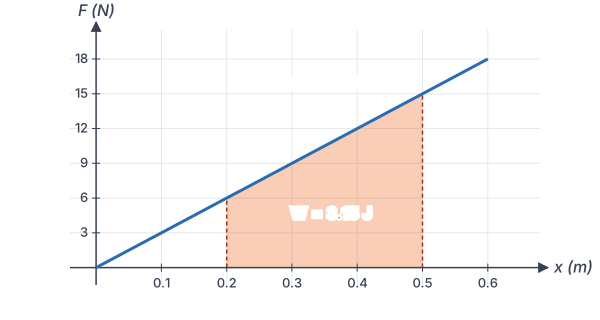
Break the motion into tiny steps Δx. Over each step, the force is almost constant, so the work is about F(x)Δx. Adding the steps is a Riemann sum, and its limit is \int_a^b F(x)\,dx. On a graph of force against distance, the work is the area under the curve.
Work formulas
W = \int_a^b F(x)\,dx
| Situation | Formula |
|---|---|
| Constant force | W = Fd |
| Variable force F(x) | W = \int_a^b F(x)\,dx |
| Spring (Hooke’s law) | F(x) = kx, where x is the distance stretched or squeezed past the natural length |
| Lifting a cable or chain | W = \int (\text{weight per length})(\text{distance lifted})\,dy |
Units: force in newtons and distance in meters give joules (J); pounds and feet give foot-pounds (ft-lb).
Work done by a variable force examples
Example 1: A force given by a formula
A force of F(x) = 3x^2 + 2 newtons moves an object from x = 0 to x = 2 meters. Find the work.
W = \int_0^2 (3x^2 + 2)\,dx
Set up the work integral.
= \Big[x^3 + 2x\Big]_0^2
Integrate with the power rule (see antiderivatives).
= (8 + 4) - 0 = 12
Plug in 2 and 0.
Answer: W = 12 joules.
Example 2: Stretching a spring
A force of 6 N holds a spring stretched 0.2 m past its natural length. How much work does it take to stretch it from 0.2 m to 0.5 m past its natural length?
6 = k(0.2)
Hooke’s law, F = kx, with x = 0.2.
k = 30
Divide both sides by 0.2. Units: N/m.
W = \int_{0.2}^{0.5} 30x\,dx = \Big[15x^2\Big]_{0.2}^{0.5}Set up and integrate.
= 15(0.25) - 15(0.04)
Plug in 0.5 and 0.2.
= 3.75 - 0.6 = 3.15
Subtract.
Answer: W = 3.15 joules. This is the shaded area in the graph above.
Example 3: Finding the spring constant from work
A spring has natural length 10 cm. It takes 2 J of work to stretch it from 10 cm to 15 cm. How much work does it take to stretch it from 15 cm to 20 cm?
0 \text{ to } 0.05 \text{ m}Measure x from the natural length, in meters: 15 cm is 0.05 m past it.
\int_0^{0.05} kx\,dx = \dfrac{k(0.05)^2}{2} = 0.00125kWork for the first stretch.
0.00125k = 2 \Rightarrow k = 1600
Set it equal to 2 J and divide.
W = \int_{0.05}^{0.10} 1600x\,dx = \Big[800x^2\Big]_{0.05}^{0.10}20 cm is 0.10 m past natural length.
= 800(0.01) - 800(0.0025) = 8 - 2 = 6
Plug in and subtract.
Answer: 6 joules, three times as much as the first 5 cm.
Example 4: Lifting a hanging cable
A 30 m cable that weighs 2 N per meter hangs from the top of a building. How much work does it take to pull the whole cable up to the top?
\text{weight of a piece} = 2\,\Delta yLet y be the distance below the top. A piece of length Δy weighs 2Δy newtons.
\text{work for that piece} \approx 2\,\Delta y \cdot yIt must be lifted y meters.
W = \int_0^{30} 2y\,dyAdd the pieces from y = 0 to y = 30.
= \Big[y^2\Big]_0^{30} = 900Integrate and plug in.
Answer: W = 900 joules. Pieces near the bottom are lifted farther, which is why the integral is needed.
Example 5: A cable lifting a bucket
The same 30 m cable (2 N/m) is used to lift a 150 N bucket of tools from the ground to the top. How much work is done in all?
W_{\text{cable}} = 900From Example 4.
W_{\text{bucket}} = 150 \cdot 30 = 4500The bucket’s weight is constant, so W = Fd.
W = 900 + 4500 = 5400
Add the two parts.
Answer: 5400 joules.
Common mistakes
| Mistake | Example of the error | Fix |
|---|---|---|
| Using W = Fd for a changing force | Spring: 30(0.5) · 0.3 | The force changes, so integrate: \int_{0.2}^{0.5} 30x\,dx. |
| Measuring from the wrong place | x = 15 cm for a 15 cm spring with natural length 10 cm | Hooke’s law uses the stretch past natural length: x = 5 cm. |
| Mixing units | Using x in centimeters with forces in newtons | Convert to meters to get joules. |
| Lifting a cable all the same distance | W = 60 · 30 for the whole 60 N cable | Each piece is lifted a different distance. Integrate weight per length times y. |
| Forgetting the load | Only the cable’s work for a cable lifting a bucket | Add the constant-force work for the load. |
Related methods
Pumping liquid out of a tank
The cable idea extends to liquids: slice the liquid into thin layers, find each layer’s weight, and multiply by the distance it must be lifted. That is the next lesson, Pumping Liquid Problems.
Force from gravity far from Earth
Gravity’s pull drops as 1/r². The work to lift a satellite from r = R to r = 2R is \int_R^{2R} \dfrac{GMm}{r^2}\,dr = \dfrac{GMm}{2R}, an integral of a variable force.
Work and energy
The work done stretching a spring from its natural length to x is (1/2)kx². This is the energy stored in the spring.
Practice problems
- A force of F(x) = 5x + 4 newtons moves an object from x = 0 to x = 3 m. Find the work.
- A force of F(x) = \dfrac{1}{x^2} newtons acts from x = 1 to x = 4 m. Find the work.
- A force of F(x) = 10\sin\dfrac{\pi x}{4} newtons acts from x = 0 to x = 2 m. Find the work.
- A force of 8 N holds a spring 0.4 m past its natural length. Find the work to stretch it from natural length to 0.4 m.
- A spring has k = 50 N/m. Find the work to stretch it from 0.1 m to 0.3 m past natural length.
- A 10 lb force stretches a spring 2 inches. Find the work, in ft-lb, to stretch it 6 inches past natural length.
- It takes 0.9 J of work to stretch a spring 0.3 m past its natural length. What force holds it there?
- A 20 ft chain weighing 3 lb/ft hangs from a winch. Find the work to wind up the whole chain.
- For the chain in problem 8, find the work to wind up only the top 10 ft.
- A bucket of water weighs 40 lb at the bottom of a 50 ft well. It leaks as it rises, so it weighs 40 − 0.2y lb at height y. Find the work to lift it to the top (ignore the rope).
Show answers
1.
W = \int_0^3 (5x + 4)\,dx = \Big[\tfrac{5}{2}x^2 + 4x\Big]_0^3Set up and integrate.
= 22.5 + 12 = 34.5
Plug in 3.
Answer: 34.5 J
2.
W = \int_1^4 x^{-2}\,dx = \Big[-\dfrac{1}{x}\Big]_1^4Set up and integrate.
= -\dfrac{1}{4} + 1 = \dfrac{3}{4}Plug in 4 and 1.
Answer: 0.75 J
3.
W = \int_0^2 10\sin\dfrac{\pi x}{4}\,dx = 10\cdot\dfrac{4}{\pi}\Big[-\cos\dfrac{\pi x}{4}\Big]_0^2Use u = πx/4, so dx = (4/π) du (see u-substitution).
= \dfrac{40}{\pi}\left(-\cos\dfrac{\pi}{2} + \cos 0\right) = \dfrac{40}{\pi}(0 + 1)Plug in 2 and 0.
= \dfrac{40}{\pi} \approx 12.73Simplify.
Answer: about 12.73 J
4.
k = \dfrac{8}{0.4} = 20Hooke’s law.
W = \int_0^{0.4} 20x\,dx = 10(0.4)^2 = 1.6Integrate and plug in.
Answer: 1.6 J
5.
W = \int_{0.1}^{0.3} 50x\,dx = 25(0.09) - 25(0.01)Integrate to 25x² and plug in.
= 2.25 - 0.25 = 2
Subtract.
Answer: 2 J
6.
2 \text{ in} = \tfrac{1}{6} \text{ ft}, \; k = \dfrac{10}{1/6} = 60Convert to feet, then use Hooke’s law.
W = \int_0^{0.5} 60x\,dx = 30(0.5)^2 = 7.56 inches is 0.5 ft.
Answer: 7.5 ft-lb
7.
\dfrac{k(0.3)^2}{2} = 0.9 \Rightarrow 0.045k = 0.9Work from 0 to 0.3 is kx²/2.
k = 20, \; F = 20(0.3) = 6
Divide, then use F = kx.
Answer: 6 N
8.
W = \int_0^{20} 3y\,dy = \Big[\tfrac{3}{2}y^2\Big]_0^{20}A piece y ft down weighs 3Δy lb and is lifted y ft.
= \tfrac{3}{2}(400) = 600Plug in.
Answer: 600 ft-lb
9.
\int_0^{10} 3y\,dy = \tfrac{3}{2}(100) = 150The top 10 ft: each piece is lifted y ft.
3 \cdot 10 \cdot 10 = 300
The bottom 10 ft weighs 30 lb and every piece rises 10 ft.
150 + 300 = 450
Add.
Answer: 450 ft-lb
10.
W = \int_0^{50} (40 - 0.2y)\,dy = \Big[40y - 0.1y^2\Big]_0^{50}The force is the bucket’s weight at height y.
= 2000 - 250 = 1750
Plug in 50.
Answer: 1750 ft-lb
Work done by a variable force FAQ
What is the formula for work done by a variable force?
W = ∫ from a to b of F(x) dx. It is the area under the graph of force against position.
How do you find work done on a spring?
Use Hooke’s law, F = kx, where x is measured from the natural length. Find k from the given data, then integrate kx over the stretch.
Why can’t you just multiply force by distance?
W = Fd only works when the force stays the same. When the force changes, you add tiny pieces F(x) dx, which is an integral.
What are the units of work?
Newtons times meters give joules. Pounds times feet give foot-pounds.
Summary
- Work by a variable force: W = ∫ₐᵇ F(x) dx, the area under the force graph.
- Springs: F = kx, with x measured from the natural length.
- Find k first, then integrate kx between the two stretches.
- Cables and chains: integrate weight per length times the distance lifted.
- Add constant-force work for any load: W = Fd.
Previous lesson: Surface Area of Revolution
Next lesson: Pumping Liquid Problems
Back to the Calculus 2 Index