
Surface Area of Revolution
The surface area of revolution is the area of the surface made by spinning a curve around an axis. For y = f(x) from a to b spun around the x-axis, S = \int_a^b 2\pi f(x)\sqrt{1 + \left(f'(x)\right)^2}\,dx. Each tiny piece of the curve sweeps out a thin band whose area is about its circumference times its slanted width.
Before this lesson: Arc Length of a Curve and Disk Method
Thin bands around the axis
Spin a curve around the x-axis and it traces a surface, like the outside of a vase. Cut the surface into thin bands. Each band is almost a short, slanted strip wrapped around the axis.
A band’s length around is its circumference, 2π times its radius. Its width is a tiny piece of the curve, ds = \sqrt{1 + (f'(x))^2}\,dx, the same piece used for arc length. So each band has area about 2π · radius · ds.
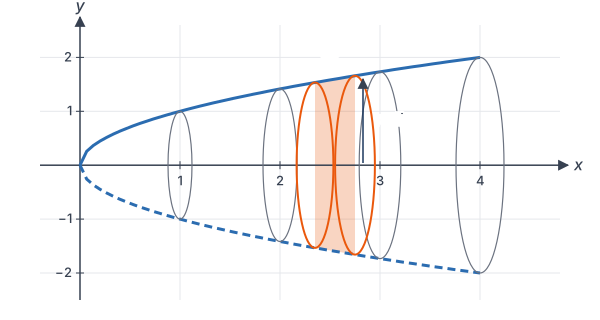
Surface area of revolution formula
| Spun around | Radius | Formula |
|---|---|---|
| The x-axis | y = f(x) | S = \int_a^b 2\pi f(x)\sqrt{1 + (f'(x))^2}\,dx |
| The y-axis | x | S = \int_a^b 2\pi x\sqrt{1 + (f'(x))^2}\,dx |
In both cases, the radius is the distance from the curve to the axis, and the square root is the arc length piece ds. Here f(x) ≥ 0 and f′ is continuous.
- Find f′(x), then 1 + (f′(x))².
- Multiply the square root by 2π times the radius.
- Simplify. Often the radius cancels part of the root.
- Integrate, often with a u-substitution.
Surface area of revolution examples
Example 1: Spinning y = √x
Find the area of the surface made by spinning y = \sqrt{x}, from x = 0 to x = 4, around the x-axis.
f'(x) = \dfrac{1}{2\sqrt{x}}Power rule: x^(1/2) becomes (1/2)x^(−1/2) (see power rule).
1 + (f'(x))^2 = 1 + \dfrac{1}{4x} = \dfrac{4x + 1}{4x}Square, add 1 and use a common denominator.
2\pi\sqrt{x}\cdot\sqrt{\dfrac{4x + 1}{4x}} = 2\pi\cdot\dfrac{\sqrt{4x + 1}}{2} = \pi\sqrt{4x + 1}√x cancels; √(4x) = 2√x.
S = \int_0^4 \pi\sqrt{4x + 1}\,dxSet up.
= \pi\cdot\dfrac{1}{4}\cdot\dfrac{2}{3}(4x + 1)^{3/2}\Big|_0^4Integrate with u = 4x + 1, du = 4 dx (see u-substitution).
= \dfrac{\pi}{6}\left(17^{3/2} - 1\right) \approx 36.18Plug in 4 and 0; 17^(3/2) ≈ 70.093.
Answer: S = \dfrac{\pi}{6}\left(17\sqrt{17} - 1\right) \approx 36.18.
Example 2: The surface of a sphere
Use the formula to find the surface area of a sphere of radius 3.
f(x) = \sqrt{9 - x^2}, \; f'(x) = \dfrac{-x}{\sqrt{9 - x^2}}Spin the upper half of the circle x² + y² = 9 around the x-axis; use the chain rule.
1 + \dfrac{x^2}{9 - x^2} = \dfrac{9}{9 - x^2}Square, add 1 and use a common denominator.
2\pi\sqrt{9 - x^2}\cdot\dfrac{3}{\sqrt{9 - x^2}} = 6\piThe radius cancels the root completely.
S = \int_{-3}^{3} 6\pi\,dx = 6\pi(6) = 36\piIntegrate the constant.
Answer: S = 36\pi, which matches the geometry formula 4πr² = 4π(9) (see surface area and volume of spheres).
Example 3: A cone
Spin the line y = 2x, from x = 0 to x = 3, around the x-axis. Find the surface area and check it.
f'(x) = 2, \; \sqrt{1 + 4} = \sqrt{5}The slope is constant.
S = \int_0^3 2\pi(2x)\sqrt{5}\,dx = 4\sqrt{5}\,\pi\int_0^3 x\,dxSet up and pull out constants.
= 4\sqrt{5}\,\pi\cdot\dfrac{9}{2} = 18\sqrt{5}\,\pi∫₀³ x dx = 9/2.
\pi r\ell = \pi(6)\left(\sqrt{3^2 + 6^2}\right) = 6\pi\cdot 3\sqrt{5} = 18\sqrt{5}\,\piCheck with the cone’s lateral area: r = 6, slant height ℓ = 3√5 (see surface area of pyramids and cones).
Answer: S = 18\sqrt{5}\,\pi \approx 126.45.
Example 4: A curve that needs substitution
Find the area of the surface made by spinning y = x³, from x = 0 to x = 1, around the x-axis.
f'(x) = 3x^2, \; 1 + (f'(x))^2 = 1 + 9x^4
Differentiate, square and add 1.
S = \int_0^1 2\pi x^3\sqrt{1 + 9x^4}\,dxSet up.
u = 1 + 9x^4, \; du = 36x^3\,dx; \; x = 0 \to u = 1, \; x = 1 \to u = 10
Substitute and change the limits (see u-substitution with definite integrals).
= \dfrac{2\pi}{36}\int_1^{10} u^{1/2}\,du = \dfrac{\pi}{18}\cdot\dfrac{2}{3}u^{3/2}\Big|_1^{10}x³ dx = du/36; integrate.
= \dfrac{\pi}{27}\left(10\sqrt{10} - 1\right) \approx 3.56310^(3/2) = 10√10.
Answer: S = \dfrac{\pi}{27}\left(10\sqrt{10} - 1\right) \approx 3.563.
Example 5: Coating a satellite dish
A dish is made by spinning y = \dfrac{x^2}{4}, from x = 0 to x = 2, around the y-axis (in meters). It is 4 meters across and 1 meter deep. How much area must be coated?
f'(x) = \dfrac{x}{2}, \; 1 + \dfrac{x^2}{4}Differentiate, square and add 1.
S = \int_0^2 2\pi x\sqrt{1 + \dfrac{x^2}{4}}\,dxSpun around the y-axis, so the radius is x.
u = 1 + \dfrac{x^2}{4}, \; du = \dfrac{x}{2}\,dx; \; x = 0 \to u = 1, \; x = 2 \to u = 2Substitute; x dx = 2 du.
= 2\pi\int_1^2 2\sqrt{u}\,du = 4\pi\cdot\dfrac{2}{3}u^{3/2}\Big|_1^2Rewrite and integrate.
= \dfrac{8\pi}{3}\left(2\sqrt{2} - 1\right) \approx 15.322^(3/2) = 2√2.
Answer: about 15.3 square meters must be coated.
Common mistakes
| Mistake | Example of the error | Fix |
|---|---|---|
| Using f′ as the radius | \int 2\pi f'(x)\sqrt{1 + (f')^2}\,dx | The radius is the distance to the axis: f(x) for the x-axis, x for the y-axis. |
| Leaving out the arc length piece | \int_0^4 2\pi\sqrt{x}\,dx | Without the square root you get the wrong answer for any curve that isn’t flat. Use ds = √(1 + (f′)²) dx. |
| Using the volume formula | \int \pi f(x)^2\,dx | That’s the disk method for volume. Surface area uses 2π · radius · ds. |
| Wrong radius for the y-axis | Using f(x) when spinning around the y-axis | Around the y-axis, the radius is x. |
| Forgetting 2π | \int f(x)\sqrt{1 + (f')^2}\,dx | Each band’s length around is 2πr. |
Related methods
Curves written as x = g(y)
If the curve is x = g(y) from y = c to y = d, use S = \int_c^d 2\pi g(y)\sqrt{1 + (g'(y))^2}\,dy around the y-axis, or replace g(y) with y as the radius for the x-axis.
Numerical estimates
Like arc length, most surface area integrals have no elementary antiderivative. Estimate them with Simpson’s rule.
Gabriel’s horn
Spin y = 1/x, for x ≥ 1, around the x-axis. The volume is π, but the surface area is infinite, because 2\pi\dfrac{1}{x}\sqrt{1 + \dfrac{1}{x^4}} \ge \dfrac{2\pi}{x}, whose integral diverges by the comparison test for improper integrals.
Practice problems
Find the surface area. Spin around the x-axis unless told otherwise.
- y = 3x, from x = 0 to x = 2
- y = √x, from x = 1 to x = 4
- y = \sqrt{4 - x^2}, from x = −1 to x = 1
- y = \dfrac{x^3}{3}, from x = 0 to x = 1
- y = 1 − x, from x = 0 to x = 1, around the y-axis
- y = x², from x = 0 to x = √2, around the y-axis
- y = cosh x, from x = 0 to x = 1
- y = sin x, from x = 0 to x = π. Use \int_{-1}^{1} \sqrt{1 + u^2}\,du = \sqrt{2} + \ln(1 + \sqrt{2}).
- Show that a sphere of radius R has surface area 4πR².
- A lampshade is made by spinning y = x + 1, from x = 0 to x = 2, around the x-axis (in feet). Find its area.
Show answers
1.
f'(x) = 3, \; \sqrt{1 + 9} = \sqrt{10}Constant slope.
S = \int_0^2 2\pi(3x)\sqrt{10}\,dx = 6\sqrt{10}\,\pi\cdot\dfrac{2^2}{2}Set up and integrate x.
= 12\sqrt{10}\,\pi \approx 119.22Multiply.
Answer: 12\sqrt{10}\,\pi, the lateral area of a cone with r = 6 and ℓ = 2√10
2.
2\pi\sqrt{x}\sqrt{1 + \dfrac{1}{4x}} = \pi\sqrt{4x + 1}Same simplification as Example 1.
S = \dfrac{\pi}{6}(4x + 1)^{3/2}\Big|_1^4 = \dfrac{\pi}{6}\left(17^{3/2} - 5^{3/2}\right)Integrate and plug in.
\approx \dfrac{\pi}{6}(70.093 - 11.180) \approx 30.85Evaluate.
Answer: about 30.85
3.
2\pi\sqrt{4 - x^2}\cdot\dfrac{2}{\sqrt{4 - x^2}} = 4\piAs in Example 2, the radius cancels the root.
S = \int_{-1}^{1} 4\pi\,dx = 8\piIntegrate the constant over a width of 2.
Answer: 8\pi \approx 25.13
4.
S = \int_0^1 2\pi\cdot\dfrac{x^3}{3}\sqrt{1 + x^4}\,dxf′(x) = x², so 1 + (f′)² = 1 + x⁴.
u = 1 + x^4, \; du = 4x^3\,dx
So x³ dx = du/4; u goes from 1 to 2.
= \dfrac{2\pi}{3}\cdot\dfrac{1}{4}\cdot\dfrac{2}{3}u^{3/2}\Big|_1^2 = \dfrac{\pi}{9}\left(2\sqrt{2} - 1\right)Integrate and plug in.
Answer: \dfrac{\pi}{9}\left(2\sqrt{2} - 1\right) \approx 0.638
5.
f'(x) = -1, \; \sqrt{1 + 1} = \sqrt{2}Constant slope.
S = \int_0^1 2\pi x\sqrt{2}\,dx = 2\sqrt{2}\,\pi\cdot\dfrac{1}{2} = \sqrt{2}\,\piThe radius is x.
Answer: \sqrt{2}\,\pi \approx 4.443, a cone with r = 1 and ℓ = √2
6.
S = \int_0^{\sqrt{2}} 2\pi x\sqrt{1 + 4x^2}\,dxf′(x) = 2x; the radius is x.
u = 1 + 4x^2, \; du = 8x\,dx
u goes from 1 to 9.
= \dfrac{2\pi}{8}\cdot\dfrac{2}{3}u^{3/2}\Big|_1^9 = \dfrac{\pi}{6}(27 - 1) = \dfrac{13\pi}{3}9^(3/2) = 27.
Answer: \dfrac{13\pi}{3} \approx 13.61
7.
2\pi\cosh x\sqrt{1 + \sinh^2 x} = 2\pi\cosh^2 xUse 1 + sinh²x = cosh²x (see hyperbolic functions).
= \pi(1 + \cosh 2x)
Use cosh²x = (1 + cosh 2x)/2.
S = \pi\Big[x + \dfrac{\sinh 2x}{2}\Big]_0^1 = \pi\left(1 + \dfrac{\sinh 2}{2}\right)Integrate and plug in.
\approx \pi(1 + 1.81343) \approx 8.839
sinh 2 ≈ 3.62686.
Answer: about 8.839
8.
S = \int_0^{\pi} 2\pi\sin x\sqrt{1 + \cos^2 x}\,dxf′(x) = cos x.
u = \cos x, \; du = -\sin x\,dx
u goes from 1 to −1.
= 2\pi\int_{-1}^{1} \sqrt{1 + u^2}\,duFlip the limits to absorb the minus sign.
= 2\pi\left(\sqrt{2} + \ln(1 + \sqrt{2})\right) \approx 14.42Use the given value.
Answer: about 14.42
9.
2\pi\sqrt{R^2 - x^2}\cdot\dfrac{R}{\sqrt{R^2 - x^2}} = 2\pi RUpper half of x² + y² = R²; the root cancels.
S = \int_{-R}^{R} 2\pi R\,dx = 2\pi R(2R) = 4\pi R^2Integrate over a width of 2R.
Answer: 4πR²
10.
f'(x) = 1, \; \sqrt{2}Constant slope.
S = \int_0^2 2\pi(x + 1)\sqrt{2}\,dx = 2\sqrt{2}\,\pi\Big[\dfrac{x^2}{2} + x\Big]_0^2Set up and integrate.
= 2\sqrt{2}\,\pi(2 + 2) = 8\sqrt{2}\,\pi \approx 35.54Plug in.
Answer: about 35.5 square feet
Surface area of revolution FAQ
What is the formula for surface area of revolution?
Around the x-axis, S = ∫ 2π f(x) √(1 + (f′(x))²) dx. Around the y-axis, replace f(x) with x. In both, 2π times the radius is multiplied by the arc length piece.
How is surface area different from volume of revolution?
Volume adds up disks, πr² dx, and needs no square root. Surface area adds up thin bands, 2πr ds, and uses the arc length piece ds.
Why is there a square root in the formula?
Each band is slanted, not flat. Its true width is a piece of the curve’s length, ds = √(1 + (f′)²) dx, not dx.
How do you find surface area around the y-axis?
Use the distance to the y-axis, x, as the radius: S = ∫ 2πx√(1 + (f′(x))²) dx, with x from a to b.
Summary
- Surface area of revolution: S = ∫ 2π · radius · ds, with ds = √(1 + (f′)²) dx.
- Around the x-axis, the radius is f(x); around the y-axis, it is x.
- The radius often cancels part of the root; u-substitution often finishes the job.
- Check answers against the sphere (4πr²) and cone (πrℓ) formulas.
- Hard cases need numerical methods.
Previous lesson: Arc Length of a Curve
Next lesson: Work Done by a Variable Force
Back to the Calculus 2 Index