
Arc Length of a Curve
The arc length of a curve y = f(x) from x = a to x = b is L = \int_a^b \sqrt{1 + \left(f'(x)\right)^2}\,dx. The formula adds up tiny straight pieces of the curve, each found with the Pythagorean theorem. It works whenever f′ is continuous on [a, b].
Before this lesson: Distance Formula, Power Rule and Definite Integrals
Measuring a curve with tiny straight pieces
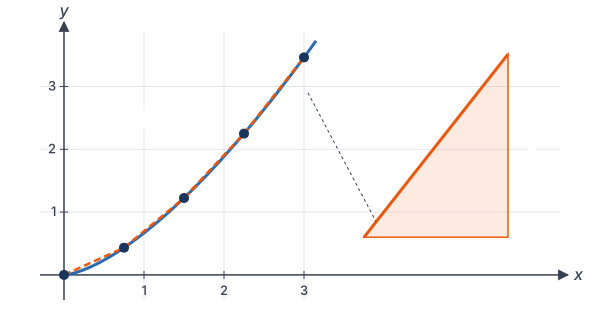
You can’t lay a ruler along a curve, but you can along a short straight piece. Break the curve into many short pieces. Each piece is the long side of a small right triangle with legs Δx and Δy.
By the Pythagorean theorem, a piece has length \sqrt{(\Delta x)^2 + (\Delta y)^2}. Factor out Δx and use Δy/Δx ≈ f′(x). Each piece is about \sqrt{1 + (f'(x))^2}\,\Delta x. As the pieces shrink, the sum becomes an integral.
Arc length formula
L = \int_a^b \sqrt{1 + \left(\dfrac{dy}{dx}\right)^2}\,dxIf the curve is written as x = g(y) from y = c to y = d, use the same idea with the roles switched:
L = \int_c^d \sqrt{1 + \left(\dfrac{dx}{dy}\right)^2}\,dy- Find the derivative f′(x).
- Square it and add 1.
- Simplify the square root, if you can. Many textbook problems turn into a perfect square.
- Integrate from a to b. If there is no antiderivative you can find, estimate the integral numerically.
Arc length examples
Example 1: A power curve
Find the arc length of y = \dfrac{2}{3}x^{3/2} from x = 0 to x = 3.
f'(x) = \dfrac{2}{3}\cdot\dfrac{3}{2}x^{1/2} = x^{1/2}Use the power rule.
1 + \left(x^{1/2}\right)^2 = 1 + xSquare and add 1.
L = \int_0^3 \sqrt{1 + x}\,dxSet up the integral.
= \Big[\dfrac{2}{3}(1 + x)^{3/2}\Big]_0^3Integrate with u = 1 + x (see u-substitution).
= \dfrac{2}{3}\left(4^{3/2} - 1^{3/2}\right) = \dfrac{2}{3}(8 - 1)Plug in; 4^(3/2) = 8.
= \dfrac{14}{3} \approx 4.667Multiply.
Answer: L = \dfrac{14}{3}.
Example 2: A line, as a check
Find the length of y = 2x + 1 from x = 0 to x = 3, and compare with the distance formula.
f'(x) = 2, \; 1 + 2^2 = 5
Differentiate, square and add 1.
L = \int_0^3 \sqrt{5}\,dx = 3\sqrt{5}The integrand is constant.
\sqrt{(3 - 0)^2 + (7 - 1)^2} = \sqrt{45} = 3\sqrt{5}Distance from (0, 1) to (3, 7) (see simplifying square roots).
Answer: L = 3\sqrt{5} \approx 6.708. Both methods agree, as they should for a straight line.
Example 3: A perfect square under the root
Find the arc length of y = \dfrac{x^3}{6} + \dfrac{1}{2x} from x = 1 to x = 2.
f'(x) = \dfrac{x^2}{2} - \dfrac{1}{2x^2}Use the power rule; 1/(2x) = (1/2)x⁻¹.
\left(f'(x)\right)^2 = \dfrac{x^4}{4} - \dfrac{1}{2} + \dfrac{1}{4x^4}Square the binomial; the middle term is 2 · (x²/2) · (1/(2x²)) = 1/2 (see special products of binomials).
1 + \left(f'(x)\right)^2 = \dfrac{x^4}{4} + \dfrac{1}{2} + \dfrac{1}{4x^4}Add 1; −1/2 + 1 = 1/2.
= \left(\dfrac{x^2}{2} + \dfrac{1}{2x^2}\right)^2Recognize a perfect square (see perfect square trinomials).
L = \int_1^2 \left(\dfrac{x^2}{2} + \dfrac{1}{2x^2}\right)dxThe square root undoes the square; the inside is positive.
= \Big[\dfrac{x^3}{6} - \dfrac{1}{2x}\Big]_1^2Integrate.
= \left(\dfrac{4}{3} - \dfrac{1}{4}\right) - \left(\dfrac{1}{6} - \dfrac{1}{2}\right)Plug in 2 and 1.
= \dfrac{13}{12} + \dfrac{1}{3} = \dfrac{17}{12}Simplify each part, then add.
Answer: L = \dfrac{17}{12} \approx 1.417.
Example 4: Estimating with Simpson’s rule
Estimate the arc length of y = x² from x = 0 to x = 1 with Simpson’s rule, n = 4.
f'(x) = 2x, \; L = \int_0^1 \sqrt{1 + 4x^2}\,dxSet up the integral.
g(0) = 1, \; g(0.25) \approx 1.118034, \; g(0.5) \approx 1.414214
Let g(x) = √(1 + 4x²) and find the first three values.
g(0.75) \approx 1.802776, \; g(1) \approx 2.236068
Find the last two.
1 + 4(1.118034) + 2(1.414214) + 4(1.802776) + 2.236068 \approx 17.747735
Apply the weights 1, 4, 2, 4, 1 (see Simpson’s rule).
L \approx \dfrac{0.25}{3}(17.747735) \approx 1.478978Multiply by Δx/3.
Answer: about 1.4790. The exact value, found with trig substitution, is (2√5 + ln(2 + √5))/4 ≈ 1.478943.
Example 5: Length of a hanging cable
A power line between two poles 60 feet apart hangs in the shape y = 20\cosh\dfrac{x}{20}, for x from −30 to 30 (in feet). How long is the cable?
y' = \sinh\dfrac{x}{20}Chain rule: 20 · (1/20) sinh(x/20) (see hyperbolic functions).
1 + \sinh^2\dfrac{x}{20} = \cosh^2\dfrac{x}{20}Use cosh²u − sinh²u = 1.
L = \int_{-30}^{30} \cosh\dfrac{x}{20}\,dxcosh is positive, so the root is cosh(x/20).
= \Big[20\sinh\dfrac{x}{20}\Big]_{-30}^{30} = 20\sinh 1.5 - 20\sinh(-1.5)Integrate and plug in.
= 40\sinh 1.5 \approx 40(2.129279) \approx 85.17
sinh is odd, so sinh(−1.5) = −sinh 1.5.
Answer: the cable is about 85.2 feet long, about 25 feet more than the straight distance between the poles.
Common mistakes
| Mistake | Example of the error | Fix |
|---|---|---|
| Forgetting to square the derivative | \int_0^3 \sqrt{1 + x^{1/2}}\,dx for y = (2/3)x^(3/2) | Square f′ first: 1 + (x^(1/2))² = 1 + x. |
| Leaving out the 1 | \int_a^b \sqrt{(f'(x))^2}\,dx | The 1 comes from Δx². Always use 1 + (f′)². |
| Taking the root term by term | \sqrt{1 + 4x^2} = 1 + 2x | A square root does not split over a sum. Simplify only when the inside is a perfect square. |
| Using f instead of f′ | \int_0^1 \sqrt{1 + (x^2)^2}\,dx for y = x² | Use the derivative: \int_0^1 \sqrt{1 + (2x)^2}\,dx. |
| Mixing up the variables | Using x-limits with the dy formula | With dx/dy, the limits are y-values, from c to d. |
Related methods
The arc length function
Measuring from a fixed point a, the length up to x is s(x) = \int_a^x \sqrt{1 + (f'(t))^2}\,dt. By the fundamental theorem, \dfrac{ds}{dx} = \sqrt{1 + (f'(x))^2}, which gives the arc length differential ds = \sqrt{dx^2 + dy^2}.
Arc length of a circle
For a circle, the geometry formula s = rθ is easier. See arc length in Geometry. The calculus formula gives the same answer, as practice problem 8 shows.
Parametric and polar curves
For a curve given by x(t) and y(t), the length is \int \sqrt{(x')^2 + (y')^2}\,dt. That comes later in this course, with parametric and polar curves.
Practice problems
Find the arc length of each curve.
- y = 3x − 2, from x = 1 to x = 4
- y = \dfrac{2}{3}x^{3/2}, from x = 0 to x = 8
- y = \dfrac{1}{3}(x^2 + 2)^{3/2}, from x = 0 to x = 3
- y = \dfrac{x^4}{8} + \dfrac{1}{4x^2}, from x = 1 to x = 2
- y = ln(cos x), from x = 0 to x = π/4
- x = \dfrac{2}{3}(y - 1)^{3/2}, from y = 1 to y = 4
- Set up the arc length integral for y = sin x from 0 to π, and estimate it.
- Use the formula to find the length of the upper half of the circle x² + y² = 9.
- y = cosh x, from x = 0 to x = ln 2
- Estimate the length of y = x³ from x = 0 to x = 1 with Simpson’s rule, n = 2.
Show answers
1.
f'(x) = 3, \; \sqrt{1 + 9} = \sqrt{10}Differentiate, square, add 1.
L = \int_1^4 \sqrt{10}\,dx = 3\sqrt{10}Constant integrand; 4 − 1 = 3.
Answer: 3\sqrt{10} \approx 9.487
2.
1 + (x^{1/2})^2 = 1 + xf′(x) = x^(1/2), as in Example 1.
L = \Big[\dfrac{2}{3}(1 + x)^{3/2}\Big]_0^8 = \dfrac{2}{3}(27 - 1)9^(3/2) = 27.
= \dfrac{52}{3}Multiply.
Answer: \dfrac{52}{3} \approx 17.33
3.
f'(x) = \dfrac{1}{3}\cdot\dfrac{3}{2}(x^2 + 2)^{1/2}\cdot 2x = x\sqrt{x^2 + 2}Chain rule (see chain rule).
1 + x^2(x^2 + 2) = x^4 + 2x^2 + 1 = (x^2 + 1)^2
Square, add 1 and factor.
L = \int_0^3 (x^2 + 1)\,dx = \Big[\dfrac{x^3}{3} + x\Big]_0^3 = 9 + 3Take the root and integrate.
= 12
Add.
Answer: 12
4.
f'(x) = \dfrac{x^3}{2} - \dfrac{1}{2x^3}Power rule.
1 + (f')^2 = \dfrac{x^6}{4} + \dfrac{1}{2} + \dfrac{1}{4x^6} = \left(\dfrac{x^3}{2} + \dfrac{1}{2x^3}\right)^2Square, add 1, and recognize a perfect square.
L = \Big[\dfrac{x^4}{8} - \dfrac{1}{4x^2}\Big]_1^2 = \left(2 - \dfrac{1}{16}\right) - \left(\dfrac{1}{8} - \dfrac{1}{4}\right)Integrate and plug in.
= \dfrac{31}{16} + \dfrac{2}{16} = \dfrac{33}{16}Simplify.
Answer: \dfrac{33}{16} \approx 2.063
5.
f'(x) = \dfrac{-\sin x}{\cos x} = -\tan xDerivative of ln(cos x) by the chain rule.
1 + \tan^2 x = \sec^2 x
Pythagorean identity (see fundamental trig identities).
L = \int_0^{\pi/4} \sec x\,dx = \Big[\ln|\sec x + \tan x|\Big]_0^{\pi/4}sec x is positive here; integrate.
= \ln(\sqrt{2} + 1) - \ln 1 \approx 0.8814sec(π/4) = √2 and tan(π/4) = 1.
Answer: \ln(\sqrt{2} + 1) \approx 0.8814
6.
\dfrac{dx}{dy} = (y - 1)^{1/2}, \; 1 + (y - 1) = yUse the dy formula.
L = \int_1^4 \sqrt{y}\,dy = \Big[\dfrac{2}{3}y^{3/2}\Big]_1^4 = \dfrac{2}{3}(8 - 1)Integrate and plug in.
= \dfrac{14}{3}Multiply.
Answer: \dfrac{14}{3}
7.
L = \int_0^{\pi} \sqrt{1 + \cos^2 x}\,dxf′(x) = cos x.
\approx 3.8202
This has no elementary antiderivative; a numerical method gives the value.
Answer: about 3.820
8.
f'(x) = \dfrac{-x}{\sqrt{9 - x^2}}, \; 1 + \dfrac{x^2}{9 - x^2} = \dfrac{9}{9 - x^2}Here y = √(9 − x²); use a common denominator.
L = \int_{-3}^{3} \dfrac{3}{\sqrt{9 - x^2}}\,dx = \Big[3\arcsin\dfrac{x}{3}\Big]_{-3}^{3}An improper integral at both ends, but it converges.
= 3\left(\dfrac{\pi}{2}\right) - 3\left(-\dfrac{\pi}{2}\right) = 3\piarcsin 1 = π/2 and arcsin(−1) = −π/2.
Answer: 3π, half of the circumference 6π
9.
1 + \sinh^2 x = \cosh^2 x
The derivative of cosh x is sinh x.
L = \int_0^{\ln 2} \cosh x\,dx = \sinh(\ln 2) = \dfrac{2 - 1/2}{2}Integrate and use the definition of sinh.
= \dfrac{3}{4}Simplify.
Answer: \dfrac{3}{4}
10.
L = \int_0^1 \sqrt{1 + 9x^4}\,dxf′(x) = 3x².
g(0) = 1, \; g(0.5) = \sqrt{1 + \tfrac{9}{16}} = 1.25, \; g(1) = \sqrt{10} \approx 3.162278Values at 0, 0.5 and 1.
\dfrac{0.5}{3}\big(1 + 4(1.25) + 3.162278\big) \approx 1.527046Weights 1, 4, 1.
Answer: about 1.527 (the true value is about 1.5479)
Arc length FAQ
What is the arc length formula?
L = ∫ from a to b of √(1 + (dy/dx)²) dx. It comes from adding the lengths of tiny straight pieces with the Pythagorean theorem.
Why are arc length integrals so hard?
The square root rarely simplifies, so most arc length integrals have no elementary antiderivative. Textbook problems are chosen so 1 + (f′)² is a perfect square; otherwise, estimate numerically.
How do you find arc length with respect to y?
Write x as a function of y and use L = ∫ from c to d of √(1 + (dx/dy)²) dy, with y-limits.
Is this the same as arc length of a circle?
For a circle, both give the same answer, but s = rθ is much faster. The integral formula works for any smooth curve.
Summary
- Arc length: L = ∫ₐᵇ √(1 + (f′(x))²) dx.
- Find f′, square it, add 1, then simplify the root if you can.
- For x = g(y), use √(1 + (dx/dy)²) dy.
- Many problems turn 1 + (f′)² into a perfect square.
- If not, estimate the integral with Simpson’s rule or another numerical method.
Previous lesson: Shell Method
Next lesson: Surface Area of Revolution
Back to the Calculus 2 Index