
Hyperbolic Functions
Hyperbolic functions are built from eˣ and e⁻ˣ: \sinh x = \dfrac{e^x - e^{-x}}{2} and \cosh x = \dfrac{e^x + e^{-x}}{2}, with tanh x = sinh x / cosh x. They satisfy cosh²x − sinh²x = 1. Their derivatives are (sinh x)′ = cosh x and (cosh x)′ = sinh x, with no minus sign.
Before this lesson: Derivatives of Exponential Functions, U-Substitution and The Number e
What hyperbolic functions are
Take the average of eˣ and e⁻ˣ and you get cosh x (said “cosh”). Take half their difference and you get sinh x (said “sinch”). These two show up in hanging cables, special relativity and many differential equations.
The names come from geometry. The point (cos t, sin t) lies on the circle x² + y² = 1. The point (cosh t, sinh t) lies on the hyperbola x² − y² = 1. That is why the identities look like trig identities with some signs changed.
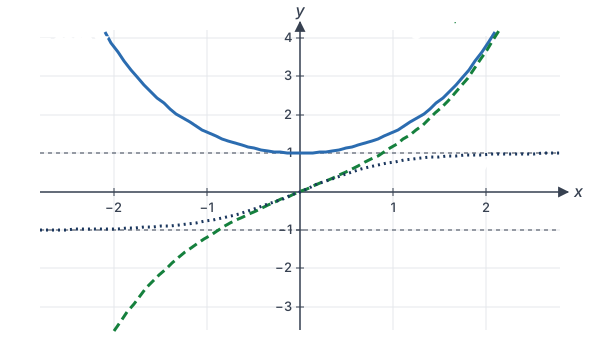
Hyperbolic function definitions and rules
\sinh x = \dfrac{e^x - e^{-x}}{2}, \qquad \cosh x = \dfrac{e^x + e^{-x}}{2}, \qquad \tanh x = \dfrac{\sinh x}{\cosh x}| Rule | Formula |
|---|---|
| Pythagorean identity | \cosh^2 x - \sinh^2 x = 1 |
| Derivative of sinh | \dfrac{d}{dx}\sinh x = \cosh x |
| Derivative of cosh | \dfrac{d}{dx}\cosh x = \sinh x |
| Derivative of tanh | \dfrac{d}{dx}\tanh x = \operatorname{sech}^2 x |
| Integral of sinh | \int \sinh x\,dx = \cosh x + C |
| Integral of cosh | \int \cosh x\,dx = \sinh x + C |
| Integral of tanh | \int \tanh x\,dx = \ln(\cosh x) + C |
Here sech x = 1/cosh x. The values to remember are sinh 0 = 0 and cosh 0 = 1.
Hyperbolic function examples
Example 1: Exact values
Find sinh(ln 2) and cosh(ln 2). Check that they satisfy the identity.
e^{\ln 2} = 2, \; e^{-\ln 2} = \dfrac{1}{2}e and ln undo each other (see logarithms).
\sinh(\ln 2) = \dfrac{2 - \tfrac{1}{2}}{2} = \dfrac{3}{4}Use the definition of sinh.
\cosh(\ln 2) = \dfrac{2 + \tfrac{1}{2}}{2} = \dfrac{5}{4}Use the definition of cosh.
\left(\dfrac{5}{4}\right)^2 - \left(\dfrac{3}{4}\right)^2 = \dfrac{25}{16} - \dfrac{9}{16} = 1Check cosh² − sinh² = 1.
Answer: \sinh(\ln 2) = \dfrac{3}{4} and \cosh(\ln 2) = \dfrac{5}{4}.
Example 2: Proving the identity
Show that cosh²x − sinh²x = 1 for every x.
\cosh^2 x = \dfrac{e^{2x} + 2 + e^{-2x}}{4}Square (eˣ + e⁻ˣ)/2; eˣ · e⁻ˣ = 1 (see exponent rules).
\sinh^2 x = \dfrac{e^{2x} - 2 + e^{-2x}}{4}Square (eˣ − e⁻ˣ)/2.
\cosh^2 x - \sinh^2 x = \dfrac{2 - (-2)}{4}Subtract; the e²ˣ and e⁻²ˣ terms cancel.
= 1
4/4 = 1.
Answer: the identity holds for all x. Unlike sin² + cos² = 1, here it is a difference.
Example 3: Derivatives
Find the derivative of y = x\sinh x - \cosh x and of y = \cosh(3x^2).
\dfrac{d}{dx}(x\sinh x) = \sinh x + x\cosh xProduct rule (see product rule).
\dfrac{d}{dx}(x\sinh x - \cosh x) = \sinh x + x\cosh x - \sinh xThe derivative of cosh x is sinh x.
= x\cosh x
The sinh terms cancel.
\dfrac{d}{dx}\cosh(3x^2) = \sinh(3x^2)\cdot 6xChain rule (see chain rule).
Answer: the first derivative is x\cosh x, and the second is 6x\sinh(3x^2).
Example 4: Integrals
Find \int x\cosh(x^2)\,dx and \int \tanh x\,dx.
u = x^2, \; du = 2x\,dx
For the first integral, let u be the inside.
\int x\cosh(x^2)\,dx = \int \dfrac{1}{2}\cosh u\,du = \dfrac{1}{2}\sinh u + CRewrite and integrate.
= \dfrac{1}{2}\sinh(x^2) + CSubstitute back.
\int \tanh x\,dx = \int \dfrac{\sinh x}{\cosh x}\,dxFor the second, write tanh as a quotient.
= \ln(\cosh x) + C
The top is the derivative of the bottom, and cosh x is always positive (see integrals that give natural logarithms).
Answer: \dfrac{1}{2}\sinh(x^2) + C and \ln(\cosh x) + C.
Example 5: A hanging cable
A power line hangs between two poles 60 feet apart. Its shape is y = 20\cosh\dfrac{x}{20} for x from −30 to 30, in feet. How much does it sag below the tops of the poles? How steep is it where it meets the right pole?
y(0) = 20\cosh 0 = 20
The lowest point is in the middle; cosh 0 = 1.
y(30) = 20\cosh 1.5 \approx 47.05
Height at the pole; cosh 1.5 ≈ 2.3524.
47.05 - 20 = 27.05
Sag = pole height minus lowest height.
y'(x) = 20\cdot\dfrac{1}{20}\sinh\dfrac{x}{20} = \sinh\dfrac{x}{20}Chain rule.
y'(30) = \sinh 1.5 \approx 2.13
Slope at the right pole.
Answer: the cable sags about 27.1 feet, and its slope at the right pole is about 2.13. A hanging cable’s curve, y = a cosh(x/a), is called a catenary.
Common mistakes
| Mistake | Example of the error | Fix |
|---|---|---|
| Adding a minus sign like trig | \dfrac{d}{dx}\cosh x = -\sinh x | There is no minus: \dfrac{d}{dx}\cosh x = \sinh x. |
| Using the trig identity | \cosh^2 x + \sinh^2 x = 1 | It’s a difference: \cosh^2 x - \sinh^2 x = 1. |
| Wrong value at 0 | sinh 0 = 1 | sinh 0 = (1 − 1)/2 = 0, and cosh 0 = (1 + 1)/2 = 1. |
| Wrong sign on the integral | \int \sinh x\,dx = -\cosh x + C | \int \sinh x\,dx = \cosh x + C. |
| Reading sinh⁻¹ as a reciprocal | \sinh^{-1} x = \dfrac{1}{\sinh x} | sinh⁻¹ is the inverse function. The reciprocal is csch x. |
Related methods
Inverse hyperbolic functions
Solving y = sinh x for x gives \sinh^{-1} x = \ln\left(x + \sqrt{x^2 + 1}\right). Similarly, \cosh^{-1} x = \ln\left(x + \sqrt{x^2 - 1}\right) for x ≥ 1. These are the logs you get from some trigonometric substitution integrals.
Hyperbolic substitution
Because 1 + sinh²u = cosh²u, the substitution x = a sinh u also removes √(a² + x²), just like x = a tan θ.
The other three functions
sech x = 1/cosh x, csch x = 1/sinh x and coth x = cosh x/sinh x, matching the six trig functions. Their derivatives follow from the quotient rule.
Practice problems
- Find sinh 0 and cosh 0.
- Find cosh(ln 3).
- Show that sinh(−x) = −sinh x.
- Find the derivative of sinh(5x).
- Find the derivative of cosh²x.
- Find the derivative of ln(cosh x).
- Find \int \cosh(2x)\,dx.
- Find \int \sinh x\cosh x\,dx.
- Evaluate \int_0^{\ln 2} \cosh x\,dx.
- An arch has the shape y = 40 - 10\cosh\dfrac{x}{10}, in meters. How wide is it at ground level?
Show answers
1.
\sinh 0 = \dfrac{e^0 - e^0}{2} = 0e⁰ = 1.
\cosh 0 = \dfrac{e^0 + e^0}{2} = 1(1 + 1)/2.
Answer: sinh 0 = 0 and cosh 0 = 1
2.
\cosh(\ln 3) = \dfrac{3 + \tfrac{1}{3}}{2}e^(ln 3) = 3 and e^(−ln 3) = 1/3.
= \dfrac{10/3}{2} = \dfrac{5}{3}Add, then divide by 2.
Answer: \dfrac{5}{3}
3.
\sinh(-x) = \dfrac{e^{-x} - e^{x}}{2}Replace x with −x in the definition.
= -\dfrac{e^x - e^{-x}}{2} = -\sinh xFactor out −1.
Answer: sinh is an odd function (see even and odd functions).
4.
\dfrac{d}{dx}\sinh(5x) = \cosh(5x)\cdot 5Chain rule.
Answer: 5\cosh(5x)
5.
\dfrac{d}{dx}\cosh^2 x = 2\cosh x\cdot\sinh xChain rule: outside power, then the derivative of cosh x.
Answer: 2\cosh x\sinh x, which equals sinh 2x
6.
\dfrac{d}{dx}\ln(\cosh x) = \dfrac{\sinh x}{\cosh x} = \tanh xChain rule with ln.
Answer: \tanh x
7.
\int \cosh(2x)\,dx = \dfrac{1}{2}\sinh(2x) + CLet u = 2x, so dx = du/2.
Answer: \dfrac{1}{2}\sinh(2x) + C
8.
\int \sinh x\cosh x\,dx = \int u\,du = \dfrac{u^2}{2} + CLet u = sinh x, du = cosh x dx.
= \dfrac{\sinh^2 x}{2} + CSubstitute back.
Answer: \dfrac{\sinh^2 x}{2} + C
9.
\int_0^{\ln 2} \cosh x\,dx = \Big[\sinh x\Big]_0^{\ln 2}Integrate.
= \sinh(\ln 2) - \sinh 0 = \dfrac{3}{4} - 0 = \dfrac{3}{4}Use Example 1.
Answer: \dfrac{3}{4}
10.
40 - 10\cosh\dfrac{x}{10} = 0Ground level is y = 0.
\cosh\dfrac{x}{10} = 4Add 10 cosh(x/10), then divide by 10.
\dfrac{x}{10} = \ln\left(4 + \sqrt{15}\right) \approx 2.063Use cosh⁻¹ 4 = ln(4 + √(16 − 1)) for the positive solution.
x \approx 20.63
Multiply by 10.
2(20.63) = 41.26
The arch is symmetric, so double it.
Answer: about 41.3 meters wide
Hyperbolic functions FAQ
What are sinh and cosh?
sinh x = (eˣ − e⁻ˣ)/2 and cosh x = (eˣ + e⁻ˣ)/2. They are called hyperbolic sine and hyperbolic cosine.
What is the derivative of cosh x?
The derivative of cosh x is sinh x, and the derivative of sinh x is cosh x. Neither has a minus sign.
Why are they called hyperbolic functions?
The point (cosh t, sinh t) lies on the hyperbola x² − y² = 1, just as (cos t, sin t) lies on the circle x² + y² = 1.
Where are hyperbolic functions used?
A hanging chain or cable takes the shape y = a cosh(x/a), called a catenary. Hyperbolic functions also appear in physics and in solutions of differential equations.
Summary
- sinh x = (eˣ − e⁻ˣ)/2 and cosh x = (eˣ + e⁻ˣ)/2; tanh x = sinh x/cosh x.
- cosh²x − sinh²x = 1.
- (sinh x)′ = cosh x and (cosh x)′ = sinh x, with no minus sign.
- ∫sinh x dx = cosh x + C and ∫cosh x dx = sinh x + C.
- sinh 0 = 0 and cosh 0 = 1; cosh is even and sinh is odd.
Previous lesson: Integration by Partial Fractions
Next lesson: Choosing an Integration Technique
Back to the Calculus 2 Index