
Choosing an Integration Technique
To choose an integration technique, check the integral’s form in order: simplify it first, then try a basic rule, a u-substitution, integration by parts, a trig method or partial fractions. Each method fits a certain shape. Matching the shape to the method is what makes hard integrals manageable.
Before this lesson: U-Substitution, Integration by Parts, Trigonometric Substitution and Integration by Partial Fractions
How to pick a method
Integration has no single formula like the product rule. Instead, you look at the integral and ask what it looks like. A fraction might split apart. A function next to its own derivative points to substitution. A product of two different kinds of functions points to parts.
Always try the cheap ideas first. Algebra and basic rules take seconds. Trig substitution and partial fractions take longer, so save them for the forms that need them.
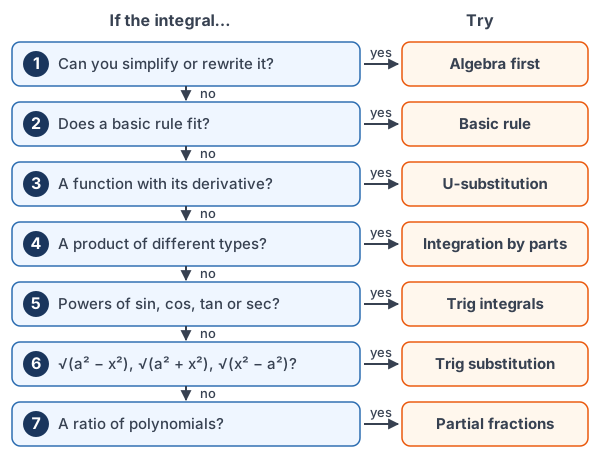
Integration techniques: which form fits which method
| If the integral has… | Try | Example |
|---|---|---|
| A sum or quotient that splits apart | Algebra first | \int \dfrac{x^2 + 1}{x}\,dx |
| A function and its derivative | U-substitution | \int 2x\cos(x^2)\,dx |
| A product of different kinds of functions | Integration by parts | \int x e^{x}\,dx |
| Powers of sin and cos, or of tan and sec | Trigonometric integrals | \int \sin^3 x\cos^2 x\,dx |
| \sqrt{a^2 - x^2}, \sqrt{a^2 + x^2} or \sqrt{x^2 - a^2} | Trigonometric substitution | \int \sqrt{9 - x^2}\,dx |
| A ratio of polynomials | Partial fractions | \int \dfrac{1}{x^2 - 5x + 6}\,dx |
For integration by parts, choose u with LIATE: Logarithmic, Inverse trig, Algebraic, Trig, Exponential. The type that comes first in the list is usually the best u.
Choosing an integration technique: examples
Example 1: Simplify first
Find \int \dfrac{x^2 + 3x - 2}{x}\,dx.
Which method? The bottom is a single term, so split the fraction. No special method is needed.
\int \dfrac{x^2 + 3x - 2}{x}\,dx = \int \left(x + 3 - \dfrac{2}{x}\right)dxDivide each term on top by x.
= \dfrac{x^2}{2} + 3x - 2\ln|x| + CIntegrate term by term with the power rule and ∫(1/x) dx = ln|x| (see antiderivatives).
Answer: \dfrac{x^2}{2} + 3x - 2\ln|x| + C.
Example 2: A function and its derivative
Find \int \dfrac{2x + 1}{x^2 + x + 5}\,dx.
Which method? The top, 2x + 1, is the derivative of the bottom. That points to u-substitution.
u = x^2 + x + 5, \; du = (2x + 1)\,dx
Let u be the bottom.
\int \dfrac{2x + 1}{x^2 + x + 5}\,dx = \int \dfrac{1}{u}\,duReplace the top and dx with du.
= \ln|u| + C
Integrate 1/u.
= \ln(x^2 + x + 5) + C
Substitute back. The bottom is always positive, so the absolute value can be dropped.
Answer: \ln(x^2 + x + 5) + C. The bottom has no real zeros, since its discriminant is 1 − 20 = −19.
Example 3: Powers of sine and cosine
Find \int \sin^3 x\cos^2 x\,dx.
Which method? It is a product of powers of sine and cosine, and the power of sine is odd. Save one sin x and change the rest to cosines (see trigonometric integrals).
\int \sin^3 x\cos^2 x\,dx = \int (1 - \cos^2 x)\cos^2 x\sin x\,dx
Write sin³x as sin²x · sin x and use sin²x = 1 − cos²x (see fundamental trig identities).
u = \cos x, \; du = -\sin x\,dx
Let u = cos x.
= -\int (1 - u^2)u^2\,du
Replace sin x dx with −du.
= -\int (u^2 - u^4)\,du
Distribute u².
= -\dfrac{u^3}{3} + \dfrac{u^5}{5} + CIntegrate each power.
= -\dfrac{\cos^3 x}{3} + \dfrac{\cos^5 x}{5} + CSubstitute back.
Answer: -\dfrac{\cos^3 x}{3} + \dfrac{\cos^5 x}{5} + C.
Example 4: A ratio of polynomials
Find \int \dfrac{1}{x^2 - 5x + 6}\,dx.
Which method? It is a ratio of polynomials, the top has a lower degree, and the bottom factors. Use partial fractions.
x^2 - 5x + 6 = (x - 2)(x - 3)
Factor the bottom (see factoring trinomials).
\dfrac{1}{(x - 2)(x - 3)} = \dfrac{A}{x - 2} + \dfrac{B}{x - 3}Set up the partial fractions.
1 = A(x - 3) + B(x - 2)
Multiply both sides by (x − 2)(x − 3).
1 = B(3 - 2) = B
Let x = 3, so the A term is 0.
1 = A(2 - 3) = -A, \text{ so } A = -1Let x = 2, so the B term is 0.
\int \left(\dfrac{-1}{x - 2} + \dfrac{1}{x - 3}\right)dx = -\ln|x - 2| + \ln|x - 3| + CIntegrate each fraction.
= \ln\left|\dfrac{x - 3}{x - 2}\right| + CCombine with a log property (see properties of logarithms).
Answer: \ln\left|\dfrac{x - 3}{x - 2}\right| + C.
Example 5: Medicine absorbed over time
A patch releases a drug into the blood at a rate of r(t) = 20te^{-t/2} milligrams per hour, where t is in hours. How much of the drug is released in the first 4 hours?
Which method? The amount is \int_0^4 20te^{-t/2}\,dt. It is a product of an algebraic factor t and an exponential. By LIATE, let u = t and use integration by parts.
u = t, \; dv = e^{-t/2}\,dtChoose u and dv.
du = dt, \; v = -2e^{-t/2}Differentiate u and integrate dv.
\int te^{-t/2}\,dt = -2te^{-t/2} - \int -2e^{-t/2}\,dtUse uv − ∫v du.
= -2te^{-t/2} + 2\int e^{-t/2}\,dtPull out the −2.
= -2te^{-t/2} - 4e^{-t/2} + CIntegrate; ∫e^(−t/2) dt = −2e^(−t/2).
\int_0^4 te^{-t/2}\,dt = \Big[-2te^{-t/2} - 4e^{-t/2}\Big]_0^4Set up the evaluation (see fundamental theorem of calculus, part 2).
= (-8e^{-2} - 4e^{-2}) - (0 - 4)Plug in 4, then 0.
= 4 - 12e^{-2} \approx 2.376Simplify; e⁻² ≈ 0.1353.
20(4 - 12e^{-2}) = 80 - 240e^{-2} \approx 47.5Multiply by the constant 20.
Answer: about 47.5 milligrams of the drug are released in the first 4 hours.
Common mistakes
| Mistake | Example of the error | Fix |
|---|---|---|
| Using a hard method when algebra works | Using parts on \int \dfrac{x^2 + 1}{x}\,dx | Split it: \int \left(x + \dfrac{1}{x}\right)dx = \dfrac{x^2}{2} + \ln|x| + C. |
| Substituting when du doesn’t match | \int e^{x^2}\,dx with u = x² | There is no x to make du = 2x dx. This integral has no elementary antiderivative; \int xe^{x^2}\,dx does work. |
| Partial fractions on a top-heavy fraction | Splitting \dfrac{x^2 + 2}{x + 1} right away | When the top’s degree is at least the bottom’s, divide first. |
| Picking u badly in parts | u = eˣ in \int xe^{x}\,dx | Use LIATE: u = x, so du = dx and the new integral is simpler. |
| Dropping the absolute value | \int \dfrac{1}{x}\,dx = \ln x + C | Write ln |x| + C, unless the inside is always positive. |
Related methods
Integrals with no formula
Some integrals, like \int e^{-x^2}\,dx and \int \sin(x^2)\,dx, have no antiderivative made of basic functions. For a definite integral of one of these, use a numerical method such as the trapezoidal rule or Simpson’s rule (the next lesson).
Hyperbolic substitution
For \sqrt{x^2 + a^2}, the substitution x = a sinh u can replace x = a tan θ, because cosh²u − sinh²u = 1. See hyperbolic functions.
Checking your answer
You can always check an antiderivative by differentiating it. If the derivative matches the integrand, the answer is right, even if it looks different from a textbook’s answer by a constant.
Practice problems
For each integral, name the method, then evaluate it.
- \int \dfrac{3x^2 - 4}{x^2}\,dx
- \int e^{\sin x}\cos x\,dx
- \int x\cos x\,dx
- \int \dfrac{1}{x^2 - 1}\,dx
- \int \dfrac{1}{\sqrt{4 - x^2}}\,dx
- \int \dfrac{x}{\sqrt{4 - x^2}}\,dx
- \int \sqrt{4 - x^2}\,dx
- \int \cos^3 x\,dx
- \int \ln x\,dx
- \int \dfrac{x^2 + 2}{x + 1}\,dx
Show answers
1.
Method: simplify first.
\int \dfrac{3x^2 - 4}{x^2}\,dx = \int (3 - 4x^{-2})\,dxDivide each term by x².
= 3x - \dfrac{4x^{-1}}{-1} + CPower rule.
= 3x + \dfrac{4}{x} + CSimplify.
Answer: 3x + \dfrac{4}{x} + C
2.
Method: u-substitution, since cos x is the derivative of sin x.
u = \sin x, \; du = \cos x\,dx
Let u be the exponent.
\int e^{\sin x}\cos x\,dx = \int e^u\,du = e^u + CRewrite and integrate.
= e^{\sin x} + CSubstitute back.
Answer: e^{\sin x} + C
3.
Method: integration by parts, with u = x by LIATE.
u = x, \; dv = \cos x\,dx, \; du = dx, \; v = \sin x
Choose u and dv, then find du and v.
\int x\cos x\,dx = x\sin x - \int \sin x\,dx
Use uv − ∫v du.
= x\sin x + \cos x + C
∫sin x dx = −cos x.
Answer: x\sin x + \cos x + C
4.
Method: partial fractions, since the bottom factors.
\dfrac{1}{(x - 1)(x + 1)} = \dfrac{A}{x - 1} + \dfrac{B}{x + 1}Factor and set up.
1 = A(x + 1) + B(x - 1)
Multiply by (x − 1)(x + 1).
A = \dfrac{1}{2}, \; B = -\dfrac{1}{2}Let x = 1, then x = −1.
\int \left(\dfrac{1/2}{x - 1} - \dfrac{1/2}{x + 1}\right)dx = \dfrac{1}{2}\ln|x - 1| - \dfrac{1}{2}\ln|x + 1| + CIntegrate each fraction.
Answer: \dfrac{1}{2}\ln\left|\dfrac{x - 1}{x + 1}\right| + C
5.
Method: a basic inverse trig form (see integrals that give inverse trig functions).
\int \dfrac{1}{\sqrt{2^2 - x^2}}\,dx = \arcsin\dfrac{x}{2} + CUse ∫ dx/√(a² − x²) = arcsin(x/a) + C with a = 2.
Answer: \arcsin\dfrac{x}{2} + C
6.
Method: u-substitution, since x is part of the derivative of 4 − x².
u = 4 - x^2, \; du = -2x\,dx
Let u be the inside of the root.
\int \dfrac{x}{\sqrt{4 - x^2}}\,dx = -\dfrac{1}{2}\int u^{-1/2}\,dux dx = −du/2.
= -\dfrac{1}{2}\cdot 2u^{1/2} + C = -\sqrt{4 - x^2} + CIntegrate and substitute back.
Answer: -\sqrt{4 - x^2} + C
7.
Method: trigonometric substitution, for √(a² − x²) with a = 2.
x = 2\sin\theta, \; dx = 2\cos\theta\,d\theta
Substitute.
\sqrt{4 - 4\sin^2\theta} = 2\cos\theta1 − sin²θ = cos²θ.
\int \sqrt{4 - x^2}\,dx = \int 4\cos^2\theta\,d\thetaMultiply 2cos θ by 2cos θ dθ.
= 2\int (1 + \cos 2\theta)\,d\theta
Use cos²θ = (1 + cos 2θ)/2 (see half-angle formulas).
= 2\theta + \sin 2\theta + C
Integrate.
= 2\theta + 2\sin\theta\cos\theta + C
Double-angle formula.
= 2\arcsin\dfrac{x}{2} + \dfrac{x\sqrt{4 - x^2}}{2} + CUse sin θ = x/2 and cos θ = √(4 − x²)/2.
Answer: 2\arcsin\dfrac{x}{2} + \dfrac{x\sqrt{4 - x^2}}{2} + C
8.
Method: trig integral with an odd power of cosine.
\int \cos^3 x\,dx = \int (1 - \sin^2 x)\cos x\,dx
Save one cos x; cos²x = 1 − sin²x.
u = \sin x, \; du = \cos x\,dx
Let u = sin x.
= \int (1 - u^2)\,du = u - \dfrac{u^3}{3} + CIntegrate.
= \sin x - \dfrac{\sin^3 x}{3} + CSubstitute back.
Answer: \sin x - \dfrac{\sin^3 x}{3} + C
9.
Method: integration by parts, with u = ln x and dv = dx.
u = \ln x, \; dv = dx, \; du = \dfrac{1}{x}\,dx, \; v = xChoose u and dv.
\int \ln x\,dx = x\ln x - \int x\cdot\dfrac{1}{x}\,dxUse uv − ∫v du.
= x\ln x - \int 1\,dx = x\ln x - x + C
Simplify and integrate.
Answer: x\ln x - x + C
10.
Method: long division first, since the top’s degree is higher.
x^2 + 2 = (x + 1)(x - 1) + 3
Divide x² + 2 by x + 1 (see polynomial long division).
\dfrac{x^2 + 2}{x + 1} = x - 1 + \dfrac{3}{x + 1}Divide both sides by x + 1.
\int \left(x - 1 + \dfrac{3}{x + 1}\right)dx = \dfrac{x^2}{2} - x + 3\ln|x + 1| + CIntegrate each term.
Answer: \dfrac{x^2}{2} - x + 3\ln|x + 1| + C
Integration techniques FAQ
What are the main integration techniques?
The main ones are u-substitution, integration by parts, trigonometric integrals, trigonometric substitution and partial fractions. Algebra, like splitting a fraction or long division, often comes first.
How do you know which integration technique to use?
Look at the form. A function with its derivative suggests substitution, a product of different types suggests parts, square roots of a² ± x² suggest trig substitution, and ratios of polynomials suggest partial fractions.
What is LIATE?
LIATE is a rule of thumb for choosing u in integration by parts: Logarithmic, Inverse trig, Algebraic, Trig, Exponential. Pick u from the type that comes first.
What if no technique works?
Some integrals, like ∫e^(−x²) dx, have no elementary antiderivative. For a definite integral, estimate it with a numerical method instead.
Summary
- Simplify first: split fractions, expand products and divide top-heavy fractions.
- Look for a function next to its derivative, and use u-substitution.
- Use parts for products of different kinds of functions, with LIATE to pick u.
- Use trig integrals for powers of trig functions and trig substitution for √(a² ± x²) or √(x² − a²).
- Use partial fractions for ratios of polynomials whose bottom factors.
Previous lesson: Hyperbolic Functions
Next lesson: Simpson’s Rule
Back to the Calculus 2 Index