
Trigonometric Integrals
Trigonometric integrals are integrals of powers and products of sin x, cos x, tan x and sec x. If sine or cosine has an odd power, save one factor, change the rest with sin²x + cos²x = 1, and substitute. If both powers are even, use the half-angle identities to lower the powers first.
Before this lesson: U-Substitution, Fundamental Trig Identities and Half-Angle Formulas
The main idea
You can’t integrate sin³x with the power rule, because the power rule needs the derivative of sin x, which is cos x, to be there. The trick is to make a factor of the derivative appear.
Write sin³x as sin²x · sin x and change sin²x into 1 − cos²x. Now every factor is a cosine except one sin x, and that sin x dx is (up to a sign) du for u = cos x. An odd power always leaves one factor to save. Even powers don’t, so you use identities that lower the power instead.
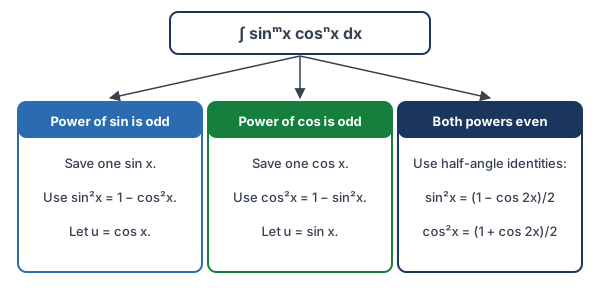
Trigonometric integral strategies
| Integral | Strategy | Substitution |
|---|---|---|
| \int \sin^m x\cos^n x\,dx, m odd | Save one sin x; use \sin^2 x = 1 - \cos^2 x | u = cos x |
| \int \sin^m x\cos^n x\,dx, n odd | Save one cos x; use \cos^2 x = 1 - \sin^2 x | u = sin x |
| \int \sin^m x\cos^n x\,dx, both even | Use the half-angle identities below | Often none needed |
| \int \tan^m x\sec^n x\,dx, n even | Save sec²x; use \sec^2 x = 1 + \tan^2 x | u = tan x |
| \int \tan^m x\sec^n x\,dx, m odd | Save sec x tan x; use \tan^2 x = \sec^2 x - 1 | u = sec x |
The half-angle identities:
\sin^2 x = \dfrac{1 - \cos 2x}{2}, \qquad \cos^2 x = \dfrac{1 + \cos 2x}{2}Trigonometric integral examples
Example 1: An odd power of sine
Find \int \sin^3 x\,dx.
\sin^3 x = \sin^2 x\cdot\sin x = (1 - \cos^2 x)\sin x
Save one sin x and use the Pythagorean identity (see fundamental trig identities).
u = \cos x
Let u be cosine.
du = -\sin x\,dx
Differentiate u, so sin x dx = −du.
\int \sin^3 x\,dx = \int -(1 - u^2)\,du
Rewrite in u (see u-substitution).
= -u + \dfrac{u^3}{3} + CIntegrate each term.
= -\cos x + \dfrac{\cos^3 x}{3} + CSubstitute back.
Answer: -\cos x + \dfrac{\cos^3 x}{3} + C
Example 2: An odd power of cosine
Find \int \sin^2 x\cos^3 x\,dx.
\cos^3 x = (1 - \sin^2 x)\cos x
The cosine power is odd: save one cos x.
u = \sin x
Let u be sine.
du = \cos x\,dx
Differentiate u.
\int \sin^2 x\cos^3 x\,dx = \int u^2(1 - u^2)\,du
Rewrite in u.
= \int (u^2 - u^4)\,du
Distribute (see distributive property).
= \dfrac{u^3}{3} - \dfrac{u^5}{5} + CIntegrate each term.
= \dfrac{\sin^3 x}{3} - \dfrac{\sin^5 x}{5} + CSubstitute back.
Answer: \dfrac{\sin^3 x}{3} - \dfrac{\sin^5 x}{5} + C
Example 3: An even power
Find \int \cos^2 x\,dx.
\cos^2 x = \dfrac{1 + \cos 2x}{2}The power is even: use the half-angle identity (see half-angle formulas).
\int \cos^2 x\,dx = \int \left(\dfrac{1}{2} + \dfrac{1}{2}\cos 2x\right)dxSplit the fraction.
= \dfrac{x}{2} + \dfrac{1}{2}\cdot\dfrac{\sin 2x}{2} + CIntegrate; cos 2x integrates to (sin 2x)/2.
= \dfrac{x}{2} + \dfrac{\sin 2x}{4} + CMultiply.
Answer: \dfrac{x}{2} + \dfrac{\sin 2x}{4} + C
Example 4: Secant and tangent
Find \int \sec^4 x\,dx.
\sec^4 x = \sec^2 x\cdot\sec^2 x = (1 + \tan^2 x)\sec^2 x
The secant power is even: save sec²x and use sec²x = 1 + tan²x.
u = \tan x
Let u be tangent.
du = \sec^2 x\,dx
Differentiate u (see derivatives of trig functions).
\int \sec^4 x\,dx = \int (1 + u^2)\,du
Rewrite in u.
= u + \dfrac{u^3}{3} + C = \tan x + \dfrac{\tan^3 x}{3} + CIntegrate and substitute back.
Answer: \tan x + \dfrac{\tan^3 x}{3} + C
Example 5: Average power in a circuit
In an AC circuit, the power used by a heater is P(t) = 100\sin^2(120\pi t) watts, where t is in seconds. One cycle lasts 1/60 of a second. Find the average power over one cycle.
P_{\text{avg}} = 60\int_0^{1/60} 100\sin^2(120\pi t)\,dtAverage value: divide by the length 1/60, which is the same as multiplying by 60 (see average value of a function).
\sin^2(120\pi t) = \dfrac{1 - \cos(240\pi t)}{2}Half-angle identity with x = 120πt.
P_{\text{avg}} = 6000\int_0^{1/60} \dfrac{1 - \cos(240\pi t)}{2}\,dtReplace the integrand; 60 · 100 = 6000.
= 3000\Big[t - \dfrac{\sin(240\pi t)}{240\pi}\Big]_0^{1/60}Factor out 1/2 and integrate.
= 3000\left(\dfrac{1}{60} - 0\right) = 50sin(4π) = 0 and sin 0 = 0.
Answer: the average power is 50 watts, exactly half the peak power of 100 watts. That is why the average of sin² over a full cycle is 1/2.
Common mistakes
| Mistake | Example of the error | Fix |
|---|---|---|
| Using the power rule on a trig power | \int \sin^2 x\,dx = \dfrac{\sin^3 x}{3} + C | There’s no cos x factor. Use the half-angle identity: \dfrac{x}{2} - \dfrac{\sin 2x}{4} + C. |
| Saving the wrong factor | In \int \sin^3 x\,dx, letting u = sin x | With an odd power of sine, save sin x and let u = cos x. |
| Mixing up the half-angle signs | \sin^2 x = \dfrac{1 + \cos 2x}{2} | Sine gets the minus: \sin^2 x = \dfrac{1 - \cos 2x}{2}. |
| Forgetting the 1/2 from cos 2x | \int \cos 2x\,dx = \sin 2x + C | u = 2x gives du = 2 dx: \dfrac{\sin 2x}{2} + C. |
| Dropping the sign of du | \int \sin x\cos^2 x\,dx = \dfrac{\cos^3 x}{3} + C | du = −sin x dx, so the answer is -\dfrac{\cos^3 x}{3} + C. |
Related methods
Products with different angles
Integrals like \int \sin 3x\cos 2x\,dx use the product-to-sum identity \sin A\cos B = \dfrac{1}{2}\big(\sin(A - B) + \sin(A + B)\big). Then each piece is a basic integral.
Odd powers of secant alone
\int \sec^3 x\,dx needs integration by parts (see integration by parts) and gives \dfrac{1}{2}\big(\sec x\tan x + \ln|\sec x + \tan x|\big) + C.
Trig substitution
These integrals show up again in the next lesson, Trigonometric Substitution, where a root like \sqrt{1 - x^2} turns into a trig integral.
Practice problems
- Find \int \cos^3 x\,dx.
- Find \int \sin x\cos^2 x\,dx.
- Find \int \sin^3 x\cos^2 x\,dx.
- Find \int \sin^2 x\,dx.
- Evaluate \int_0^{\pi/2} \cos^2 x\,dx.
- Find \int \sin^5 x\,dx.
- Find \int \tan x\sec^2 x\,dx.
- Find \int \tan^3 x\sec x\,dx.
- Find \int \tan^2 x\,dx.
- Find \int \sin^2 x\cos^2 x\,dx.
Show answers
1.
\cos^3 x = (1 - \sin^2 x)\cos x
Save one cos x.
\int \cos^3 x\,dx = \int (1 - u^2)\,du
Let u = sin x, du = cos x dx.
= u - \dfrac{u^3}{3} + C = \sin x - \dfrac{\sin^3 x}{3} + CIntegrate and substitute back.
Answer: \sin x - \dfrac{\sin^3 x}{3} + C
2.
\int \sin x\cos^2 x\,dx = \int -u^2\,du
Let u = cos x, du = −sin x dx.
= -\dfrac{u^3}{3} + C = -\dfrac{\cos^3 x}{3} + CIntegrate and substitute back.
Answer: -\dfrac{\cos^3 x}{3} + C
3.
\sin^3 x\cos^2 x = (1 - \cos^2 x)\cos^2 x\sin x
Save one sin x.
\int \sin^3 x\cos^2 x\,dx = \int -(u^2 - u^4)\,du
Let u = cos x, du = −sin x dx.
= -\dfrac{u^3}{3} + \dfrac{u^5}{5} + C = -\dfrac{\cos^3 x}{3} + \dfrac{\cos^5 x}{5} + CIntegrate and substitute back.
Answer: -\dfrac{\cos^3 x}{3} + \dfrac{\cos^5 x}{5} + C
4.
\int \sin^2 x\,dx = \int \left(\dfrac{1}{2} - \dfrac{1}{2}\cos 2x\right)dxHalf-angle identity.
= \dfrac{x}{2} - \dfrac{\sin 2x}{4} + CIntegrate each term.
Answer: \dfrac{x}{2} - \dfrac{\sin 2x}{4} + C
5.
\int_0^{\pi/2} \cos^2 x\,dx = \Big[\dfrac{x}{2} + \dfrac{\sin 2x}{4}\Big]_0^{\pi/2}Use Example 3.
= \left(\dfrac{\pi}{4} + \dfrac{\sin\pi}{4}\right) - 0 = \dfrac{\pi}{4}sin π = 0.
Answer: \dfrac{\pi}{4}
6.
\sin^5 x = (1 - \cos^2 x)^2\sin x
Save one sin x; sin⁴x = (sin²x)².
\int \sin^5 x\,dx = \int -(1 - 2u^2 + u^4)\,du
Let u = cos x, du = −sin x dx; expand the square.
= -u + \dfrac{2u^3}{3} - \dfrac{u^5}{5} + CIntegrate each term.
= -\cos x + \dfrac{2\cos^3 x}{3} - \dfrac{\cos^5 x}{5} + CSubstitute back.
Answer: -\cos x + \dfrac{2\cos^3 x}{3} - \dfrac{\cos^5 x}{5} + C
7.
\int \tan x\sec^2 x\,dx = \int u\,du = \dfrac{u^2}{2} + CLet u = tan x, du = sec²x dx.
= \dfrac{\tan^2 x}{2} + CSubstitute back.
Answer: \dfrac{\tan^2 x}{2} + C
8.
\tan^3 x\sec x = (\sec^2 x - 1)\sec x\tan x
Save sec x tan x; use tan²x = sec²x − 1.
\int \tan^3 x\sec x\,dx = \int (u^2 - 1)\,du
Let u = sec x, du = sec x tan x dx.
= \dfrac{u^3}{3} - u + C = \dfrac{\sec^3 x}{3} - \sec x + CIntegrate and substitute back.
Answer: \dfrac{\sec^3 x}{3} - \sec x + C
9.
\int \tan^2 x\,dx = \int (\sec^2 x - 1)\,dx
Use tan²x = sec²x − 1.
= \tan x - x + C
Integrate each term.
Answer: \tan x - x + C
10.
\sin^2 x\cos^2 x = \dfrac{1}{4}\sin^2 2xsin x cos x = (sin 2x)/2, so square both sides (see double-angle formulas).
\dfrac{1}{4}\sin^2 2x = \dfrac{1}{8}(1 - \cos 4x)Half-angle identity with angle 2x.
\int \dfrac{1}{8}(1 - \cos 4x)\,dx = \dfrac{x}{8} - \dfrac{\sin 4x}{32} + CIntegrate each term.
Answer: \dfrac{x}{8} - \dfrac{\sin 4x}{32} + C
Trigonometric integrals FAQ
How do you integrate sin²x?
Use the half-angle identity sin²x = (1 − cos 2x)/2. Then \int \sin^2 x\,dx = \dfrac{x}{2} - \dfrac{\sin 2x}{4} + C.
When do you use half-angle identities in integrals?
Use them when sine and cosine both have even powers (including 0). Odd powers are easier: save one factor and substitute.
What is the integral of sec²x?
It is tan x + C, because the derivative of tan x is sec²x.
What is the integral of tan²x?
Write tan²x = sec²x − 1. The integral is tan x − x + C.
Summary
- Odd power of sine: save sin x, convert to cosines, u = cos x.
- Odd power of cosine: save cos x, convert to sines, u = sin x.
- Both even: use sin²x = (1 − cos 2x)/2 and cos²x = (1 + cos 2x)/2.
- Even power of secant: save sec²x, u = tan x.
- Odd power of tangent with a secant: save sec x tan x, u = sec x.
Previous lesson: Integration by Parts
Next lesson: Trigonometric Substitution
Back to the Calculus 2 Index