
Simpson’s Rule
Simpson’s rule estimates a definite integral by fitting parabolas to the curve, two subintervals at a time. With an even number n of subintervals of width Δx, it adds the function values with weights 1, 4, 2, 4, …, 2, 4, 1 and multiplies by Δx/3. It is usually far more accurate than the trapezoidal rule.
Before this lesson: Riemann Sums, Trapezoidal Rule and Definite Integrals
Why parabolas work so well
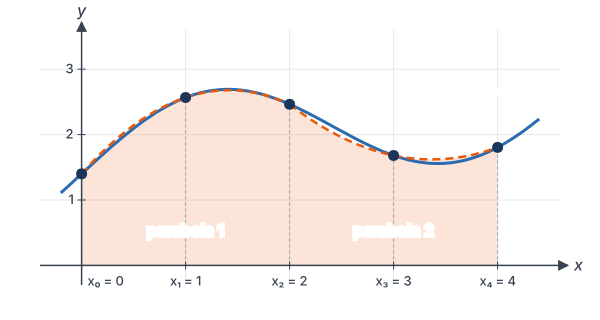
The trapezoidal rule joins points with straight lines. A curve bends, so straight lines miss some area. Simpson’s rule joins each group of three points with a parabola instead, and a parabola can bend with the curve.
That is why n must be even. Each parabola covers two subintervals, so the subintervals have to come in pairs.
Simpson’s rule formula
\int_a^b f(x)\,dx \approx S_n = \dfrac{\Delta x}{3}\Big[f(x_0) + 4f(x_1) + 2f(x_2) + 4f(x_3) + \cdots + 2f(x_{n-2}) + 4f(x_{n-1}) + f(x_n)\Big]Here \Delta x = \dfrac{b - a}{n}, x_k = a + k\,\Delta x, and n is even. The two ends get weight 1. Inside, the weights alternate 4, 2, 4, 2, … and the last inside point gets 4.
- Find Δx = (b − a)/n and list the x-values.
- Find f at each x-value.
- Multiply by the weights 1, 4, 2, 4, …, 4, 1 and add.
- Multiply the sum by Δx/3.
Error bound: if |f^{(4)}(x)| \le K on [a, b], then the error is at most \dfrac{K(b - a)^5}{180n^4}. Doubling n cuts this bound by a factor of 16.
Simpson’s rule examples
Example 1: A parabola is exact
Use Simpson’s rule with n = 2 to estimate \int_0^2 x^2\,dx.
\Delta x = \dfrac{2 - 0}{2} = 1Find the width.
x_0 = 0, \; x_1 = 1, \; x_2 = 2
List the x-values.
f(0) = 0, \; f(1) = 1, \; f(2) = 4
Square each x-value.
0 + 4(1) + 4 = 8
Use the weights 1, 4, 1 and add.
S_2 = \dfrac{1}{3}(8) = \dfrac{8}{3}Multiply by Δx/3.
\int_0^2 x^2\,dx = \dfrac{2^3}{3} - 0 = \dfrac{8}{3}Find the exact value (see fundamental theorem of calculus, part 2).
Answer: S_2 = \dfrac{8}{3}, which is exact. Simpson’s rule is exact for any polynomial of degree 3 or less.
Example 2: Estimating ln 3
Use Simpson’s rule with n = 4 to estimate \int_1^3 \dfrac{1}{x}\,dx. Compare it with the exact value, ln 3.
\Delta x = \dfrac{3 - 1}{4} = 0.5Find the width.
x = 1, \; 1.5, \; 2, \; 2.5, \; 3
List the x-values.
f = 1, \; \dfrac{2}{3}, \; \dfrac{1}{2}, \; \dfrac{2}{5}, \; \dfrac{1}{3}Find 1/x at each one.
1 + 4\left(\dfrac{2}{3}\right) + 2\left(\dfrac{1}{2}\right) + 4\left(\dfrac{2}{5}\right) + \dfrac{1}{3}Apply the weights 1, 4, 2, 4, 1.
= 1 + \dfrac{8}{3} + 1 + \dfrac{8}{5} + \dfrac{1}{3} = 6.6Multiply and add (see adding and subtracting fractions).
S_4 = \dfrac{0.5}{3}(6.6) = 1.1Multiply by Δx/3.
\ln 3 \approx 1.098612
The exact value.
1.1 - 1.098612 = 0.001388
Find the error.
Answer: S_4 = 1.1, off by only about 0.0014.
Example 3: An integral with no formula
Estimate \int_0^1 e^{-x^2}\,dx with n = 4. This integral has no antiderivative made of basic functions, so a numerical method is the way to go.
\Delta x = \dfrac{1 - 0}{4} = 0.25Find the width.
f(0) = 1, \; f(0.25) \approx 0.939413, \; f(0.5) \approx 0.778801
Find e^(−x²) at the first three x-values.
f(0.75) \approx 0.569783, \; f(1) \approx 0.367879
Find the last two.
1 + 4(0.939413) + 2(0.778801) + 4(0.569783) + 0.367879
Apply the weights.
= 1 + 3.757652 + 1.557602 + 2.279132 + 0.367879 = 8.962265
Multiply, then add.
S_4 = \dfrac{0.25}{3}(8.962265) \approx 0.746855Multiply by Δx/3.
Answer: about 0.74686. The true value is 0.746824…, so the error is about 0.00003.
Example 4: Choosing n with the error bound
How large must n be so that Simpson’s rule estimates \int_1^3 \dfrac{1}{x}\,dx with error at most 0.0001?
f(x) = x^{-1}, \; f^{(4)}(x) = 24x^{-5}Differentiate four times (see higher-order derivatives).
K = 24(1)^{-5} = 2424/x⁵ is largest on [1, 3] at x = 1.
\dfrac{24(3 - 1)^5}{180n^4} \le 0.0001Set the bound at most 0.0001.
\dfrac{768}{180n^4} \le 0.000124 · 32 = 768.
n^4 \ge \dfrac{768}{180(0.0001)} \approx 42{,}667Solve for n⁴.
n \ge 14.37
Take the fourth root.
n = 16
Round up to the next even number.
Answer: n = 16 subintervals is enough.
Example 5: Area of a pond
A surveyor measures the width of a pond every 10 meters along its 80-meter length. The widths, in meters, are 0, 18, 26, 30, 32, 29, 24, 15 and 0. Estimate the pond’s area.
\Delta x = 10, \; n = 8
Nine widths give 8 subintervals, an even number.
0 + 4(18) + 2(26) + 4(30) + 2(32) + 4(29) + 2(24) + 4(15) + 0
Apply the weights 1, 4, 2, 4, 2, 4, 2, 4, 1.
= 0 + 72 + 52 + 120 + 64 + 116 + 48 + 60 + 0 = 532
Multiply, then add.
S_8 = \dfrac{10}{3}(532) \approx 1773.3Multiply by Δx/3.
Answer: the pond’s area is about 1773 square meters. Simpson’s rule works with table data, as long as the points are evenly spaced and n is even.
Common mistakes
| Mistake | Example of the error | Fix |
|---|---|---|
| Using an odd n | Simpson’s rule with n = 5 | n must be even, since each parabola covers two subintervals. |
| Wrong weights | 1, 4, 4, 4, 1 for n = 4 | The inside weights alternate: 1, 4, 2, 4, 1. |
| Using Δx/2 | \dfrac{\Delta x}{2}\big[f(x_0) + 4f(x_1) + f(x_2)\big] | Simpson’s rule uses Δx/3. Δx/2 belongs to the trapezoidal rule. |
| Counting points as n | 9 data points, so n = 9 | n counts subintervals: 9 points give n = 8. |
| Wrong derivative in the error bound | Using f″ for K | Simpson’s bound uses the fourth derivative, |f^{(4)}(x)| \le K. |
Related methods
Simpson’s rule from the trapezoidal and midpoint rules
If T_n is the trapezoidal estimate and M_n is the midpoint estimate with n subintervals, then S_{2n} = \dfrac{T_n + 2M_n}{3}. Their errors tend to have opposite signs, and this average cancels most of them.
Comparing the methods
| Method | Error bound | Exact for |
|---|---|---|
| Midpoint rule | \dfrac{K_2(b - a)^3}{24n^2} | Lines |
| Trapezoidal rule | \dfrac{K_2(b - a)^3}{12n^2} | Lines |
| Simpson’s rule | \dfrac{K_4(b - a)^5}{180n^4} | Cubics |
Here K₂ bounds |f″| and K₄ bounds |f⁽⁴⁾|. Because Simpson’s error shrinks like 1/n⁴, it usually needs far fewer points.
Practice problems
- Use Simpson’s rule with n = 4 to estimate \int_0^4 x^3\,dx.
- Use Simpson’s rule with n = 4 to estimate \int_0^{\pi} \sin x\,dx.
- Use Simpson’s rule with n = 4 to estimate \int_0^1 \dfrac{1}{1 + x^2}\,dx. Multiply by 4 to estimate π.
- For n = 6, how many function values do you need, and what are the weights?
- Use Simpson’s rule with n = 2 to estimate \int_2^4 \ln x\,dx. Compare with the exact value, 6 ln 2 − 2.
- A car’s speed, in meters per second, is 0, 12, 20, 24 and 26 at t = 0, 2, 4, 6 and 8 seconds. Estimate the distance it travels.
- Find the error bound for Simpson’s rule with n = 4 on \int_0^2 e^x\,dx.
- How large must n be for Simpson’s rule to estimate \int_0^1 e^x\,dx with error at most 0.000001?
- Use Simpson’s rule with n = 2 on \int_{-1}^3 (2x^3 - x + 5)\,dx and explain why the answer is exact.
- For \int_0^2 x^4\,dx, T₂ = 9 and M₂ = 5.125. Find S₄ from them, and compare with the exact value.
Show answers
1.
\Delta x = 1; \; f = 0, 1, 8, 27, 64
Find the width and cube each x-value.
0 + 4(1) + 2(8) + 4(27) + 64 = 192
Apply the weights and add.
S_4 = \dfrac{1}{3}(192) = 64Multiply by Δx/3.
Answer: 64, which is exact, since x³ is a cubic.
2.
\Delta x = \dfrac{\pi}{4}; \; f = 0, \tfrac{\sqrt{2}}{2}, 1, \tfrac{\sqrt{2}}{2}, 0Find sin x at 0, π/4, π/2, 3π/4 and π (see unit circle).
0 + 4\left(\tfrac{\sqrt{2}}{2}\right) + 2(1) + 4\left(\tfrac{\sqrt{2}}{2}\right) + 0 = 4\sqrt{2} + 2 \approx 7.656854Apply the weights and add.
S_4 = \dfrac{\pi}{12}(4\sqrt{2} + 2) \approx 2.00456Multiply by Δx/3 = π/12.
Answer: about 2.0046. The exact value is 2.
3.
\Delta x = 0.25; \; f = 1, \tfrac{16}{17}, 0.8, 0.64, 0.5Find 1/(1 + x²) at 0, 0.25, 0.5, 0.75 and 1.
1 + 4\left(\tfrac{16}{17}\right) + 2(0.8) + 4(0.64) + 0.5 \approx 9.424706Apply the weights and add.
S_4 = \dfrac{0.25}{3}(9.424706) \approx 0.785392Multiply by Δx/3.
4(0.785392) \approx 3.14157
The exact integral is π/4, so 4 S₄ estimates π.
Answer: S₄ ≈ 0.785392, and π ≈ 3.14157.
4.
n + 1 = 7
n subintervals have n + 1 endpoints.
1, 4, 2, 4, 2, 4, 1
Ends get 1; inside weights alternate, starting and ending with 4.
Answer: 7 function values, with weights 1, 4, 2, 4, 2, 4, 1.
5.
\Delta x = 1; \; f \approx 0.693147, \; 1.098612, \; 1.386294
Find ln 2, ln 3 and ln 4.
0.693147 + 4(1.098612) + 1.386294 = 6.473889
Apply the weights 1, 4, 1.
S_2 = \dfrac{1}{3}(6.473889) \approx 2.157963Multiply by Δx/3.
6\ln 2 - 2 \approx 2.158883
The exact value.
Answer: about 2.1580, off by about 0.0009.
6.
\Delta t = 2, \; n = 4
Five speeds give 4 subintervals.
0 + 4(12) + 2(20) + 4(24) + 26 = 210
Apply the weights and add.
S_4 = \dfrac{2}{3}(210) = 140Multiply by Δt/3.
Answer: about 140 meters (see displacement and total distance).
7.
K = e^2 \approx 7.389056
Every derivative of eˣ is eˣ, largest at x = 2.
\dfrac{e^2(2 - 0)^5}{180(4)^4} = \dfrac{32e^2}{46{,}080}Use the error bound.
\approx 0.005131
Divide.
Answer: the error is at most about 0.0051.
8.
K = e
The fourth derivative of eˣ is eˣ, largest at x = 1.
\dfrac{e(1 - 0)^5}{180n^4} \le 0.000001Set up the bound.
n^4 \ge \dfrac{e}{180(0.000001)} \approx 15{,}101.6Solve for n⁴.
n \ge 11.09
Take the fourth root.
Answer: n = 12, the next even number.
9.
\Delta x = 2; \; f(-1) = 4, \; f(1) = 6, \; f(3) = 56
Find the width and the three values.
S_2 = \dfrac{2}{3}\big(4 + 4(6) + 56\big) = \dfrac{2}{3}(84) = 56Apply the weights 1, 4, 1 and multiply by Δx/3.
\Big[\tfrac{x^4}{2} - \tfrac{x^2}{2} + 5x\Big]_{-1}^{3} = 51 - (-5) = 56Find the exact value.
Answer: 56. It is exact because the integrand is a cubic.
10.
S_4 = \dfrac{T_2 + 2M_2}{3} = \dfrac{9 + 2(5.125)}{3}Use S₂ₙ = (Tₙ + 2Mₙ)/3 with n = 2.
= \dfrac{19.25}{3} \approx 6.41667Add, then divide.
\int_0^2 x^4\,dx = \dfrac{2^5}{5} = 6.4The exact value.
Answer: S₄ ≈ 6.4167, off by about 0.0167.
Simpson’s rule FAQ
What is Simpson’s rule?
Simpson’s rule is a way to estimate a definite integral. It fits parabolas through groups of three points and adds the areas under them, using weights 1, 4, 2, 4, …, 4, 1 and the factor Δx/3.
Why does n have to be even in Simpson’s rule?
Each parabola covers two subintervals. To cover the whole interval with parabolas, the subintervals must come in pairs, so n is even.
Is Simpson’s rule more accurate than the trapezoidal rule?
Usually, yes. Its error shrinks like 1/n⁴, while the trapezoidal rule’s error shrinks like 1/n². It is also exact for cubics.
What is the error bound for Simpson’s rule?
The error is at most K(b − a)⁵/(180n⁴), where K is the largest value of |f⁽⁴⁾(x)| on [a, b].
Summary
- Simpson’s rule: S_n = (Δx/3)[f(x₀) + 4f(x₁) + 2f(x₂) + … + 4f(xₙ₋₁) + f(xₙ)].
- n must be even; the weights are 1, 4, 2, 4, …, 2, 4, 1.
- It is exact for polynomials of degree 3 or less.
- Error bound: K(b − a)⁵/(180n⁴), with K bounding |f⁽⁴⁾|.
- It works on evenly spaced table data, too.
Previous lesson: Choosing an Integration Technique
Next lesson: Improper Integrals
Back to the Calculus 2 Index