
Improper Integrals
An improper integral is a definite integral over an infinite interval, such as \int_1^{\infty} \dfrac{1}{x^2}\,dx. To find it, replace ∞ with a variable t, integrate, and take the limit as t → ∞. If the limit is a finite number, the integral converges to that number. Otherwise it diverges.
Before this lesson: Limits at Infinity, Definite Integrals and Fundamental Theorem of Calculus, Part 2
Can an endless region have a finite area?
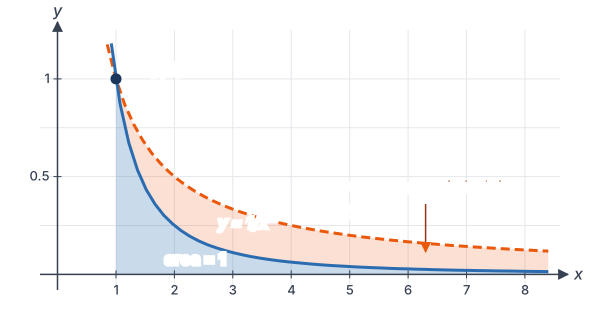
The region under y = 1/x² to the right of x = 1 goes on forever. Even so, its area is exactly 1. The curve drops toward the x-axis so fast that the extra slivers of area add up to less and less.
The region under y = 1/x looks almost the same, but its area is infinite. It drops too slowly. Telling these two cases apart is the main job in this lesson.
Improper integral definitions
\int_a^{\infty} f(x)\,dx = \lim_{t \to \infty} \int_a^t f(x)\,dx \qquad \int_{-\infty}^{b} f(x)\,dx = \lim_{t \to -\infty} \int_t^b f(x)\,dxThe integral converges if the limit exists and is finite. It diverges if the limit is infinite or does not exist.
\int_{-\infty}^{\infty} f(x)\,dx = \int_{-\infty}^{c} f(x)\,dx + \int_{c}^{\infty} f(x)\,dxFor a two-sided integral, pick any number c. It converges only if both pieces converge.
The p-integral rule: \int_1^{\infty} \dfrac{1}{x^p}\,dx converges to \dfrac{1}{p - 1} if p is greater than 1 and diverges if p ≤ 1.
Improper integral examples
Example 1: A convergent integral
Evaluate \int_1^{\infty} \dfrac{1}{x^2}\,dx.
\int_1^{\infty} \dfrac{1}{x^2}\,dx = \lim_{t \to \infty} \int_1^{t} x^{-2}\,dxReplace ∞ with t and take a limit.
= \lim_{t \to \infty} \Big[-\dfrac{1}{x}\Big]_1^{t}Integrate with the power rule (see antiderivatives).
= \lim_{t \to \infty} \left(-\dfrac{1}{t} + 1\right)Plug in t and 1.
= 0 + 1 = 1
1/t → 0 as t → ∞.
Answer: the integral converges to 1.
Example 2: A divergent integral
Evaluate \int_1^{\infty} \dfrac{1}{x}\,dx.
\int_1^{\infty} \dfrac{1}{x}\,dx = \lim_{t \to \infty} \int_1^{t} \dfrac{1}{x}\,dxReplace ∞ with t.
= \lim_{t \to \infty} \Big[\ln x\Big]_1^{t}Integrate 1/x.
= \lim_{t \to \infty} (\ln t - 0)ln 1 = 0.
= \infty
ln t grows without bound.
Answer: the integral diverges, even though 1/x → 0.
Example 3: Using integration by parts
Evaluate \int_0^{\infty} xe^{-x}\,dx.
\int xe^{-x}\,dx = -xe^{-x} - e^{-x} + CUse parts with u = x and dv = e⁻ˣ dx (see integration by parts).
\int_0^{\infty} xe^{-x}\,dx = \lim_{t \to \infty} \Big[-xe^{-x} - e^{-x}\Big]_0^{t}Set up the limit.
= \lim_{t \to \infty} \Big[(-te^{-t} - e^{-t}) - (0 - 1)\Big]Plug in t and 0.
= \lim_{t \to \infty} \left(1 - \dfrac{t + 1}{e^{t}}\right)Combine the terms.
\lim_{t \to \infty} \dfrac{t + 1}{e^{t}} = \lim_{t \to \infty} \dfrac{1}{e^{t}} = 0Use L’Hôpital’s rule on ∞/∞ (see L’Hôpital’s rule).
= 1 - 0 = 1
Finish the limit.
Answer: the integral converges to 1.
Example 4: Both ends infinite
Evaluate \int_{-\infty}^{\infty} \dfrac{1}{1 + x^2}\,dx.
\int_{-\infty}^{\infty} \dfrac{dx}{1 + x^2} = \int_{-\infty}^{0} \dfrac{dx}{1 + x^2} + \int_{0}^{\infty} \dfrac{dx}{1 + x^2}Split at c = 0.
\int_{0}^{\infty} \dfrac{dx}{1 + x^2} = \lim_{t \to \infty} (\arctan t - \arctan 0) = \dfrac{\pi}{2}∫dx/(1 + x²) = arctan x, and arctan t → π/2 (see integrals that give inverse trig functions).
\int_{-\infty}^{0} \dfrac{dx}{1 + x^2} = \lim_{t \to -\infty} (\arctan 0 - \arctan t) = \dfrac{\pi}{2}arctan t → −π/2 as t → −∞.
\dfrac{\pi}{2} + \dfrac{\pi}{2} = \piBoth pieces converge, so add them.
Answer: the integral converges to π.
Example 5: A leak that slows down
A tank leaks oil at a rate of r(t) = 50e^{-0.2t} liters per hour, where t is in hours. If the leak is never fixed, how much oil leaks out in all?
\int_0^{\infty} 50e^{-0.2t}\,dt = \lim_{b \to \infty} \int_0^{b} 50e^{-0.2t}\,dtTotal amount = integral of the rate (see displacement and total distance).
= \lim_{b \to \infty} \Big[-250e^{-0.2t}\Big]_0^{b}Integrate: 50 ÷ (−0.2) = −250.
= \lim_{b \to \infty} \left(-250e^{-0.2b} + 250\right)Plug in b and 0; e⁰ = 1.
= 0 + 250 = 250
e^(−0.2b) → 0.
Answer: at most 250 liters leak out, no matter how long you wait.
Common mistakes
| Mistake | Example of the error | Fix |
|---|---|---|
| Plugging in ∞ like a number | \Big[-\dfrac{1}{x}\Big]_1^{\infty} = -\dfrac{1}{\infty} + 1 | Replace ∞ with t and take a limit as t → ∞. |
| Thinking f → 0 means it converges | 1/x → 0, so \int_1^{\infty} \dfrac{1}{x}\,dx converges | The function must drop fast enough. This one diverges. |
| Using one symmetric limit | \lim_{t \to \infty} \int_{-t}^{t} x\,dx = 0, so it converges | Split at a point. \int_0^{\infty} x\,dx diverges, so the whole integral diverges. |
| Getting the p-rule backward | \int_1^{\infty} \dfrac{1}{\sqrt{x}}\,dx converges | Here p = 1/2 ≤ 1, so it diverges. It converges only when p is greater than 1. |
| Ignoring a piece that diverges | One piece is π/2 and the other is ∞, so the total is ∞ − … | If either piece diverges, the whole integral diverges. |
Related methods
Infinite discontinuities
An integral is also improper when the function blows up inside or at an end of the interval, as in \int_0^1 \dfrac{1}{\sqrt{x}}\,dx. That is the next lesson, Improper Integrals with Infinite Discontinuities.
Comparison without integrating
You can often decide convergence without finding an antiderivative. Compare the integrand with a p-integral or an exponential you know. This is the comparison test, two lessons ahead.
Why the p-integral rule works
For p ≠ 1, \int_1^{t} x^{-p}\,dx = \dfrac{t^{1-p} - 1}{1 - p}. If p is greater than 1, t¹⁻ᵖ → 0 and the integral approaches 1/(p − 1). If p is less than 1, t¹⁻ᵖ → ∞. For p = 1, you get ln t → ∞.
Practice problems
Decide whether each integral converges or diverges. If it converges, find its value.
- \int_1^{\infty} \dfrac{1}{x^3}\,dx
- \int_1^{\infty} \dfrac{1}{\sqrt{x}}\,dx
- \int_0^{\infty} e^{-3x}\,dx
- \int_2^{\infty} \dfrac{1}{x\ln x}\,dx
- \int_{-\infty}^{0} e^{x}\,dx
- \int_1^{\infty} \dfrac{\ln x}{x^2}\,dx
- \int_0^{\infty} \cos x\,dx
- \int_{-\infty}^{\infty} xe^{-x^2}\,dx
- Use the p-integral rule to find \int_1^{\infty} x^{-4}\,dx.
- A factory’s pollution falls off at a rate of 30e^{-0.1t} tons per year. Find the total pollution over all time.
Show answers
1.
\lim_{t \to \infty} \Big[-\dfrac{1}{2x^2}\Big]_1^{t}Integrate x⁻³ and set up the limit.
= \lim_{t \to \infty} \left(-\dfrac{1}{2t^2} + \dfrac{1}{2}\right) = \dfrac{1}{2}Plug in, and 1/(2t²) → 0.
Answer: converges to 1/2
2.
\lim_{t \to \infty} \Big[2\sqrt{x}\Big]_1^{t}Integrate x^(−1/2) to get 2x^(1/2).
= \lim_{t \to \infty} (2\sqrt{t} - 2) = \infty√t grows without bound.
Answer: diverges (p = 1/2 ≤ 1)
3.
\lim_{t \to \infty} \Big[-\dfrac{1}{3}e^{-3x}\Big]_0^{t}Integrate e⁻³ˣ.
= \lim_{t \to \infty} \left(-\dfrac{1}{3}e^{-3t} + \dfrac{1}{3}\right) = \dfrac{1}{3}e⁻³ᵗ → 0.
Answer: converges to 1/3
4.
\int \dfrac{1}{x\ln x}\,dx = \ln(\ln x) + CLet u = ln x, du = dx/x, so the integral is ∫du/u (see u-substitution).
\lim_{t \to \infty} \big(\ln(\ln t) - \ln(\ln 2)\big) = \inftyln(ln t) grows without bound, slowly.
Answer: diverges
5.
\lim_{t \to -\infty} \Big[e^{x}\Big]_t^{0} = \lim_{t \to -\infty} (1 - e^{t})Integrate and plug in.
= 1 - 0 = 1
eᵗ → 0 as t → −∞.
Answer: converges to 1
6.
\int \dfrac{\ln x}{x^2}\,dx = -\dfrac{\ln x}{x} + \int \dfrac{1}{x^2}\,dxParts with u = ln x, dv = x⁻² dx, v = −1/x.
= -\dfrac{\ln x}{x} - \dfrac{1}{x} + CIntegrate x⁻².
\lim_{t \to \infty} \left[\left(-\dfrac{\ln t}{t} - \dfrac{1}{t}\right) - (0 - 1)\right]Plug in t and 1.
= 0 - 0 + 1 = 1
ln t / t → 0 by L’Hôpital’s rule.
Answer: converges to 1
7.
\lim_{t \to \infty} \Big[\sin x\Big]_0^{t} = \lim_{t \to \infty} \sin tIntegrate cos x.
\sin t \text{ keeps swinging between } -1 \text{ and } 1The limit does not exist.
Answer: diverges
8.
\int_0^{\infty} xe^{-x^2}\,dx = \lim_{t \to \infty} \Big[-\dfrac{1}{2}e^{-x^2}\Big]_0^{t} = \dfrac{1}{2}Use u = x² for the right piece.
\int_{-\infty}^{0} xe^{-x^2}\,dx = \lim_{t \to -\infty} \Big[-\dfrac{1}{2}e^{-x^2}\Big]_t^{0} = -\dfrac{1}{2}The left piece.
\dfrac{1}{2} + \left(-\dfrac{1}{2}\right) = 0Both converge, so add.
Answer: converges to 0
9.
p = 4 \gt 1
The rule applies.
\dfrac{1}{4 - 1} = \dfrac{1}{3}Use 1/(p − 1).
Answer: converges to 1/3
10.
\int_0^{\infty} 30e^{-0.1t}\,dt = \lim_{b \to \infty} \Big[-300e^{-0.1t}\Big]_0^{b}30 ÷ (−0.1) = −300.
= \lim_{b \to \infty} \left(-300e^{-0.1b} + 300\right) = 300e^(−0.1b) → 0.
Answer: 300 tons in all
Improper integrals FAQ
What makes an integral improper?
An integral is improper if a limit of integration is infinite, or if the function becomes infinite somewhere on the interval. This lesson covers the first kind.
How do you know if an improper integral converges?
Replace the infinite limit with t, integrate and take the limit. A finite answer means it converges. You can also compare it with an integral you already know.
Does the integral of 1/x from 1 to infinity converge?
No. It equals the limit of ln t, which grows without bound, so it diverges. The integral of 1/x² from 1 to infinity converges to 1.
What is the p-test for improper integrals?
The integral of 1/xᵖ from 1 to ∞ converges when p is greater than 1, to 1/(p − 1), and diverges when p ≤ 1.
Summary
- Replace each infinite limit with a variable and take a limit.
- A finite limit means the integral converges; otherwise it diverges.
- Split a two-sided integral at a point; both pieces must converge.
- ∫ from 1 to ∞ of 1/xᵖ converges only when p is greater than 1, to 1/(p − 1).
- A function that approaches 0 can still have a divergent integral, like 1/x.
Previous lesson: Simpson’s Rule
Next lesson: Improper Integrals with Infinite Discontinuities
Back to the Calculus 2 Index