
Displacement and Total Distance
Displacement is the net change in position, \int_a^b v(t)\,dt. Total distance counts all motion as positive, \int_a^b |v(t)|\,dt. To find total distance, find where the velocity changes sign, integrate v on each piece, and add the absolute values of the results.
Before this lesson: Position, Velocity and Acceleration, Fundamental Theorem of Calculus, Part 2 and Absolute Value
Displacement vs. distance
Picture an object moving back and forth on a number line. Its velocity v(t) is positive when it moves right and negative when it moves left. Displacement asks, “Where did it end up, compared with where it started?” Total distance asks, “How far did it travel in all?”
Walk 5 meters right, then 2 meters left. Your displacement is 5 − 2 = 3 meters. Your total distance is 5 + 2 = 7 meters. The integral of velocity gives displacement, because the backward part counts as negative.
Displacement and total distance formulas
For an object with velocity v(t) from t = a to t = b:
\text{displacement} = \int_a^b v(t)\,dt = s(b) - s(a)\text{total distance} = \int_a^b |v(t)|\,dtTo find a position, add the displacement to the starting position: s(b) = s(a) + \int_a^b v(t)\,dt.
How to find total distance:
- Solve v(t) = 0 to find where the velocity may change sign. Keep only times inside [a, b].
- Split [a, b] at those times.
- Integrate v(t) on each piece.
- Add the absolute values of the pieces.
Displacement and total distance examples
Example 1: Velocity that stays positive
A particle has velocity v(t) = 3t^2 + 2 meters per second. Find its displacement and total distance from t = 0 to t = 2.
\int_0^2 (3t^2 + 2)\,dt = \Big[t^3 + 2t\Big]_0^2
Antidifferentiate each term (see fundamental theorem of calculus, part 2).
= (8 + 4) - 0 = 12
Plug in the limits and subtract.
Answer: the displacement is 12 meters. Since 3t² + 2 is always positive, the particle never turns around, so the total distance is also 12 meters.
Example 2: Velocity that changes sign once
A particle has velocity v(t) = 2t - 6 feet per second. Find its displacement and total distance from t = 0 to t = 5.
\int_0^5 (2t - 6)\,dt = \Big[t^2 - 6t\Big]_0^5
Antidifferentiate each term.
= (25 - 30) - 0 = -5
Plug in the limits and subtract.
2t - 6 = 0
Set the velocity equal to 0.
t = 3
Add 6 to both sides, then divide by 2.
\int_0^3 (2t - 6)\,dt = (9 - 18) - 0 = -9
First piece: plug 3 and 0 into t² − 6t.
\int_3^5 (2t - 6)\,dt = (25 - 30) - (9 - 18) = 4
Second piece: plug in 5 and 3.
|-9| + |4| = 9 + 4 = 13
Add the absolute values.
Answer: the displacement is −5 feet, so the particle ends 5 feet left of where it started. The total distance is 13 feet: 9 feet left, then 4 feet right.
Example 3: Velocity that changes sign twice
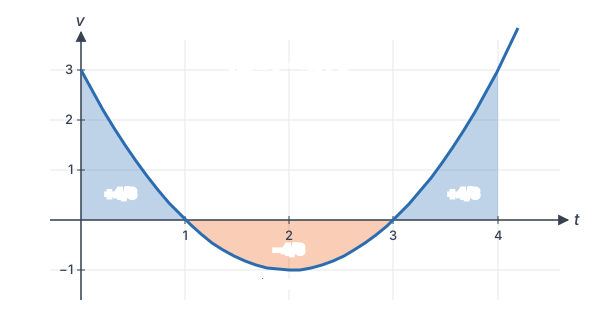
A particle has velocity v(t) = t^2 - 4t + 3. Find its displacement and total distance from t = 0 to t = 4.
t^2 - 4t + 3 = (t - 1)(t - 3)
Factor the velocity (see factoring trinomials).
t = 1, \; t = 3
Each factor equals 0 at one time. Both are inside [0, 4].
F(t) = \dfrac{t^3}{3} - 2t^2 + 3tFind an antiderivative of v.
F(0) = 0, \; F(1) = \dfrac{4}{3}, \; F(3) = 0, \; F(4) = \dfrac{4}{3}Evaluate F at the endpoints and the turning times.
\int_0^1 v\,dt = F(1) - F(0) = \dfrac{4}{3}First piece.
\int_1^3 v\,dt = F(3) - F(1) = -\dfrac{4}{3}Second piece: the particle moves backward.
\int_3^4 v\,dt = F(4) - F(3) = \dfrac{4}{3}Third piece.
\dfrac{4}{3} - \dfrac{4}{3} + \dfrac{4}{3} = \dfrac{4}{3}Displacement: add the signed pieces.
\dfrac{4}{3} + \dfrac{4}{3} + \dfrac{4}{3} = 4Total distance: add the absolute values.
Answer: displacement \dfrac{4}{3}, total distance 4. These match the shaded areas in the graph above.
Example 4: Back where it started
A weight on a spring has velocity v(t) = \cos t centimeters per second. Find its displacement and total distance from t = 0 to t = π.
\int_0^{\pi} \cos t\,dt = \Big[\sin t\Big]_0^{\pi} = 0 - 0 = 0Displacement: an antiderivative of cos t is sin t.
\cos t = 0 \text{ at } t = \dfrac{\pi}{2}The velocity changes sign at π/2 (see unit circle).
\int_0^{\pi/2} \cos t\,dt = \sin\dfrac{\pi}{2} - \sin 0 = 1First piece.
\int_{\pi/2}^{\pi} \cos t\,dt = \sin\pi - \sin\dfrac{\pi}{2} = -1Second piece.
|1| + |-1| = 2
Add the absolute values.
Answer: the displacement is 0 cm, because the weight ends where it started. The total distance is 2 cm: 1 cm out and 1 cm back.
Example 5: A remote-control car
A remote-control car moves along a straight track with velocity v(t) = t^2 - 6t + 8 feet per second. At t = 0 it is 2 feet from the starting line. Find its position at t = 5 and the total distance it travels from t = 0 to t = 5.
t^2 - 6t + 8 = (t - 2)(t - 4)
Factor to find when the car stops: t = 2 and t = 4.
F(t) = \dfrac{t^3}{3} - 3t^2 + 8tFind an antiderivative of v.
F(2) = \dfrac{8}{3} - 12 + 16 = \dfrac{20}{3}Evaluate at t = 2.
F(4) = \dfrac{64}{3} - 48 + 32 = \dfrac{16}{3}Evaluate at t = 4.
F(5) = \dfrac{125}{3} - 75 + 40 = \dfrac{20}{3}Evaluate at t = 5. F(0) = 0.
s(5) = 2 + \left(\dfrac{20}{3} - 0\right) = \dfrac{26}{3}Position: starting position plus displacement.
\dfrac{20}{3} + \left|\dfrac{16}{3} - \dfrac{20}{3}\right| + \left|\dfrac{20}{3} - \dfrac{16}{3}\right|Total distance: add the absolute values of the three pieces.
= \dfrac{20}{3} + \dfrac{4}{3} + \dfrac{4}{3} = \dfrac{28}{3}Add the fractions.
Answer: at t = 5 the car is \dfrac{26}{3} \approx 8.67 feet from the starting line. It traveled \dfrac{28}{3} \approx 9.33 feet in all, because it backed up for a while between t = 2 and t = 4.
Common mistakes
| Mistake | Example of the error | Fix |
|---|---|---|
| Using the plain integral for total distance | Distance for v = 2t − 6 on [0, 5] given as −5 | Split at t = 3 and add absolute values: 9 + 4 = 13. |
| Taking the absolute value at the end | Distance = |−5| = 5 | Take the absolute value of each piece, not of the total. |
| Forgetting the starting position | Position at t = 5 given as 20/3 when s(0) = 2 | Add the starting position: s(5) = 2 + \dfrac{20}{3}. |
| Splitting at times outside the interval | Using t = −1 as a turning time on [0, 4] | Keep only the zeros of v that are inside [a, b]. |
| Mixing up velocity and speed | Saying speed is −4 ft/s | Speed is |v(t)|, never negative. Its integral is total distance. |
Related methods
Velocity from acceleration
The same idea works one level down. If a(t) is the acceleration, then v(b) = v(a) + \int_a^b a(t)\,dt. First find v(t) from a(t), then use v(t) for displacement and distance.
Displacement from a velocity graph
If you only have a graph made of lines, find each signed area with geometry (see area of triangles). Area above the axis is positive and area below is negative. Add them for displacement; add their sizes for total distance.
Net change in other settings
Displacement is one case of the net change idea: the integral of any rate is the change in the amount. Water flow in and out of a tank works the same way. The average value of a function of v is the displacement divided by the time.
Practice problems
- For v(t) = 4t + 1 on [0, 3], find the displacement and total distance.
- For v(t) = 3t^2 on [1, 2], find the displacement and total distance.
- For v(t) = t - 2 on [0, 6], find the displacement and total distance.
- For v(t) = 3 - t on [0, 4], find the displacement and total distance.
- For v(t) = t^2 - 1 on [0, 2], find the displacement and total distance.
- For v(t) = \sin t on [0, 2π], find the displacement and total distance.
- A particle starts at s(0) = 4 with v(t) = 2t - 4. Find its position at t = 3.
- For v(t) = t^2 - 5t + 6 on [0, 4], find the displacement and total distance.
- A particle has acceleration a(t) = 6t and starting velocity v(0) = −3. Find v(t), then the total distance on [0, 2].
- A toy train moves along a straight track with velocity v(t) = 1.5 - 0.5t meters per second. Find its displacement and total distance from t = 0 to t = 5.
Show answers
1.
\int_0^3 (4t + 1)\,dt = \Big[2t^2 + t\Big]_0^3 = 18 + 3 = 21
Antidifferentiate; plug in the limits.
Answer: displacement 21 and distance 21, since v is positive on the whole interval.
2.
\int_1^2 3t^2\,dt = \Big[t^3\Big]_1^2 = 8 - 1 = 7
Antidifferentiate; plug in the limits.
Answer: displacement 7 and distance 7, since 3t² is positive here.
3.
\int_0^6 (t - 2)\,dt = \Big[\dfrac{t^2}{2} - 2t\Big]_0^6 = 18 - 12 = 6Displacement.
t - 2 = 0
Find where v = 0: t = 2.
\int_0^2 (t - 2)\,dt = 2 - 4 = -2
First piece.
\int_2^6 (t - 2)\,dt = 6 - (-2) = 8
Second piece.
|-2| + |8| = 10
Add the absolute values.
Answer: displacement 6, distance 10
4.
\int_0^4 (3 - t)\,dt = \Big[3t - \dfrac{t^2}{2}\Big]_0^4 = 12 - 8 = 4Displacement.
\int_0^3 (3 - t)\,dt = 9 - 4.5 = 4.5
v = 0 at t = 3. First piece.
\int_3^4 (3 - t)\,dt = 4 - 4.5 = -0.5
Second piece.
4.5 + 0.5 = 5
Add the absolute values.
Answer: displacement 4, distance 5
5.
\int_0^2 (t^2 - 1)\,dt = \Big[\dfrac{t^3}{3} - t\Big]_0^2 = \dfrac{8}{3} - 2 = \dfrac{2}{3}Displacement.
\int_0^1 (t^2 - 1)\,dt = \dfrac{1}{3} - 1 = -\dfrac{2}{3}v = 0 at t = 1. First piece.
\int_1^2 (t^2 - 1)\,dt = \dfrac{2}{3} - \left(-\dfrac{2}{3}\right) = \dfrac{4}{3}Second piece.
\dfrac{2}{3} + \dfrac{4}{3} = 2Add the absolute values.
Answer: displacement \dfrac{2}{3}, distance 2
6.
\int_0^{2\pi} \sin t\,dt = \Big[-\cos t\Big]_0^{2\pi} = -1 - (-1) = 0Displacement.
\int_0^{\pi} \sin t\,dt = -\cos\pi + \cos 0 = 2v = 0 at t = π. First piece.
\int_{\pi}^{2\pi} \sin t\,dt = -\cos 2\pi + \cos\pi = -2Second piece.
2 + 2 = 4
Add the absolute values.
Answer: displacement 0, distance 4
7.
s(3) = 4 + \int_0^3 (2t - 4)\,dt
Starting position plus displacement.
\int_0^3 (2t - 4)\,dt = \Big[t^2 - 4t\Big]_0^3 = 9 - 12 = -3
Antidifferentiate; plug in the limits.
s(3) = 4 + (-3) = 1
Add.
Answer: s(3) = 1
8.
t^2 - 5t + 6 = (t - 2)(t - 3)
Factor: v = 0 at t = 2 and t = 3.
F(t) = \dfrac{t^3}{3} - \dfrac{5t^2}{2} + 6tAntiderivative of v.
F(2) = \dfrac{14}{3}, \; F(3) = \dfrac{9}{2}, \; F(4) = \dfrac{16}{3}Evaluate; F(0) = 0.
\dfrac{9}{2} - \dfrac{14}{3} = -\dfrac{1}{6}Middle piece, from 2 to 3.
\dfrac{16}{3} - \dfrac{9}{2} = \dfrac{5}{6}Last piece, from 3 to 4.
\dfrac{14}{3} + \dfrac{1}{6} + \dfrac{5}{6} = \dfrac{17}{3}Add the absolute values.
Answer: displacement F(4) − F(0) = \dfrac{16}{3}, distance \dfrac{17}{3}
9.
v(t) = -3 + \int_0^t 6u\,du = -3 + 3t^2
Starting velocity plus the integral of acceleration.
-3 + 3t^2 = 0
Set v = 0: t² = 1, so t = 1 in [0, 2].
\int_0^1 (3t^2 - 3)\,dt = \Big[t^3 - 3t\Big]_0^1 = -2
First piece.
\int_1^2 (3t^2 - 3)\,dt = (8 - 6) - (-2) = 4
Second piece.
2 + 4 = 6
Add the absolute values.
Answer: v(t) = 3t^2 - 3; total distance 6
10.
\int_0^5 (1.5 - 0.5t)\,dt = \Big[1.5t - 0.25t^2\Big]_0^5 = 7.5 - 6.25 = 1.25
Displacement.
1.5 - 0.5t = 0
Set v = 0: t = 3.
\int_0^3 (1.5 - 0.5t)\,dt = 4.5 - 2.25 = 2.25
First piece.
\int_3^5 (1.5 - 0.5t)\,dt = 1.25 - 2.25 = -1
Second piece.
2.25 + 1 = 3.25
Add the absolute values.
Answer: displacement 1.25 m, distance 3.25 m
Displacement and total distance FAQ
What is the difference between displacement and distance?
Displacement is how far the object ends up from its starting point, with a sign for direction. Distance is how far it traveled in all, and it is never negative.
How do you find total distance traveled with an integral?
Integrate the speed, \int_a^b |v(t)|\,dt. In practice, split the interval where v(t) = 0, integrate each piece and add the absolute values.
Can displacement be negative?
Yes. A negative displacement means the object ended up in the negative direction from where it started, for example to the left or below.
How do you find position from velocity?
Add the displacement to the starting position: s(b) = s(a) + \int_a^b v(t)\,dt.
Summary
- Displacement = \int_a^b v(t)\,dt, the net change in position.
- Total distance = \int_a^b |v(t)|\,dt, which is never negative.
- For distance, split where v(t) = 0, integrate each piece, and add the absolute values.
- Position: s(b) = s(a) + \int_a^b v(t)\,dt.
- If v never changes sign, displacement and distance have the same size.
Previous lesson: Average Value of a Function
Next lesson: U-Substitution
Back to the Calculus 1 Index