
Position, Velocity and Acceleration
Position, velocity and acceleration are linked by derivatives. If s(t) gives an object’s position at time t, then its velocity is v(t) = s'(t) and its acceleration is a(t) = v'(t) = s''(t). Velocity tells how fast the object moves and in which direction. Acceleration tells how fast the velocity is changing.
Before this lesson: Power Rule, Higher-Order Derivatives and Solving Quadratic Equations by Factoring
What velocity and acceleration mean
Picture a particle moving back and forth along a number line. Its position s(t) is where it is at time t. Positive values are to the right of 0, and negative values are to the left.
Velocity is the rate of change of position, so it is the derivative s'(t). Its sign gives the direction. If v(t) \gt 0, the particle moves right (or up). If v(t) \lt 0, it moves left (or down). If v(t) = 0, it is at rest for that instant.
Speed is the size of the velocity without its sign: speed = |v(t)|. A velocity of −5 m/s and a velocity of 5 m/s both have a speed of 5 m/s.
Acceleration is the rate of change of velocity, so it is v'(t), the second derivative of position. If position is in meters and time is in seconds, velocity is in m/s and acceleration is in m/s² (meters per second, per second).
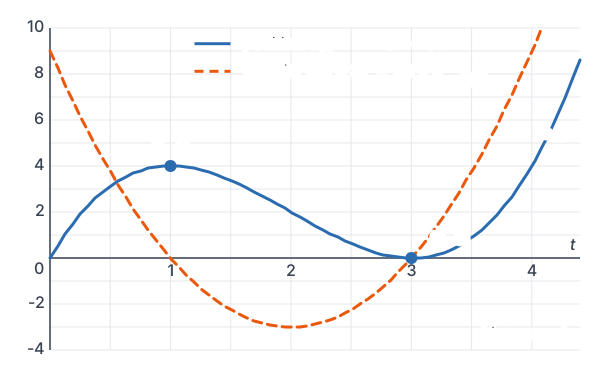
Position, velocity and acceleration formulas
v(t) = s'(t), \qquad a(t) = v'(t) = s''(t), \qquad \text{speed} = |v(t)|| Question | What to check | Rule |
|---|---|---|
| Which way is it moving? | The sign of v(t) | v \gt 0: right or up. v \lt 0: left or down. |
| When is it at rest? | Where v(t) = 0 | Solve v(t) = 0. |
| When does it change direction? | Where v(t) changes sign | Check the sign of v(t) on each side of each zero. |
| Is it speeding up or slowing down? | The signs of v(t) and a(t) together | Same signs: speeding up. Opposite signs: slowing down. |
| How far did it travel? | Position at the start, the end and every turn | Add the distances between those positions. |
The speeding-up rule surprises many students. A negative acceleration does not always mean slowing down. If the velocity is also negative, the particle moves left faster and faster, so its speed grows.
Position, velocity and acceleration examples
Example 1: Find velocity and acceleration
A particle’s position is s(t) = t^3 - 6t^2 + 9t meters after t seconds. Find v(t) and a(t). Then find the velocity and acceleration at t = 2.
v(t) = s'(t) = 3t^2 - 12t + 9
Differentiate the position with the power rule.
a(t) = v'(t) = 6t - 12
Differentiate the velocity.
v(2) = 3(2)^2 - 12(2) + 9
Substitute t = 2 into v(t).
v(2) = 12 - 24 + 9
Square 2, then multiply.
v(2) = -3
Add and subtract from left to right.
a(2) = 6(2) - 12 = 0
Substitute t = 2 into a(t).
Answer: v(t) = 3t^2 - 12t + 9 and a(t) = 6t - 12. At t = 2 the particle moves left at 3 m/s, and its acceleration is 0 m/s² for that instant.
Example 2: When is it at rest, and which way does it move?
For the same particle, s(t) = t^3 - 6t^2 + 9t with t \ge 0, find when it is at rest. Then find when it moves right and when it moves left.
3t^2 - 12t + 9 = 0
The particle is at rest when v(t) = 0.
t^2 - 4t + 3 = 0
Divide both sides by 3.
(t - 1)(t - 3) = 0
Factor the trinomial (see factoring trinomials).
t = 1 \text{ or } t = 3Set each factor equal to 0 (see solving quadratic equations by factoring).
v(0.5) = 3(0.25) - 6 + 9 = 3.75
Test a time before 1. The velocity is positive.
v(2) = -3
Test a time between 1 and 3 (from Example 1). The velocity is negative.
v(4) = 48 - 48 + 9 = 9
Test a time after 3. The velocity is positive.
Answer: the particle is at rest at t = 1 and t = 3 seconds. It moves right for 0 \le t \lt 1, left for 1 \lt t \lt 3, and right again for t \gt 3. Since v changes sign at both zeros, the particle changes direction at t = 1 and at t = 3.
Example 3: Speeding up or slowing down?
For s(t) = t^3 - 6t^2 + 9t, decide whether the particle is speeding up or slowing down at t = 0.5 and at t = 1.5.
v(0.5) = 3.75
From Example 2, the velocity is positive.
a(0.5) = 6(0.5) - 12 = -9
Substitute t = 0.5 into a(t). The acceleration is negative.
v(1.5) = 3(2.25) - 18 + 9
Substitute t = 1.5 into v(t).
v(1.5) = 6.75 - 18 + 9 = -2.25
Add and subtract. The velocity is negative.
a(1.5) = 6(1.5) - 12 = -3
Substitute t = 1.5 into a(t). The acceleration is negative.
Answer: at t = 0.5, v and a have opposite signs, so the particle is slowing down as it nears its stop at t = 1. At t = 1.5, v and a are both negative, so it is speeding up as it moves left.
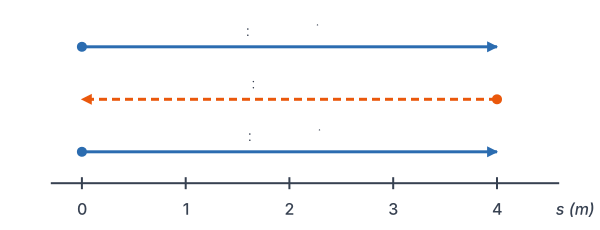
Example 4: Total distance versus displacement
Find the total distance the particle travels from t = 0 to t = 4, and its displacement (change in position) over that time.
s(0) = 0
Find the starting position.
s(1) = 1 - 6 + 9 = 4
Find the position at the first turn.
s(3) = 27 - 54 + 27 = 0
Find the position at the second turn.
s(4) = 64 - 96 + 36 = 4
Find the ending position.
|4 - 0| + |0 - 4| + |4 - 0|
Add the distance covered on each leg of the trip.
4 + 4 + 4 = 12
Take each absolute value and add.
s(4) - s(0) = 4 - 0 = 4
Displacement is the final position minus the starting position.
Answer: the particle travels 12 meters in total, but its displacement is only 4 meters, because it doubled back. Always split the trip at the times when the particle turns around.
Example 5: A ball thrown upward
A ball is thrown upward from the top of a 64-foot building. Its height after t seconds is h(t) = -16t^2 + 48t + 64 feet. Find its maximum height, when it hits the ground, and its velocity at impact.
v(t) = h'(t) = -32t + 48
Differentiate the height to get the velocity.
a(t) = v'(t) = -32
Differentiate again. The acceleration is gravity, −32 ft/s².
-32t + 48 = 0
The ball is highest when its velocity is 0.
-32t = -48
Subtract 48 from both sides.
t = 1.5
Divide both sides by −32.
h(1.5) = -16(2.25) + 48(1.5) + 64
Substitute t = 1.5 into h(t).
h(1.5) = -36 + 72 + 64 = 100
Multiply, then add.
-16t^2 + 48t + 64 = 0
The ball hits the ground when h(t) = 0.
t^2 - 3t - 4 = 0
Divide both sides by −16.
(t - 4)(t + 1) = 0
Factor the trinomial.
t = 4
Set each factor equal to 0. Reject t = −1, since time starts at 0.
v(4) = -32(4) + 48 = -80
Substitute t = 4 into v(t).
Answer: the ball reaches 100 feet at t = 1.5 seconds and hits the ground at t = 4 seconds. Its velocity at impact is −80 ft/s, so its speed is 80 ft/s. The negative sign means it is moving down.
Common mistakes
| Mistake | Example of the error | Fix |
|---|---|---|
| Treating speed and velocity as the same | “The speed is −80 ft/s” | Speed has no sign: speed = |v(t)| = 80 ft/s. |
| Thinking negative acceleration always means slowing down | At t = 1.5 in Example 3, “a = −3, so it slows down” | Compare signs: v and a are both negative, so it speeds up. |
| Using displacement as total distance | “Distance from t = 0 to t = 4 is s(4) − s(0) = 4” | Split the trip where v = 0 and add each leg: 12 m. |
| Calling every zero of v a change of direction | For s(t) = t^3, “it turns at t = 0” | v(t) = 3t^2 is never negative, so the motion never reverses. Check the sign on both sides. |
| Substituting before differentiating | “s(2) = 2, so v(2) = 0“ | Find v(t) first, then substitute t = 2. |
| Wrong units for acceleration | “a = −32 ft/s” | Acceleration is in units per second per second: −32 ft/s². |
Related methods
Reading motion from a graph
On a position graph, the slope at a point is the velocity. Where the graph rises, the particle moves right; where it falls, it moves left. A peak or a low point marks a stop and a turn. On a velocity graph, the slope is the acceleration, and points where the graph crosses the t-axis are the turns.
Going backward: from velocity to position
If you know v(t) instead of s(t), you undo the derivative to get the position. That needs antiderivatives and integrals, which come later in Calculus 1 in Displacement and Total Distance.
Practice problems
- For s(t) = 4t^2 - 3t + 2, find v(t) and a(t).
- For s(t) = t^3 - 3t^2, find v(4) and a(4).
- For s(t) = t^2 - 8t + 5, find when the particle is at rest.
- For s(t) = 2t^3 - 9t^2 + 12t with t \ge 0, find when the particle changes direction.
- For the particle in Problem 4, find when it moves left.
- For s(t) = t^3 - 12t, find the velocity and the speed at t = 1.
- For s(t) = t^3 - 6t^2, is the particle speeding up or slowing down at t = 1?
- For s(t) = t^2 - 4t, find the total distance traveled and the displacement from t = 0 to t = 3.
- A ball’s height is h(t) = -16t^2 + 32t + 48 feet after t seconds. Find its maximum height and its velocity when it hits the ground.
- A car brakes so that it has gone s(t) = 24t - 1.5t^2 meters, t seconds after the brakes are applied, until it stops. Find its acceleration, when it stops, and how far it travels while braking.
Show answers
1.
v(t) = 8t - 3
Differentiate the position with the power rule.
a(t) = 8
Differentiate the velocity.
Answer: v(t) = 8t - 3 and a(t) = 8
2.
v(t) = 3t^2 - 6t
Differentiate the position.
v(4) = 3(16) - 6(4) = 48 - 24 = 24
Substitute t = 4.
a(t) = 6t - 6
Differentiate the velocity.
a(4) = 6(4) - 6 = 18
Substitute t = 4.
Answer: v(4) = 24 and a(4) = 18
3.
v(t) = 2t - 8
Differentiate the position.
2t - 8 = 0
At rest means v(t) = 0.
2t = 8
Add 8 to both sides.
t = 4
Divide both sides by 2.
Answer: t = 4
4.
v(t) = 6t^2 - 18t + 12
Differentiate the position.
6t^2 - 18t + 12 = 0
Set the velocity equal to 0.
t^2 - 3t + 2 = 0
Divide both sides by 6.
(t - 1)(t - 2) = 0
Factor the trinomial.
t = 1 \text{ or } t = 2Set each factor equal to 0.
v(0) = 12, \; v(1.5) = -1.5, \; v(3) = 12
Test a time in each interval. The sign changes at t = 1 and at t = 2.
Answer: it changes direction at t = 1 and t = 2.
5.
v(1.5) = 6(2.25) - 27 + 12 = -1.5
Test a time between the zeros. The velocity is negative there.
Answer: it moves left for 1 \lt t \lt 2.
6.
v(t) = 3t^2 - 12
Differentiate the position.
v(1) = 3 - 12 = -9
Substitute t = 1.
|-9| = 9
Speed is the absolute value of velocity.
Answer: the velocity is −9 and the speed is 9.
7.
v(t) = 3t^2 - 12t
Differentiate the position.
v(1) = 3 - 12 = -9
Substitute t = 1. The velocity is negative.
a(t) = 6t - 12
Differentiate the velocity.
a(1) = 6 - 12 = -6
Substitute t = 1. The acceleration is negative.
Answer: v and a have the same sign, so the particle is speeding up.
8.
v(t) = 2t - 4
Differentiate the position.
2t - 4 = 0 \Rightarrow t = 2
Find the turn: add 4, then divide by 2.
s(0) = 0, \; s(2) = -4, \; s(3) = -3
Find the positions at the start, the turn and the end.
|-4 - 0| + |-3 - (-4)| = 4 + 1 = 5
Add the length of each leg.
s(3) - s(0) = -3 - 0 = -3
Displacement is the final position minus the starting position.
Answer: total distance 5, displacement −3
9.
v(t) = -32t + 32
Differentiate the height.
-32t + 32 = 0 \Rightarrow t = 1
The top is where v = 0: subtract 32, then divide by −32.
h(1) = -16 + 32 + 48 = 64
Substitute t = 1 into h(t).
-16t^2 + 32t + 48 = 0
It hits the ground when h(t) = 0.
t^2 - 2t - 3 = 0
Divide both sides by −16.
(t - 3)(t + 1) = 0 \Rightarrow t = 3
Factor, then reject t = −1.
v(3) = -96 + 32 = -64
Substitute t = 3 into v(t).
Answer: maximum height 64 feet; velocity at impact −64 ft/s (speed 64 ft/s)
10.
v(t) = 24 - 3t
Differentiate the position.
a(t) = -3
Differentiate the velocity.
24 - 3t = 0
The car stops when v(t) = 0.
-3t = -24 \Rightarrow t = 8
Subtract 24, then divide by −3.
s(8) = 24(8) - 1.5(64) = 192 - 96 = 96
Substitute t = 8 into s(t).
Answer: a = −3 m/s², it stops after 8 seconds, and it travels 96 meters while braking.
Position, velocity and acceleration FAQ
What is the difference between speed and velocity?
Velocity has a sign that shows direction, and speed does not. Speed is the absolute value of velocity, so it is never negative.
Is acceleration the second derivative of position?
Yes. Acceleration is the derivative of velocity, and velocity is the derivative of position, so a(t) = s''(t).
How do you know if an object is speeding up or slowing down?
Compare the signs of v(t) and a(t) at that time. If they match, the object is speeding up. If they are opposite, it is slowing down.
How do you find when a particle changes direction?
Solve v(t) = 0, then check the sign of v(t) just before and just after each solution. The particle changes direction only where the sign of the velocity changes.
Summary
- Velocity is the derivative of position: v(t) = s'(t). Acceleration is the derivative of velocity: a(t) = s''(t).
- The sign of v(t) gives the direction. Speed is |v(t)|.
- The particle is at rest when v(t) = 0, and it changes direction where v(t) changes sign.
- It speeds up when v and a have the same sign and slows down when their signs are opposite.
- Total distance adds every leg of the trip; displacement is just final position minus starting position.
Previous lesson: Higher-Order Derivatives
Next lesson: Product Rule
Back to the Calculus 1 Index