
Antiderivatives and Indefinite Integrals
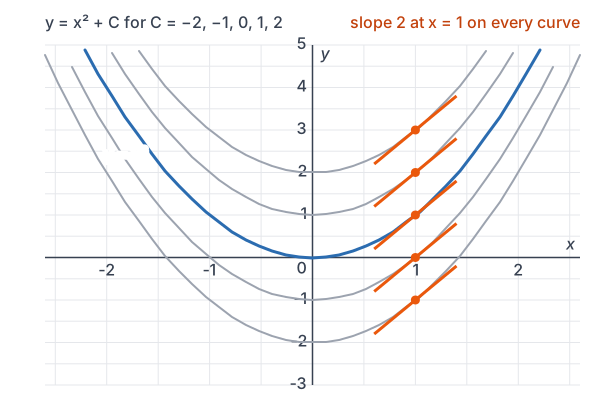
An antiderivative of f is a function F whose derivative is f: F′(x) = f(x). The indefinite integral \int f(x)\,dx = F(x) + C stands for all the antiderivatives at once, where C is any constant. For example, \int 2x\,dx = x^2 + C, because the derivative of x² + C is 2x.
Before this lesson: Power Rule, Derivatives of Trig Functions and Derivatives of Exponential Functions
Undoing the derivative
Differentiation turns a function into its rate of change. Antidifferentiation goes backward: given the rate of change, find a function that has it. If a car’s velocity is known, the antiderivative gives its position.
There is never just one answer. x², x² + 3 and x² − 7 all have derivative 2x, because the derivative of a constant is 0. That is why every indefinite integral ends with “+ C,” the constant of integration. By the mean value theorem, two antiderivatives of the same function differ only by a constant.
Basic integration rules
| Integral | Result | Check by differentiating |
|---|---|---|
| \int x^n\,dx (n ≠ −1) | \frac{x^{n+1}}{n+1} + C | \frac{(n+1)x^n}{n+1} = x^n |
| \int \frac{1}{x}\,dx | \ln|x| + C | \frac{1}{x} |
| \int k\,dx | kx + C | k |
| \int e^x\,dx | e^x + C | e^x |
| \int \cos x\,dx | \sin x + C | \cos x |
| \int \sin x\,dx | -\cos x + C | \sin x |
| \int \sec^2 x\,dx | \tan x + C | \sec^2 x |
Constants factor out, and sums split term by term: \int [af(x) + bg(x)]\,dx = a\int f(x)\,dx + b\int g(x)\,dx. In words, the power rule for integrals says: add 1 to the exponent, then divide by the new exponent.
Antiderivative examples
Example 1: A polynomial
Find \int (6x^2 - 4x + 5)\,dx.
\int 6x^2\,dx = 6 \cdot \frac{x^3}{3} = 2x^3Power rule: raise 2 to 3 and divide by 3.
\int 4x\,dx = 4 \cdot \frac{x^2}{2} = 2x^2Power rule on x¹.
\int 5\,dx = 5x
The integral of a constant.
\int (6x^2 - 4x + 5)\,dx = 2x^3 - 2x^2 + 5x + C
Combine the terms and add one constant C.
Answer: 2x^3 - 2x^2 + 5x + C. Check: the derivative is 6x² − 4x + 5.
Example 2: Roots and negative powers
Find \int \left(\sqrt{x} + \frac{3}{x^2}\right)dx.
\int \left(x^{1/2} + 3x^{-2}\right)dxRewrite as powers (see rational exponents and negative exponents).
\int x^{1/2}\,dx = \frac{x^{3/2}}{3/2} = \frac{2}{3}x^{3/2}Add 1: ½ + 1 = 3/2. Dividing by 3/2 is multiplying by 2/3.
\int 3x^{-2}\,dx = 3 \cdot \frac{x^{-1}}{-1} = -3x^{-1}Add 1: −2 + 1 = −1.
\frac{2}{3}x^{3/2} - \frac{3}{x} + CRewrite x⁻¹ as 1/x and add C.
Answer: \frac{2}{3}x^{3/2} - \frac{3}{x} + C.
Example 3: Trig, exponential and 1/x
Find \int \left(4\cos x - e^x + \frac{2}{x}\right)dx.
\int 4\cos x\,dx = 4\sin x
The derivative of sin x is cos x.
\int e^x\,dx = e^x
eˣ is its own antiderivative.
\int \frac{2}{x}\,dx = 2\ln|x|The power rule fails for n = −1; use ln|x|.
4\sin x - e^x + 2\ln|x| + C
Combine and add C.
Answer: 4\sin x - e^x + 2\ln|x| + C.
Example 4: Simplify before integrating
Find \int \frac{x^3 - 2x}{x}\,dx.
\frac{x^3 - 2x}{x} = x^2 - 2Divide each term by x. There is no quotient rule for integrals.
\int (x^2 - 2)\,dx = \frac{x^3}{3} - 2x + CPower rule on each term.
Answer: \frac{x^3}{3} - 2x + C (for x ≠ 0).
Example 5: Word problem with position
A particle’s velocity is v(t) = 3t^2 - 4t m/s, and its position at t = 0 is 5 m. Find its position function s(t) and its position at t = 3.
s(t) = \int (3t^2 - 4t)\,dt = t^3 - 2t^2 + C
Position is an antiderivative of velocity.
s(0) = 0 - 0 + C = 5 \Rightarrow C = 5
Use the initial condition s(0) = 5.
s(t) = t^3 - 2t^2 + 5
The position function.
s(3) = 27 - 18 + 5 = 14
Substitute t = 3.
Answer: s(t) = t^3 - 2t^2 + 5, and s(3) = 14 m. A problem with a starting value like s(0) = 5 is called an initial value problem. The starting value picks out one antiderivative from the family. (See position, velocity and acceleration.)
Common mistakes
| Mistake | Example of the error | Fix |
|---|---|---|
| Forgetting + C | \int 2x\,dx = x^2 | Every indefinite integral has + C: x^2 + C. |
| Using the power rule on 1/x | \int x^{-1}\,dx = \frac{x^0}{0} | For n = −1 the answer is \ln|x| + C. |
| Sign error with sine | \int \sin x\,dx = \cos x + C | The derivative of −cos x is sin x: -\cos x + C. |
| Integrating a product factor by factor | \int x(x + 1)\,dx = \frac{x^2}{2} \cdot \frac{x^2}{2} + x | Multiply out first: \int (x^2 + x)\,dx = \frac{x^3}{3} + \frac{x^2}{2} + C. |
| Forgetting to divide by the new exponent | \int x^4\,dx = x^5 + C | \frac{x^5}{5} + C. Check by differentiating. |
Related methods
Check by differentiating
You can always check an antiderivative: differentiate your answer and see if you get the integrand back. This catches most sign and coefficient mistakes.
What comes next
Antiderivatives connect to areas through the Fundamental Theorem of Calculus, later in this unit. Integrals of products and compositions need new methods, such as u-substitution in Unit 8.
Practice problems
- Find \int (8x^3 + 6x)\,dx.
- Find \int x^{-3}\,dx.
- Find \int \sqrt[3]{x}\,dx.
- Find \int (5\sin x + \sec^2 x)\,dx.
- Find \int \left(3e^x - \frac{1}{x}\right)dx.
- Find \int (x + 2)(x - 2)\,dx.
- Find \int \frac{x^2 + \sqrt{x}}{x}\,dx.
- Find f(x) if f′(x) = 6x + 2 and f(1) = 4.
- Find f(x) if f″(x) = 12x, f′(0) = 1 and f(0) = 2.
- A ball is thrown upward at 48 ft/s from a 64-ft roof. Its acceleration is −32 ft/s². Find its height function and its height at t = 2.
Show answers
1.
\int 8x^3\,dx = 2x^4, \; \int 6x\,dx = 3x^2
Power rule: 8/4 = 2 and 6/2 = 3.
Answer: 2x^4 + 3x^2 + C
2.
\int x^{-3}\,dx = \frac{x^{-2}}{-2}Add 1 to −3 and divide by −2.
Answer: -\frac{1}{2x^2} + C
3.
\int x^{1/3}\,dx = \frac{x^{4/3}}{4/3}Rewrite the root; add 1 to ⅓.
Answer: \frac{3}{4}x^{4/3} + C
4.
\int 5\sin x\,dx = -5\cos x, \; \int \sec^2 x\,dx = \tan x
Use the trig rules.
Answer: -5\cos x + \tan x + C
5.
\int 3e^x\,dx = 3e^x, \; \int \frac{1}{x}\,dx = \ln|x|Use the rules for eˣ and 1/x.
Answer: 3e^x - \ln|x| + C
6.
(x + 2)(x - 2) = x^2 - 4
Multiply first (difference of squares).
\int (x^2 - 4)\,dx = \frac{x^3}{3} - 4xPower rule.
Answer: \frac{x^3}{3} - 4x + C
7.
\frac{x^2 + x^{1/2}}{x} = x + x^{-1/2}Divide each term by x.
\int (x + x^{-1/2})\,dx = \frac{x^2}{2} + 2x^{1/2}−½ + 1 = ½, and dividing by ½ doubles.
Answer: \frac{x^2}{2} + 2\sqrt{x} + C
8.
f(x) = 3x^2 + 2x + C
Antiderivative of 6x + 2.
3 + 2 + C = 4 \Rightarrow C = -1
Use f(1) = 4.
Answer: f(x) = 3x^2 + 2x - 1
9.
f'(x) = 6x^2 + C_1, \; f'(0) = 1 \Rightarrow C_1 = 1
Integrate f″ and use f′(0) = 1.
f(x) = 2x^3 + x + C_2, \; f(0) = 2 \Rightarrow C_2 = 2
Integrate f′ and use f(0) = 2.
Answer: f(x) = 2x^3 + x + 2
10.
v(t) = -32t + C_1 = -32t + 48
Integrate a = −32; v(0) = 48.
s(t) = -16t^2 + 48t + C_2 = -16t^2 + 48t + 64
Integrate v; s(0) = 64.
s(2) = -64 + 96 + 64 = 96
Substitute t = 2.
Answer: s(t) = -16t^2 + 48t + 64; 96 ft at t = 2
Antiderivatives FAQ
What is the difference between an antiderivative and an indefinite integral?
An antiderivative is one function F with F′ = f. The indefinite integral \int f(x)\,dx = F(x) + C is the whole family of antiderivatives.
Why do you add C to an indefinite integral?
Because the derivative of any constant is 0, adding a constant to an antiderivative gives another antiderivative. C stands for all of them.
What is the power rule for integrals?
\int x^n\,dx = \frac{x^{n+1}}{n+1} + C for n ≠ −1. Add 1 to the exponent, then divide by the new exponent.
What is the integral of 1/x?
\int \frac{1}{x}\,dx = \ln|x| + C. The absolute value lets the formula work for negative x too.
Summary
- An antiderivative F of f satisfies F′ = f; \int f(x)\,dx = F(x) + C.
- Power rule: \int x^n\,dx = \frac{x^{n+1}}{n+1} + C, n ≠ −1; and \int \frac{1}{x}\,dx = \ln|x| + C.
- \int e^x\,dx = e^x + C, \int \cos x\,dx = \sin x + C, \int \sin x\,dx = -\cos x + C.
- Simplify products and quotients before integrating.
- An initial condition finds the value of C.
Previous lesson: Newton’s Method
Next lesson: Riemann Sums
Back to the Calculus 1 Index