
Fundamental Theorem of Calculus, Part 1
The fundamental theorem of calculus, part 1 says that if f is continuous, the accumulation function F(x) = \int_a^x f(t)\,dt has derivative F'(x) = f(x). In words, the rate at which area builds up under a curve equals the height of the curve. Taking the derivative of an integral gives back the function inside.
Before this lesson: Definite Integrals, Properties of Definite Integrals, Antiderivatives and Indefinite Integrals and Chain Rule
What the theorem means
Start at a fixed point a and let the right edge x move. The signed area under f from a to x is a new function of x, called an accumulation function. We write it F(x) = \int_a^x f(t)\,dt. The letter t is a dummy variable: it only names the input inside the integral, so x can name the moving edge.
Now push the edge from x to x + h. The new area is a thin strip about f(x) tall and h wide, so F(x + h) - F(x) \approx f(x)\cdot h. Divide by h and let h shrink to 0. The difference quotient becomes F′(x), and the right side becomes f(x).
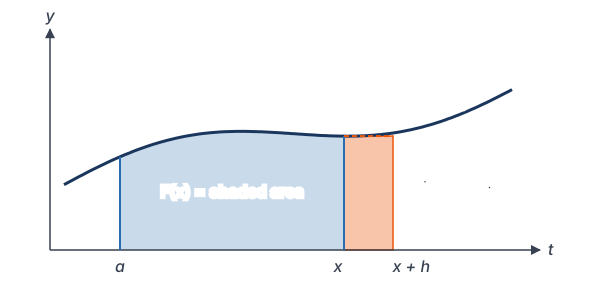
So the area function grows fastest where f is tallest. It shrinks where f is below the axis, because that area counts as negative.
Fundamental theorem of calculus part 1 formula
If f is continuous on an interval that contains a, then for every x in that interval:
\dfrac{d}{dx}\int_a^x f(t)\,dt = f(x)When the upper limit is a function g(x), use the chain rule:
\dfrac{d}{dx}\int_a^{g(x)} f(t)\,dt = f\big(g(x)\big)\,g'(x)When both limits change, subtract the lower limit’s term:
\dfrac{d}{dx}\int_{h(x)}^{g(x)} f(t)\,dt = f\big(g(x)\big)\,g'(x) - f\big(h(x)\big)\,h'(x)How to use it:
- Check that the constant limit is a number and that f is continuous.
- If x is the lower limit, flip the limits and add a minus sign.
- Replace t with the upper limit in f.
- Multiply by the derivative of the upper limit.
Fundamental theorem of calculus part 1 examples
Example 1: Upper limit x
Let F(x) = \int_2^x (t^3 + 5t)\,dt. Find F′(x) and F(2).
F'(x) = \dfrac{d}{dx}\int_2^x (t^3 + 5t)\,dtWrite the derivative of the integral.
F'(x) = x^3 + 5x
FTC Part 1: replace t with x.
F(2) = \int_2^2 (t^3 + 5t)\,dt
Put x = 2 into F.
F(2) = 0
An interval of zero width has zero area.
Answer: F'(x) = x^3 + 5x and F(2) = 0. The lower limit 2 does not change the derivative. It only sets where F equals 0.
Example 2: Upper limit x²
Find \dfrac{d}{dx}\int_1^{x^2} \sqrt{1 + t^3}\,dt.
f(t) = \sqrt{1 + t^3},\; g(x) = x^2Name the inside function and the upper limit.
f\big(g(x)\big) = \sqrt{1 + (x^2)^3}Replace t with x².
f\big(g(x)\big) = \sqrt{1 + x^6}Power of a power: multiply the exponents (see exponent rules).
g'(x) = 2x
Differentiate the upper limit (see power rule).
\dfrac{d}{dx}\int_1^{x^2} \sqrt{1 + t^3}\,dt = \sqrt{1 + x^6}\cdot 2xMultiply, by the chain rule.
= 2x\sqrt{1 + x^6}Put the factor 2x in front.
Answer: 2x\sqrt{1 + x^6}. We never had to find an antiderivative of \sqrt{1 + t^3}, which has no simple formula.
Example 3: x in the lower limit
Find \dfrac{d}{dx}\int_x^4 \cos(t^2)\,dt.
\int_x^4 \cos(t^2)\,dt = -\int_4^x \cos(t^2)\,dt
Reverse the limits and change the sign (see properties of definite integrals).
\dfrac{d}{dx}\left(-\int_4^x \cos(t^2)\,dt\right) = -\cos(x^2)FTC Part 1: replace t with x.
Answer: -\cos(x^2). When x is the lower limit, the answer has a minus sign.
Example 4: Both limits change
Find \dfrac{d}{dx}\int_{2x}^{x^3} \dfrac{1}{1 + t^2}\,dt.
\int_{2x}^{x^3} \dfrac{dt}{1 + t^2} = \int_0^{x^3} \dfrac{dt}{1 + t^2} - \int_0^{2x} \dfrac{dt}{1 + t^2}Split at 0 with additivity; the piece from 2x to 0 flips to minus the piece from 0 to 2x.
\dfrac{d}{dx}\int_0^{x^3} \dfrac{dt}{1 + t^2} = \dfrac{1}{1 + x^6}\cdot 3x^2Upper limit x³: replace t, then multiply by 3x².
\dfrac{d}{dx}\int_0^{2x} \dfrac{dt}{1 + t^2} = \dfrac{1}{1 + 4x^2}\cdot 2Upper limit 2x: replace t, then multiply by 2.
\dfrac{3x^2}{1 + x^6} - \dfrac{2}{1 + 4x^2}Subtract the second result from the first.
Answer: \dfrac{3x^2}{1 + x^6} - \dfrac{2}{1 + 4x^2}. This matches the both-limits formula: top term minus bottom term.
Example 5: Water in a tank
A tank holds 50 liters at time 0. Water flows at a rate of 6 − 2t liters per minute, t minutes later. Negative values mean water drains out. The volume after x minutes is V(x) = 50 + \int_0^x (6 - 2t)\,dt. Find the rate of change at 1 minute and at 5 minutes. Then find when the tank is fullest and how much it holds then.
V'(x) = 0 + (6 - 2x)
The constant 50 has derivative 0; FTC Part 1 on the integral.
V'(1) = 6 - 2(1) = 4
Substitute x = 1.
V'(5) = 6 - 2(5) = -4
Substitute x = 5.
6 - 2x = 0
Set V′(x) = 0 to find the critical point.
2x = 6
Add 2x to both sides.
x = 3
Divide both sides by 2.
V'(x) \gt 0 \text{ for } x \lt 3,\; V'(x) \lt 0 \text{ for } x \gt 3V′ changes from + to −, so V has a maximum at 3 (see first derivative test).
\int_0^3 (6 - 2t)\,dt = \tfrac{1}{2}(3)(6)The region is a triangle with base 3 and height 6, the rate at t = 0 (see area of triangles).
\tfrac{1}{2}(3)(6) = 9Multiply.
V(3) = 50 + 9 = 59
Add the starting volume.
Answer: the volume rises at 4 liters per minute at 1 minute and falls at 4 liters per minute at 5 minutes. The tank is fullest at 3 minutes, with 59 liters.
Common mistakes
| Mistake | Example of the error | Fix |
|---|---|---|
| Forgetting the chain rule | \dfrac{d}{dx}\int_0^{x^2} \sin t\,dt = \sin(x^2) | Multiply by the derivative of the limit: 2x\sin(x^2). |
| Leaving t in the answer | \dfrac{d}{dx}\int_1^x t^3\,dt = t^3 | Replace t with the limit: x^3. |
| Dropping the minus sign when x is the lower limit | \dfrac{d}{dx}\int_x^4 f(t)\,dt = f(x) | Flip the limits first: -f(x). |
| Subtracting the constant limit’s value | \dfrac{d}{dx}\int_2^x f(t)\,dt = f(x) - f(2) | A constant limit adds nothing: the answer is f(x). |
| Looking for an antiderivative first | Trying to integrate e^{t^2} before differentiating | Part 1 needs no antiderivative: \dfrac{d}{dx}\int_0^x e^{t^2}\,dt = e^{x^2}. |
Related methods
Reading an accumulation function from a graph
If g(x) = \int_a^x f(t)\,dt, then g′ = f and g″ = f′. So g increases where the graph of f is above the axis and decreases where it is below. g has a local maximum where f crosses from positive to negative. g has an inflection point where f has a peak or a valley (see concavity and inflection points).
Position from velocity
If v(t) is a velocity, then s(x) = s(0) + \int_0^x v(t)\,dt is the position, and Part 1 gives s′(x) = v(x). This links integrals to position, velocity and acceleration.
Part 2 of the theorem
Part 1 shows that \int_a^x f(t)\,dt is an antiderivative of f. Part 2 turns that fact into a shortcut: evaluate an antiderivative at the two limits and subtract. That is the next lesson, Fundamental Theorem of Calculus, Part 2.
Practice problems
- Find \dfrac{d}{dx}\int_1^x (t^2 - 3t)\,dt.
- Find \dfrac{d}{dx}\int_0^x \sqrt{t + 4}\,dt.
- Find \dfrac{d}{dx}\int_5^x e^{-t^2}\,dt.
- Find \dfrac{d}{dx}\int_x^2 t\sin t\,dt.
- Find \dfrac{d}{dx}\int_0^{x^3} \cos t\,dt.
- Find \dfrac{d}{dx}\int_1^{\sqrt{x}} t^2\,dt for positive x.
- Find \dfrac{d}{dx}\int_{x^2}^{0} \dfrac{1}{1 + t}\,dt.
- Find \dfrac{d}{dx}\int_x^{3x} t^2\,dt.
- Let g(x) = \int_0^x (t - 2)\,dt. Find g′(x) and g″(x). Where does g decrease, and what is its smallest value?
- Snow falls on a roof at a rate of 0.5 + 0.25t inches per hour, t hours after it starts. The depth after x hours is S(x) = \int_0^x (0.5 + 0.25t)\,dt. Find S′(4) and S(4).
Show answers
1.
\dfrac{d}{dx}\int_1^x (t^2 - 3t)\,dt = x^2 - 3xFTC Part 1: replace t with x.
Answer: x^2 - 3x
2.
\dfrac{d}{dx}\int_0^x \sqrt{t + 4}\,dt = \sqrt{x + 4}FTC Part 1: replace t with x.
Answer: \sqrt{x + 4}
3.
\dfrac{d}{dx}\int_5^x e^{-t^2}\,dt = e^{-x^2}FTC Part 1: replace t with x.
Answer: e^{-x^2}
4.
\int_x^2 t\sin t\,dt = -\int_2^x t\sin t\,dt
Reverse the limits and change the sign.
\dfrac{d}{dx}\left(-\int_2^x t\sin t\,dt\right) = -x\sin xFTC Part 1: replace t with x.
Answer: -x\sin x
5.
\cos(x^3)
Replace t with the upper limit x³.
\dfrac{d}{dx}(x^3) = 3x^2Differentiate the upper limit.
\cos(x^3)\cdot 3x^2 = 3x^2\cos(x^3)
Multiply, by the chain rule.
Answer: 3x^2\cos(x^3)
6.
(\sqrt{x})^2 = xReplace t with the upper limit √x.
\dfrac{d}{dx}\sqrt{x} = \dfrac{1}{2\sqrt{x}}Differentiate the upper limit.
x\cdot\dfrac{1}{2\sqrt{x}} = \dfrac{x}{2\sqrt{x}}Multiply, by the chain rule.
\dfrac{x}{2\sqrt{x}} = \dfrac{\sqrt{x}}{2}Simplify: x divided by √x is √x.
Answer: \dfrac{\sqrt{x}}{2}
7.
\int_{x^2}^{0} \dfrac{dt}{1 + t} = -\int_0^{x^2} \dfrac{dt}{1 + t}Reverse the limits and change the sign.
\dfrac{1}{1 + x^2}\cdot 2xReplace t with x², then multiply by the derivative 2x.
-\dfrac{2x}{1 + x^2}Apply the minus sign.
Answer: -\dfrac{2x}{1 + x^2}
8.
(3x)^2\cdot 3 = 9x^2\cdot 3 = 27x^2
Upper limit 3x: replace t, then multiply by 3.
x^2\cdot 1 = x^2
Lower limit x: replace t, then multiply by 1.
27x^2 - x^2 = 26x^2
Top term minus bottom term.
Answer: 26x^2
9.
g'(x) = x - 2
FTC Part 1.
g''(x) = 1
Differentiate x − 2.
x - 2 \lt 0 \text{ when } x \lt 2g decreases where g′ is negative.
x - 2 \gt 0 \text{ when } x \gt 2g increases after 2, so its smallest value is at x = 2.
g(2) = \int_0^2 (t - 2)\,dt = -\tfrac{1}{2}(2)(2)A triangle below the axis with base 2 and height 2.
g(2) = -2
Multiply.
Answer: g′(x) = x − 2, g″(x) = 1; g decreases when x is less than 2; smallest value g(2) = −2.
10.
S'(x) = 0.5 + 0.25x
FTC Part 1.
S'(4) = 0.5 + 0.25(4) = 0.5 + 1 = 1.5
Substitute x = 4.
S(4) = \tfrac{1}{2}(0.5 + 1.5)(4)The region is a trapezoid with parallel sides 0.5 and 1.5 and width 4 (see area of trapezoids).
S(4) = \tfrac{1}{2}(2)(4) = 4Add, then multiply.
Answer: the snow is getting deeper at 1.5 inches per hour at 4 hours, and it is 4 inches deep.
Fundamental theorem of calculus part 1 FAQ
What does the fundamental theorem of calculus part 1 say?
If f is continuous, then \dfrac{d}{dx}\int_a^x f(t)\,dt = f(x). Taking the derivative of an accumulation function gives back the function being integrated.
What is the difference between part 1 and part 2?
Part 1 is about taking the derivative of an integral with a variable limit. Part 2 is about evaluating a definite integral: find an antiderivative F, then compute F(b) − F(a).
How do you use the chain rule with the fundamental theorem of calculus?
If the upper limit is g(x), replace t with g(x) and multiply by g′(x). For example, \dfrac{d}{dx}\int_0^{x^2} \sin t\,dt = 2x\sin(x^2).
Why is the variable inside the integral t instead of x?
The letter x already names the moving limit. Using t inside keeps the two roles apart, and t disappears once the integral is computed.
Summary
- Part 1: \dfrac{d}{dx}\int_a^x f(t)\,dt = f(x) when f is continuous.
- An accumulation function’s rate of change is the height of the curve at its right edge.
- Upper limit g(x): multiply f(g(x)) by g′(x).
- x in the lower limit: flip the limits and add a minus sign.
- Both limits change: top term minus bottom term.
- The constant limit only sets where the function equals 0.
Previous lesson: Properties of Definite Integrals
Next lesson: Fundamental Theorem of Calculus, Part 2
Back to the Calculus 1 Index