
Properties of Definite Integrals
The properties of definite integrals are rules that let you split, combine and rearrange integrals without computing them from scratch. The main ones: integrals over adjacent intervals add, \int_a^b f + \int_b^c f = \int_a^c f; reversing the limits changes the sign; constants factor out; and the integral of a sum is the sum of the integrals.
Before this lesson: Definite Integrals, Even and Odd Functions and Riemann Sums
Why the properties make sense
A definite integral is a signed area, so area facts become integral rules. Two regions side by side have a total area equal to the sum of their areas. Doubling a function’s height doubles the area. Running from right to left flips the sign of every Δx, which flips the sign of the integral.
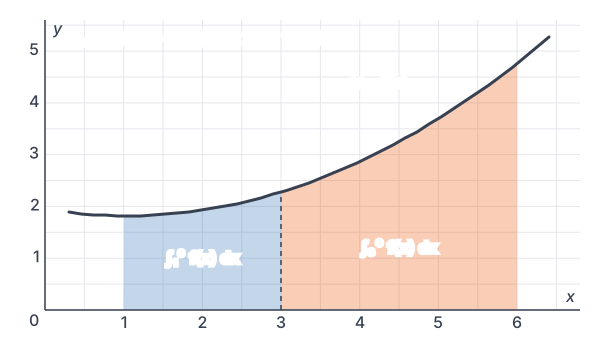
Properties of definite integrals
| Property | Rule |
|---|---|
| Zero width | \int_a^a f(x)\,dx = 0 |
| Reversed limits | \int_b^a f(x)\,dx = -\int_a^b f(x)\,dx |
| Constant multiple | \int_a^b k f(x)\,dx = k\int_a^b f(x)\,dx |
| Sum and difference | \int_a^b [f(x) \pm g(x)]\,dx = \int_a^b f(x)\,dx \pm \int_a^b g(x)\,dx |
| Additivity | \int_a^b f(x)\,dx + \int_b^c f(x)\,dx = \int_a^c f(x)\,dx |
| Constant | \int_a^b k\,dx = k(b - a) |
| Comparison | If f(x) \ge g(x) on [a, b], then \int_a^b f \ge \int_a^b g |
| Bounds | If m \le f(x) \le M on [a, b], then m(b - a) \le \int_a^b f \le M(b - a) |
Symmetry: if f is odd, \int_{-a}^{a} f(x)\,dx = 0, because the area on the left cancels the area on the right. If f is even, \int_{-a}^{a} f(x)\,dx = 2\int_0^a f(x)\,dx (see even and odd functions).
There is no product rule for integrals: \int fg is not \left(\int f\right)\left(\int g\right).
Properties of definite integrals examples
Example 1: Additivity
Suppose \int_0^5 f(x)\,dx = 8 and \int_0^2 f(x)\,dx = 3. Find \int_2^5 f(x)\,dx.
\int_0^2 f + \int_2^5 f = \int_0^5 f
Additivity: [0, 2] and [2, 5] together make [0, 5].
3 + \int_2^5 f = 8
Substitute the known values.
\int_2^5 f(x)\,dx = 5
Subtract 3 from both sides.
Answer: 5.
Example 2: Constant multiples and sums
Suppose \int_0^5 f(x)\,dx = 8 and \int_0^5 g(x)\,dx = -2. Find \int_0^5 [3f(x) - 2g(x)]\,dx.
\int_0^5 3f - \int_0^5 2g
Split the difference.
3\int_0^5 f - 2\int_0^5 g
Factor out the constants.
3(8) - 2(-2) = 24 + 4
Substitute.
= 28
Add.
Answer: 28.
Example 3: Reversed and zero-width intervals
With \int_0^5 f(x)\,dx = 8, find \int_5^0 f(x)\,dx and \int_2^2 f(x)\,dx.
\int_5^0 f(x)\,dx = -\int_0^5 f(x)\,dx = -8
Reversing the limits changes the sign.
\int_2^2 f(x)\,dx = 0
An interval with zero width has zero area.
Answer: −8 and 0.
Example 4: Using symmetry
Evaluate \int_{-2}^{2} (x^3 + 4)\,dx.
\int_{-2}^{2} x^3\,dx + \int_{-2}^{2} 4\,dxSplit the sum.
\int_{-2}^{2} x^3\,dx = 0x³ is odd, so the left and right areas cancel.
\int_{-2}^{2} 4\,dx = 4(2 - (-2)) = 16A constant: height times width.
0 + 16 = 16
Add.
Answer: 16, with no antiderivative needed.
Example 5: Word problem with sales
A store’s sales rate is s(t) items per hour, t hours after opening. You know \int_0^4 s(t)\,dt = 90 and \int_0^{10} s(t)\,dt = 260. How many items were sold from hour 4 to hour 10, and what was the average sales rate then?
\int_4^{10} s(t)\,dt = \int_0^{10} s(t)\,dt - \int_0^4 s(t)\,dtAdditivity, rearranged.
\int_4^{10} s(t)\,dt = 260 - 90 = 170Substitute.
\frac{170}{10 - 4} = \frac{170}{6} \approx 28.3Divide by the 6 hours.
Answer: 170 items were sold from hour 4 to hour 10, about 28.3 items per hour on average. Dividing an integral by the length of the interval gives an average rate, an idea developed in the lesson on the average value of a function.
Common mistakes
| Mistake | Example of the error | Fix |
|---|---|---|
| Forgetting the sign when reversing limits | \int_5^0 f = 8 | Reversed limits flip the sign: −8. |
| Multiplying integrals of a product | \int_0^1 x \cdot x\,dx = \left(\int_0^1 x\,dx\right)^2 = \frac{1}{4} | No product rule exists: \int_0^1 x^2\,dx = \frac{1}{3}. |
| Adding non-adjacent intervals | \int_0^2 f + \int_3^5 f = \int_0^5 f | The intervals must meet: [a, b] and [b, c]. |
| Using odd symmetry on a non-symmetric interval | \int_{-1}^{2} x^3\,dx = 0 | Symmetry needs [−a, a]. |
| Forgetting the width with a constant | \int_{-2}^{2} 4\,dx = 4 | Multiply by the width: 4 · 4 = 16. |
Related methods
Using properties with the Fundamental Theorem
Once you can evaluate integrals with antiderivatives (Fundamental Theorem of Calculus, Part 2), these properties still save time: split at points where a formula changes, factor out constants, and use symmetry to skip work.
Integrals of absolute values and piecewise functions
To integrate |x − 2| or a piecewise function, split the interval where the formula changes and use additivity, as in Practice Problem 10.
Practice problems
- Given \int_1^4 f = 6 and \int_4^7 f = 2, find \int_1^7 f(x)\,dx.
- Given \int_1^4 f = 6, find \int_4^1 f(x)\,dx.
- Given \int_1^4 f = 6 and \int_1^4 g = -3, find \int_1^4 [f(x) + g(x)]\,dx.
- With the same values, find \int_1^4 [2f(x) - 5g(x)]\,dx.
- Given \int_1^4 f = 6, find \int_1^4 [f(x) + 3]\,dx.
- Evaluate \int_3^3 x^2\,dx.
- Evaluate \int_{-1}^{1} x^5\,dx.
- Evaluate \int_{-3}^{3} (x^3 - 2x + 1)\,dx.
- Find lower and upper bounds for \int_0^1 \sqrt{1 + x^2}\,dx.
- Evaluate \int_0^6 |x - 2|\,dx by splitting the interval.
Show answers
1.
\int_1^7 f = \int_1^4 f + \int_4^7 f = 6 + 2
Additivity.
Answer: 8
2.
\int_4^1 f = -\int_1^4 f
Reverse the limits.
Answer: −6
3.
\int_1^4 f + \int_1^4 g = 6 + (-3)
Sum rule.
Answer: 3
4.
2(6) - 5(-3) = 12 + 15
Constant multiples and the difference rule.
Answer: 27
5.
\int_1^4 f + \int_1^4 3\,dx = 6 + 3(4 - 1)
Sum rule; a constant is height times width.
Answer: 6 + 9 = 15
6.
\int_3^3 x^2\,dx = 0
Zero width.
Answer: 0
7.
\int_{-1}^{1} x^5\,dx = 0x⁵ is odd and the interval is symmetric.
Answer: 0
8.
\int_{-3}^{3}(x^3 - 2x)\,dx = 0x³ − 2x is odd.
\int_{-3}^{3} 1\,dx = 6Height 1 times width 6.
Answer: 6
9.
1 \le \sqrt{1 + x^2} \le \sqrt{2} \text{ on } [0, 1]The function increases from √1 = 1 to √2.
1(1 - 0) \le \int_0^1 \sqrt{1 + x^2}\,dx \le \sqrt{2}(1 - 0)Bounds property with width 1.
Answer: between 1 and √2 ≈ 1.414 (the true value is about 1.148)
10.
\int_0^2 (2 - x)\,dx + \int_2^6 (x - 2)\,dx
Split at x = 2, where x − 2 changes sign.
\frac{1}{2}(2)(2) + \frac{1}{2}(4)(4) = 2 + 8Two triangles.
Answer: 10
Properties of definite integrals FAQ
What happens if you switch the limits of integration?
The integral changes sign: \int_b^a f(x)\,dx = -\int_a^b f(x)\,dx.
Can you split a definite integral into two integrals?
Yes. For any b between a and c (and even outside, when f is integrable there), \int_a^c f = \int_a^b f + \int_b^c f.
What is the integral of an odd function over a symmetric interval?
Zero. The signed area on the left cancels the signed area on the right.
Is there a product rule for definite integrals?
No. The integral of a product is generally not the product of the integrals. Products need other methods, such as substitution or integration by parts.
Summary
- Adjacent intervals add; reversing the limits changes the sign; zero width gives 0.
- Constants factor out, and sums and differences split.
- \int_a^b k\,dx = k(b - a).
- Odd functions on [−a, a] integrate to 0; even functions give twice the integral from 0 to a.
- If m ≤ f ≤ M, the integral is between m(b − a) and M(b − a).
Previous lesson: Definite Integrals
Next lesson: Fundamental Theorem of Calculus, Part 1
Back to the Calculus 1 Index