
U-Substitution with Definite Integrals
To do u-substitution with definite integrals, change the limits along with the variable. If u = g(x), the new limits are g(a) and g(b): \int_a^b f\big(g(x)\big)\,g'(x)\,dx = \int_{g(a)}^{g(b)} f(u)\,du. Then evaluate the u-integral with those limits. You never have to substitute back.
Before this lesson: U-Substitution and Fundamental Theorem of Calculus, Part 2
Why the limits change
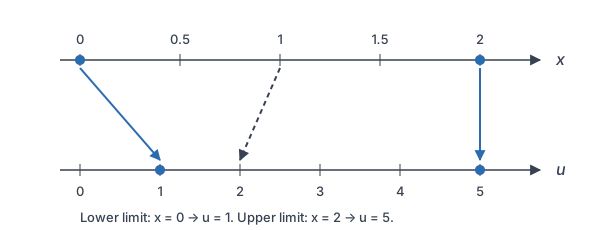
The limits of a definite integral are values of the variable of integration. In \int_0^2 \ldots\,dx, the 0 and 2 are x-values. After you switch to u, the integral needs u-values instead.
So run each x-limit through the substitution. If u = x² + 1, then x = 0 gives u = 1 and x = 2 gives u = 5. The u-integral goes from 1 to 5.
U-substitution with definite integrals formula
If u = g(x) and g′ is continuous on [a, b], then:
\int_a^b f\big(g(x)\big)\,g'(x)\,dx = \int_{g(a)}^{g(b)} f(u)\,duSteps:
- Choose u and find du, as in an indefinite integral.
- Change the limits: put a and b into u = g(x).
- Rewrite the integrand and dx in terms of u.
- Integrate and evaluate with the new limits. Do not substitute back.
U-substitution with definite integrals examples
Example 1: A polynomial inside a power
Evaluate \int_0^2 2x(x^2 + 1)^2\,dx.
u = x^2 + 1
Let u be the inside of the power.
du = 2x\,dx
Differentiate u.
x = 0 \to u = 0^2 + 1 = 1
New lower limit.
x = 2 \to u = 2^2 + 1 = 5
New upper limit.
\int_0^2 2x(x^2 + 1)^2\,dx = \int_1^5 u^2\,du
Replace the integrand, dx and the limits.
= \Big[\dfrac{u^3}{3}\Big]_1^5Power rule.
= \dfrac{125}{3} - \dfrac{1}{3} = \dfrac{124}{3}Plug in the u-limits and subtract (see fundamental theorem of calculus, part 2).
Answer: \dfrac{124}{3} \approx 41.33
Example 2: A root in the denominator
Evaluate \int_0^1 \dfrac{x}{\sqrt{x^2 + 3}}\,dx.
u = x^2 + 3
Let u be the inside of the root.
du = 2x\,dx
Differentiate u, so x dx = du/2.
x = 0 \to u = 3, \quad x = 1 \to u = 4
Change the limits.
\int_0^1 \dfrac{x}{\sqrt{x^2 + 3}}\,dx = \int_3^4 \dfrac{1}{2}u^{-1/2}\,duRewrite in u; 1/√u is u^(−1/2).
= \Big[u^{1/2}\Big]_3^4Power rule: 1/2 divided by 1/2 is 1.
= \sqrt{4} - \sqrt{3} = 2 - \sqrt{3}Plug in the limits and subtract.
Answer: 2 - \sqrt{3} \approx 0.268
Example 3: A trig substitution
Evaluate \int_0^{\pi/2} \sin^3 x\cos x\,dx.
u = \sin x
Let u be the base of the power.
du = \cos x\,dx
Differentiate u (see derivatives of trig functions).
x = 0 \to u = \sin 0 = 0
New lower limit.
x = \dfrac{\pi}{2} \to u = \sin\dfrac{\pi}{2} = 1New upper limit.
\int_0^{\pi/2} \sin^3 x\cos x\,dx = \int_0^1 u^3\,duRewrite in u.
= \Big[\dfrac{u^4}{4}\Big]_0^1 = \dfrac{1}{4} - 0 = \dfrac{1}{4}Integrate and evaluate.
Answer: \dfrac{1}{4}
Example 4: When the new limits flip
Evaluate \int_1^2 \dfrac{e^{1/x}}{x^2}\,dx.
u = \dfrac{1}{x}Let u be the exponent.
du = -\dfrac{1}{x^2}\,dxDifferentiate u = x⁻¹, so dx/x² = −du.
x = 1 \to u = 1, \quad x = 2 \to u = \dfrac{1}{2}Change the limits. The upper limit is now smaller.
\int_1^2 \dfrac{e^{1/x}}{x^2}\,dx = \int_1^{1/2} -e^u\,duRewrite in u. Keep the limits in this order.
= \int_{1/2}^1 e^u\,duSwap the limits and drop the minus sign (see properties of definite integrals).
= \Big[e^u\Big]_{1/2}^1 = e - e^{1/2}Integrate and evaluate.
\approx 1.070
Use e ≈ 2.71828 and e^(1/2) ≈ 1.64872.
Answer: e - \sqrt{e} \approx 1.070. A flipped pair of limits is fine. Keep them in order, then use the minus sign to swap them.
Example 5: Water flowing into a tank
Water flows into a tank at a rate of r(t) = \dfrac{8t}{(t^2 + 1)^2} liters per minute. How much water flows in from t = 0 to t = 3 minutes?
u = t^2 + 1
Let u be the inside of the power.
du = 2t\,dt
Differentiate u, so 8t dt = 4 du.
t = 0 \to u = 1, \quad t = 3 \to u = 10
Change the limits.
\int_0^3 \dfrac{8t}{(t^2 + 1)^2}\,dt = \int_1^{10} 4u^{-2}\,duRewrite in u.
= \Big[-\dfrac{4}{u}\Big]_1^{10}Power rule: 4u⁻² becomes −4u⁻¹.
= -\dfrac{4}{10} - \left(-\dfrac{4}{1}\right)Plug in the limits and subtract.
= -0.4 + 4 = 3.6
Simplify.
Answer: 3.6 liters flow in during the first 3 minutes.
Common mistakes
| Mistake | Example of the error | Fix |
|---|---|---|
| Keeping the x-limits on a u-integral | \int_0^2 u^2\,du for Example 1 | Change the limits too: \int_1^5 u^2\,du. |
| Substituting back and using the u-limits | \Big[\dfrac{(x^2 + 1)^3}{3}\Big]_1^5 | Use the new limits with u, or the old limits with x. Never mix them. |
| Putting the limits into du instead of u | For u = x² + 1, using du = 2x to get limits 0 and 4 | Put each x-limit into u = g(x). |
| Forgetting the constant factor | \int_0^1 \dfrac{x}{\sqrt{x^2 + 3}}\,dx = \int_3^4 u^{-1/2}\,du | x dx = du/2, so include the 1/2. |
| “Fixing” limits that come out backward | Writing \int_{1/2}^1 -e^u\,du in Example 4 | Keep g(a) on the bottom and g(b) on top. Swap them only by changing the sign. |
Related methods
Substitute back and keep the x-limits
You can also find the antiderivative in x first, then use the original limits. In Example 1, \int 2x(x^2 + 1)^2\,dx = \dfrac{(x^2 + 1)^3}{3} + C, and \Big[\dfrac{(x^2 + 1)^3}{3}\Big]_0^2 = \dfrac{125}{3} - \dfrac{1}{3}. Both methods give 124/3.
Symmetric limits
If f is odd, \int_{-a}^{a} f(x)\,dx = 0. If f is even, it equals 2\int_0^a f(x)\,dx. Checking for symmetry first can save a substitution (see even and odd functions).
When u-substitution is not enough
Some integrals need other methods, such as integration by parts, in Calculus 2. If no inside function has its derivative nearby, u-substitution won’t help.
Practice problems
- Evaluate \int_0^1 3x^2(x^3 + 1)^4\,dx.
- Evaluate \int_0^2 (2x + 1)^3\,dx.
- Evaluate \int_0^4 \dfrac{1}{\sqrt{2x + 1}}\,dx.
- Evaluate \int_0^{\pi/4} \sin(2x)\,dx.
- Evaluate \int_0^{\pi/3} \sin x\cos^2 x\,dx.
- Evaluate \int_0^1 x e^{x^2}\,dx.
- Evaluate \int_1^2 x(x^2 - 1)^3\,dx.
- Evaluate \int_0^{\pi/4} \sec^2 x\tan^2 x\,dx.
- Evaluate \int_{-1}^{1} x^3(x^4 + 2)^5\,dx.
- A factory makes parts at a rate of r(t) = 6t\sqrt{t^2 + 16} parts per hour. How many parts does it make from t = 0 to t = 3 hours?
Show answers
1.
u = x^3 + 1,\; du = 3x^2\,dx
Choose u and find du.
x = 0 \to u = 1, \quad x = 1 \to u = 2
Change the limits.
\int_1^2 u^4\,du = \Big[\dfrac{u^5}{5}\Big]_1^2 = \dfrac{32}{5} - \dfrac{1}{5} = \dfrac{31}{5}Integrate and evaluate.
Answer: \dfrac{31}{5}
2.
u = 2x + 1,\; du = 2\,dx
Choose u; dx = du/2.
x = 0 \to u = 1, \quad x = 2 \to u = 5
Change the limits.
\int_1^5 \dfrac{1}{2}u^3\,du = \Big[\dfrac{u^4}{8}\Big]_1^5Rewrite and integrate.
= \dfrac{625}{8} - \dfrac{1}{8} = 78Evaluate: 624/8 = 78.
Answer: 78
3.
u = 2x + 1,\; du = 2\,dx
Choose u; dx = du/2.
x = 0 \to u = 1, \quad x = 4 \to u = 9
Change the limits.
\int_1^9 \dfrac{1}{2}u^{-1/2}\,du = \Big[u^{1/2}\Big]_1^9Rewrite and integrate.
= 3 - 1 = 2
Evaluate.
Answer: 2
4.
u = 2x,\; du = 2\,dx
Choose u; dx = du/2.
x = 0 \to u = 0, \quad x = \dfrac{\pi}{4} \to u = \dfrac{\pi}{2}Change the limits.
\int_0^{\pi/2} \dfrac{1}{2}\sin u\,du = \Big[-\dfrac{1}{2}\cos u\Big]_0^{\pi/2}Rewrite and integrate.
= 0 - \left(-\dfrac{1}{2}\right) = \dfrac{1}{2}cos(π/2) = 0 and cos 0 = 1.
Answer: \dfrac{1}{2}
5.
u = \cos x,\; du = -\sin x\,dx
Choose u; sin x dx = −du.
x = 0 \to u = 1, \quad x = \dfrac{\pi}{3} \to u = \dfrac{1}{2}Change the limits.
\int_1^{1/2} -u^2\,du = \int_{1/2}^1 u^2\,duRewrite, then swap the limits and drop the minus sign.
= \Big[\dfrac{u^3}{3}\Big]_{1/2}^1 = \dfrac{1}{3} - \dfrac{1}{24} = \dfrac{7}{24}Integrate and evaluate.
Answer: \dfrac{7}{24}
6.
u = x^2,\; du = 2x\,dx
Choose u; x dx = du/2.
x = 0 \to u = 0, \quad x = 1 \to u = 1
Change the limits.
\int_0^1 \dfrac{1}{2}e^u\,du = \Big[\dfrac{1}{2}e^u\Big]_0^1 = \dfrac{e - 1}{2}Integrate and evaluate.
Answer: \dfrac{e - 1}{2} \approx 0.859
7.
u = x^2 - 1,\; du = 2x\,dx
Choose u; x dx = du/2.
x = 1 \to u = 0, \quad x = 2 \to u = 3
Change the limits.
\int_0^3 \dfrac{1}{2}u^3\,du = \Big[\dfrac{u^4}{8}\Big]_0^3 = \dfrac{81}{8}Integrate and evaluate.
Answer: \dfrac{81}{8}
8.
u = \tan x,\; du = \sec^2 x\,dx
Choose u.
x = 0 \to u = 0, \quad x = \dfrac{\pi}{4} \to u = 1Change the limits.
\int_0^1 u^2\,du = \Big[\dfrac{u^3}{3}\Big]_0^1 = \dfrac{1}{3}Integrate and evaluate.
Answer: \dfrac{1}{3}
9.
u = x^4 + 2,\; du = 4x^3\,dx
Choose u; x³ dx = du/4.
x = -1 \to u = 3, \quad x = 1 \to u = 3
Change the limits. They are the same.
\int_3^3 \dfrac{1}{4}u^5\,du = 0An integral from a number to itself is 0.
Answer: 0. The integrand is odd, so this matches the symmetry rule.
10.
u = t^2 + 16,\; du = 2t\,dt
Choose u; 6t dt = 3 du.
t = 0 \to u = 16, \quad t = 3 \to u = 25
Change the limits.
\int_{16}^{25} 3u^{1/2}\,du = \Big[2u^{3/2}\Big]_{16}^{25}Rewrite and integrate: 3 divided by 3/2 is 2.
= 2(125) - 2(64) = 122
25^(3/2) = 125 and 16^(3/2) = 64.
Answer: 122 parts
U-substitution with definite integrals FAQ
Do you have to change the limits in u-substitution?
You must either change the limits to u-values or substitute back to x and use the original limits. Changing the limits is usually faster.
How do you find the new limits?
Put each original limit into u = g(x). The lower limit a becomes g(a) and the upper limit b becomes g(b).
What if the new upper limit is smaller than the lower limit?
That is fine. Evaluate it as written, or swap the limits and change the sign of the integral.
Why don’t you substitute back with definite integrals?
After you change the limits, the u-integral already has the right value. Substituting back would need the old limits again.
Summary
- With u = g(x), \int_a^b f\big(g(x)\big)\,g'(x)\,dx = \int_{g(a)}^{g(b)} f(u)\,du.
- Change both limits by putting them into u = g(x).
- Evaluate in u with the new limits; don’t substitute back.
- Or substitute back and use the original x-limits. Never mix the two.
- Flipped limits are fine; a minus sign swaps them.
- Odd functions on symmetric limits give 0.
Previous lesson: U-Substitution
Next lesson: Integrals That Give Natural Logarithms
Back to the Calculus 1 Index