
Surface Area and Volume of Spheres
The surface area and volume of a sphere depend only on its radius r. The surface area is S = 4\pi r^2, and the volume is V = \tfrac{4}{3}\pi r^3. A sphere is the set of all points in space that are the same distance from a center point, like a ball.
Before this lesson: You should know Circumference and Area of Circles, Volume of Pyramids and Cones and Exponents.
Parts of a Sphere
A sphere is all the points in space at a distance r from a center. The radius goes from the center to the surface, and the diameter goes through the center from one side to the other. A great circle is the largest circle you can draw on a sphere. It cuts the sphere into two hemispheres.
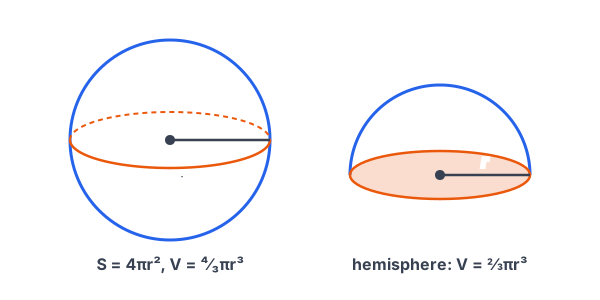
Sphere Formulas
S = 4\pi r^2 \qquad V = \tfrac{4}{3}\pi r^3The surface area is exactly 4 great circles, since each great circle has area \pi r^2. The volume can be shown with Cavalieri’s principle: a hemisphere holds the same amount as a cylinder minus a cone, both with radius r and height r. That gives \pi r^3 - \tfrac{1}{3}\pi r^3 = \tfrac{2}{3}\pi r^3 for half the sphere.
| Shape | Surface area | Volume |
|---|---|---|
| Sphere | 4\pi r^2 | \tfrac{4}{3}\pi r^3 |
| Hemisphere (with its flat base) | 2\pi r^2 + \pi r^2 = 3\pi r^2 | \tfrac{2}{3}\pi r^3 |
How to Find Surface Area and Volume
- Find the radius. If you know the diameter, divide by 2.
- For surface area, square the radius and multiply by 4\pi.
- For volume, cube the radius and multiply by \tfrac{4}{3}\pi.
- Square units for surface area, cubic units for volume. Round only at the end.
Worked Examples
Example 1: Radius given
A sphere has radius 6 cm. Find its surface area and volume.
- Write the surface area formula: S = 4\pi(6)^2
- Square: S = 4\pi(36)
- Multiply: S = 144\pi \approx 452.39
- Write the volume formula: V = \tfrac{4}{3}\pi(6)^3
- Cube (see exponents): V = \tfrac{4}{3}\pi(216)
- Multiply: V = 288\pi \approx 904.78
Answer: S = 144\pi \approx 452.39 cm² and V = 288\pi \approx 904.78 cm³
Example 2: Diameter given
A ball has a diameter of 10 in. Find its surface area and volume.
- Find the radius: r = 10 \div 2 = 5
- Surface area: S = 4\pi(5)^2 = 4\pi(25)
- Multiply: S = 100\pi \approx 314.16
- Volume: V = \tfrac{4}{3}\pi(5)^3 = \tfrac{4}{3}\pi(125)
- Multiply: V = \frac{500\pi}{3} \approx 523.60
Answer: S \approx 314.16 in² and V \approx 523.60 in³
Example 3: Work backward from the surface area
A sphere has surface area 196\pi m². Find its radius and volume.
- Write the formula: 196\pi = 4\pi r^2
- Divide both sides by 4\pi: 49 = r^2
- Take the positive square root: r = 7
- Volume: V = \tfrac{4}{3}\pi(7)^3 = \tfrac{4}{3}\pi(343)
- Multiply: V = \frac{1372\pi}{3} \approx 1436.76
Answer: r = 7 m and V \approx 1436.76 m³
Example 4: A hemisphere
A solid hemisphere has radius 3 ft. Find its volume and its total surface area (curved part plus flat base).
- Volume is half of a sphere: V = \tfrac{2}{3}\pi(3)^3
- Cube: V = \tfrac{2}{3}\pi(27)
- Multiply: V = 18\pi \approx 56.55
- Curved part is half the sphere’s surface: 2\pi(3)^2 = 18\pi
- Flat base is a circle: \pi(3)^2 = 9\pi
- Add: S = 18\pi + 9\pi = 27\pi \approx 84.82
Answer: V \approx 56.55 ft³ and S \approx 84.82 ft²
Example 5: Word problem with a water tank
A spherical water tank has a radius of 10 ft. How many cubic feet of water can it hold? One cubic foot holds about 7.48 gallons. About how many gallons is that?
- Write the volume formula: V = \tfrac{4}{3}\pi(10)^3
- Cube: V = \tfrac{4}{3}\pi(1000)
- Multiply: V = \frac{4000\pi}{3} \approx 4188.79
- Convert to gallons: 4188.79 \times 7.48 \approx 31{,}332.2
Answer: about 4,188.79 ft³, or about 31,332 gallons
Common Mistakes
| Mistake | Example of the error | Fix |
|---|---|---|
| Squaring instead of cubing for volume | V = \tfrac{4}{3}\pi(6)^2 | Volume uses r^3: \tfrac{4}{3}\pi(216). |
| Using the diameter | S = 4\pi(10)^2 for a ball 10 in across | Use r = 5. |
| Mixing up the formulas | S = \tfrac{4}{3}\pi r^2 | S = 4\pi r^2 and V = \tfrac{4}{3}\pi r^3. |
| Forgetting the flat base of a solid hemisphere | S = 2\pi r^2 only | A solid hemisphere also has a circle: add \pi r^2. |
| Rounding \pi early | Using 3.14 and then rounding again | Keep \pi and round once at the end. |
Practice Problems
Give answers with \pi exactly, then rounded to the nearest hundredth.
- Find the surface area and volume of a sphere with radius 3.
- Find the surface area and volume of a sphere with radius 9.
- Find the surface area and volume of a sphere with diameter 14.
- A sphere has surface area 64\pi. Find its volume.
- A sphere has volume 36\pi. Find its radius.
- Find the volume and total surface area of a solid hemisphere with radius 6.
- A great circle of a sphere has area 25\pi. Find the sphere’s surface area.
- An ice cream cone is a cone with radius 3 cm and height 10 cm, topped with a hemisphere of ice cream with radius 3 cm. Find the total volume.
- A ball has a radius of 12 cm. How much leather covers it?
- If you double the radius of a sphere, what happens to its surface area and its volume?
Show answers
- Surface area: S = 4\pi(3)^2 = 36\pi \approx 113.10
Volume: V = \tfrac{4}{3}\pi(3)^3 = \tfrac{4}{3}\pi(27) = 36\pi \approx 113.10 - Surface area: S = 4\pi(9)^2 = 4\pi(81) = 324\pi \approx 1017.88
Volume: V = \tfrac{4}{3}\pi(9)^3 = \tfrac{4}{3}\pi(729) = 972\pi \approx 3053.63 - Find the radius: r = 14 \div 2 = 7
Surface area: S = 4\pi(49) = 196\pi \approx 615.75
Volume: V = \tfrac{4}{3}\pi(343) = \frac{1372\pi}{3} \approx 1436.76 - Write the formula: 64\pi = 4\pi r^2
Divide both sides by 4\pi: 16 = r^2
Take the square root: r = 4
Volume: V = \tfrac{4}{3}\pi(64) = \frac{256\pi}{3} \approx 268.08 - Write the formula: 36\pi = \tfrac{4}{3}\pi r^3
Multiply both sides by 3: 108\pi = 4\pi r^3
Divide both sides by 4\pi: 27 = r^3
Take the cube root (see cube roots): r = 3 - Volume: V = \tfrac{2}{3}\pi(6)^3 = \tfrac{2}{3}\pi(216) = 144\pi \approx 452.39
Curved part: 2\pi(6)^2 = 72\pi
Base: \pi(6)^2 = 36\pi
Add: S = 108\pi \approx 339.29 - Write the great circle area: \pi r^2 = 25\pi
Divide both sides by \pi: r^2 = 25
Surface area is 4 great circles: S = 4(25\pi) = 100\pi \approx 314.16 - Cone (see volume of pyramids and cones): \tfrac{1}{3}\pi(3)^2(10) = \tfrac{1}{3}\pi(90) = 30\pi
Hemisphere: \tfrac{2}{3}\pi(3)^3 = \tfrac{2}{3}\pi(27) = 18\pi
Add: 30\pi + 18\pi = 48\pi \approx 150.80 cm³ - Surface area: S = 4\pi(12)^2 = 4\pi(144) = 576\pi \approx 1809.56 cm²
- Surface area depends on r^2, so it is multiplied by 2^2 = 4. Volume depends on r^3, so it is multiplied by 2^3 = 8. You will see this idea again in similar solids.
FAQ
What is the formula for the volume of a sphere?
V = \tfrac{4}{3}\pi r^3, where r is the radius.
What is the formula for the surface area of a sphere?
S = 4\pi r^2. It equals the area of four great circles.
How do you find the volume of a hemisphere?
Take half of the sphere’s volume: V = \tfrac{2}{3}\pi r^3.
How do you find the radius from the volume?
Multiply the volume by 3, divide by 4\pi, then take the cube root.
Summary
- A sphere is all points the same distance r from a center.
- Surface area: S = 4\pi r^2. Volume: V = \tfrac{4}{3}\pi r^3.
- A hemisphere has volume \tfrac{2}{3}\pi r^3 and total surface area 3\pi r^2.
- Use the radius, cube it for volume, and round at the end.
Previous lesson: Volume of Pyramids and Cones
Next lesson: Similar Solids
Back to the Geometry Index