
Continuous Income Streams
A continuous income stream is money that flows in steadily, at a rate of f(t) dollars per year, instead of in separate payments. With interest compounded continuously at rate r for T years, its present value is PV = \int_0^T f(t)e^{-rt}\,dt and its future value is FV = \int_0^T f(t)e^{r(T - t)}\,dt.
Before this lesson: Definite Integrals, The Number e and Present Value of an Annuity
The idea
Some businesses earn money almost every minute: a vending machine, a parking garage, an online store. It is easier to model their income as a smooth flow than as separate payments. The rate of flow f(t) is measured in dollars per year at time t.
A dollar earned later is worth less today, because a dollar today can earn interest. To find what the whole stream is worth today, we discount each small piece of income back to time 0 and add the pieces. Adding many small pieces is exactly what an integral does.
This is the continuous version of the annuity lessons. An annuity has separate payments; an income stream has a constant flow.
Continuous income stream formulas
Let f(t) be the rate of flow in dollars per year, r the yearly interest rate compounded continuously, and T the number of years.
| Quantity | Formula | Meaning |
|---|---|---|
| Total income | \int_0^T f(t)\,dt | All the money received, with no interest |
| Present value | \int_0^T f(t)e^{-rt}\,dt | What the stream is worth at time 0 |
| Future value | \int_0^T f(t)e^{r(T - t)}\,dt | What the stream grows to by time T if every dollar is invested |
The two values are linked by continuous compounding, FV = PV \cdot e^{rT}. For a constant flow f(t) = c, the integrals give short formulas:
PV = \frac{c}{r}\left(1 - e^{-rT}\right), \qquad FV = \frac{c}{r}\left(e^{rT} - 1\right)- Identify f(t), r and T. Use r as a decimal: 5% is 0.05.
- Set up the integral for total income, present value or future value.
- Integrate, using \int e^{kt}\,dt = \frac{1}{k}e^{kt}.
- Evaluate at T and 0, then use a calculator for the powers of e.
Continuous income stream examples
Example 1: Total income from a growing stream
A small app earns money at a rate of f(t) = 20{,}000 + 1000t dollars per year, where t is in years. How much does it earn in total over the first 5 years (ignoring interest)?
\int_0^{5} (20{,}000 + 1000t)\,dtTotal income is the integral of the rate of flow.
= \left[20{,}000t + 500t^2\right]_0^{5}Find an antiderivative (see antiderivatives).
= 20{,}000(5) + 500(25) - 0Evaluate at 5 and subtract the value at 0 (see definite integrals).
= 100{,}000 + 12{,}500Multiply.
= 112{,}500Add.
Answer: the app earns $112,500 over the 5 years.
Example 2: Present value of a constant stream
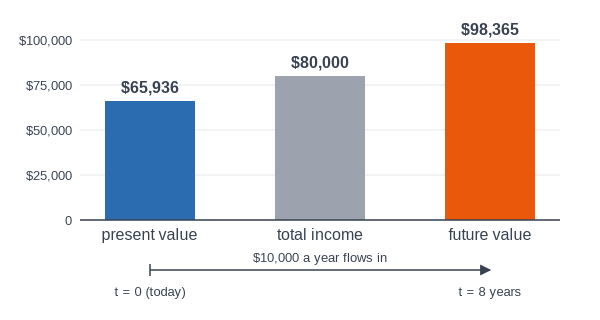
A parking lot brings in $10,000 a year, flowing continuously, for 8 years. Money earns 5% compounded continuously. What is the stream worth today?
PV = \int_0^{8} 10{,}000e^{-0.05t}\,dtSet up: f(t) = 10,000, r = 0.05 and T = 8.
PV = \left[-\dfrac{10{,}000}{0.05}e^{-0.05t}\right]_0^{8}Integrate: the antiderivative of e^{-0.05t} is \frac{e^{-0.05t}}{-0.05} (see u-substitution).
PV = -200{,}000e^{-0.4} + 200{,}000Evaluate at 8 and 0; 0.05 × 8 = 0.4 and e^{0} = 1.
PV = 200{,}000\left(1 - e^{-0.4}\right)Factor out 200,000.
PV \approx 200{,}000(1 - 0.670320)Use a calculator: e^{-0.4} \approx 0.670320.
PV \approx 200{,}000(0.329680)Subtract.
PV \approx 65{,}936Multiply.
Answer: the stream is worth about $65,936 today, although it pays $80,000 in total. The difference is the interest that money could have earned.
Example 3: Future value of the same stream
If every dollar from the parking lot in Example 2 is invested at 5% compounded continuously, how much will there be after 8 years?
FV = \dfrac{10{,}000}{0.05}\left(e^{0.4} - 1\right)Use the constant-flow formula with rT = 0.05 × 8 = 0.4.
FV = 200{,}000\left(e^{0.4} - 1\right)Divide.
FV \approx 200{,}000(1.491825 - 1)Use a calculator: e^{0.4} \approx 1.491825.
FV \approx 200{,}000(0.491825)Subtract.
FV \approx 98{,}365Multiply.
FV \approx 65{,}936 \times 1.491825 \approx 98{,}365Check: FV = PV \cdot e^{rT} gives the same value.
Answer: about $98,365 after 8 years.
Example 4: A stream that grows
Rent from a building flows in at f(t) = 5000e^{0.02t} dollars per year, growing 2% a year, for 10 years. Money earns 6% compounded continuously. Find the present value.
PV = \int_0^{10} 5000e^{0.02t}e^{-0.06t}\,dtMultiply the flow by the discount factor e^{-rt}.
PV = \int_0^{10} 5000e^{-0.04t}\,dtAdd the exponents (see exponent rules): 0.02 − 0.06 = −0.04.
PV = \left[-\dfrac{5000}{0.04}e^{-0.04t}\right]_0^{10}Integrate.
PV = 125{,}000\left(1 - e^{-0.4}\right)Evaluate at 10 and 0; 5000 ÷ 0.04 = 125,000.
PV \approx 125{,}000(0.329680)Use e^{-0.4} \approx 0.670320, then subtract from 1.
PV \approx 41{,}210Multiply.
Answer: the rent stream is worth about $41,210 today.
Example 5: Lump sum or income stream? (word problem)
A contest winner can take $50,000 now, or an income stream of $8,000 a year for 7 years, paid continuously. Money earns 4% compounded continuously. Which choice is worth more?
PV = \dfrac{8000}{0.04}\left(1 - e^{-0.28}\right)Use the constant-flow formula with rT = 0.04 × 7 = 0.28.
PV = 200{,}000\left(1 - e^{-0.28}\right)Divide.
PV \approx 200{,}000(1 - 0.755784)Use a calculator: e^{-0.28} \approx 0.755784.
PV \approx 200{,}000(0.244216)Subtract.
PV \approx 48{,}843Multiply.
48{,}843 \lt 50{,}000Compare the present values.
Answer: the stream is worth about $48,843 today, so the $50,000 lump sum is worth more, even though the stream pays $56,000 in total.
Common mistakes
| Mistake | Example of the error | Fix |
|---|---|---|
| Forgetting the discount factor | Using \int_0^8 10{,}000\,dt = 80{,}000 as the present value | That is total income. Multiply by e^{-rt} inside the integral. |
| Using a percent instead of a decimal | e^{-5t} for 5% | Write r = 0.05, so the factor is e^{-0.05t}. |
| Losing the 1/k when integrating | \int e^{-0.05t}\,dt = e^{-0.05t} | Divide by the coefficient: \int e^{-0.05t}\,dt = -\frac{1}{0.05}e^{-0.05t} + C. |
| Forgetting the value at t = 0 | Stopping at -200{,}000e^{-0.4} | Subtract the value at 0: e^0 = 1, so add 200,000. |
| Mixing up the exponents in the future value | Using e^{rt} instead of e^{r(T - t)} | Money received at time t grows for the remaining T − t years. |
| Comparing a future value with a lump sum today | Comparing $98,365 with a $70,000 offer today | Compare values at the same time: present value with present value. |
Related ideas
Connection to annuities
The present value of an annuity adds separate discounted payments. An income stream makes the payments so small and so frequent that the sum becomes an integral. For the same yearly amount, the two values are close.
Why FV = PV \cdot e^{rT}
Growing every piece of the stream from time t to time T is the same as moving the whole present value forward T years. That is continuous compounding of one lump sum.
Streams that are not constant
When the rate of flow is a polynomial times e^{-rt}, such as (20{,}000 + 1000t)e^{-rt}, the present value needs integration by parts, or a calculator’s numerical integration.
Practice problems
- A business earns at a rate of f(t) = 12{,}000 + 600t dollars per year. Find its total income over the first 4 years.
- Find the present value of $6,000 a year for 5 years at 3% compounded continuously.
- Find the future value of the stream in Problem 2.
- Check that FV = PV \cdot e^{rT} for Problems 2 and 3.
- A stream flows at f(t) = 4000e^{0.05t} for 6 years, and money earns 5%. Find its present value.
- Find the future value of $2,500 a year for 10 years at 6% compounded continuously.
- Find the present value of $30,000 a year for 3 years at 8% compounded continuously.
- Find the total income from f(t) = 1000e^{0.1t} over the first 5 years.
- A vending machine costs $15,000 and earns $3,600 a year, continuously, for 5 years. At 6%, is it worth buying?
- At 5%, which is worth more today: $1,000 a year for 10 years, paid continuously, or $7,500 now?
Show answers
1.
\int_0^{4} (12{,}000 + 600t)\,dt = \left[12{,}000t + 300t^2\right]_0^{4}Find an antiderivative.
= 48{,}000 + 4800Evaluate at 4 and 0.
= 52{,}800Add.
Answer: $52,800
2.
PV = \dfrac{6000}{0.03}\left(1 - e^{-0.15}\right)Constant-flow formula with rT = 0.15.
PV \approx 200{,}000(1 - 0.860708)Divide; e^{-0.15} \approx 0.860708.
PV \approx 200{,}000(0.139292) \approx 27{,}858Subtract, then multiply.
Answer: about $27,858
3.
FV = \dfrac{6000}{0.03}\left(e^{0.15} - 1\right)Constant-flow formula.
FV \approx 200{,}000(1.161834 - 1)Divide; e^{0.15} \approx 1.161834.
FV \approx 200{,}000(0.161834) \approx 32{,}367Subtract, then multiply.
Answer: about $32,367
4.
27{,}858 \times 1.161834 \approx 32{,}366Multiply PV by e^{0.15}.
Answer: about $32,366, which matches $32,367 up to rounding
5.
PV = \int_0^{6} 4000e^{0.05t}e^{-0.05t}\,dt = \int_0^{6} 4000\,dtThe exponents add to 0, and e^{0} = 1.
PV = 4000(6) = 24{,}000Integrate a constant.
Answer: $24,000 (the growth exactly cancels the discounting)
6.
FV = \dfrac{2500}{0.06}\left(e^{0.6} - 1\right)Constant-flow formula with rT = 0.6.
FV \approx 41{,}666.67(0.822119)Divide; e^{0.6} \approx 1.822119, then subtract 1.
FV \approx 34{,}255Multiply.
Answer: about $34,255
7.
PV = \dfrac{30{,}000}{0.08}\left(1 - e^{-0.24}\right)Constant-flow formula with rT = 0.24.
PV \approx 375{,}000(1 - 0.786628)Divide; e^{-0.24} \approx 0.786628.
PV \approx 375{,}000(0.213372) \approx 80{,}015Subtract, then multiply.
Answer: about $80,015
8.
\int_0^{5} 1000e^{0.1t}\,dt = \left[10{,}000e^{0.1t}\right]_0^{5}Integrate: 1000 ÷ 0.1 = 10,000.
= 10{,}000\left(e^{0.5} - 1\right)Evaluate at 5 and 0.
\approx 10{,}000(0.648721) \approx 6487e^{0.5} \approx 1.648721; subtract 1, then multiply.
Answer: about $6,487
9.
PV = \dfrac{3600}{0.06}\left(1 - e^{-0.3}\right)Constant-flow formula with rT = 0.3.
PV \approx 60{,}000(1 - 0.740818)Divide; e^{-0.3} \approx 0.740818.
PV \approx 60{,}000(0.259182) \approx 15{,}551Subtract, then multiply.
15{,}551 \gt 15{,}000Compare with the cost.
Answer: yes, barely; its earnings are worth about $15,551 today, $551 more than its cost
10.
PV = \dfrac{1000}{0.05}\left(1 - e^{-0.5}\right)Constant-flow formula with rT = 0.5.
PV \approx 20{,}000(1 - 0.606531)Divide; e^{-0.5} \approx 0.606531.
PV \approx 20{,}000(0.393469) \approx 7869Subtract, then multiply.
Answer: the stream, worth about $7,869 today, is worth more than $7,500
Continuous income streams FAQ
What is the present value of a continuous income stream?
It is the amount that, invested today at the interest rate r, would be worth the same as the stream. It equals \int_0^T f(t)e^{-rt}\,dt.
What is the formula for the future value of an income stream?
FV = \int_0^T f(t)e^{r(T - t)}\,dt. For a constant flow c, this becomes FV = \frac{c}{r}\left(e^{rT} - 1\right).
How are present value and future value related?
The future value is the present value grown at continuous interest for T years: FV = PV \cdot e^{rT}.
What is the difference between total income and present value?
Total income adds up all the money with no interest, \int_0^T f(t)\,dt. Present value discounts later money, so it is always smaller when r is positive.
Summary
- An income stream flows at f(t) dollars per year.
- Total income: \int_0^T f(t)\,dt. Present value: \int_0^T f(t)e^{-rt}\,dt. Future value: \int_0^T f(t)e^{r(T - t)}\,dt.
- FV = PV \cdot e^{rT}.
- For a constant flow c: PV = \frac{c}{r}\left(1 - e^{-rT}\right) and FV = \frac{c}{r}\left(e^{rT} - 1\right).
- Compare choices by their present values.
Previous lesson: Consumer and Producer Surplus
Next lesson: Lorenz Curve and Gini Index
Back to the Finite Math Index