
Present Value of an Annuity
The present value of an annuity is what a series of equal future payments is worth today. For a payment PMT at the end of each period, at rate i per period for n periods, PV = PMT × [1 − (1 + i)⁻ⁿ] / i. It shows what a loan, pension or prize paid over time is worth now.
Before this lesson: Future Value of an Annuity, Effective Annual Rate and Zero and Negative Exponents
The idea
Money you get later is worth less than the same money today, because money you have now can earn interest. The present value of a future payment is the amount you would have to invest today to grow into that payment.
To find the present value of one payment, divide by the growth factor: a payment of A made n periods from now is worth A(1 + i)⁻ⁿ today. This is called discounting.
An annuity is a series of equal payments. Its present value is the sum of the present values of all the payments. Later payments are discounted more, so they count for less.
Present value of an annuity formula
PV = PMT \cdot \frac{1 - (1 + i)^{-n}}{i}Here PMT is the payment each period, i = r/m is the rate per period and n = mt is the number of payments. The payments are made at the end of each period (an ordinary annuity), and they line up with the compounding periods.
Why it works: the payments are worth PMT(1 + i)⁻¹, PMT(1 + i)⁻², and so on down to PMT(1 + i)⁻ⁿ today. That is a geometric series, and its sum is the formula. You can also get it by discounting the future value: PV = FV(1 + i)⁻ⁿ.
How to find the present value of an annuity
- Find the rate per period, i = r/m, and the number of payments, n = mt.
- Raise 1 + i to the power −n.
- Subtract that result from 1.
- Divide by i.
- Multiply by the payment PMT.
Keep at least 8 digits in the calculator until the last step, especially when the payment is large.
Present value of an annuity examples
Example 1: Monthly payments
Find the present value of $500 paid at the end of every month for 4 years, at 6% compounded monthly.
i = \frac{0.06}{12} = 0.005Find the rate per period.
n = 12 \times 4 = 48
Find the number of payments.
1.005^{-48} \approx 0.78709841Raise 1 + i to the power −n (see negative exponents).
1 - 0.78709841 = 0.21290159
Subtract from 1.
\frac{0.21290159}{0.005} = 42.580318Divide by i.
500 \times 42.580318 \approx 21290.16
Multiply by the payment.
Answer: about $21,290.16. Investing that amount today at 6% would pay out exactly $500 a month for 4 years.
Example 2: Discounting each payment
Find the present value of $1,000 paid at the end of each year for 3 years at 5% compounded annually. Do it payment by payment, then with the formula.
| Payment | Paid at end of year | Present value today |
|---|---|---|
| 1 | 1 | \frac{1000}{1.05} \approx 952.38 |
| 2 | 2 | \frac{1000}{1.05^2} \approx 907.03 |
| 3 | 3 | \frac{1000}{1.05^3} \approx 863.84 |
952.38 + 907.03 + 863.84 = 2723.25
Add the present values in the table.
1.05^{-3} \approx 0.86383760Now use the formula with i = 0.05 and n = 3.
1 - 0.86383760 = 0.13616240
Subtract from 1.
\frac{0.13616240}{0.05} = 2.723248Divide by i.
1000 \times 2.723248 \approx 2723.25
Multiply by the payment.
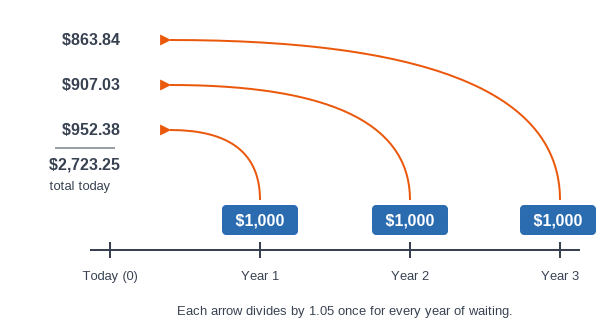
Answer: both ways give $2,723.25. You would pay less than the $3,000 total, because you wait for the money.
Example 3: Lottery prize, annual payments or a lump sum? (word problem)
A lottery winner can take $50,000 at the end of each year for 20 years, or $600,000 now. If money can earn 5% compounded annually, which option is worth more today?
1.05^{-20} \approx 0.37688948Raise 1.05 to the power −20.
1 - 0.37688948 = 0.62311052
Subtract from 1.
\frac{0.62311052}{0.05} = 12.4622104Divide by i = 0.05.
50000 \times 12.4622104 = 623110.52
Multiply by the payment.
623110.52 \gt 600000
Compare with the lump sum.
Answer: at 5%, the payments are worth about $623,110.52 today, so they are worth more than the $600,000 lump sum. At a higher interest rate, the lump sum could win (see Practice Problem 7).
Example 4: Saving enough for retirement
How much must be in a retirement account to withdraw $2,500 at the end of each month for 25 years, if the account earns 4.8% compounded monthly?
i = \frac{0.048}{12} = 0.004Find the rate per period.
n = 12 \times 25 = 300
Find the number of withdrawals.
1.004^{-300} \approx 0.30191602Raise 1 + i to the power −n.
1 - 0.30191602 = 0.69808398
Subtract from 1.
\frac{0.69808398}{0.004} = 174.520995Divide by i.
2500 \times 174.520995 \approx 436302.49
Multiply by the payment.
Answer: about $436,302.49. The withdrawals total 2,500 × 300 = $750,000; interest earned during retirement covers the rest.
Example 5: How much car can you afford?
You can pay $350 at the end of each month for 5 years. A car loan charges 7.2% compounded monthly. What is the largest loan you can take, and how much interest would you pay?
i = \frac{0.072}{12} = 0.006,\ n = 60Find the rate per period and the number of payments.
1.006^{-60} \approx 0.69842722Raise 1 + i to the power −n.
1 - 0.69842722 = 0.30157278
Subtract from 1.
\frac{0.30157278}{0.006} = 50.26213Divide by i.
350 \times 50.26213 \approx 17591.75
Multiply by the payment.
350 \times 60 = 21000
Find the total of all payments.
21000 - 17591.75 = 3408.25
Subtract the loan amount to find the interest.
Answer: you can borrow about $17,591.75, and you would pay $3,408.25 in interest. A loan amount is the present value of its payments.
Calculator and spreadsheet steps
Work the formula by hand first, then check with a tool.
- Excel or Google Sheets: =PV(0.005, 48, -500) returns 21290.16 for Example 1. Enter the payment as a negative number to get a positive answer; spreadsheets use signs to show money going in or out.
- TI-84 Plus TVM Solver: press APPS, Finance, TVM Solver. For Example 1 enter N = 48, I% = 6, PMT = 500, FV = 0, P/Y = C/Y = 12, PMT: END, then move to PV and press ALPHA ENTER. It shows −21290.16 (negative, since you would pay it in).
- One payment: the present value of a single amount A is =A/(1+i)^n, or =PV(i, n, 0, -A).
Common mistakes
| Mistake | Example of the error | Fix |
|---|---|---|
| Using +n instead of −n | Computing 1 - 1.005^{48}, which is negative | The exponent is −n: 1 - 1.005^{-48}. |
| Using the future value formula | Finding what $500 a month grows to instead of its value today | Present value means today; use 1 - (1 + i)^{-n} in the numerator. |
| Adding up the payments | Saying 48 payments of $500 are worth $24,000 today | Discount each payment; the present value is less than the total. |
| Using the annual rate and years | Using i = 0.06 and n = 4 for monthly payments | Use i = 0.06/12 and n = 48. |
| Rounding the discount factor too early | Using 0.377 for 1.05⁻²⁰ with a $50,000 payment | Keep 8 digits; a small rounding error is multiplied by the payment. |
| Forgetting payments are at the end of each period | Discounting the first payment by 0 periods | In an ordinary annuity, the first payment is discounted 1 period. |
Related ideas
When money flows in continuously instead of in equal payments, the sum becomes an integral; see continuous income streams.
Present value vs. future value
The future value of an annuity tells what payments grow to at the end; the present value tells what they are worth at the start. They are linked by one lump-sum step: FV = PV(1 + i)ⁿ, the same growth as compound interest.
Annuity due
If each payment is made at the start of a period (an annuity due), every payment is discounted one period less. Multiply the ordinary present value by 1 + i, as in Practice Problem 9.
Loans
A loan amount is the present value of its payments, as Example 5 shows. Solving the formula for PMT gives the loan payment. The next lesson, Loan Amortization, solves for that payment and tracks how each one splits into interest and principal.
Practice problems
- Find the present value of $300 paid at the end of each month for 3 years at 6% compounded monthly.
- Find the present value of $2,000 paid at the end of each year for 10 years at 4% compounded annually.
- Find the present value of $1,200 paid at the end of each quarter for 5 years at 8% compounded quarterly.
- In Problem 2, how much less is the present value than the total of the payments?
- How much must a retirement account hold to pay $1,800 at the end of each month for 20 years at 6% compounded monthly?
- You can afford $425 a month for 4 years. The loan rate is 5.4% compounded monthly. What is the largest loan you can take?
- A prize pays $40,000 at the end of each year for 25 years, or $550,000 now. At 6% compounded annually, which is worth more today?
- A scholarship pays $5,000 at the end of every 6 months for 4 years. At 4% compounded semiannually, what is it worth today?
- Find the present value of $1,000 paid at the start of each year for 4 years at 5% compounded annually (an annuity due).
- At 6% compounded monthly, which is worth more today: $400 at the end of each month for 3 years, or $14,000 now?
Show answers
1.
1.005^{-36} \approx 0.83564492Use i = 0.005 and n = 36.
\frac{1 - 0.83564492}{0.005} = 32.871016Subtract from 1, then divide by i.
300 \times 32.871016 \approx 9861.30
Multiply by the payment.
Answer: about $9,861.30
2.
1.04^{-10} \approx 0.67556417Use i = 0.04 and n = 10.
\frac{1 - 0.67556417}{0.04} = 8.11089575Subtract from 1, then divide by i.
2000 \times 8.11089575 \approx 16221.79
Multiply by the payment.
Answer: about $16,221.79
3.
1.02^{-20} \approx 0.67297133Use i = 0.08/4 = 0.02 and n = 20.
\frac{1 - 0.67297133}{0.02} = 16.3514335Subtract from 1, then divide by i.
1200 \times 16.3514335 \approx 19621.72
Multiply by the payment.
Answer: about $19,621.72
4.
2000 \times 10 = 20000
Find the total of the payments.
20000 - 16221.79 = 3778.21
Subtract the present value.
Answer: $3,778.21 less
5.
1.005^{-240} \approx 0.30209614Use i = 0.005 and n = 240.
\frac{1 - 0.30209614}{0.005} = 139.580772Subtract from 1, then divide by i.
1800 \times 139.580772 \approx 251245.39
Multiply by the payment.
Answer: about $251,245.39
6.
1.0045^{-48} \approx 0.80612581Use i = 0.054/12 = 0.0045 and n = 48.
\frac{1 - 0.80612581}{0.0045} \approx 43.0831533Subtract from 1, then divide by i.
425 \times 43.0831533 \approx 18310.34
Multiply by the payment.
Answer: about $18,310.34
7.
1.06^{-25} \approx 0.23299863Use i = 0.06 and n = 25.
\frac{1 - 0.23299863}{0.06} \approx 12.7833562Subtract from 1, then divide by i.
40000 \times 12.7833562 \approx 511334.25
Multiply by the payment.
511334.25 \lt 550000
Compare with the lump sum.
Answer: the $550,000 lump sum is worth more
8.
1.02^{-8} \approx 0.85349037Use i = 0.04/2 = 0.02 and n = 8.
\frac{1 - 0.85349037}{0.02} = 7.3254815Subtract from 1, then divide by i.
5000 \times 7.3254815 \approx 36627.41
Multiply by the payment.
Answer: about $36,627.41
9.
1.05^{-4} \approx 0.82270247Use i = 0.05 and n = 4.
\frac{1 - 0.82270247}{0.05} = 3.5459506Subtract from 1, then divide by i.
1000 \times 3.5459506 = 3545.9506
Multiply by the payment (ordinary annuity value).
3545.9506 \times 1.05 \approx 3723.25
Multiply by 1 + i for an annuity due.
Answer: about $3,723.25
10.
1.005^{-36} \approx 0.83564492Use i = 0.005 and n = 36.
\frac{1 - 0.83564492}{0.005} = 32.871016Subtract from 1, then divide by i.
400 \times 32.871016 \approx 13148.41
Multiply by the payment.
13148.41 \lt 14000
Compare with the lump sum.
Answer: $14,000 now is worth more
Present value of an annuity FAQ
What is the formula for the present value of an annuity?
PV = PMT × [1 − (1 + i)⁻ⁿ] / i, where PMT is the payment, i is the rate per period and n is the number of payments.
Why is the present value less than the total of the payments?
Each payment comes in the future, and money today could earn interest in the meantime. Discounting each payment back to today makes it worth less than its face amount.
What is the difference between present value and future value of an annuity?
Present value is what the payments are worth at the start; future value is what they grow to at the end. FV = PV(1 + i)ⁿ connects them.
Is a loan amount a present value?
Yes. The amount you borrow equals the present value of all your payments at the loan’s interest rate.
Summary
- The present value of an annuity is what a series of equal future payments is worth today.
- PV = PMT × [1 − (1 + i)⁻ⁿ] / i, with i = r/m and n = mt.
- Each payment is discounted by (1 + i) for every period you wait for it.
- Use it to value pensions, prizes and retirement withdrawals, and to find how much you can borrow.
- For an annuity due, multiply the present value by 1 + i.
Previous lesson: Future Value of an Annuity
Next lesson: Loan Amortization
Back to the Finite Math and Business Calculus Index