
Future Value of an Annuity
The future value of an annuity is what a series of equal, regular deposits grows to, interest included. For a payment PMT made at the end of each period at rate i per period for n periods, FV = PMT × [(1 + i)ⁿ − 1] / i. Solved for PMT, it gives the deposit for a sinking fund.
Before this lesson: Effective Annual Rate, Compound Interest and Geometric Series
The idea
An annuity is a series of equal payments made at equal time intervals, like $200 put into savings every month. In an ordinary annuity, each payment is made at the end of a period. That is the type this lesson uses unless it says otherwise.
Each deposit earns compound interest from the day it goes in. The first deposit grows the longest, and the last deposit earns nothing at all. The future value is the total of all these grown deposits at the end.
You could find each deposit’s value one at a time and add them up, as in Example 2. The formula does that whole sum in one step.
Future value of an annuity formula
FV = PMT \cdot \frac{(1 + i)^{n} - 1}{i}Here PMT is the payment each period, i = r/m is the rate per period (the annual rate r divided by m periods per year) and n = mt is the total number of payments over t years. Payments and compounding happen at the same time, such as monthly deposits with monthly compounding.
Why it works: the deposits grow to PMT, PMT(1 + i), PMT(1 + i)², and so on up to PMT(1 + i)ⁿ⁻¹. That is a geometric series with ratio 1 + i, and its sum is the formula above.
Sinking fund formula
A sinking fund is an account you pay into on a schedule to reach a set amount by a set date. Solve the formula for PMT:
PMT = FV \cdot \frac{i}{(1 + i)^{n} - 1}How to find the future value of an annuity
- Find the rate per period, i = r/m, and the number of payments, n = mt.
- Raise 1 + i to the power n, then subtract 1.
- Divide by i.
- Multiply by the payment PMT.
For a sinking fund, do steps 1 and 2, then multiply the goal FV by i and divide by the result of step 2.
Future value of an annuity examples
Example 1: Monthly deposits
You deposit $200 at the end of every month for 10 years into an account paying 6% compounded monthly. How much is in the account at the end?
i = \frac{0.06}{12} = 0.005Find the rate per period.
n = 12 \times 10 = 120
Find the number of deposits.
1.005^{120} \approx 1.8193967Raise 1 + i to the power n with a calculator.
1.8193967 - 1 = 0.8193967
Subtract 1.
\frac{0.8193967}{0.005} \approx 163.87934Divide by i.
200 \times 163.87934 \approx 32775.87
Multiply by the payment.
Answer: about $32,775.87.
Example 2: Adding up each deposit
You deposit $3,000 at the end of each year for 5 years at 4% compounded annually. Find the future value two ways: deposit by deposit, then with the formula.
| Deposit | Made at end of year | Years of growth | Value at year 5 |
|---|---|---|---|
| 1 | 1 | 4 | 3000(1.04)^4 \approx 3509.58 |
| 2 | 2 | 3 | 3000(1.04)^3 \approx 3374.59 |
| 3 | 3 | 2 | 3000(1.04)^2 = 3244.80 |
| 4 | 4 | 1 | 3000(1.04) = 3120.00 |
| 5 | 5 | 0 | 3000.00 |
3509.58 + 3374.59 + 3244.80 + 3120.00 + 3000.00 = 16248.97
Add the values in the table.
1.04^{5} = 1.2166529024Now use the formula: i = 0.04 and n = 5, so raise 1.04 to the 5th power.
1.2166529024 - 1 = 0.2166529024
Subtract 1.
\frac{0.2166529024}{0.04} = 5.41632256Divide by i.
3000 \times 5.41632256 \approx 16248.97
Multiply by the payment.
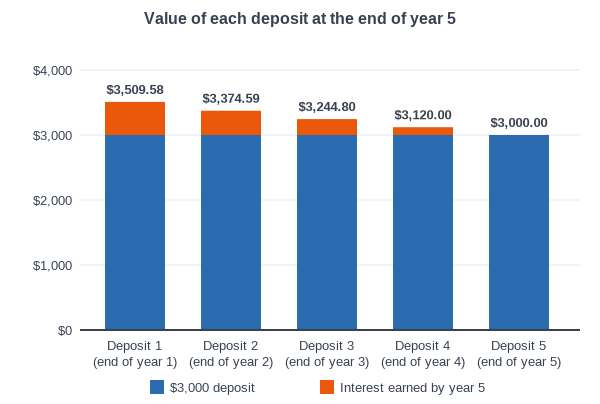
Answer: both ways give $16,248.97. The formula saves you from computing every deposit separately.
Example 3: How much of it is interest?
In Example 1, how much did you deposit in total, and how much interest did the account earn?
200 \times 120 = 24000
Multiply the payment by the number of deposits.
32775.87 - 24000 = 8775.87
Subtract the deposits from the future value.
Answer: you deposited $24,000, and the account earned $8,775.87 in interest.
Example 4: A sinking fund for new equipment (word problem)
A print shop will need $50,000 in 4 years to replace a press. It makes equal deposits at the end of each quarter into an account paying 5% compounded quarterly. How large must each deposit be, and how much of the $50,000 comes from interest?
i = \frac{0.05}{4} = 0.0125Find the quarterly rate.
n = 4 \times 4 = 16
Find the number of deposits.
1.0125^{16} \approx 1.2198895Raise 1 + i to the power n.
1.2198895 - 1 = 0.2198895
Subtract 1.
50000 \times 0.0125 = 625
Multiply the goal by i.
\frac{625}{0.2198895} \approx 2842.34Divide by the result from the fourth line.
16 \times 2842.34 = 45477.44
Find the total deposited.
50000 - 45477.44 = 4522.56
Subtract to find the interest.
Answer: each quarterly deposit is about $2,842.34. The shop deposits $45,477.44, and interest supplies the other $4,522.56.
Example 5: How many deposits to reach a goal?
You save $150 at the end of each month at 4.8% compounded monthly. How many deposits does it take to have at least $10,000?
10000 = 150 \cdot \frac{1.004^{n} - 1}{0.004}Use i = 0.048/12 = 0.004 and set the formula equal to the goal.
40 = 150\left(1.004^{n} - 1\right)Multiply both sides by 0.004.
0.2666667 \approx 1.004^{n} - 1Divide both sides by 150.
1.2666667 \approx 1.004^{n}Add 1 to both sides.
n = \frac{\ln 1.2666667}{\ln 1.004}Take the natural log of both sides and divide (see solving exponential equations).
n \approx \frac{0.2363888}{0.0039920} \approx 59.22Evaluate the logs with a calculator.
n = 60
Round up, since 59 deposits fall a little short.
Answer: 60 deposits (5 years). Check: 59 deposits give about $9,959.19, and 60 give about $10,149.03.
Calculator and spreadsheet steps
Work the formula by hand first, then check with a tool.
- Excel or Google Sheets: =FV(0.005, 120, -200) returns 32775.87 for Example 1. The payment is entered as a negative number because it is money you pay in. =PMT(0.0125, 16, 0, -50000) returns 2842.34 for Example 4.
- TI-84 Plus TVM Solver: press APPS, Finance, TVM Solver. For Example 1 enter N = 120, I% = 6, PV = 0, PMT = −200, P/Y = C/Y = 12, PMT: END, then move to FV and press ALPHA ENTER to get 32775.87.
- Number of payments: =NPER(0.004, -150, 0, 10000) returns 59.22 for Example 5; round up to 60.
Common mistakes
| Mistake | Example of the error | Fix |
|---|---|---|
| Using the annual rate as i | Using i = 0.06 with monthly deposits | Divide by the number of periods per year: i = 0.06/12 = 0.005. |
| Using years as n | Using n = 10 for 10 years of monthly deposits | n counts payments: 12 × 10 = 120. |
| Dividing by the wrong thing | Dividing by 1 + i instead of by i | The formula divides by i, the rate per period. |
| Treating the whole sum as one lump deposit | Computing 24,000(1.005)¹²⁰ | Each deposit grows for a different time; use the annuity formula. |
| Rounding (1 + i)ⁿ too early | Using 1.82 for 1.005¹²⁰ | Keep at least 7 significant digits until the last step. |
| Rounding a sinking fund payment or number of deposits down | Saying 59 deposits reach $10,000 | Round up so you actually reach the goal. |
Related ideas
A loan is the reverse problem: you get the money now and pay it back in equal payments; see loan amortization.
Annuity due
In an annuity due, each payment is made at the start of the period, so every deposit earns one extra period of interest. Multiply the ordinary annuity value by 1 + i:
FV_{\text{due}} = PMT \cdot \frac{(1 + i)^{n} - 1}{i} \cdot (1 + i)Lump sum vs. annuity
A single deposit grows by the compound interest formula, A = P(1 + i)ⁿ. An annuity is many of those lump sums added together. To compare savings plans with different compounding, convert the rates to an effective annual rate first.
Starting early
Because the earliest deposits grow the longest, saving for more years often matters more than saving larger amounts. Practice Problem 8 shows this with exponential growth. The next lesson, Present Value of an Annuity, works the other way: it finds what a series of future payments is worth today.
Practice problems
- You deposit $100 at the end of each month for 5 years at 3% compounded monthly. Find the future value.
- You deposit $1,000 at the end of each year for 10 years at 5% compounded annually. Find the future value.
- You deposit $500 at the end of each quarter for 8 years at 6% compounded quarterly. Find the future value.
- In Problem 2, how much interest is earned?
- You want $20,000 in 5 years. Find the monthly deposit at 4.2% compounded monthly.
- A club needs $8,000 in 3 years. Find the quarterly deposit at 8% compounded quarterly.
- You deposit $250 at the end of every 6 months for 6 years at 5% compounded semiannually. Find the future value.
- Plan A: $300 a month for 20 years. Plan B: $600 a month for 10 years. Both earn 6% compounded monthly. Which grows to more?
- How many monthly deposits of $200 at 6% compounded monthly does it take to reach at least $5,000?
- You deposit $100 at the start of each month for 2 years at 6% compounded monthly (an annuity due). Find the future value.
Show answers
1.
i = 0.0025,\ n = 60
Divide 0.03 by 12 and multiply 12 by 5.
1.0025^{60} \approx 1.1616168Raise 1 + i to the power n.
\frac{0.1616168}{0.0025} \approx 64.64672Subtract 1, then divide by i.
100 \times 64.64672 \approx 6464.67
Multiply by the payment.
Answer: about $6,464.67
2.
1.05^{10} \approx 1.6288946Raise 1.05 to the 10th power.
\frac{0.6288946}{0.05} \approx 12.577892Subtract 1, then divide by 0.05.
1000 \times 12.577892 \approx 12577.89
Multiply by the payment.
Answer: about $12,577.89
3.
i = 0.015,\ n = 32
Divide 0.06 by 4 and multiply 4 by 8.
1.015^{32} \approx 1.6103243Raise 1 + i to the power n.
\frac{0.6103243}{0.015} \approx 40.688287Subtract 1, then divide by i.
500 \times 40.688287 \approx 20344.14
Multiply by the payment.
Answer: about $20,344.14
4.
1000 \times 10 = 10000
Find the total deposited.
12577.89 - 10000 = 2577.89
Subtract from the future value.
Answer: about $2,577.89
5.
i = 0.0035,\ n = 60
Divide 0.042 by 12 and multiply 12 by 5.
1.0035^{60} - 1 \approx 0.2332258Raise 1 + i to the power n and subtract 1.
20000 \times 0.0035 = 70
Multiply the goal by i.
\frac{70}{0.2332258} \approx 300.14Divide.
Answer: about $300.14 a month
6.
i = 0.02,\ n = 12
Divide 0.08 by 4 and multiply 4 by 3.
1.02^{12} - 1 \approx 0.2682418Raise 1 + i to the power n and subtract 1.
8000 \times 0.02 = 160
Multiply the goal by i.
\frac{160}{0.2682418} \approx 596.48Divide.
Answer: about $596.48 a quarter
7.
i = 0.025,\ n = 12
Divide 0.05 by 2 and multiply 2 by 6.
1.025^{12} \approx 1.3448888Raise 1 + i to the power n.
\frac{0.3448888}{0.025} = 13.795552Subtract 1, then divide by i.
250 \times 13.795552 \approx 3448.89
Multiply by the payment.
Answer: about $3,448.89
8.
\frac{1.005^{240} - 1}{0.005} \approx 462.04090Plan A: i = 0.005 and n = 240.
300 \times 462.04090 \approx 138612.27
Multiply by Plan A’s payment.
\frac{1.005^{120} - 1}{0.005} \approx 163.87935Plan B: n = 120.
600 \times 163.87935 \approx 98327.61
Multiply by Plan B’s payment.
Answer: Plan A, about $138,612.27 vs. $98,327.61, even though both deposit $72,000
9.
5000 = 200 \cdot \frac{1.005^{n} - 1}{0.005}Set the formula equal to the goal.
0.125 = 1.005^{n} - 1Multiply both sides by 0.005, then divide by 200.
1.125 = 1.005^{n}Add 1 to both sides.
n = \frac{\ln 1.125}{\ln 1.005} \approx 23.62Take the natural log of both sides and divide.
Answer: 24 deposits (23 give only about $4,862.08)
10.
\frac{1.005^{24} - 1}{0.005} \approx 25.431955Use i = 0.005 and n = 24.
100 \times 25.431955 = 2543.1955
Multiply by the payment (ordinary annuity value).
2543.1955 \times 1.005 \approx 2555.91
Multiply by 1 + i for an annuity due.
Answer: about $2,555.91
Future value of an annuity FAQ
What is the formula for the future value of an annuity?
FV = PMT × [(1 + i)ⁿ − 1] / i, where PMT is the payment, i is the rate per period and n is the number of payments.
What is the difference between an ordinary annuity and an annuity due?
Ordinary annuity payments are made at the end of each period; annuity due payments are made at the start. An annuity due is worth (1 + i) times as much because each payment earns one more period of interest.
What is a sinking fund?
It is a savings plan with equal deposits made to reach a set amount by a set date. Find the deposit with PMT = FV × i / [(1 + i)ⁿ − 1].
Is the future value of an annuity the same as compound interest?
No. Compound interest is for one lump-sum deposit. An annuity is a series of deposits, each earning compound interest for a different length of time.
Summary
- An annuity is a series of equal payments at equal intervals; an ordinary annuity pays at the end of each period.
- FV = PMT × [(1 + i)ⁿ − 1] / i, with i = r/m and n = mt.
- A sinking fund uses PMT = FV × i / [(1 + i)ⁿ − 1].
- Interest earned = future value − total deposits.
- For an annuity due, multiply the future value by 1 + i.
Previous lesson: Effective Annual Rate
Next lesson: Present Value of an Annuity
Back to the Finite Math and Business Calculus Index