
Effective Annual Rate
The effective annual rate (EAR) is the interest rate you actually earn or pay in one year once compounding is included. For a nominal rate r compounded n times a year, EAR = (1 + r/n)ⁿ − 1. On savings accounts it is called the APY, and it lets you compare rates with different compounding fairly.
Before this lesson: Compound Interest, The Number e and Rational Exponents
The idea
A bank might say “6% compounded monthly.” The 6% is the nominal rate, also called the stated rate or APR. It is not what you end up with after a year, because each month’s interest also earns interest.
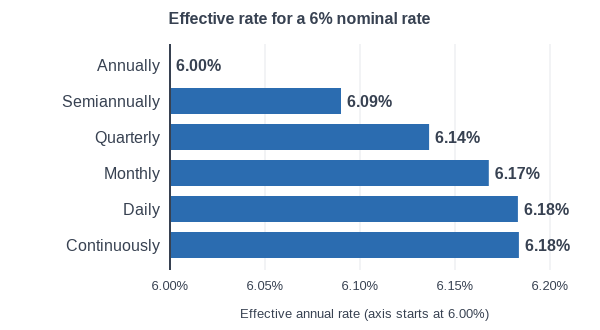
The effective annual rate answers one question: what single rate, compounded once a year, would give the same result? If $1 grows to $1.0617 in a year, the effective rate is 6.17%, no matter how the bank compounds.
This is why the effective rate is the fair way to compare offers. A rate compounded daily and a rate compounded quarterly can’t be compared by their nominal rates alone, but their effective rates can.
Effective annual rate formula
\text{EAR} = \left(1 + \frac{r}{n}\right)^{n} - 1Here r is the nominal annual rate written as a decimal and n is the number of compounding periods per year: 1 for annually, 2 for semiannually, 4 for quarterly, 12 for monthly and 365 for daily. The ratio r/n is the rate for one period.
For continuous compounding, the formula becomes:
\text{EAR} = e^{r} - 1The formula comes from compound interest: $1 grows to (1 + r/n)ⁿ dollars in one year, and subtracting the original $1 leaves the interest earned per dollar.
How to find the effective annual rate
- Write the nominal rate as a decimal r and find n.
- Divide r by n to get the rate per period.
- Add 1 and raise the result to the power n.
- Subtract 1, then write the answer as a percent.
Keep every digit in your calculator until the last step. Rounding r/n too early can change the answer in the second decimal place.
Effective annual rate examples
Example 1: Monthly compounding
Find the effective annual rate for 6% compounded monthly.
r = 0.06,\ n = 12
Write 6% as a decimal (see percentages); monthly means 12 periods.
\frac{0.06}{12} = 0.005Divide to get the monthly rate.
1 + 0.005 = 1.005
Add 1.
1.005^{12} \approx 1.0616778Raise to the 12th power with a calculator.
1.0616778 - 1 = 0.0616778
Subtract 1.
0.0616778 \approx 6.17\%
Write as a percent, rounded to two decimal places.
Answer: the effective annual rate is about 6.17%. A $1,000 deposit earns about $61.68 in a year, not $60.
Example 2: Which savings account pays more?
Bank A pays 4.8% compounded quarterly. Bank B pays 4.75% compounded daily. Which account earns more in a year?
\frac{0.048}{4} = 0.012Bank A: find the quarterly rate.
1 + 0.012 = 1.012
Add 1.
1.012^{4} \approx 1.0488709Raise to the 4th power.
1.0488709 - 1 = 0.0488709 \approx 4.89\%
Subtract 1 and write as a percent.
\frac{0.0475}{365} \approx 0.000130137Bank B: find the daily rate (keep all digits in the calculator).
1 + 0.000130137 = 1.000130137
Add 1.
1.000130137^{365} \approx 1.0486430Raise to the 365th power.
1.0486430 - 1 = 0.0486430 \approx 4.86\%
Subtract 1 and write as a percent.
4.89\% \gt 4.86\%
Compare the effective rates.
Answer: Bank A earns more (APY about 4.89% vs. 4.86%). Daily compounding can’t make up for Bank B’s lower nominal rate.
Example 3: Continuous compounding
Find the effective annual rate for 5% compounded continuously.
r = 0.05
Write the rate as a decimal.
e^{0.05} \approx 1.0512711Raise e to the power r (see the number e).
1.0512711 - 1 = 0.0512711
Subtract 1.
0.0512711 \approx 5.13\%
Write as a percent.
Answer: about 5.13%. Continuous compounding gives the largest effective rate possible for a nominal rate of 5%.
Example 4: The true cost of a credit card (word problem)
A credit card charges an APR of 21.9%, compounded monthly. Maya carries a $2,000 balance for a full year and makes no payments or new charges. What effective rate does she pay, and how much interest builds up?
\frac{0.219}{12} = 0.01825Find the monthly rate.
1 + 0.01825 = 1.01825
Add 1.
1.01825^{12} \approx 1.2423759Raise to the 12th power.
1.2423759 - 1 = 0.2423759 \approx 24.24\%
Subtract 1 and write as a percent.
2000 \times 0.2423759 \approx 484.75
Multiply the balance by the effective rate to get one year of interest.
2000 \times 0.219 = 438
For comparison, multiply the balance by the APR.
484.75 - 438 = 46.75
Subtract to see how much more compounding costs.
Answer: the effective rate is about 24.24%, so about $484.75 of interest builds up, which is $46.75 more than the 21.9% APR suggests.
Example 5: Working backward from an APY
A savings account advertises an APY of 5.00% with monthly compounding. What nominal rate does it pay?
\left(1 + \frac{r}{12}\right)^{12} - 1 = 0.05Set the EAR formula equal to the APY.
\left(1 + \frac{r}{12}\right)^{12} = 1.05Add 1 to both sides.
1 + \frac{r}{12} = 1.05^{1/12}Take the 12th root of both sides (see rational exponents).
1 + \frac{r}{12} \approx 1.0040741Evaluate with a calculator.
\frac{r}{12} \approx 0.0040741Subtract 1 from both sides.
r \approx 0.048889
Multiply both sides by 12 (keep all digits: 12 × 0.00407412).
0.048889 \approx 4.89\%
Write as a percent.
Answer: the nominal rate is about 4.89% compounded monthly. In general, r = n[(1 + EAR)^(1/n) − 1].
Calculator and spreadsheet steps
Always know the formula first, but you can check your work with these tools.
- Excel or Google Sheets: =EFFECT(0.06, 12) returns 0.0616778, the EAR for Example 1. =NOMINAL(0.05, 12) returns 0.0488895, the nominal rate for Example 5.
- TI-84 Plus: press APPS, choose Finance, then scroll to ▶Eff(. Enter ▶Eff(6, 12) to get 6.1678. ▶Nom(5, 12) gives 4.8889. Both use percents, not decimals.
- Continuous compounding: type e^(0.05) − 1 directly; the spreadsheet version is =EXP(0.05)-1.
Common mistakes
| Mistake | Example of the error | Fix |
|---|---|---|
| Using the percent instead of the decimal | (1 + 6/12)^{12} - 1 gives a huge answer | Write 6% as 0.06 before dividing by n. |
| Forgetting to subtract 1 | Reporting 1.0617 as the rate | (1 + r/n)^n is the growth factor; subtract 1 to get the rate. |
| Comparing nominal rates with different compounding | Picking 4.8% quarterly over 4.75% daily just because 4.8 is bigger | Convert both to effective rates first, as in Example 2. |
| Rounding the period rate too early | Using 0.0001 for 0.0475/365 | Keep every digit in the calculator until the final answer. |
| Mixing up APR and APY | Thinking a 21.9% APR card costs exactly 21.9% a year | The APR is nominal; the effective rate (24.24% in Example 4) is higher. |
| Using n = 12 for continuous compounding | Computing (1 + 0.05/12)^{12} - 1 for “continuously” | Use e^r - 1 for continuous compounding. |
Related ideas
APR vs. APY
In the United States, lenders must show the APR (annual percentage rate), which is a nominal rate, and banks must show the APY (annual percentage yield) on deposits, which is the effective rate. A loan’s APR can also include some fees, so read the fine print. When you borrow, a lower effective rate is better; when you save, a higher one is better.
Effective rate and growth over many years
Once you know the effective rate, growth over t years is simply P(1 + EAR)ᵗ. For 6% compounded monthly, $1,000 grows to 1000(1.0616778)³ ≈ $1,196.68 in three years, the same as the compound interest formula gives. This links to exponential growth, since the growth factor 1 + EAR is the base.
Simple interest has no compounding
With simple interest, interest never earns interest, so over one year the effective rate equals the stated rate. The next lesson, Future Value of an Annuity, uses the rate per period to find what regular deposits grow to.
Practice problems
- Find the effective annual rate for 8% compounded quarterly.
- Find the effective annual rate for 3.6% compounded monthly.
- Find the effective annual rate for 7% compounded continuously.
- Find the effective annual rate for 12% compounded semiannually.
- Which pays more: 5.2% compounded annually or 5.1% compounded monthly?
- A store card has an APR of 24%, compounded monthly. What is its effective annual rate?
- An account has an APY of 6% with monthly compounding. Find its nominal rate.
- You deposit $5,000 at 4.5% compounded daily. How much interest do you earn in one year?
- Loan A charges 9% compounded monthly. Loan B charges 9.2% compounded annually. Which loan costs less?
- What nominal rate, compounded continuously, gives an effective annual rate of 4%?
Show answers
1.
\frac{0.08}{4} = 0.02Divide the nominal rate by 4.
1 + 0.02 = 1.02
Add 1.
1.02^{4} = 1.08243216Raise to the 4th power.
1.08243216 - 1 = 0.08243216
Subtract 1.
Answer: about 8.24%
2.
\frac{0.036}{12} = 0.003Divide by 12.
1 + 0.003 = 1.003
Add 1.
1.003^{12} \approx 1.0366000Raise to the 12th power.
1.0366000 - 1 = 0.0366000
Subtract 1.
Answer: about 3.66%
3.
e^{0.07} \approx 1.0725082Raise e to the power 0.07.
1.0725082 - 1 = 0.0725082
Subtract 1.
Answer: about 7.25%
4.
\frac{0.12}{2} = 0.06Divide by 2.
1 + 0.06 = 1.06
Add 1.
1.06^{2} = 1.1236Square.
1.1236 - 1 = 0.1236
Subtract 1.
Answer: 12.36%
5.
0.052 = 5.20\%
Annual compounding: the effective rate equals the nominal rate.
\frac{0.051}{12} = 0.00425Monthly option: divide by 12.
1.00425^{12} \approx 1.0522092Add 1 and raise to the 12th power.
1.0522092 - 1 = 0.0522092 \approx 5.22\%
Subtract 1 and write as a percent.
5.22\% \gt 5.20\%
Compare.
Answer: 5.1% compounded monthly pays slightly more
6.
\frac{0.24}{12} = 0.02Divide by 12.
1.02^{12} \approx 1.2682418Add 1 and raise to the 12th power.
1.2682418 - 1 = 0.2682418
Subtract 1.
Answer: about 26.82%
7.
\left(1 + \frac{r}{12}\right)^{12} = 1.06Set the formula equal to 0.06 and add 1 to both sides.
1 + \frac{r}{12} = 1.06^{1/12} \approx 1.0048676Take the 12th root of both sides.
\frac{r}{12} \approx 0.0048676Subtract 1.
r \approx 0.058411
Multiply by 12 (keep all digits).
Answer: about 5.84% compounded monthly
8.
\frac{0.045}{365} \approx 0.000123288Find the daily rate.
\left(1 + \frac{0.045}{365}\right)^{365} \approx 1.04602496Add 1 and raise to the 365th power (keep all digits).
1.04602496 - 1 = 0.04602496
Subtract 1 to get the EAR.
5000 \times 0.04602496 \approx 230.12
Multiply by the deposit.
Answer: about $230.12
9.
\frac{0.09}{12} = 0.0075Loan A: divide by 12.
1.0075^{12} \approx 1.0938069Add 1 and raise to the 12th power.
1.0938069 - 1 = 0.0938069 \approx 9.38\%
Subtract 1 and write as a percent.
9.20\% \lt 9.38\%
Loan B compounds once a year, so its effective rate is 9.20%.
Answer: Loan B costs less
10.
e^{r} - 1 = 0.04Set the continuous EAR formula equal to 0.04.
e^{r} = 1.04Add 1 to both sides.
r = \ln 1.04
Take the natural log of both sides (see logarithms).
r \approx 0.039221
Evaluate with a calculator.
Answer: about 3.92% compounded continuously
Effective annual rate FAQ
What is the difference between APR and effective annual rate?
The APR is the nominal yearly rate before compounding. The effective annual rate includes compounding, so it is higher whenever interest compounds more than once a year.
Is APY the same as the effective annual rate?
Yes. APY is the name banks use for the effective annual rate on savings accounts and CDs.
Does more frequent compounding always raise the effective rate?
Yes, for a fixed nominal rate, but the increase gets very small. Daily compounding is almost the same as continuous compounding.
How do you convert an effective rate back to a nominal rate?
Use r = n[(1 + EAR)^(1/n) − 1] for n periods a year, or r = ln(1 + EAR) for continuous compounding, as in Example 5.
Summary
- The effective annual rate is the rate you really earn or pay in a year, compounding included.
- EAR = (1 + r/n)ⁿ − 1, with r as a decimal and n compounding periods per year.
- For continuous compounding, EAR = eʳ − 1.
- APY on savings accounts is the effective rate; APR on loans is a nominal rate.
- Compare offers with different compounding by their effective rates.
Previous lesson: Simplex Method for Minimization
Next lesson: Future Value of an Annuity
Back to the Finite Math and Business Calculus Index