
Simplex Method for Minimization
The simplex method for minimization solves a standard minimization problem by turning it into a maximization problem called the dual. You write the problem as a matrix, transpose it, and solve the dual with the simplex method. The maximum of the dual equals the minimum you want, and the bottom row gives the values that reach it.
Before this lesson: Simplex Method, Linear Programming and Transpose of a Matrix
The idea
In the simplex method for maximization, the start is the origin, where every variable is 0. A minimization problem usually has a system of inequalities with “≥” constraints, such as “at least 10 units”. The origin breaks them, since 0 is not at least 10, so the usual start does not work.
Every linear programming problem has a partner problem called its dual. The dual of a minimization problem with “≥” constraints is a maximization problem with “≤” constraints. The duality theorem says that both problems have the same best value. So you can solve the easy one, the maximization, and read off the answer to the hard one.
This lesson covers standard minimization problems: minimize C = c_1x + c_2y + \cdots with every c_i \ge 0, every variable nonnegative, and every constraint of the form (expression) ≥ (number).
Simplex method for minimization steps
- Write the problem as a matrix: one row per constraint (its coefficients, then its right side), and the objective’s coefficients as the last row, with a 0 at the end.
- Transpose the matrix: its rows become columns (see transpose of a matrix).
- Read the dual from the new matrix: the last row gives the objective P to maximize, and the other rows give “≤” constraints. Use new variables, such as u and v.
- Solve the dual with the simplex method.
- Read the answer from the final bottom row: the minimum of C is the bottom-right entry, and x and y are the entries under the slack columns s_1 and s_2, in order.
\min C = \max P
The dual has one variable for each constraint of the original problem, and one constraint for each original variable.
Simplex method for minimization examples
Examples 1 and 2 solve the same problem: minimize C = 9x + 5y subject to x + y \ge 10, 2x + y \ge 14, x \ge 0 and y \ge 0.
Example 1: Writing the dual
\begin{bmatrix} 1 & 1 & 10 \\ 2 & 1 & 14 \\ 9 & 5 & 0 \end{bmatrix}Write the constraints as rows, then the objective’s coefficients 9 and 5 with a 0.
\begin{bmatrix} 1 & 2 & 9 \\ 1 & 1 & 5 \\ 10 & 14 & 0 \end{bmatrix}Transpose: the first column becomes the first row, and so on.
P = 10u + 14v
The last row gives the dual objective, to be maximized.
u + 2v \le 9
The first row gives the first constraint.
u + v \le 5
The second row gives the second constraint, with u \ge 0 and v \ge 0.
Answer: maximize P = 10u + 14v subject to u + 2v \le 9, u + v \le 5, u \ge 0, v \ge 0. The origin is a valid start here, so the simplex method can begin.
Example 2: Solving the dual
Add slack variables s_1 and s_2 to the dual. The columns are u, v, s_1, s_2 and the right-hand side (RHS).
| Basic | u | v | s_1 | s_2 | RHS |
|---|---|---|---|---|---|
| s_1 | 1 | 2 | 1 | 0 | 9 |
| s_2 | 1 | 1 | 0 | 1 | 5 |
| P | −10 | −14 | 0 | 0 | 0 |
\tfrac{9}{2} = 4.5,\ \tfrac{5}{1} = 5The v column (−14) is the pivot column. Row 1 has the smaller ratio, so the pivot is the 2 in row 1.
R_1 = \tfrac{1}{2}(1,\ 2,\ 1,\ 0 \mid 9) = (\tfrac{1}{2},\ 1,\ \tfrac{1}{2},\ 0 \mid \tfrac{9}{2})Divide row 1 by 2.
R_2 = (1,\ 1,\ 0,\ 1 \mid 5) - (\tfrac{1}{2},\ 1,\ \tfrac{1}{2},\ 0 \mid \tfrac{9}{2}) = (\tfrac{1}{2},\ 0,\ -\tfrac{1}{2},\ 1 \mid \tfrac{1}{2})Subtract the new row 1 from row 2.
R_P = (-10,\ -14,\ 0,\ 0 \mid 0) + 14(\tfrac{1}{2},\ 1,\ \tfrac{1}{2},\ 0 \mid \tfrac{9}{2}) = (-3,\ 0,\ 7,\ 0 \mid 63)Add 14 times the new row 1. The u column still shows −3.
\tfrac{9/2}{1/2} = 9,\ \tfrac{1/2}{1/2} = 1Ratio test in the u column. Row 2 wins, so the pivot is the \tfrac{1}{2} in row 2.
R_2 = 2(\tfrac{1}{2},\ 0,\ -\tfrac{1}{2},\ 1 \mid \tfrac{1}{2}) = (1,\ 0,\ -1,\ 2 \mid 1)Divide row 2 by \tfrac{1}{2} by multiplying it by 2.
R_1 = (\tfrac{1}{2},\ 1,\ \tfrac{1}{2},\ 0 \mid \tfrac{9}{2}) - \tfrac{1}{2}(1,\ 0,\ -1,\ 2 \mid 1) = (0,\ 1,\ 1,\ -1 \mid 4)Subtract one half of the new row 2.
R_P = (-3,\ 0,\ 7,\ 0 \mid 63) + 3(1,\ 0,\ -1,\ 2 \mid 1) = (0,\ 0,\ 4,\ 6 \mid 66)
Add 3 times the new row 2. No negatives remain.
| Basic | u | v | s_1 | s_2 | RHS |
|---|---|---|---|---|---|
| v | 0 | 1 | 1 | −1 | 4 |
| u | 1 | 0 | −1 | 2 | 1 |
| P | 0 | 0 | 4 | 6 | 66 |
x = 4,\ y = 6
Read the bottom row under s_1 and s_2.
C = 66
The minimum of C is the bottom-right entry.
9(4) + 5(6) = 36 + 30 = 66
Check the cost.
4 + 6 = 10 \ge 10
Check the first constraint.
2(4) + 6 = 8 + 6 = 14 \ge 14
Check the second constraint.
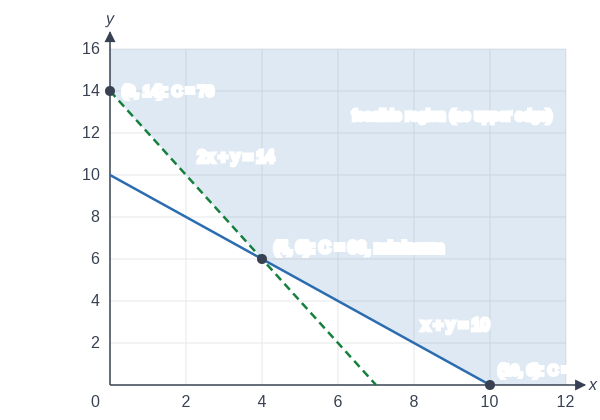
Answer: the minimum is C = 66 at x = 4, y = 6. The dual’s own solution, u = 1 and v = 4, gives P = 10(1) + 14(4) = 66, the same value.
Example 3: Reading the answer from a final dual tableau
To minimize C = 12x + 8y subject to 2x + 2y \ge 26 and 2x + y \ge 20, a student solved the dual: maximize P = 26u + 20v subject to 2u + 2v \le 12 and 2u + v \le 8. The final tableau is:
| Basic | u | v | s_1 | s_2 | RHS |
|---|---|---|---|---|---|
| v | 0 | 1 | 1 | −1 | 4 |
| u | 1 | 0 | -\tfrac{1}{2} | 1 | 2 |
| P | 0 | 0 | 7 | 6 | 132 |
0,\ 0,\ 7,\ 6 \ge 0
The bottom row has no negative entries, so the tableau is final.
x = 7
Read the bottom entry under s_1.
y = 6
Read the bottom entry under s_2.
C = 132
Read the bottom-right entry.
12(7) + 8(6) = 84 + 48 = 132
Check the cost.
2(7) + 2(6) = 14 + 12 = 26 \ge 26
Check the first constraint.
2(7) + 6 = 14 + 6 = 20 \ge 20
Check the second constraint.
Answer: the minimum is C = 132 at x = 7, y = 6. A common slip is to read x and y from the RHS column; those values, 4 and 2, are the dual’s v and u.
Example 4: Three constraints
Minimize C = 7x + 10y subject to x + 2y \ge 36, 2x + y \ge 18 and x + y \ge 24, with x and y nonnegative.
\begin{bmatrix} 1 & 2 & 36 \\ 2 & 1 & 18 \\ 1 & 1 & 24 \\ 7 & 10 & 0 \end{bmatrix}^T = \begin{bmatrix} 1 & 2 & 1 & 7 \\ 2 & 1 & 1 & 10 \\ 36 & 18 & 24 & 0 \end{bmatrix}Write the matrix and transpose it. Three constraints give three dual variables, u, v and w.
P = 36u + 18v + 24w
Read the dual objective.
u + 2v + w \le 7,\ 2u + v + w \le 10
Read the two dual constraints.
\tfrac{7}{1} = 7,\ \tfrac{10}{2} = 5Start the tableau with slack variables. The u column (−36) is the pivot column; row 2 wins, pivot 2.
R_2 = \tfrac{1}{2}(2,\ 1,\ 1,\ 0,\ 1 \mid 10) = (1,\ \tfrac{1}{2},\ \tfrac{1}{2},\ 0,\ \tfrac{1}{2} \mid 5)Divide row 2 by 2.
R_1 = (1,\ 2,\ 1,\ 1,\ 0 \mid 7) - (1,\ \tfrac{1}{2},\ \tfrac{1}{2},\ 0,\ \tfrac{1}{2} \mid 5) = (0,\ \tfrac{3}{2},\ \tfrac{1}{2},\ 1,\ -\tfrac{1}{2} \mid 2)Subtract the new row 2 from row 1.
R_P = (-36,\ -18,\ -24,\ 0,\ 0 \mid 0) + 36(1,\ \tfrac{1}{2},\ \tfrac{1}{2},\ 0,\ \tfrac{1}{2} \mid 5) = (0,\ 0,\ -6,\ 0,\ 18 \mid 180)Add 36 times the new row 2. The w column still shows −6.
\tfrac{2}{1/2} = 4,\ \tfrac{5}{1/2} = 10Ratio test in the w column. Row 1 wins, pivot \tfrac{1}{2}.
R_1 = 2(0,\ \tfrac{3}{2},\ \tfrac{1}{2},\ 1,\ -\tfrac{1}{2} \mid 2) = (0,\ 3,\ 1,\ 2,\ -1 \mid 4)Multiply row 1 by 2.
R_2 = (1,\ \tfrac{1}{2},\ \tfrac{1}{2},\ 0,\ \tfrac{1}{2} \mid 5) - \tfrac{1}{2}(0,\ 3,\ 1,\ 2,\ -1 \mid 4) = (1,\ -1,\ 0,\ -1,\ 1 \mid 3)Subtract one half of the new row 1.
R_P = (0,\ 0,\ -6,\ 0,\ 18 \mid 180) + 6(0,\ 3,\ 1,\ 2,\ -1 \mid 4) = (0,\ 18,\ 0,\ 12,\ 12 \mid 204)
Add 6 times the new row 1. No negatives remain.
x = 12,\ y = 12,\ C = 204
Read the entries under s_1 and s_2, and the bottom-right entry.
7(12) + 10(12) = 84 + 120 = 204
Check the cost.
12 + 24 = 36,\ 24 + 12 = 36,\ 12 + 12 = 24
Check the constraints: 36 ≥ 36, 36 ≥ 18 and 24 ≥ 24.
Answer: the minimum is C = 204 at x = 12, y = 12. The second constraint is more than met (36 instead of 18), and its dual variable v is 0 in the final tableau.
Example 5: The cheapest feed mix (word problem)
A farmer mixes two feeds. A bag of Feed A has 2 units of protein, 1 unit of vitamins and 2 units of fiber, and costs $10. A bag of Feed B has 1 unit of protein, 4 units of vitamins and 2 units of fiber, and costs $6. The animals need at least 28 units of protein, 12 of vitamins and 40 of fiber. How many bags of each feed give the cheapest mix?
x = \text{bags of A},\ y = \text{bags of B}Define the variables.
C = 10x + 6y
Write the cost to minimize.
2x + y \ge 28,\ x + 4y \ge 12,\ 2x + 2y \ge 40
Write the protein, vitamin and fiber needs.
P = 28u + 12v + 40w
Transpose to get the dual objective.
2u + v + 2w \le 10,\ u + 4v + 2w \le 6
Read the dual constraints from the transposed rows.
\tfrac{10}{2} = 5,\ \tfrac{6}{2} = 3The w column (−40) is the pivot column; row 2 wins, pivot 2.
R_2 = \tfrac{1}{2}(1,\ 4,\ 2,\ 0,\ 1 \mid 6) = (\tfrac{1}{2},\ 2,\ 1,\ 0,\ \tfrac{1}{2} \mid 3)Divide row 2 by 2.
R_1 = (2,\ 1,\ 2,\ 1,\ 0 \mid 10) - 2(\tfrac{1}{2},\ 2,\ 1,\ 0,\ \tfrac{1}{2} \mid 3) = (1,\ -3,\ 0,\ 1,\ -1 \mid 4)Subtract 2 times the new row 2.
R_P = (-28,\ -12,\ -40,\ 0,\ 0 \mid 0) + 40(\tfrac{1}{2},\ 2,\ 1,\ 0,\ \tfrac{1}{2} \mid 3) = (-8,\ 68,\ 0,\ 0,\ 20 \mid 120)Add 40 times the new row 2. The u column still shows −8.
\tfrac{4}{1} = 4,\ \tfrac{3}{1/2} = 6Ratio test in the u column. Row 1 wins, and its pivot is already 1.
R_2 = (\tfrac{1}{2},\ 2,\ 1,\ 0,\ \tfrac{1}{2} \mid 3) - \tfrac{1}{2}(1,\ -3,\ 0,\ 1,\ -1 \mid 4) = (0,\ \tfrac{7}{2},\ 1,\ -\tfrac{1}{2},\ 1 \mid 1)Subtract one half of row 1.
R_P = (-8,\ 68,\ 0,\ 0,\ 20 \mid 120) + 8(1,\ -3,\ 0,\ 1,\ -1 \mid 4) = (0,\ 44,\ 0,\ 8,\ 12 \mid 152)
Add 8 times row 1. No negatives remain.
x = 8,\ y = 12,\ C = 152
Read the entries under s_1 and s_2, and the bottom-right entry.
10(8) + 6(12) = 80 + 72 = 152
Check the cost.
2(8) + 12 = 28,\ 8 + 4(12) = 56,\ 2(8) + 2(12) = 40
Check the nutrients: 28 ≥ 28, 56 ≥ 12 and 40 ≥ 40.
Answer: use 8 bags of Feed A and 12 bags of Feed B, for a minimum cost of $152. The mix has 44 more vitamin units than needed, which matches the 44 under v in the bottom row.
Common mistakes
| Mistake | Example of the error | Fix |
|---|---|---|
| Transposing only the constraint rows | Leaving out the cost row 9, 5, 0 in Example 1 | Include the objective row before you transpose; it becomes the right-hand column of the dual. |
| Reading x and y from the RHS column | Saying x = 4, y = 2 in Example 3 | The RHS column holds the dual variables. Read x and y from the bottom row under the slack columns. |
| Running the simplex method on the original problem | Starting Example 1 at (0, 0) | The origin breaks “≥” constraints. Solve the dual instead. |
| Forgetting that P and C match | Reporting 66 as a maximum cost in Example 2 | The dual’s maximum is the original problem’s minimum: C = 66 is the lowest cost. |
| Mixing up the number of dual variables | Using two dual variables for the three constraints in Example 4 | Use one dual variable per original constraint and one dual constraint per original variable. |
| Using the method on a problem with a negative cost coefficient | Minimizing C = 2x − 3y this way | This method needs every cost coefficient to be 0 or more, so that the dual starts at the origin. |
Related ideas
Why the duality theorem works
Every feasible value of the dual’s P is at most every feasible value of C. This is called weak duality. The simplex method finds a pair where the two are equal, so neither can improve: that common value is the minimum of C and the maximum of P.
What the dual variables mean
In a cost problem, each dual variable is the value of one more unit of a requirement. In Example 5, u = 4 means one more unit of protein needed would raise the cost by $4, and v = 0 means the vitamin need could rise a little at no cost, since the mix already has extra vitamins.
Problems that are not standard
If a problem mixes “≤” and “≥” constraints, or has a negative cost coefficient, the dual trick does not apply directly. Methods such as the two-phase method or the big-M method handle those cases, and software usually solves them.
Connection to graphing
With two variables you can also graph the inequalities and test the corners of the region, as in linear programming. The graph in Example 2 shows the same answer. The dual method works with any number of variables.
Practice problems
- Write the dual of: minimize C = 8x + 11y subject to x + 2y \ge 6, x + y \ge 4, x \ge 0, y \ge 0.
- Write the dual of: minimize C = 9x + 8y subject to x + 2y \ge 4, 2x + y \ge 40, x + y \ge 28, x \ge 0, y \ge 0.
- Write the dual of: minimize C = 2x + 3y + 4z subject to x + y + z \ge 10, 2x + y + 3z \ge 15, with x, y and z nonnegative.
- The dual of a minimization problem with variables x and y has the final tableau rows (1,\ 0,\ 2,\ -1 \mid 4), (0,\ 1,\ -1,\ 1 \mid 1) and bottom row (0,\ 0,\ 6,\ 14 \mid 114), with columns u, v, s_1, s_2. Find the minimum and where it occurs.
- Explain why the simplex method cannot start at the origin for: minimize C = 7x + 5y subject to 2x + y \ge 32 and x + y \ge 24.
- Solve Problem 1.
- Solve the problem in Problem 5.
- Solve Problem 2.
- A company runs Plant A and Plant B. Each day, Plant A makes 2 thousand small parts and 1 thousand large parts, and costs $5 thousand to run. Plant B makes 3 thousand small parts and 2 thousand large parts, and costs $9 thousand. An order needs at least 28 thousand small parts and 16 thousand large parts. How many days should each plant run to fill the order at the lowest cost?
- In Problem 9, the dual’s solution is u = 1 and v = 3. Show that the dual’s P equals the minimum cost.
Show answers
1.
\begin{bmatrix} 1 & 2 & 6 \\ 1 & 1 & 4 \\ 8 & 11 & 0 \end{bmatrix}^T = \begin{bmatrix} 1 & 1 & 8 \\ 2 & 1 & 11 \\ 6 & 4 & 0 \end{bmatrix}Write the matrix and transpose it.
P = 6u + 4v
Read the dual objective from the last row.
u + v \le 8,\ 2u + v \le 11
Read the constraints from the other rows.
Answer: maximize P = 6u + 4v subject to u + v ≤ 8, 2u + v ≤ 11, u ≥ 0, v ≥ 0
2.
\begin{bmatrix} 1 & 2 & 4 \\ 2 & 1 & 40 \\ 1 & 1 & 28 \\ 9 & 8 & 0 \end{bmatrix}^T = \begin{bmatrix} 1 & 2 & 1 & 9 \\ 2 & 1 & 1 & 8 \\ 4 & 40 & 28 & 0 \end{bmatrix}Write the matrix and transpose it.
P = 4u + 40v + 28w
Read the dual objective.
u + 2v + w \le 9,\ 2u + v + w \le 8
Read the dual constraints.
Answer: maximize P = 4u + 40v + 28w subject to u + 2v + w ≤ 9, 2u + v + w ≤ 8, with u, v, w ≥ 0
3.
\begin{bmatrix} 1 & 1 & 1 & 10 \\ 2 & 1 & 3 & 15 \\ 2 & 3 & 4 & 0 \end{bmatrix}^T = \begin{bmatrix} 1 & 2 & 2 \\ 1 & 1 & 3 \\ 1 & 3 & 4 \\ 10 & 15 & 0 \end{bmatrix}Write the matrix and transpose it.
P = 10u + 15v
Read the dual objective.
u + 2v \le 2,\ u + v \le 3,\ u + 3v \le 4
Three original variables give three dual constraints.
Answer: maximize P = 10u + 15v subject to u + 2v ≤ 2, u + v ≤ 3, u + 3v ≤ 4, u ≥ 0, v ≥ 0
4.
0,\ 0,\ 6,\ 14 \ge 0
The bottom row has no negatives, so the tableau is final.
x = 6,\ y = 14
Read the bottom entries under s_1 and s_2.
C = 114
Read the bottom-right entry.
Answer: minimum C = 114 at x = 6, y = 14
5.
x = 0,\ y = 0
Try the origin.
2(0) + 0 = 0
Evaluate the first constraint.
0 \lt 32
The origin does not meet “at least 32”.
Answer: the origin is not in the feasible region, so the usual start fails; solve the dual instead
6.
(1,\ 1,\ 1,\ 0 \mid 8),\ (2,\ 1,\ 0,\ 1 \mid 11),\ (-6,\ -4,\ 0,\ 0 \mid 0)
Set up the dual tableau from Problem 1.
\tfrac{8}{1} = 8,\ \tfrac{11}{2} = 5.5The u column (−6) is the pivot column; row 2 wins, pivot 2.
R_2 = (1,\ \tfrac{1}{2},\ 0,\ \tfrac{1}{2} \mid \tfrac{11}{2})Divide row 2 by 2.
R_1 = (0,\ \tfrac{1}{2},\ 1,\ -\tfrac{1}{2} \mid \tfrac{5}{2})Subtract the new row 2 from row 1.
R_P = (0,\ -1,\ 0,\ 3 \mid 33)
Add 6 times the new row 2 to the bottom row.
\tfrac{5/2}{1/2} = 5,\ \tfrac{11/2}{1/2} = 11The v column is next; row 1 wins, pivot \tfrac{1}{2}.
R_1 = (0,\ 1,\ 2,\ -1 \mid 5)
Multiply row 1 by 2.
R_2 = (1,\ 0,\ -1,\ 1 \mid 3)
Subtract one half of the new row 1 from row 2.
R_P = (0,\ 0,\ 2,\ 2 \mid 38)
Add the new row 1 to the bottom row. No negatives remain.
8(2) + 11(2) = 16 + 22 = 38
Check the cost at x = 2, y = 2 (the entries under the slack columns).
Answer: minimum C = 38 at x = 2, y = 2
7.
(2,\ 1,\ 1,\ 0 \mid 7),\ (1,\ 1,\ 0,\ 1 \mid 5),\ (-32,\ -24,\ 0,\ 0 \mid 0)
The dual is: maximize P = 32u + 24v with 2u + v ≤ 7 and u + v ≤ 5.
\tfrac{7}{2} = 3.5,\ \tfrac{5}{1} = 5The u column is the pivot column; row 1 wins, pivot 2.
R_1 = (1,\ \tfrac{1}{2},\ \tfrac{1}{2},\ 0 \mid \tfrac{7}{2})Divide row 1 by 2.
R_2 = (0,\ \tfrac{1}{2},\ -\tfrac{1}{2},\ 1 \mid \tfrac{3}{2})Subtract the new row 1 from row 2.
R_P = (0,\ -8,\ 16,\ 0 \mid 112)
Add 32 times the new row 1 to the bottom row.
\tfrac{7/2}{1/2} = 7,\ \tfrac{3/2}{1/2} = 3The v column is next; row 2 wins, pivot \tfrac{1}{2}.
R_2 = (0,\ 1,\ -1,\ 2 \mid 3)
Multiply row 2 by 2.
R_1 = (1,\ 0,\ 1,\ -1 \mid 2)
Subtract one half of the new row 2 from row 1.
R_P = (0,\ 0,\ 8,\ 16 \mid 136)
Add 8 times the new row 2 to the bottom row. No negatives remain.
7(8) + 5(16) = 56 + 80 = 136
Check the cost at x = 8, y = 16.
Answer: minimum C = 136 at x = 8, y = 16
8.
(1,\ 2,\ 1,\ 1,\ 0 \mid 9),\ (2,\ 1,\ 1,\ 0,\ 1 \mid 8),\ (-4,\ -40,\ -28,\ 0,\ 0 \mid 0)
Set up the dual tableau from Problem 2.
\tfrac{9}{2} = 4.5,\ \tfrac{8}{1} = 8The v column (−40) is the pivot column; row 1 wins, pivot 2.
R_1 = (\tfrac{1}{2},\ 1,\ \tfrac{1}{2},\ \tfrac{1}{2},\ 0 \mid \tfrac{9}{2})Divide row 1 by 2.
R_2 = (\tfrac{3}{2},\ 0,\ \tfrac{1}{2},\ -\tfrac{1}{2},\ 1 \mid \tfrac{7}{2})Subtract the new row 1 from row 2.
R_P = (16,\ 0,\ -8,\ 20,\ 0 \mid 180)
Add 40 times the new row 1 to the bottom row.
\tfrac{9/2}{1/2} = 9,\ \tfrac{7/2}{1/2} = 7The w column is next; row 2 wins, pivot \tfrac{1}{2}.
R_2 = (3,\ 0,\ 1,\ -1,\ 2 \mid 7)
Multiply row 2 by 2.
R_1 = (-1,\ 1,\ 0,\ 1,\ -1 \mid 1)
Subtract one half of the new row 2 from row 1.
R_P = (40,\ 0,\ 0,\ 12,\ 16 \mid 236)
Add 8 times the new row 2 to the bottom row. No negatives remain.
9(12) + 8(16) = 108 + 128 = 236
Check the cost at x = 12, y = 16.
Answer: minimum C = 236 at x = 12, y = 16
9.
C = 5x + 9y
Let x = days for Plant A and y = days for Plant B; cost in thousands of dollars.
2x + 3y \ge 28,\ x + 2y \ge 16
Write the small-part and large-part needs.
(2,\ 1,\ 1,\ 0 \mid 5),\ (3,\ 2,\ 0,\ 1 \mid 9),\ (-28,\ -16,\ 0,\ 0 \mid 0)
The dual is: maximize P = 28u + 16v with 2u + v ≤ 5 and 3u + 2v ≤ 9.
\tfrac{5}{2} = 2.5,\ \tfrac{9}{3} = 3The u column is the pivot column; row 1 wins, pivot 2.
R_1 = (1,\ \tfrac{1}{2},\ \tfrac{1}{2},\ 0 \mid \tfrac{5}{2})Divide row 1 by 2.
R_2 = (0,\ \tfrac{1}{2},\ -\tfrac{3}{2},\ 1 \mid \tfrac{3}{2})Subtract 3 times the new row 1 from row 2.
R_P = (0,\ -2,\ 14,\ 0 \mid 70)
Add 28 times the new row 1 to the bottom row.
\tfrac{5/2}{1/2} = 5,\ \tfrac{3/2}{1/2} = 3The v column is next; row 2 wins, pivot \tfrac{1}{2}.
R_2 = (0,\ 1,\ -3,\ 2 \mid 3)
Multiply row 2 by 2.
R_1 = (1,\ 0,\ 2,\ -1 \mid 1)
Subtract one half of the new row 2 from row 1.
R_P = (0,\ 0,\ 8,\ 4 \mid 76)
Add 2 times the new row 2 to the bottom row. No negatives remain.
5(8) + 9(4) = 40 + 36 = 76
Check the cost at x = 8, y = 4.
Answer: run Plant A for 8 days and Plant B for 4 days, for a minimum cost of $76 thousand
10.
P = 28(1) + 16(3)
Substitute u = 1 and v = 3 into the dual objective.
P = 28 + 48 = 76
Multiply and add.
Answer: P = 76, which equals the minimum cost C = 76, as the duality theorem says
Simplex method for minimization FAQ
How do you use the simplex method to minimize?
For a standard minimization problem, write the dual maximization problem by transposing the matrix, solve the dual with the simplex method, and read the minimum and the values of x and y from the bottom row of the final tableau.
What is the dual problem?
The dual is a partner problem built from the same numbers. For a minimization problem with “≥” constraints, the dual is a maximization problem with “≤” constraints, and both have the same best value.
Where are x and y in the final tableau?
They are in the bottom row, under the slack variable columns: x under s_1 and y under s_2. The right-hand column holds the dual variables, not x and y.
Can you minimize by maximizing the negative?
Yes. Minimizing C is the same as maximizing −C. But with “≥” constraints the origin is still not feasible, so the plain simplex method still cannot start; that is why the dual is used here.
Summary
- A standard minimization problem has nonnegative cost coefficients and “≥” constraints.
- Write the matrix with the cost row last, transpose it, and read the dual maximization problem.
- Solve the dual with the simplex method; min C = max P.
- Read x and y from the bottom row under the slack columns, not from the RHS column.
- The dual variables measure how much one more unit of each requirement would cost.
Previous lesson: Simplex Method
Next lesson: Effective Annual Rate
Back to the Finite Math and Business Calculus Index