
Loan Amortization
Loan amortization is paying off a loan with equal payments that cover both interest and principal. The payment is PMT = PV × i / [1 − (1 + i)⁻ⁿ], where PV is the amount borrowed, i is the rate per period and n is the number of payments. An amortization schedule shows how each payment splits.
Before this lesson: Present Value of an Annuity, Future Value of an Annuity and Effective Annual Rate
The idea
When you take out a car loan or a mortgage, you usually pay the same amount every month. Part of each payment is interest for that month, and the rest is principal, which lowers what you still owe (the balance).
Early on, the balance is large, so most of each payment goes to interest. As the balance shrinks, the interest part shrinks and more of each payment goes to principal. The last payment brings the balance to zero.
The amount you borrow is the present value of an annuity made up of your payments. Solving that formula for the payment gives the loan payment formula.
Loan amortization formula
PMT = PV \cdot \frac{i}{1 - (1 + i)^{-n}}Here PV is the loan amount, i = r/m is the rate per period and n = mt is the number of payments. Each period of the schedule uses three rules:
\text{interest} = i \times \text{balance}, \quad \text{principal} = PMT - \text{interest}, \quad \text{new balance} = \text{balance} - \text{principal}The total interest over the loan is n × PMT − PV. The unpaid balance after some payments is the present value of the payments that are left.
How to amortize a loan
- Find i = r/m and n = mt.
- Compute (1 + i)⁻ⁿ and subtract it from 1.
- Multiply the loan amount by i, then divide by the result of step 2. Round the payment to the cent.
- For each row of the schedule, find the interest, then the principal, then the new balance.
- Adjust the last payment so the balance ends at exactly $0.
Loan amortization examples
Example 1: Monthly car payment
Find the monthly payment on a $12,000 car loan at 6% compounded monthly for 4 years.
i = \frac{0.06}{12} = 0.005Find the rate per period.
n = 12 \times 4 = 48
Find the number of payments.
1.005^{-48} \approx 0.78709841Raise 1 + i to the power −n (see negative exponents).
1 - 0.78709841 = 0.21290159
Subtract from 1.
12000 \times 0.005 = 60
Multiply the loan amount by i.
\frac{60}{0.21290159} \approx 281.82Divide, and round to the cent.
Answer: the payment is $281.82 a month.
Example 2: An amortization schedule
A $4,000 loan at 8% compounded quarterly is paid off with 4 quarterly payments. Find the payment and build the amortization schedule.
i = \frac{0.08}{4} = 0.02,\ n = 4Find the rate per period and the number of payments.
1 - 1.02^{-4} \approx 1 - 0.92384543 = 0.07615457Raise 1.02 to the power −4 and subtract from 1.
\frac{4000 \times 0.02}{0.07615457} = \frac{80}{0.07615457} \approx 1050.50Multiply the loan amount by i and divide.
4000 \times 0.02 = 80.00
Payment 1: interest on the full balance.
1050.50 - 80.00 = 970.50
Payment 1: the rest of the payment is principal.
4000 - 970.50 = 3029.50
Payment 1: subtract the principal from the balance.
3029.50 \times 0.02 = 60.59
Payment 2: interest on the new balance.
1050.50 - 60.59 = 989.91
Payment 2: principal.
3029.50 - 989.91 = 2039.59
Payment 2: new balance.
2039.59 \times 0.02 \approx 40.79
Payment 3: interest, rounded to the cent.
1050.50 - 40.79 = 1009.71
Payment 3: principal.
2039.59 - 1009.71 = 1029.88
Payment 3: new balance.
1029.88 \times 0.02 \approx 20.60
Payment 4: interest.
1029.88 + 20.60 = 1050.48
Payment 4: pay off the whole balance plus interest.
| Payment | Payment amount | Interest | Principal | Balance |
|---|---|---|---|---|
| 0 | — | — | — | $4,000.00 |
| 1 | $1,050.50 | $80.00 | $970.50 | $3,029.50 |
| 2 | $1,050.50 | $60.59 | $989.91 | $2,039.59 |
| 3 | $1,050.50 | $40.79 | $1,009.71 | $1,029.88 |
| 4 | $1,050.48 | $20.60 | $1,029.88 | $0.00 |
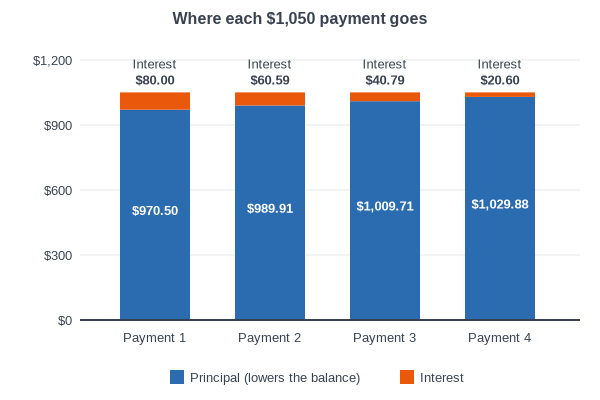
Answer: the payment is $1,050.50, with a final payment of $1,050.48. The interest column adds to $201.98, which matches 3 × 1050.50 + 1050.48 − 4000.
Example 3: Total interest on a loan
How much interest is paid over the life of the car loan in Example 1?
48 \times 281.82 = 13527.36
Multiply the payment by the number of payments.
13527.36 - 12000 = 1527.36
Subtract the amount borrowed.
Answer: about $1,527.36 in interest (a final payment adjusted by a few cents could change this slightly).
Example 4: A 30-year mortgage (word problem)
The Lees borrow $240,000 for a home at 6.6% compounded monthly for 30 years. Find their monthly payment and the total interest they will pay.
i = \frac{0.066}{12} = 0.0055Find the rate per period.
n = 12 \times 30 = 360
Find the number of payments.
1.0055^{-360} \approx 0.13882031Raise 1 + i to the power −n.
1 - 0.13882031 = 0.86117969
Subtract from 1.
240000 \times 0.0055 = 1320
Multiply the loan amount by i.
\frac{1320}{0.86117969} \approx 1532.78Divide, and round to the cent.
360 \times 1532.78 = 551800.80
Find the total of all payments.
551800.80 - 240000 = 311800.80
Subtract the loan amount.
Answer: the payment is $1,532.78 a month, and the total interest is about $311,800.80, more than the amount borrowed.
Example 5: Unpaid balance after 5 years
After 5 years of payments on the mortgage in Example 4, how much do the Lees still owe?
360 - 60 = 300
Subtract the 60 payments made to find the payments left.
1.0055^{-300} \approx 0.19292012Raise 1 + i to the power −300.
1 - 0.19292012 = 0.80707988
Subtract from 1.
\frac{0.80707988}{0.0055} \approx 146.741796Divide by i.
1532.78 \times 146.741796 \approx 224922.89
Multiply by the payment: this is the present value of the payments left.
240000 - 224922.89 = 15077.11
Subtract from the loan to see how much principal has been paid.
Answer: they still owe about $224,922.89. (A month-by-month schedule with every interest charge rounded to the cent gives $224,923.11; the small gap comes from rounding the payment.) After 60 payments totaling $91,966.80, only about $15,077.11 has gone to principal.
Calculator and spreadsheet steps
Find the payment by hand first, then check it with a tool.
- Excel or Google Sheets: =PMT(0.005, 48, -12000) returns 281.82 for Example 1. =IPMT(0.005, 1, 48, -12000) gives the interest in payment 1 ($60.00), and =PPMT(0.005, 1, 48, -12000) gives the principal ($221.82).
- Building a schedule: put the balance in one column. In each new row, interest = ROUND(balance × i, 2), principal = payment − interest and new balance = balance − principal, then fill down.
- TI-84 Plus TVM Solver: for Example 1 enter N = 48, I% = 6, PV = 12000, FV = 0, P/Y = C/Y = 12, PMT: END, then solve for PMT to get −281.82. The Finance menu’s bal( command gives the unpaid balance.
Common mistakes
| Mistake | Example of the error | Fix |
|---|---|---|
| Dividing the loan by the number of payments | Saying the payment is 12,000 ÷ 48 = $250 | That ignores interest; use the payment formula. |
| Finding interest on the original loan every time | Using $80.00 interest for every payment in Example 2 | Interest is i times the current balance. |
| Subtracting the whole payment from the balance | Balance after payment 1 = 4000 − 1050.50 | Only the principal part lowers the balance. |
| Using a positive exponent | Computing 1 - 1.005^{48} | The exponent is −n. |
| Thinking half the loan is paid off halfway through | Expecting a $120,000 balance after 15 years of a 30-year mortgage | Early payments are mostly interest; find the unpaid balance as a present value. |
| Forgetting to adjust the last payment | Paying $1,050.50 in Example 2 and ending with −$0.02 | The last payment equals the balance plus its interest. |
Related ideas
Shorter loans cost less interest
A shorter loan has a higher payment but much less total interest, because the balance falls faster. Practice Problem 7 compares a 15-year and a 30-year mortgage.
APR and the true cost
Loan rates are quoted as an APR, a nominal rate. Its effective annual rate is a little higher because of monthly compounding. Interest on an amortized loan is charged only on the current balance, not on the original amount, which is different from simple interest on the whole loan.
Paying extra
Any extra payment goes straight to principal, so every later interest charge is smaller. The loan is paid off early, and the total interest drops. This is the reverse of compound interest working for you on savings.
What comes next
This lesson finishes the finance unit. The next unit starts with Markov Chains, which use matrices to predict how things change from one step to the next.
Practice problems
- Find the monthly payment on an $8,000 loan at 9% compounded monthly for 3 years.
- Find the monthly payment on a $150,000 mortgage at 5.4% compounded monthly for 15 years.
- Find the total interest paid on the mortgage in Problem 2.
- For the loan in Problem 1, how much of the first payment is interest and how much is principal? What is the new balance?
- A $2,000 loan at 10% compounded semiannually is repaid with 2 semiannual payments. Find the payment and build the amortization schedule.
- For the loan in Problem 1, what is the unpaid balance after 12 payments?
- On a $200,000 mortgage at 6% compounded monthly, compare the total interest for a 30-year loan and a 15-year loan.
- Find the annual payment on a $10,000 loan at 7% compounded annually for 5 years.
- For the car loan in Example 1, find the interest and principal in the second payment.
- Find the monthly payment on a $25,000 loan at 4.2% compounded monthly for 5 years.
Show answers
1.
i = 0.0075,\ n = 36
Divide 0.09 by 12 and multiply 12 by 3.
1 - 1.0075^{-36} \approx 1 - 0.76414896 = 0.23585104Raise 1 + i to the power −n and subtract from 1.
8000 \times 0.0075 = 60
Multiply the loan amount by i.
\frac{60}{0.23585104} \approx 254.40Divide, and round to the cent.
Answer: $254.40 a month
2.
i = 0.0045,\ n = 180
Divide 0.054 by 12 and multiply 12 by 15.
1 - 1.0045^{-180} \approx 1 - 0.44566713 = 0.55433287Raise 1 + i to the power −n and subtract from 1.
150000 \times 0.0045 = 675
Multiply the loan amount by i.
\frac{675}{0.55433287} \approx 1217.68Divide, and round to the cent.
Answer: $1,217.68 a month
3.
180 \times 1217.68 = 219182.40
Find the total of all payments.
219182.40 - 150000 = 69182.40
Subtract the loan amount.
Answer: about $69,182.40
4.
8000 \times 0.0075 = 60.00
Interest on the full balance.
254.40 - 60.00 = 194.40
The rest is principal.
8000 - 194.40 = 7805.60
Subtract the principal from the balance.
Answer: $60.00 interest, $194.40 principal, new balance $7,805.60
5.
1 - 1.05^{-2} \approx 1 - 0.90702948 = 0.09297052Use i = 0.05 and n = 2.
\frac{2000 \times 0.05}{0.09297052} = \frac{100}{0.09297052} \approx 1075.61Multiply the loan amount by i and divide.
2000 \times 0.05 = 100.00
Payment 1: interest.
1075.61 - 100.00 = 975.61
Payment 1: principal.
2000 - 975.61 = 1024.39
Payment 1: new balance.
1024.39 \times 0.05 \approx 51.22
Payment 2: interest.
1024.39 + 51.22 = 1075.61
Payment 2: pay off the balance plus interest.
Answer: payments of $1,075.61; payment 1 is $100.00 interest and $975.61 principal (balance $1,024.39); payment 2 is $51.22 interest and $1,024.39 principal (balance $0)
6.
1.0075^{-24} \approx 0.83583140There are 36 − 12 = 24 payments left.
\frac{1 - 0.83583140}{0.0075} \approx 21.889147Subtract from 1, then divide by i.
254.40 \times 21.889147 \approx 5568.60
Multiply by the payment.
Answer: about $5,568.60
7.
\frac{200000 \times 0.005}{1 - 1.005^{-360}} \approx \frac{1000}{0.83395807} \approx 1199.1030-year payment: i = 0.005 and n = 360.
360 \times 1199.10 - 200000 = 231676.00
30-year total interest.
\frac{1000}{1 - 1.005^{-180}} \approx \frac{1000}{0.59251757} \approx 1687.7115-year payment: n = 180.
180 \times 1687.71 - 200000 = 103787.80
15-year total interest.
231676.00 - 103787.80 = 127888.20
Subtract to compare.
Answer: the 15-year loan saves about $127,888.20 in interest (payment $1,687.71 vs. $1,199.10)
8.
1 - 1.07^{-5} \approx 1 - 0.71298618 = 0.28701382Use i = 0.07 and n = 5.
10000 \times 0.07 = 700
Multiply the loan amount by i.
\frac{700}{0.28701382} \approx 2438.91Divide, and round to the cent.
Answer: $2,438.91 a year
9.
281.82 - 60.00 = 221.82
Payment 1: principal (interest was 12,000 × 0.005 = 60.00).
12000 - 221.82 = 11778.18
Balance after payment 1.
11778.18 \times 0.005 \approx 58.89
Payment 2: interest.
281.82 - 58.89 = 222.93
Payment 2: principal.
Answer: $58.89 interest and $222.93 principal
10.
1 - 1.0035^{-60} \approx 1 - 0.81088150 = 0.18911850Use i = 0.042/12 = 0.0035 and n = 60.
25000 \times 0.0035 = 87.5
Multiply the loan amount by i.
\frac{87.5}{0.18911850} \approx 462.67Divide, and round to the cent.
Answer: $462.67 a month
Loan amortization FAQ
How do you calculate a loan payment?
Use PMT = PV × i / [1 − (1 + i)⁻ⁿ], where PV is the amount borrowed, i is the rate per period and n is the number of payments.
What is an amortization schedule?
It is a table that shows, for every payment, how much goes to interest, how much goes to principal and the balance left afterward.
Why do early payments go mostly to interest?
Interest is charged on the current balance, which is largest at the start. As the balance falls, the interest part shrinks and the principal part grows.
How do you find the remaining balance on a loan?
Find the present value of the payments that are left, using the same rate per period. Example 5 shows this for a mortgage.
Summary
- An amortized loan is paid off with equal payments that cover interest and principal.
- PMT = PV × i / [1 − (1 + i)⁻ⁿ], with i = r/m and n = mt.
- Each row: interest = i × balance, principal = PMT − interest, new balance = balance − principal.
- Total interest = n × PMT − PV.
- The unpaid balance is the present value of the payments left.
Previous lesson: Present Value of an Annuity
Next lesson: Markov Chains
Back to the Finite Math and Business Calculus Index