
Geometric Series
A geometric series is the sum of the terms of a geometric sequence, where each term is the one before it times a common ratio r. The sum of the first n terms is S_n = \frac{a_1(1 - r^n)}{1 - r}, where a_1 is the first term and r \ne 1.
Before this lesson: You should know Geometric Sequences, Sigma Notation and Arithmetic Series.
Why the Formula Works
In an arithmetic series the terms go up by adding the same number. In a geometric series they grow (or shrink) by multiplying by the same number. So the pairing trick from arithmetic series does not work here. A different trick does: multiply the whole sum by r and subtract.
- Write the sum: S_n = a_1 + a_1 r + a_1 r^2 + \cdots + a_1 r^{n - 1}
- Multiply every term by r: rS_n = a_1 r + a_1 r^2 + \cdots + a_1 r^{n - 1} + a_1 r^n
- Subtract the second line from the first. Every middle term cancels: S_n - rS_n = a_1 - a_1 r^n
- Factor out S_n on the left and a_1 on the right (see factoring out the GCF): S_n(1 - r) = a_1(1 - r^n)
- Divide both sides by 1 - r: S_n = \frac{a_1(1 - r^n)}{1 - r}
The Geometric Series Formula
S_n = \frac{a_1(1 - r^n)}{1 - r}, \quad r \ne 1| Symbol | Meaning | How to find it |
|---|---|---|
| a_1 | First term | Read it from the list or plug the lower limit into the rule |
| r | Common ratio | Divide any term by the term before it: r = \frac{a_2}{a_1} |
| n | Number of terms | Count them, or solve a_1 r^{n - 1} = \text{last term} |
If r = 1, every term is the same, so the sum is just n \cdot a_1.
Worked Examples
Example 1: Sum of a growing series
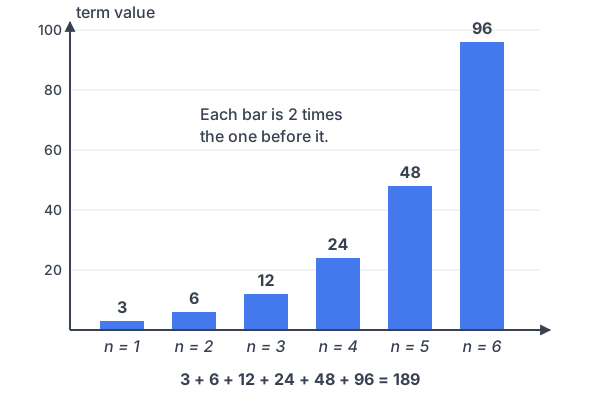
Find the sum of the first 6 terms of 3, 6, 12, 24, \ldots
r = \frac{6}{3} = 2Find the common ratio.
Identify the parts: a_1 = 3, r = 2, n = 6
S_6 = \frac{3(1 - 2^6)}{1 - 2}Substitute into the formula.
S_6 = \frac{3(1 - 64)}{1 - 2}Evaluate the power.
S_6 = \frac{3(-63)}{-1}Subtract inside the parentheses.
S_6 = \frac{-189}{-1}Multiply.
S_6 = 189
Divide.
Answer: 189. Check: 3 + 6 + 12 + 24 + 48 + 96 = 189.
Example 2: A ratio between 0 and 1
Find the sum of the first 5 terms of 80, 40, 20, \ldots
r = \frac{40}{80} = \frac{1}{2}Find the common ratio.
S_5 = \frac{80(1 - (\frac{1}{2})^5)}{1 - \frac{1}{2}}Substitute into the formula.
S_5 = \frac{80(1 - \frac{1}{32})}{1 - \frac{1}{2}}Evaluate the power.
S_5 = \frac{80 \cdot \frac{31}{32}}{\frac{1}{2}}Subtract the fractions (see adding and subtracting fractions)
S_5 = \frac{\frac{155}{2}}{\frac{1}{2}}Multiply in the numerator.
S_5 = \frac{155}{2} \cdot 2 = 155Divide by multiplying by the reciprocal (see multiplying and dividing fractions)
Answer: 155. Check: 80 + 40 + 20 + 10 + 5 = 155.
Example 3: A negative ratio in sigma notation
Evaluate \sum_{n=1}^{6} 2(-3)^{n - 1}.
2(-3)^0 = 2
Find the first term.
r = -3
Read the ratio from the base of the power.
n = 6
Count the terms.
S_6 = \frac{2(1 - (-3)^6)}{1 - (-3)}Substitute into the formula.
(-3)^6 = 729
Evaluate the power. An even power of a negative is positive.
2(1 - 729) = 2(-728) = -1456
Simplify the numerator.
1 - (-3) = 4
Simplify the denominator.
\frac{-1456}{4} = -364Divide.
Answer: −364. Check: 2 - 6 + 18 - 54 + 162 - 486 = -364.
Example 4: Find the number of terms
How many terms of 4 + 12 + 36 + \cdots add up to 484?
r = \frac{12}{4} = 3Find the common ratio.
484 = \frac{4(1 - 3^n)}{1 - 3}Substitute into the formula.
484 = \frac{4(1 - 3^n)}{-2}Simplify the denominator.
484 = -2(1 - 3^n)
Divide 4 by −2.
-242 = 1 - 3^n
Divide both sides by −2.
-243 = -3^n
Subtract 1 from both sides.
243 = 3^n
Multiply both sides by −1.
3^5 = 3^n
Write 243 as a power of 3 (see solving exponential equations)
n = 5
Set the exponents equal.
Answer: 5 terms. Check: 4 + 12 + 36 + 108 + 324 = 484.
Example 5: Word problem with yearly raises
A job pays $40,000 the first year, and the pay goes up 5% each year. What is the total pay for the first 4 years?
A 5% raise multiplies the pay by 1.05 each year, so a_1 = 40{,}000, r = 1.05 and n = 4
S_4 = \frac{40{,}000(1 - 1.05^4)}{1 - 1.05}Substitute into the formula.
1.05 \cdot 1.05 = 1.1025
Find 1.05^2.
1.1025 \cdot 1.1025 = 1.21550625
Find 1.05^4 by squaring.
1 - 1.21550625 = -0.21550625
Subtract in the numerator.
1 - 1.05 = -0.05
Subtract in the denominator.
\frac{-0.21550625}{-0.05} = 4.310125Divide.
40{,}000 \cdot 4.310125 = 172{,}405Multiply by 40,000.
Answer: $172,405. Check: 40{,}000 + 42{,}000 + 44{,}100 + 46{,}305 = 172{,}405. Compare this with the arithmetic raises in arithmetic series, where the pay grows by the same dollar amount each year.
Common Mistakes
| Mistake | Example of the error | Fix |
|---|---|---|
| Subtracting to find the ratio | For 3, 6, 12, using r = 6 - 3 = 3 | Divide: r = \frac{6}{3} = 2. |
| Losing the sign of a negative ratio | (-3)^6 = -729 | An even power of a negative number is positive: (-3)^6 = 729. |
| Multiplying before the power | 4(1 - 3^n) treated as 4 - 12^n | Find the power first, then subtract, then multiply. |
| Using the arithmetic series formula | \frac{6(3 + 96)}{2} = 297 for 3 + 6 + \cdots + 96 | The terms are multiplied by 2, not increased by a constant. The sum is 189. |
| Dividing by zero when r = 1 | Using the formula for 5 + 5 + 5 + 5 | When r = 1, the sum is n \cdot a_1 = 4 \cdot 5 = 20. |
Related Methods
An equivalent form of the formula
Multiplying the top and bottom by −1 gives S_n = \frac{a_1(r^n - 1)}{r - 1}. This form avoids negative signs when r \gt 1. Both forms always give the same answer.
Using the last term
If you know the last term a_n, you can also use S_n = \frac{a_1 - r a_n}{1 - r}. For Example 1, \frac{3 - 2 \cdot 96}{1 - 2} = \frac{-189}{-1} = 189.
When n gets very large
If r is between −1 and 1, the power r^n gets closer and closer to 0 as n grows. That leads to a formula for adding infinitely many terms, which is the next lesson.
Practice Problems
- Find the sum of the first 5 terms of 1, 2, 4, \ldots
- Find the sum of the first 6 terms of 5, 15, 45, \ldots
- Find the sum of the first 4 terms of 64, 16, 4, \ldots
- Evaluate \sum_{k=1}^{5} 3(2)^{k - 1}.
- Evaluate \sum_{n=1}^{4} 10(-2)^{n - 1}.
- Find the sum of the first 8 terms of 1, -1, 1, -1, \ldots
- Find 2 + 6 + 18 + \cdots + 486.
- A geometric series has a_1 = 7 and r = 2. How many terms add up to 217?
- A geometric series has 4 terms, a ratio of 3 and a sum of 120. Find the first term.
- A small shop sells $2,000 of goods in its first month, and sales grow 10% each month. What are its total sales for the first 3 months?
Show answers
1.
r = \frac{2}{1} = 2Find the ratio.
S_5 = \frac{1(1 - 2^5)}{1 - 2}Substitute.
S_5 = \frac{1 - 32}{-1}Evaluate the power.
S_5 = \frac{-31}{-1}Subtract.
S_5 = 31
Divide.
Answer: 31
2.
r = \frac{15}{5} = 3Find the ratio.
S_6 = \frac{5(1 - 3^6)}{1 - 3}Substitute.
S_6 = \frac{5(1 - 729)}{-2}Evaluate the power.
S_6 = \frac{5(-728)}{-2}Subtract.
S_6 = \frac{-3640}{-2}Multiply.
S_6 = 1820
Divide.
Answer: 1820
3.
r = \frac{16}{64} = \frac{1}{4}Find the ratio.
S_4 = \frac{64(1 - (\frac{1}{4})^4)}{1 - \frac{1}{4}}Substitute.
S_4 = \frac{64(1 - \frac{1}{256})}{\frac{3}{4}}Evaluate the power.
S_4 = \frac{64 \cdot \frac{255}{256}}{\frac{3}{4}}Subtract.
S_4 = \frac{\frac{255}{4}}{\frac{3}{4}}Multiply in the numerator.
S_4 = \frac{255}{4} \cdot \frac{4}{3} = 85Divide.
Answer: 85
4.
Find the first term: 3(2)^0 = 3, and the ratio is r = 2
S_5 = \frac{3(1 - 2^5)}{1 - 2}Substitute.
S_5 = \frac{3(1 - 32)}{-1}Evaluate the power.
S_5 = \frac{3(-31)}{-1}Subtract.
S_5 = \frac{-93}{-1}Multiply.
S_5 = 93
Divide.
Answer: 93
5.
Find the first term: 10(-2)^0 = 10, and the ratio is r = -2
S_4 = \frac{10(1 - (-2)^4)}{1 - (-2)}Substitute.
(-2)^4 = 16
Evaluate the power.
10(1 - 16) = 10(-15) = -150
Simplify the numerator.
1 - (-2) = 3
Simplify the denominator.
\frac{-150}{3} = -50Divide.
Answer: −50
6.
r = \frac{-1}{1} = -1Find the ratio.
S_8 = \frac{1(1 - (-1)^8)}{1 - (-1)}Substitute.
(-1)^8 = 1
Evaluate the power.
S_8 = \frac{1 - 1}{2} = \frac{0}{2} = 0Simplify.
Answer: 0 (the terms cancel in pairs)
7.
r = \frac{6}{2} = 3Find the ratio.
2 \cdot 3^{n - 1} = 486Set the last term.
3^{n - 1} = 243Divide both sides by 2.
3^{n - 1} = 3^5Write 243 as a power of 3.
n - 1 = 5
Set the exponents equal.
n = 6
Add 1 to both sides.
S_6 = \frac{2(1 - 3^6)}{1 - 3} = \frac{2(1 - 729)}{-2}Substitute.
\frac{2(-728)}{-2} = \frac{-1456}{-2} = 728Simplify.
Answer: 728
8.
217 = \frac{7(1 - 2^n)}{1 - 2}Substitute.
217 = \frac{7(1 - 2^n)}{-1}Simplify the denominator.
217 = -7(1 - 2^n)
Divide by −1.
-31 = 1 - 2^n
Divide both sides by −7.
-32 = -2^n
Subtract 1 from both sides.
32 = 2^n
Multiply both sides by −1.
2^5 = 2^n
Write 32 as a power of 2.
n = 5
Set the exponents equal.
Answer: 5 terms
9.
120 = \frac{a_1(1 - 3^4)}{1 - 3}Substitute.
120 = \frac{a_1(1 - 81)}{-2}Evaluate the power.
120 = \frac{-80a_1}{-2}Subtract.
120 = 40a_1
Divide.
a_1 = 3
Divide both sides by 40.
Answer: a_1 = 3
10.
A 10% increase multiplies sales by 1.1, so a_1 = 2000, r = 1.1, n = 3
S_3 = \frac{2000(1 - 1.1^3)}{1 - 1.1}Substitute.
1.1^3 = 1.1 \cdot 1.1 \cdot 1.1 = 1.331
Find the power.
1 - 1.331 = -0.331
Subtract in the numerator.
1 - 1.1 = -0.1
Subtract in the denominator.
\frac{-0.331}{-0.1} = 3.31Divide.
2000 \cdot 3.31 = 6620
Multiply.
Answer: $6,620 (check: 2000 + 2200 + 2420 = 6620)
FAQ
What is the formula for the sum of a geometric series?
The sum of the first n terms is S_n = \frac{a_1(1 - r^n)}{1 - r}, where a_1 is the first term and r is the common ratio. It works for any ratio except r = 1.
How do you find the common ratio of a geometric series?
Divide any term by the term just before it. For 5 + 15 + 45 + \cdots, the ratio is \frac{15}{5} = 3.
What is the difference between a geometric series and an arithmetic series?
In an arithmetic series you add the same number to get each new term. In a geometric series you multiply by the same number. They use different sum formulas.
What happens if the common ratio is 1?
Every term equals the first term, so the formula would divide by zero. Instead, multiply: the sum is n \cdot a_1.
Summary
- A geometric series adds the terms of a geometric sequence.
- Find the ratio by dividing a term by the one before it.
- S_n = \frac{a_1(1 - r^n)}{1 - r} for r \ne 1.
- Watch the signs when r is negative: even powers are positive.
- To find n, set up the formula and solve the exponential equation.
Previous lesson: Arithmetic Series
Next lesson: Infinite Geometric Series
Back to the Algebra 2 Index