
Arithmetic Series
An arithmetic series is the sum of the terms of an arithmetic sequence. To add the first n terms, average the first and last terms and multiply by the number of terms: S_n = \frac{n(a_1 + a_n)}{2}. If you don’t know the last term, use S_n = \frac{n}{2}[2a_1 + (n - 1)d].
Before this lesson: You should know Arithmetic Sequences and Sigma Notation.
The Pairing Trick
Suppose you want 1 + 2 + 3 + \cdots + 100. Pair the first term with the last, the second with the second to last, and so on. Each pair adds to the same total: 1 + 100 = 101, 2 + 99 = 101, 3 + 98 = 101.
There are 100 terms, so there are 50 pairs. The sum is 50 \cdot 101 = 5050. This works for every arithmetic series, because the terms go up by the same amount from one end and down by that amount from the other.
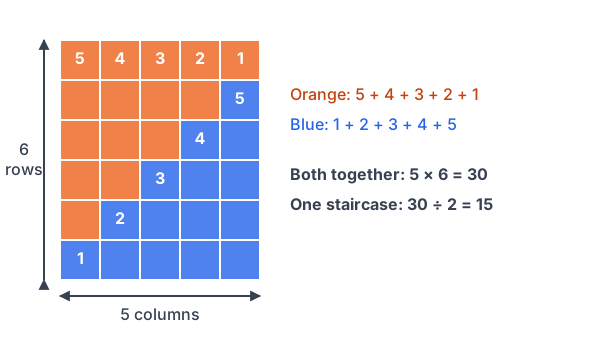
Arithmetic Series Formulas
For an arithmetic sequence with first term a_1, common difference d and n terms:
S_n = \frac{n(a_1 + a_n)}{2}S_n = \frac{n}{2}\left[2a_1 + (n - 1)d\right]The second formula comes from the first. Replace a_n with the nth term formula a_1 + (n - 1)d.
- Find a_1, d and n.
- If you need it, find the last term with a_n = a_1 + (n - 1)d.
- Substitute into a sum formula.
- Simplify. Work inside the parentheses or brackets first.
Worked Examples
Example 1: Add 1 through 100
Find 1 + 2 + 3 + \cdots + 100.
Identify the parts: a_1 = 1, a_n = 100, n = 100
S_{100} = \frac{100(1 + 100)}{2}Substitute into the formula.
S_{100} = \frac{100 \cdot 101}{2}Add inside the parentheses.
S_{100} = \frac{10{,}100}{2}Multiply.
S_{100} = 5050Divide.
Answer: 5050
Example 2: Find the sum of the first 20 terms
Find the sum of the first 20 terms of 3, 7, 11, 15, \ldots
d = 7 - 3 = 4
Find the common difference.
a_{20} = 3 + (20 - 1) \cdot 4Write the 20th term formula.
a_{20} = 3 + 19 \cdot 4Subtract inside the parentheses.
a_{20} = 3 + 76Multiply.
a_{20} = 79Add.
S_{20} = \frac{20(3 + 79)}{2}Substitute into the sum formula.
S_{20} = \frac{20 \cdot 82}{2}Add inside the parentheses.
S_{20} = \frac{1640}{2}Multiply.
S_{20} = 820Divide.
Answer: 820
Example 3: A sum in sigma notation
Evaluate \sum_{n=1}^{15} (2n + 5).
15 - 1 + 1 = 15
Count the terms.
2(1) + 5 = 7
Find the first term.
2(15) + 5 = 35
Find the last term.
S_{15} = \frac{15(7 + 35)}{2}Substitute into the formula.
S_{15} = \frac{15 \cdot 42}{2}Add inside the parentheses.
S_{15} = \frac{630}{2}Multiply.
S_{15} = 315Divide.
Answer: 315. The terms go up by 2 each time, so this is an arithmetic series.
Example 4: Find the number of terms
How many terms of 5 + 8 + 11 + \cdots add up to 220?
Identify the parts: a_1 = 5, d = 3, S_n = 220
220 = \frac{n}{2}[2(5) + (n - 1) \cdot 3]Substitute into the second formula.
220 = \frac{n}{2}[10 + 3n - 3]Multiply inside the brackets.
220 = \frac{n}{2}(3n + 7)Combine like terms.
440 = n(3n + 7)
Multiply both sides by 2.
440 = 3n^2 + 7n
Distribute.
0 = 3n^2 + 7n - 440
Subtract 440 from both sides.
0 = (3n + 40)(n - 11)
Factor the trinomial (see factoring trinomials when a is not 1)
Solve each factor: n = -\frac{40}{3} or n = 11
The number of terms must be a positive whole number, so n = 11
Check: the 11th term is 5 + 10 \cdot 3 = 35, and \frac{11(5 + 35)}{2} = 220
Answer: 11 terms
Example 5: Word problem with yearly raises
A job pays $42,000 the first year, with a raise of $1,500 every year. What is the total pay for the first 10 years?
Identify the parts: a_1 = 42{,}000, d = 1500, n = 10
a_{10} = 42{,}000 + (10 - 1) \cdot 1500Write the 10th term formula.
a_{10} = 42{,}000 + 9 \cdot 1500Subtract inside the parentheses.
a_{10} = 42{,}000 + 13{,}500Multiply.
a_{10} = 55{,}500Add.
S_{10} = \frac{10(42{,}000 + 55{,}500)}{2}Substitute into the sum formula.
S_{10} = \frac{10 \cdot 97{,}500}{2}Add inside the parentheses.
S_{10} = \frac{975{,}000}{2}Multiply.
S_{10} = 487{,}500Divide.
Answer: The total pay for 10 years is $487,500.
Common Mistakes
| Mistake | Example of the error | Fix |
|---|---|---|
| Using the wrong last term | For 20 terms of 3, 7, 11, \ldots, using a_{20} = 3 + 20 \cdot 4 = 83 | Use n - 1: a_{20} = 3 + 19 \cdot 4 = 79. |
| Forgetting to divide by 2 | S_{100} = 100(1 + 100) = 10{,}100 | The formula averages the first and last terms: divide by 2 to get 5050. |
| Counting the terms wrong | 2 + 5 + 8 + \cdots + 62 has \frac{62}{3} terms | Solve 2 + (n - 1) \cdot 3 = 62 to get n = 21. |
| Using the formula on a geometric sequence | Adding 2 + 4 + 8 + 16 with \frac{4(2 + 16)}{2} = 36 | The terms must go up by a constant difference. This sum is 30. Use a geometric series formula instead. |
| Keeping a negative or fraction for n | Answering n = -\frac{40}{3} in Example 4 | The number of terms is a positive whole number. |
Related Methods
Sum of the first n whole numbers
A handy special case is 1 + 2 + \cdots + n = \frac{n(n + 1)}{2}. For example, 1 + 2 + \cdots + 8 = \frac{8 \cdot 9}{2} = 36.
Using the properties of sigma notation
You can also split a sum into simpler sums, as shown in sigma notation. For \sum_{n=1}^{15} (2n + 5), use 2 \cdot \frac{15 \cdot 16}{2} + 15 \cdot 5 = 240 + 75 = 315.
Average times count
The formula says the sum equals the number of terms times the average of the first and last terms. In Example 5, the average yearly pay is $48,750, and 10 \cdot 48{,}750 = 487{,}500.
Practice Problems
- Find 1 + 2 + 3 + \cdots + 50.
- Find the sum of the first 12 terms of 4, 9, 14, \ldots
- Find the sum of the first 15 terms of 10, 7, 4, \ldots
- Evaluate \sum_{k=1}^{25} (4k - 1).
- Find the sum of the first 30 odd numbers.
- Find the sum of all the multiples of 6 from 6 to 120.
- Find 2 + 5 + 8 + \cdots + 62.
- An arithmetic series has a_1 = 8 and d = 2. How many terms add up to 170?
- An arithmetic series has 10 terms, a common difference of 3 and a sum of 245. Find the first term.
- A theater has 24 seats in the first row, and each row has 3 more seats than the row in front of it. How many seats are in the first 15 rows?
Show answers
1.
Identify the parts: a_1 = 1, a_n = 50, n = 50
S_{50} = \frac{50(1 + 50)}{2}Substitute.
S_{50} = \frac{50 \cdot 51}{2}Add.
S_{50} = \frac{2550}{2}Multiply.
S_{50} = 1275Divide.
Answer: 1275
2.
d = 9 - 4 = 5
Find the difference.
a_{12} = 4 + 11 \cdot 5 = 4 + 55 = 59Find the 12th term.
S_{12} = \frac{12(4 + 59)}{2}Substitute.
S_{12} = \frac{12 \cdot 63}{2}Add.
S_{12} = \frac{756}{2}Multiply.
S_{12} = 378Divide.
Answer: 378
3.
d = 7 - 10 = -3
Find the difference.
a_{15} = 10 + 14 \cdot (-3) = 10 - 42 = -32Find the 15th term.
S_{15} = \frac{15(10 + (-32))}{2}Substitute.
S_{15} = \frac{15 \cdot (-22)}{2}Add.
S_{15} = \frac{-330}{2}Multiply (see multiplying and dividing integers)
S_{15} = -165Divide.
Answer: −165
4.
4(1) - 1 = 3
Find the first term.
4(25) - 1 = 99
Find the last term.
S_{25} = \frac{25(3 + 99)}{2}Substitute.
S_{25} = \frac{25 \cdot 102}{2}Add.
S_{25} = \frac{2550}{2}Multiply.
S_{25} = 1275Divide.
Answer: 1275
5.
The odd numbers are 1, 3, 5, \ldots, so a_1 = 1 and d = 2
a_{30} = 1 + 29 \cdot 2 = 59Find the 30th term.
S_{30} = \frac{30(1 + 59)}{2}Substitute.
S_{30} = \frac{30 \cdot 60}{2}Add.
S_{30} = \frac{1800}{2}Multiply.
S_{30} = 900Divide.
Answer: 900
6.
\frac{120}{6} = 20Count the terms.
S_{20} = \frac{20(6 + 120)}{2}Substitute.
S_{20} = \frac{20 \cdot 126}{2}Add.
S_{20} = \frac{2520}{2}Multiply.
S_{20} = 1260Divide.
Answer: 1260
7.
2 + (n - 1) \cdot 3 = 62
Set up the last term.
(n - 1) \cdot 3 = 60
Subtract 2 from both sides.
n - 1 = 20
Divide both sides by 3.
n = 21
Add 1 to both sides.
S_{21} = \frac{21(2 + 62)}{2}Substitute.
S_{21} = \frac{21 \cdot 64}{2}Add.
S_{21} = \frac{1344}{2}Multiply.
S_{21} = 672Divide.
Answer: 672
8.
170 = \frac{n}{2}[2(8) + (n - 1) \cdot 2]Substitute.
170 = \frac{n}{2}[16 + 2n - 2]Multiply inside the brackets.
170 = \frac{n}{2}(2n + 14)Combine like terms.
170 = n(n + 7)
Divide 2n + 14 by 2.
170 = n^2 + 7n
Distribute.
0 = n^2 + 7n - 170
Subtract 170 from both sides.
0 = (n + 17)(n - 10)
Factor the trinomial.
Solve each factor: n = -17 or n = 10
Reject the negative value
Answer: 10 terms
9.
245 = \frac{10}{2}[2a_1 + (10 - 1) \cdot 3]Substitute.
245 = 5[2a_1 + 9 \cdot 3]
Simplify the fraction.
245 = 5(2a_1 + 27)
Multiply.
49 = 2a_1 + 27
Divide both sides by 5.
22 = 2a_1
Subtract 27 from both sides.
a_1 = 11
Divide both sides by 2.
Answer: a_1 = 11
10.
Identify the parts: a_1 = 24, d = 3, n = 15
a_{15} = 24 + 14 \cdot 3 = 24 + 42 = 66Find the 15th row.
S_{15} = \frac{15(24 + 66)}{2}Substitute.
S_{15} = \frac{15 \cdot 90}{2}Add.
S_{15} = \frac{1350}{2}Multiply.
S_{15} = 675Divide.
Answer: 675 seats
FAQ
What is the formula for an arithmetic series?
The sum of the first n terms is S_n = \frac{n(a_1 + a_n)}{2}. If you know the common difference but not the last term, use S_n = \frac{n}{2}[2a_1 + (n - 1)d].
What is the difference between an arithmetic sequence and an arithmetic series?
A sequence is a list of terms, like 3, 7, 11, 15. A series is their sum, like 3 + 7 + 11 + 15 = 36.
How do you find the sum of the numbers from 1 to 100?
Pair the first and last numbers: each pair adds to 101, and there are 50 pairs. So the sum is 50 \cdot 101 = 5050.
Can an arithmetic series have a negative sum?
Yes. If the common difference is negative, the terms eventually become negative. For example, the first 15 terms of 10, 7, 4, \ldots add up to −165.
Summary
- An arithmetic series adds the terms of an arithmetic sequence.
- S_n = \frac{n(a_1 + a_n)}{2}: the number of terms times the average of the first and last terms.
- S_n = \frac{n}{2}[2a_1 + (n - 1)d] when you know d but not the last term.
- Find the last term with a_n = a_1 + (n - 1)d.
- The number of terms is always a positive whole number.
Previous lesson: Sigma Notation
Next lesson: Geometric Series
Back to the Algebra 2 Index