
Cost, Revenue and Profit Functions
Cost, revenue and profit functions describe a business’s money in terms of x, the number of items sold. In the linear model, cost is C(x) = mx + b, where b is the fixed cost and m is the cost per item. Revenue is R(x) = px for a price p, and profit is P(x) = R(x) - C(x).
Before this lesson: Function Notation, Slope-Intercept Form and Point-Slope Form
What are cost, revenue and profit?
A business pays two kinds of costs. A fixed cost stays the same no matter how many items are made, like rent, insurance or a machine. A variable cost is paid for each item, like materials and packaging.
Revenue is the money that comes in from sales. Profit is what is left after paying all costs. If the costs are bigger than the revenue, the profit is negative, and the business has a loss.
In this lesson, x is the number of items made and sold. The functions are linear: each extra item adds the same amount to cost and the same amount to revenue.
Cost, revenue and profit formulas
| Function | Formula | What the numbers mean |
|---|---|---|
| Cost | C(x) = mx + b | b = fixed cost (the y-intercept); m = variable cost per item (the slope) |
| Revenue | R(x) = px | p = selling price per item |
| Profit | P(x) = R(x) - C(x) | money left after all costs; negative means a loss |
Putting the first two formulas into the third gives a short form of the profit function.
P(x) = px - (mx + b) = (p - m)x - b
The slope p - m is the profit from each item sold. The fixed cost b is the loss when nothing is sold, since P(0) = -b.
Cost, revenue and profit examples
Example 1: Write the three functions
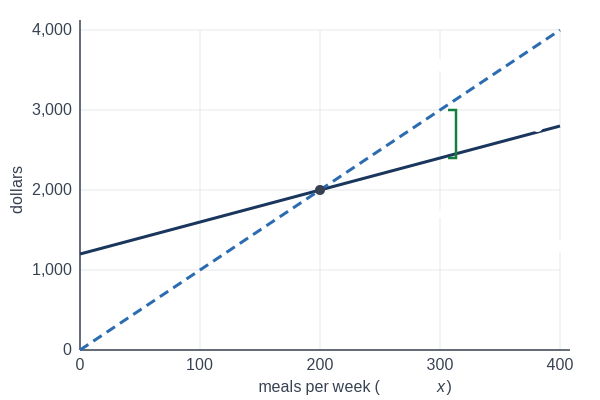
A food truck has fixed costs of $1,200 per week. Each meal costs $4 to make and sells for $10. Write the cost, revenue and profit functions for x meals per week.
C(x) = 4x + 1200
Cost: $4 per meal plus the $1,200 fixed cost.
R(x) = 10x
Revenue: $10 for each meal sold.
P(x) = 10x - (4x + 1200)
Profit is revenue minus cost.
P(x) = 10x - 4x - 1200
Distribute the minus sign (see distributive property).
P(x) = 6x - 1200
Combine like terms (see combining like terms).
Answer: C(x) = 4x + 1200, R(x) = 10x and P(x) = 6x - 1200. Each meal adds $6 of profit.
Example 2: Find the profit or loss
Use the food truck’s profit function P(x) = 6x - 1200. Find the profit for 150 meals and for 300 meals.
P(150) = 6(150) - 1200
Substitute 150 for x.
P(150) = 900 - 1200
Multiply.
P(150) = -300
Subtract. The result is negative.
P(300) = 6(300) - 1200
Substitute 300 for x.
P(300) = 1800 - 1200
Multiply.
P(300) = 600
Subtract.
Answer: selling 150 meals gives a loss of $300. Selling 300 meals gives a profit of $600, which matches the gap in the graph.
Example 3: Find a cost function from two data points
A print shop finds that making 200 shirts costs $3,100 and making 500 shirts costs $5,800. Assume cost is linear. Find the cost function.
m = \frac{5800 - 3100}{500 - 200}The slope is the change in cost over the change in shirts (see slope).
m = \frac{2700}{300}Subtract.
m = 9
Divide. Each shirt costs $9.
3100 = 9(200) + b
Put the point (200, 3100) into C(x) = 9x + b.
3100 = 1800 + b
Multiply.
1300 = b
Subtract 1800 from both sides.
C(x) = 9x + 1300
Write the cost function.
Answer: C(x) = 9x + 1300. The fixed cost is $1,300, and each shirt adds $9. Check: C(500) = 4500 + 1300 = 5800.
Example 4: Sell enough for a profit goal
The food truck wants a weekly profit of $2,400. How many meals must it sell? Use P(x) = 6x - 1200.
6x - 1200 = 2400
Set the profit equal to the goal.
6x = 3600
Add 1200 to both sides (see two-step equations).
x = 600
Divide both sides by 6.
Answer: 600 meals per week. Check: 6(600) - 1200 = 3600 - 1200 = 2400.
Example 5: An online store (word problem)
An online store sells phone cases. It pays $850 per month for its website and storage. Each case costs $3.50 to buy and ship, and it sells for $12. Find the cost, revenue and profit for a month with 140 sales. How much does each extra sale add to profit?
C(x) = 3.5x + 850
Write the cost function.
C(140) = 3.5(140) + 850 = 490 + 850 = 1340
Cost of 140 cases.
R(x) = 12x
Write the revenue function.
R(140) = 12(140) = 1680
Revenue from 140 cases.
P(140) = 1680 - 1340 = 340
Profit is revenue minus cost.
12 - 3.5 = 8.5
Profit per case is price minus cost per case.
Answer: cost $1,340, revenue $1,680 and profit $340. Each extra case sold adds $8.50 to profit, so P(x) = 8.5x - 850.
Common mistakes
| Mistake | Example of the error | Fix |
|---|---|---|
| Leaving out the fixed cost | Writing the food truck’s cost as C(x) = 4x | Cost includes the fixed cost: C(x) = 4x + 1200. |
| Not subtracting the whole cost | P(x) = 10x - 4x + 1200 | Use parentheses and distribute the minus: 10x - (4x + 1200) = 6x - 1200. |
| Swapping the slope and the intercept | C(x) = 1200x + 4 | The cost per item multiplies x; the fixed cost is the constant. |
| Using the cost per item as the price | R(x) = 4x for the food truck | Revenue uses the selling price: R(x) = 10x. |
| Treating revenue as profit | “We sold $3,000 of meals, so we made $3,000.” | Profit is revenue minus cost: 3000 - 2400 = 600. |
| Rounding down an item count | Selling 29.5 sessions rounds to 29 | You can’t sell part of an item, and 29 falls short of the goal; round up to 30. |
Related ideas
Break-even point
The point where R(x) = C(x) is the break-even point, where profit is 0. In Example 1 the lines cross at 200 meals. The next lesson, Break-Even Analysis, finds this point step by step.
Average cost
The average cost per item is \overline{C}(x) = \frac{C(x)}{x}. For the food truck, \overline{C}(100) = \frac{1600}{100} = 16 dollars per meal, but \overline{C}(400) = \frac{2800}{400} = 7. Spreading the fixed cost over more items lowers the average cost.
When the price changes
Real prices often drop when a business wants to sell more. Then revenue is R(x) = x \cdot p(x), where p(x) is the price that sells x items. That makes revenue a quadratic function. Business calculus uses derivatives of these functions to find marginal cost and maximum profit.
Practice problems
- A company has fixed costs of $500 and a variable cost of $2 per item. Write C(x) and find C(100).
- An item sells for $15. Write R(x) and find R(40).
- Find the profit function when C(x) = 7x + 2100 and R(x) = 19x.
- Use your answer to Problem 3 to find P(150) and P(250). Which is a loss?
- Making 100 items costs $1,450, and making 300 items costs $2,250. Find the linear cost function.
- In Problem 5, what is the fixed cost? What does the slope mean?
- A business has P(x) = 8x - 3200. How many items must it sell for a profit of $4,000?
- A bakery’s daily profit is P(x) = 2.5x - 600, where x is the number of loaves sold. Find the profit for 400 loaves.
- A company has R(x) = 25x and C(x) = 13x + 4800. If it sells 300 items, does it make a profit or a loss? How much?
- A tutor pays $180 per month for an online platform. Each session costs $5 in fees, and the tutor charges $45 per session. Write P(x), and find how many sessions give a monthly profit of at least $1,000.
Show answers
1.
C(x) = 2x + 500
$2 per item plus the $500 fixed cost.
C(100) = 2(100) + 500
Substitute 100 for x.
C(100) = 200 + 500 = 700
Multiply, then add.
Answer: C(x) = 2x + 500; C(100) = 700, or $700
2.
R(x) = 15x
$15 for each item.
R(40) = 15(40) = 600
Substitute 40 for x and multiply.
Answer: R(x) = 15x; R(40) = 600, or $600
3.
P(x) = 19x - (7x + 2100)
Profit is revenue minus cost.
P(x) = 19x - 7x - 2100
Distribute the minus sign.
P(x) = 12x - 2100
Combine like terms.
Answer: P(x) = 12x - 2100
4.
P(150) = 12(150) - 2100 = 1800 - 2100 = -300
Substitute 150, multiply, then subtract.
P(250) = 12(250) - 2100 = 3000 - 2100 = 900
Substitute 250, multiply, then subtract.
Answer: P(150) = -300, a loss of $300; P(250) = 900, a profit of $900
5.
m = \frac{2250 - 1450}{300 - 100} = \frac{800}{200}Find the slope from the two points.
m = 4
Divide.
1450 = 4(100) + b
Put (100, 1450) into C(x) = 4x + b.
1450 = 400 + b
Multiply.
1050 = b
Subtract 400 from both sides.
Answer: C(x) = 4x + 1050
6.
C(0) = 4(0) + 1050 = 1050
The fixed cost is the cost when no items are made.
m = 4
The slope is the cost of each extra item.
Answer: the fixed cost is $1,050, and each item adds $4 to the cost
7.
8x - 3200 = 4000
Set the profit equal to the goal.
8x = 7200
Add 3200 to both sides.
x = 900
Divide both sides by 8.
Answer: 900 items
8.
P(400) = 2.5(400) - 600
Substitute 400 for x.
P(400) = 1000 - 600 = 400
Multiply, then subtract.
Answer: a profit of $400
9.
R(300) = 25(300) = 7500
Revenue from 300 items.
C(300) = 13(300) + 4800 = 3900 + 4800 = 8700
Cost of 300 items.
P(300) = 7500 - 8700 = -1200
Profit is revenue minus cost.
Answer: a loss of $1,200
10.
P(x) = 45x - (5x + 180)
Revenue 45x minus cost 5x + 180.
P(x) = 40x - 180
Distribute the minus sign and combine like terms.
40x - 180 = 1000
Set the profit equal to the goal.
40x = 1180
Add 180 to both sides.
x = 29.5
Divide both sides by 40.
x = 30
Round up, since 29 sessions earn only 40(29) - 180 = 980 dollars.
Answer: P(x) = 40x - 180; at least 30 sessions per month
Cost, revenue and profit FAQ
What is the difference between revenue and profit?
Revenue is all the money that comes in from sales. Profit is what is left after you subtract all the costs from the revenue.
What is the difference between fixed cost and variable cost?
A fixed cost stays the same no matter how many items you make, like rent. A variable cost grows with each item, like materials. In C(x) = mx + b, b is the fixed cost and mx is the variable cost.
How do you write a profit function?
Subtract the cost function from the revenue function: P(x) = R(x) - C(x). Put the whole cost in parentheses so the minus sign reaches every term.
Can profit be negative?
Yes. A negative profit is a loss. It happens when costs are bigger than revenue, such as when too few items are sold to cover the fixed cost.
Summary
- Cost: C(x) = mx + b, with fixed cost b and variable cost m per item.
- Revenue: R(x) = px, where p is the selling price.
- Profit: P(x) = R(x) - C(x) = (p - m)x - b; a negative profit is a loss.
- Two data points give a linear cost function: find the slope, then the fixed cost.
- To reach a profit goal, set P(x) equal to the goal and solve, rounding up to a whole item.
Previous lesson: Big-O Notation (the last lesson of Discrete Math)
Next lesson: Break-Even Analysis
Back to the Finite Math and Business Calculus Index