
Minimizing Average Cost
Minimizing average cost means finding the production level where the cost per unit, \bar{C}(x) = \frac{C(x)}{x}, is lowest. Set its derivative to zero, \bar{C}'(x) = 0, and solve. At that level, the marginal cost equals the average cost, so you can also solve C'(x) = \bar{C}(x).
Before this lesson: Marginal Analysis, Maximizing Profit and Zero and Negative Exponents
The idea
Every business has fixed costs, like rent, that it pays no matter how much it makes. Spreading them over more units makes each unit cheaper. But making a lot can also push costs up: overtime, extra shifts and wear on machines.
So the cost per unit first falls and then rises. The bottom of that curve is the most efficient production level. It is where the average cost has a flat tangent line, so its derivative is 0.
How to minimize average cost
- Write the average cost \bar{C}(x) = \frac{C(x)}{x} and simplify by dividing each term by x.
- Find \bar{C}'(x) and solve \bar{C}'(x) = 0 for x > 0.
- Check that it is a minimum: \bar{C}''(x) \gt 0 there.
- Find the minimum average cost by substituting x into \bar{C}(x). If x must be a whole number, compare the two nearest whole numbers.
\bar{C}(x) = \frac{C(x)}{x}, \qquad \text{minimum where } \bar{C}'(x) = 0 \ \text{ and } \ C'(x) = \bar{C}(x)Shortcut: for a cost of the form C(x) = F + bx + ax^2, the average cost is lowest at x = \sqrt{F/a}.
Minimizing average cost examples
Example 1: Minimum average cost
A company’s cost to make x units is C(x) = 500 + 20x + 0.05x^2 dollars. Find the production level that minimizes average cost and the minimum average cost.
\bar{C}(x) = \dfrac{500}{x} + 20 + 0.05xDivide each term of C(x) by x.
\bar{C}(x) = 500x^{-1} + 20 + 0.05xRewrite with a negative exponent (see zero and negative exponents).
\bar{C}'(x) = -500x^{-2} + 0.05Differentiate each term (see power rule).
-\dfrac{500}{x^2} + 0.05 = 0Set the derivative equal to 0.
0.05 = \dfrac{500}{x^2}Add 500/x² to both sides.
0.05x^2 = 500
Multiply both sides by x².
x^2 = 10{,}000Divide both sides by 0.05.
x = 100
Take the positive square root (see solving quadratics with square roots).
\bar{C}''(x) = 1000x^{-3}Differentiate again.
\bar{C}''(100) = \dfrac{1000}{1{,}000{,}000} = 0.001 \gt 0Positive, so x = 100 is a minimum (see second derivative test).
\bar{C}(100) = 5 + 20 + 5Substitute x = 100 into each term.
\bar{C}(100) = 30Add.
Answer: making 100 units gives the lowest average cost, $30 per unit.
Example 2: Using marginal cost = average cost
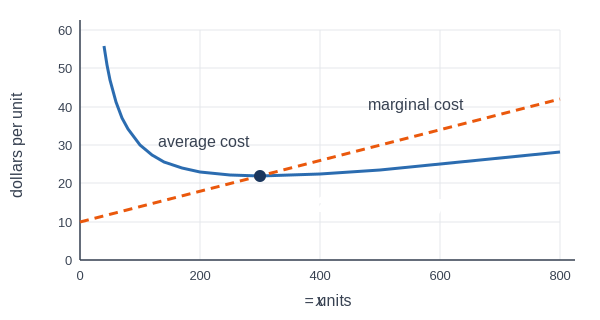
For C(x) = 1800 + 10x + 0.02x^2, use the fact that marginal cost equals average cost at the minimum to find the best production level.
C'(x) = 10 + 0.04x
Find the marginal cost.
\bar{C}(x) = \dfrac{1800}{x} + 10 + 0.02xFind the average cost.
10 + 0.04x = \dfrac{1800}{x} + 10 + 0.02xSet marginal cost equal to average cost.
0.04x = \dfrac{1800}{x} + 0.02xSubtract 10 from both sides.
0.02x = \dfrac{1800}{x}Subtract 0.02x from both sides.
0.02x^2 = 1800
Multiply both sides by x.
x^2 = 90{,}000Divide both sides by 0.02.
x = 300
Take the positive square root.
\bar{C}(300) = 6 + 10 + 6 = 22Average cost at 300: evaluate each term, then add.
C'(300) = 10 + 12 = 22
Check: the marginal cost is also 22.
Answer: 300 units, at an average cost of $22 per unit. The shortcut gives the same answer: \sqrt{1800/0.02} = \sqrt{90{,}000} = 300.
Example 3: A cubic cost function
A workshop’s cost to make x thousand parts is C(x) = x^3 - 6x^2 + 20x thousand dollars. Find the production level with the lowest average cost.
\bar{C}(x) = x^2 - 6x + 20Divide each term by x.
\bar{C}'(x) = 2x - 6Differentiate each term.
2x - 6 = 0
Set the derivative equal to 0.
2x = 6
Add 6 to both sides.
x = 3
Divide both sides by 2.
\bar{C}''(x) = 2 \gt 0Positive, so this is a minimum.
\bar{C}(3) = 9 - 18 + 20 = 11Substitute x = 3, then simplify.
C'(3) = 3(9) - 12(3) + 20 = 11
Check: C′(x) = 3x² − 12x + 20 also equals 11 at x = 3.
Answer: 3,000 parts, at an average cost of 11 thousand dollars per thousand parts, or $11 per part.
Example 4: Lowest average cost is not highest profit
The company in Example 2 sells every unit for $40. Compare the output with the lowest average cost and the output with the highest profit.
40 = 10 + 0.04x
For the highest profit, set MR = MC; the marginal revenue is the price, 40.
30 = 0.04x
Subtract 10 from both sides.
x = 750
Divide both sides by 0.04.
P(300) = 40(300) - 22(300) = 5400
Profit at 300: revenue minus average cost times units.
\bar{C}(750) = 2.4 + 10 + 15 = 27.4Average cost at 750.
P(750) = 40(750) - 27.4(750) = 9450
Profit at 750.
Answer: the lowest average cost is at 300 units, but the highest profit is at 750 units: $9,450 compared with $5,400. Each unit past 300 costs a bit more on average, but it still sells for more than it costs to make, so profit keeps rising until MR = MC (see maximizing profit).
Example 5: How many bikes to build (word problem)
A bike shop builds x custom bikes a month. Its cost is C(x) = 3000 + 40x + 0.6x^2 dollars. How many bikes should it build each month to keep the cost per bike as low as possible?
\bar{C}(x) = 3000x^{-1} + 40 + 0.6xDivide each term by x and use a negative exponent.
\bar{C}'(x) = -3000x^{-2} + 0.6Differentiate each term.
0.6x^2 = 3000
Set the derivative equal to 0 and multiply both sides by x².
x^2 = 5000
Divide both sides by 0.6.
x = \sqrt{5000} \approx 70.71Take the positive square root with a calculator.
\bar{C}(70) \approx 42.857 + 40 + 42 = 124.857Bikes come in whole numbers, so check 70.
\bar{C}(71) \approx 42.254 + 40 + 42.6 = 124.854Check 71.
124.854 \lt 124.857
Compare.
Answer: build 71 bikes a month, for an average cost of about $124.85 per bike. The two whole numbers are very close, but 71 is slightly cheaper per bike.
Common mistakes
| Mistake | Example of the error | Fix |
|---|---|---|
| Minimizing total cost instead of average cost | Solving C'(x) = 0 in Example 1 | Total cost keeps rising. Divide by x first, then minimize \bar{C}(x). |
| Dividing only some terms by x | \bar{C}(x) = \frac{500}{x} + 20x + 0.05x^2 | Divide every term: \frac{500}{x} + 20 + 0.05x. |
| Sign error with the negative exponent | Writing the derivative of 500x^{-1} as 500x^{-2} | Bring down the −1: the derivative is -500x^{-2}. |
| Keeping the negative square root | x = −100 in Example 1 | Production can’t be negative; use x = 100. |
| Rounding x without checking | Rounding 70.71 to 71 without comparing 70 | Compare the average cost at both nearby whole numbers. |
| Thinking lowest average cost means highest profit | Stopping at 300 units in Example 4 | Profit is highest where MR = MC, which can be a larger output. |
Related ideas
Why marginal cost equals average cost at the minimum
By the quotient rule, \bar{C}'(x) = \frac{x \cdot C'(x) - C(x)}{x^2}. This is 0 exactly when x \cdot C'(x) = C(x), which means C'(x) = \bar{C}(x). When marginal cost is below average cost, the next unit pulls the average down; when it is above, it pulls the average up.
The shortcut formula
For C(x) = F + bx + ax^2, \bar{C}'(x) = -\frac{F}{x^2} + a. Setting it to 0 gives x^2 = \frac{F}{a}, so x = \sqrt{F/a}. The middle term b does not affect where the minimum is.
The same idea in inventory
The next lesson balances two costs the same way: ordering often costs more in fees, while ordering rarely costs more in storage. The best order size also comes from a square root.
Practice problems
- For C(x) = 800 + 4x + 0.02x^2, find the production level that minimizes average cost and the minimum average cost.
- For C(x) = 4500 + 12x + 0.05x^2, find the production level that minimizes average cost.
- In Problem 2, check that the marginal cost equals the average cost at your answer.
- For C(x) = x^3 - 10x^2 + 40x, find the production level with the lowest average cost and that cost.
- For C(x) = 2x^3 - 12x^2 + 30x, find the production level with the lowest average cost.
- Use the second derivative to confirm that your answer to Problem 1 is a minimum.
- In Problem 1, the fixed cost doubles to $1,600. How many whole units minimize the average cost now?
- At 100 units, the average cost is $30 and the marginal cost is $24. Is the average cost rising or falling? Should the company make more units to lower it?
- A bakery’s cost to bake x loaves a day is C(x) = 200 + 2x + 0.005x^2 dollars. How many loaves give the lowest cost per loaf, and what is that cost?
- The bakery in Problem 9 sells each loaf for $5. How many loaves maximize profit? Compare with your answer to Problem 9.
Show answers
1.
\bar{C}'(x) = -800x^{-2} + 0.02Write C̄(x) = 800x⁻¹ + 4 + 0.02x and differentiate.
0.02x^2 = 800
Set the derivative equal to 0 and multiply both sides by x².
x^2 = 40{,}000Divide both sides by 0.02.
x = 200
Take the positive square root.
\bar{C}(200) = 4 + 4 + 4 = 12Substitute x = 200 into 800/x + 4 + 0.02x.
Answer: 200 units, at $12 per unit
2.
0.05x^2 = 4500
Set C̄′(x) = −4500x⁻² + 0.05 equal to 0 and multiply by x².
x^2 = 90{,}000Divide both sides by 0.05.
x = 300
Take the positive square root.
\bar{C}(300) = 15 + 12 + 15 = 42Find the average cost at 300.
Answer: 300 units (average cost $42 per unit)
3.
C'(x) = 12 + 0.1x
Find the marginal cost.
C'(300) = 12 + 30 = 42
Substitute x = 300.
Answer: C′(300) = 42 and C̄(300) = 42, so they are equal
4.
\bar{C}(x) = x^2 - 10x + 40Divide each term by x.
2x - 10 = 0
Set the derivative equal to 0.
x = 5
Add 10 to both sides, then divide by 2.
\bar{C}(5) = 25 - 50 + 40 = 15Substitute x = 5.
Answer: x = 5, with an average cost of 15
5.
\bar{C}(x) = 2x^2 - 12x + 30Divide each term by x.
4x - 12 = 0
Set the derivative equal to 0.
x = 3
Add 12 to both sides, then divide by 4.
\bar{C}(3) = 18 - 36 + 30 = 12Substitute x = 3.
Answer: x = 3, with an average cost of 12
6.
\bar{C}''(x) = 1600x^{-3}Differentiate C̄′(x) = −800x⁻² + 0.02.
\bar{C}''(200) = \dfrac{1600}{8{,}000{,}000} = 0.0002 \gt 0Substitute x = 200.
Answer: C̄″(200) is positive, so x = 200 is a minimum
7.
x^2 = \dfrac{1600}{0.02} = 80{,}000Use x² = F/a with the new fixed cost.
x = \sqrt{80{,}000} \approx 282.84Take the positive square root with a calculator.
\bar{C}(282) \approx 15.31376Average cost at 282: 1600/282 + 4 + 0.02(282).
\bar{C}(283) \approx 15.31371Average cost at 283.
Answer: 283 units (average cost about $15.31; 282 units costs a tiny bit more)
8.
24 \lt 30
Marginal cost is below average cost.
Answer: the average cost is falling; making more units will lower it
9.
x^2 = \dfrac{200}{0.005} = 40{,}000Use x² = F/a.
x = 200
Take the positive square root.
\bar{C}(200) = 1 + 2 + 1 = 4Substitute x = 200 into 200/x + 2 + 0.005x.
Answer: 200 loaves a day, at $4 per loaf
10.
5 = 2 + 0.01x
Set MR = MC: the price is 5 and C′(x) = 2 + 0.01x.
3 = 0.01x
Subtract 2 from both sides.
x = 300
Divide both sides by 0.01.
Answer: 300 loaves a day maximize profit, more than the 200 loaves that minimize the cost per loaf
Minimizing average cost FAQ
How do you find the minimum average cost?
Divide the cost function by x to get \bar{C}(x), set its derivative equal to 0 and solve for x. Then substitute x back into \bar{C}(x) to find the lowest cost per unit.
Why does marginal cost equal average cost at the minimum?
If the next unit costs less than the average, it pulls the average down; if it costs more, it pulls the average up. The average stops falling and starts rising exactly when the next unit costs the same as the average.
What is the difference between average cost and marginal cost?
Average cost is total cost divided by the number of units, the cost per unit so far. Marginal cost is the derivative of total cost, the approximate cost of one more unit.
Does minimizing average cost maximize profit?
Not usually. Profit is largest where marginal revenue equals marginal cost, which can be at a higher output than the lowest average cost, as in Example 4.
Summary
- Average cost is \bar{C}(x) = \frac{C(x)}{x}, the cost per unit.
- Minimize it by solving \bar{C}'(x) = 0 for x > 0 and checking \bar{C}''(x) \gt 0.
- At the minimum, marginal cost equals average cost.
- For C(x) = F + bx + ax^2, the minimum is at x = \sqrt{F/a}.
- Compare nearby whole numbers when x must be whole, and remember that lowest average cost is not the same as highest profit.
Previous lesson: Maximizing Profit
Next lesson: Economic Order Quantity
Back to the Finite Math Index